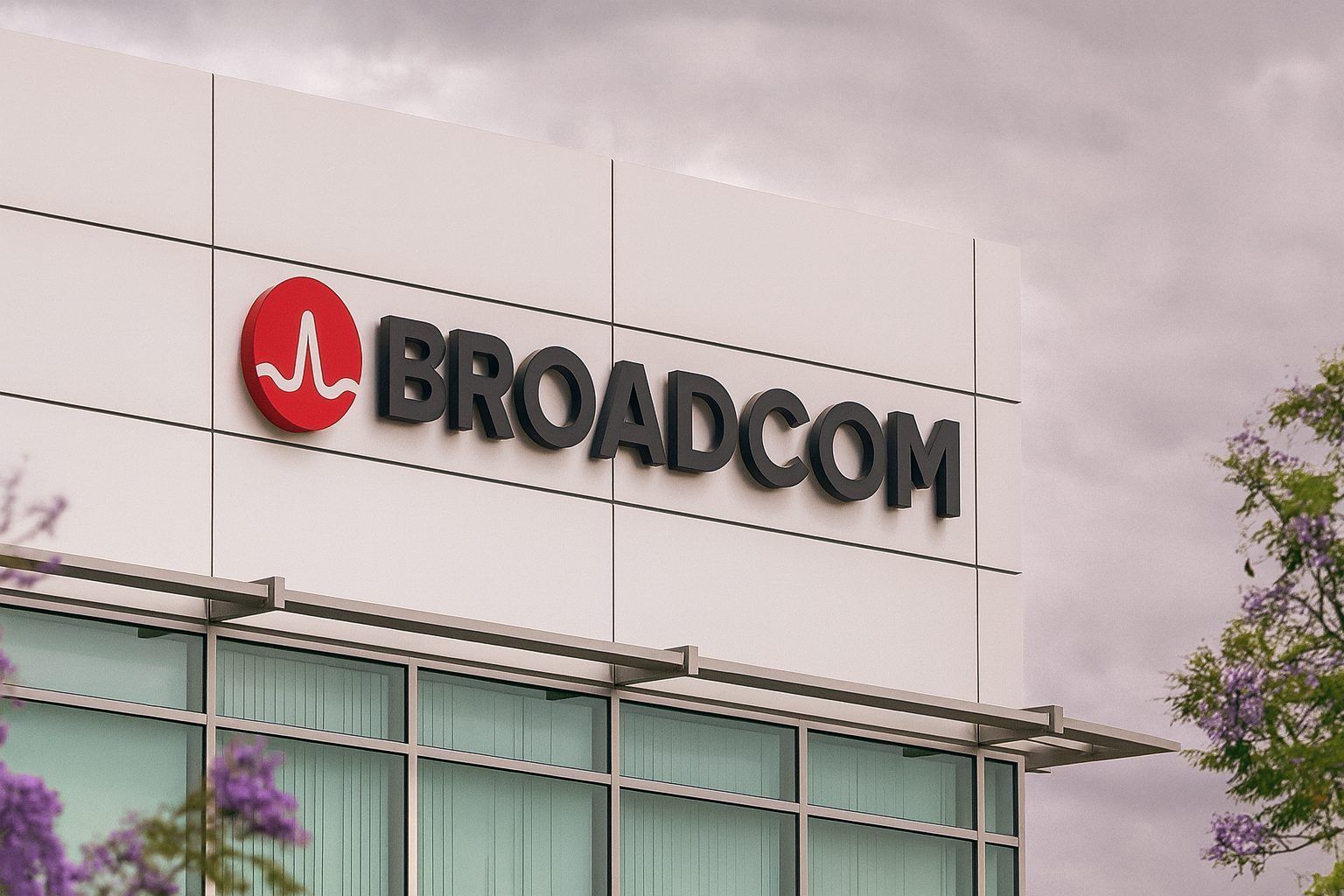
December 12, 2025 — Broadcom’s latest earnings were strong on the surface: record quarterly revenue, a beat on profit, and guidance that topped Wall Street expectations. Yet the market reaction on Friday was unmistakably cautious. Broadcom (NASDAQ: AVGO) sank sharply in early trading as investors homed in on a familiar 2025 concern across the AI hardware boom: fast growth, but at what margin—and how durable is demand when the bills come due? Bloomberg+3Reuters+3Reuters+3
What changed the tone wasn’t the size of Broadcom’s AI business—management highlighted a surge and projected more ahead—but rather the company’s message that profitability could be squeezed as the mix shifts toward lower-margin AI products and systems. Reuters+2PR Newswire+2
Broadcom’s “beat-and-raise” quarter—then a sharp selloff
Broadcom reported fourth-quarter revenue of $18.015 billion, up 28% from a year earlier, alongside non-GAAP EPS of $1.95 and GAAP net income of $8.518 billion. The company also emphasized strong cash generation, with free cash flow of $7.466 billion in the quarter—about 41% of revenue. PR Newswire
For the full fiscal year ended November 2, 2025, Broadcom posted $63.887 billion in revenue, up 24% year over year, and said free cash flow reached $26.914 billion. PR Newswire
So why did the stock fall anyway?
By Friday, Reuters reported Broadcom shares were down more than 11% at one point, while Bloomberg described losses reaching about 8%+ after the New York open—underscoring how quickly sentiment shifted from “strong quarter” to “strong quarter, but…” Reuters+1
The key issue: AI momentum is real, but it’s pressuring margins
Broadcom’s own guidance captured the push-and-pull investors are trying to price:
- Q1 fiscal 2026 revenue guidance: about $19.1 billion, which Broadcom said would be 28% higher than the prior-year period PR Newswire+1
- AI semiconductor revenue outlook: Broadcom expects AI semiconductor revenue to double year over year to $8.2 billion in the current quarter, driven by custom AI accelerators and Ethernet AI switches PR Newswire+1
- Profitability warning: CFO Kirsten Spears said Broadcom expects first-quarter consolidated gross margin to be down ~100 basis points sequentially, “primarily reflecting a higher mix of AI revenue.” Reuters
This is the nuance that spooked markets on Dec. 12: Broadcom is telling investors that, at least in the near term, more AI can mean less gross margin, even if revenue and operating dollars rise. Reuters+1
Some analysts pushed back on the idea that lower gross margin automatically means weaker overall profitability. Reuters cited Morningstar analysts arguing that the margin dilution isn’t necessarily alarming because the AI chips can still be operating-margin accretive—but that argument didn’t stop the selloff on Friday. Reuters
The $73 billion backlog headline—and why it didn’t fully calm the market
Broadcom’s AI narrative includes a staggering demand pipeline: management pointed to an AI product backlog of $73 billion expected to ship over roughly the next 18 months / six quarters. Reuters+2Bloomberg+2
Normally, a backlog number like that is the kind of “sleep well at night” metric investors crave. But Friday’s reaction suggests the market wanted either a bigger figure, more customer breadth, or clearer longer-term guardrails on AI revenue and profitability.
Two details stood out in coverage:
- Customer concentration: Reuters reported investor focus on the fact that the backlog is largely tied to just five customers, amplifying worries that a spending pause by any one hyperscaler could ripple quickly through near-term results. Reuters
- “Minimum” clarification: Bloomberg reported CEO Hock Tan described the $73 billion figure as a “minimum,” implying more orders could land—but the need to clarify itself signaled how high expectations have become for AI-exposed chipmakers. Bloomberg
Reuters also highlighted how deeply Broadcom is embedded in custom AI silicon efforts and noted the company has secured massive contracts—including $21 billion from Anthropic in the past two quarters tied to Google’s custom AI chips, according to the report. Reuters
Broadcom’s AI position: custom accelerators + networking, not just “another GPU story”
Broadcom has increasingly been framed as an AI “bellwether” because it plays in two areas that scale with data-center AI buildouts:
- Custom AI accelerators (ASICs) designed with hyperscalers as alternatives to general-purpose GPUs Reuters+1
- Data-center connectivity—notably Ethernet switching used inside AI clusters PR Newswire+1
Reuters described Broadcom’s custom chips as an alternative to Nvidia’s GPUs for major cloud customers. Reuters
The strategic bet is straightforward: as leading AI buyers seek tighter control over cost, performance, and supply, more of them may pursue proprietary accelerators—and Broadcom wants to be the partner that designs and helps manufacture those chips at scale.
But the same model introduces the questions markets wrestled with on Dec. 12:
- Custom programs can require heavy up-front investment
- Some system-level sales can carry lower gross margins
- Manufacturing costs and foundry relationships (e.g., with contract manufacturers) can influence how much profit Broadcom ultimately captures Reuters+1
The VMware factor: Broadcom isn’t only a chip story—and that matters for the margin debate
Broadcom’s results also reflect its two-engine structure: semiconductors plus infrastructure software.
In Q4, Broadcom reported segment revenue of:
- $11.072 billion from Semiconductor solutions
- $6.943 billion from Infrastructure software PR Newswire
For the full year, Broadcom reported:
- $36.858 billion in semiconductor solutions revenue
- $27.029 billion in infrastructure software revenue PR Newswire
That mix matters because investor concern isn’t simply “AI is lower margin.” It’s also the question of whether higher-margin software can offset a near-term gross margin dip from surging AI hardware, and whether Broadcom can keep software growth steady while AI hardware ramps even faster. Reuters+1
Dividends, cash flow, and shareholder returns: Broadcom leans into “quality” signals
Broadcom also tried to reinforce the “cash machine” narrative that has long supported its valuation.
The company announced a 10% increase in its quarterly dividend to $0.65 per share, targeting an annual dividend of $2.60 for fiscal 2026. The dividend is payable December 31, 2025, to shareholders of record December 22, 2025. PR Newswire
In a market increasingly skeptical of AI spending cycles, steady and rising shareholder returns can serve as a counterweight to volatility—though Friday’s trading showed dividends alone can’t offset concerns about the AI profit equation. Reuters+2Reuters+2
Why Broadcom’s earnings hit the entire AI trade on December 12
Broadcom didn’t drop in isolation. On Dec. 12, Reuters reported the S&P 500 and Nasdaq slipped as Broadcom’s margin commentary revived anxiety about an AI-fueled bubble—particularly after the prior day’s volatility in other AI-linked names. Reuters
At 9:47 a.m. ET, Reuters pegged:
- Dow up 0.31%
- S&P 500 down 0.18%
- Nasdaq down 0.51% Reuters
The key market tell: even with many sectors higher, heavyweight tech weakness weighed on the broader indexes, signaling continued rotation away from the most crowded AI winners. Reuters
Investopedia also described a renewed downturn in AI-related stocks on Dec. 12, with Broadcom among the biggest decliners—even after a headline earnings beat—capturing the shift from “growth at any price” toward “show me the profits.” Investopedia
What investors will watch next: the three questions behind the selloff
Broadcom’s Dec. 12 slide wasn’t a rejection of its AI trajectory so much as a demand for sharper visibility. Going forward, three questions are likely to dominate every AVGO earnings cycle:
1) Can Broadcom grow AI revenue while stabilizing margins?
Broadcom has clearly signaled that mix effects may weigh on gross margin near term. Investors will be looking for evidence that scale, pricing, and operating leverage can keep overall profitability expanding—even if gross margin compresses. Reuters+1
2) How diversified is the AI backlog—and how “sticky” are the top customers?
The $73 billion backlog is huge, but Reuters’ reporting on concentration (and investor focus on it) means markets will watch for signs Broadcom can broaden the customer base and expand programs beyond a small handful of hyperscalers. Reuters+2Reuters+2
3) What does “AI payoff” look like beyond the next six quarters?
Bloomberg’s framing—investors seeking a “bigger AI payoff”—captures the sentiment shift. It’s no longer enough to say AI is growing; markets want clearer line-of-sight to multi-year economics, especially as data-center buyers weigh in-house chip strategies. Bloomberg+1
Bottom line
Broadcom’s latest quarter reinforced its status as a core infrastructure winner in the AI buildout—record revenue, rising cash flow, and an AI semiconductor outlook pointing to another step-function up. PR Newswire+1
But the Dec. 12 reaction also showed how unforgiving the market has become for AI leaders with premium valuations: guidance has to be strong, backlog has to be convincing, and margins have to be defendable—simultaneously. Broadcom delivered the first two; investors are now laser-focused on the third. Reuters+2Reuters+2