Browse Category

Satellite Internet News 6 June 2025 - 16 June 2025

2025 Satellite Internet Showdown: Starlink vs Viasat vs HughesNet vs OneWeb & More

2025 Satellite Internet Showdown: Starlink vs Viasat vs HughesNet vs OneWeb & More

Starlink (SpaceX) is a LEO constellation (~4,500 satellites) delivering residential speeds ~100–250 Mbps down / 10–20 Mbps up, business up to ~350–400 Mbps, with a median latency ~45 ms in Q1 2025 and no hard data caps, employing a Fair Use Policy that deprioritizes after 1 TB. HughesNet Jupiter-3 (GEO) upgrade in 2024–25 offers 50–100 Mbps down (about 3 Mbps up), with latency ~600–700 ms, Fusion hybrid areas lowering latency, and a 24-month contract with equipment lease around $14.99/month or $299–$449 purchase, dish ~0.74 m, Wi‑Fi 6 modem, and 100–200 GB Priority Data per month plus 2 AM–8 AM unmetered

Everything You Need to Know About Internet Access in Sweden—Even from Space

Everything You Need to Know About Internet Access in Sweden—Even from Space

As of 2022, about 96% of Swedes use the internet. Nearly 99% of Swedish households have internet access. 67% of the population has at least basic digital skills. Fiber-optic broadband is available to over 98% of premises, with about 85% of buildings connected and Very High Capacity Network coverage of roughly 83%. By 2024, roughly 98% of households or businesses are either connected to or near a network capable of 1 Gbps speeds. By 2023 around 82% of the population had access to 5G service, up from 18% in 2021. The 2016 National Broadband Strategy aimed for 95% of households
Hungary’s Digital Lifeline: How Fiber, 5G, and Satellites Are Rewiring the Nation

Hungary’s Digital Lifeline: How Fiber, 5G, and Satellites Are Rewiring the Nation

As of late 2023, more than 97% of Hungarian households have access to wired fixed broadband networks, including FTTH and upgraded cable. Thanks to the Superfast Internet Programme (SZIP), by 2020 at least 30 Mbps service reached over 95% of households in underserved areas. By 2022, gigabit-speed networks pass about two-thirds of households, and Very High Capacity Network coverage rose from 72% in 2021 to 80% in 2022, well above the EU average of about 72%. Pure fiber (FTTP) coverage reached 70% of households by 2022, up from roughly 50% two years earlier. Mobile networks provide nearly universal 4G coverage
Mobile & Portable Satellite Internet in 2025: The Ultimate Guide to Starlink Roam, HughesNet, Inmarsat, Viasat & More

Mobile & Portable Satellite Internet in 2025: The Ultimate Guide to Starlink Roam, HughesNet, Inmarsat, Viasat & More

Starlink Roam hardware costs $599, with Regional plans at $150 per month and Global plans at $200 per month, offering unlimited data and high speeds. As of May 2025, SpaceX’s Starlink LEO constellation includes over 7,600 satellites and provides coverage in more than 100 countries. Starlink Roam typical real‑world performance ranges from 50–150 Mbps download and 5–20 Mbps upload, with latency around 30–50 ms. HughesNet’s Jupiter 3 satellite (GEO) delivers up to 100 Mbps download and 5 Mbps upload, with roughly 600 ms latency across North and South America. Viasat is deploying the ViaSat-3 global constellation, with three satellites each
5G From Space: How Satellite Internet is Revolutionizing Global Connectivity

5G From Space: How Satellite Internet is Revolutionizing Global Connectivity

Starlink has over 6,700 satellites in orbit as of early 2025 and surpassed 4 million subscribers by late 2024 across 100+ countries. Starlink satellites orbit at about 550 km altitude and deliver typical download speeds of 50–200 Mbps with latency around 20–40 ms. Starlink Gen2 introduces inter-satellite laser links to route data between satellites, reducing reliance on ground gateways. SpaceX began testing Direct-to-Cell satellites in 2023–2024 to text ordinary phones using T-Mobile spectrum, with voice and data services planned for 2025. OneWeb’s first-generation constellation targets 648 satellites, with about 632 operational by late 2024, and it merged with Eutelsat to
Rural Broadband Revolution: Satellite Internet’s Sky-High Growth (2024–2030)

Rural Broadband Revolution: Satellite Internet’s Sky-High Growth (2024–2030)

The global satellite broadband market was roughly $5–9 billion in 2023 and is forecast to reach about $24–23 billion by 2030, with an annual CAGR of 14–30%. North America led in 2023 with about 32% of revenues, while Asia-Pacific (~15%), Europe (~14%), Latin America (~12.5%), and Middle East & Africa (~12%) are forecast to grow fastest. By 2030, North America, Europe and Asia-Pacific are each projected to be in the $6–7+ billion range, with Latin America and MEA contributing several hundred million USD. In 2023 the regional revenues were North America $2,966.1 M, Europe $2,435.0 M, Asia–Pacific $2,264.6 M, Latin
Bandwidth Wars: The High-Stakes Battle for High-Throughput Satellite Dominance (2025–2035)

Bandwidth Wars: The High-Stakes Battle for High-Throughput Satellite Dominance (2025–2035)

HTS use numerous narrow spot-beams and on-board processing to deliver dramatically higher data rates than legacy FSS, with platforms like Boeing 702X and SES-17 featuring fully digital, reconfigurable payloads. HTS constellations can deliver terabits of capacity worldwide to power broadband, backhaul, IoT and government networks. Modern HTS platforms operate primarily in Ku/Ka-bands and increasingly in V/Q/KuL bands to support mobility. In aviation, Ka-band GEO and LEO HTS provide in-flight connectivity on thousands of passenger aircraft, with SES-17 Ka-band HTS expected to meet exponential airline connectivity needs. On-the-move broadband can deliver gigabit links to moving antennas for military, emergency-response and commercial
Internet Access in Czechia: From Prague to the Sky

Internet Access in Czechia: From Prague to the Sky

As of 2023, about 91.6% of Czechia’s population is online, equating to roughly 9.6 million internet users in a country of 10.5 million. Fixed broadband connections reached 4.1 million in 2023, roughly 38–40 subscriptions per 100 people. There are 15.5 million mobile SIM cards (about 148 per 100 people) and 11.5 million active mobile internet subscriptions, with mobile broadband subscriptions nearly three times fixed broadband. Wireless fixed access accounts for about 27% of fixed connections in 2023, with about 1.13 million fixed wireless subscriptions in 2022 and 452,000 fixed LTE/5G connections in 2022, together about 39% of fixed broadband. FTTH
Internet Access in Cuba: From Control to Constellations

Internet Access in Cuba: From Control to Constellations

The first internet connection in Cuba was established in 1996 as a 64 Kbps link via Sprint in the United States. In 2011, with help from Venezuela, Cuba installed the ALBA-1 undersea fiber-optic cable, which became publicly usable in January 2013, replacing the old satellite backbone. From December 6–8, 2018, ETECSA rolled out mobile internet over 3G for Cuban cellphone users. By the end of 2019, an estimated 7.1 million Cubans were online in some capacity, as mobile data began to take hold. In 2023, the Arimao undersea cable, built with France’s Orange, was completed, linking Cuba to Martinique and
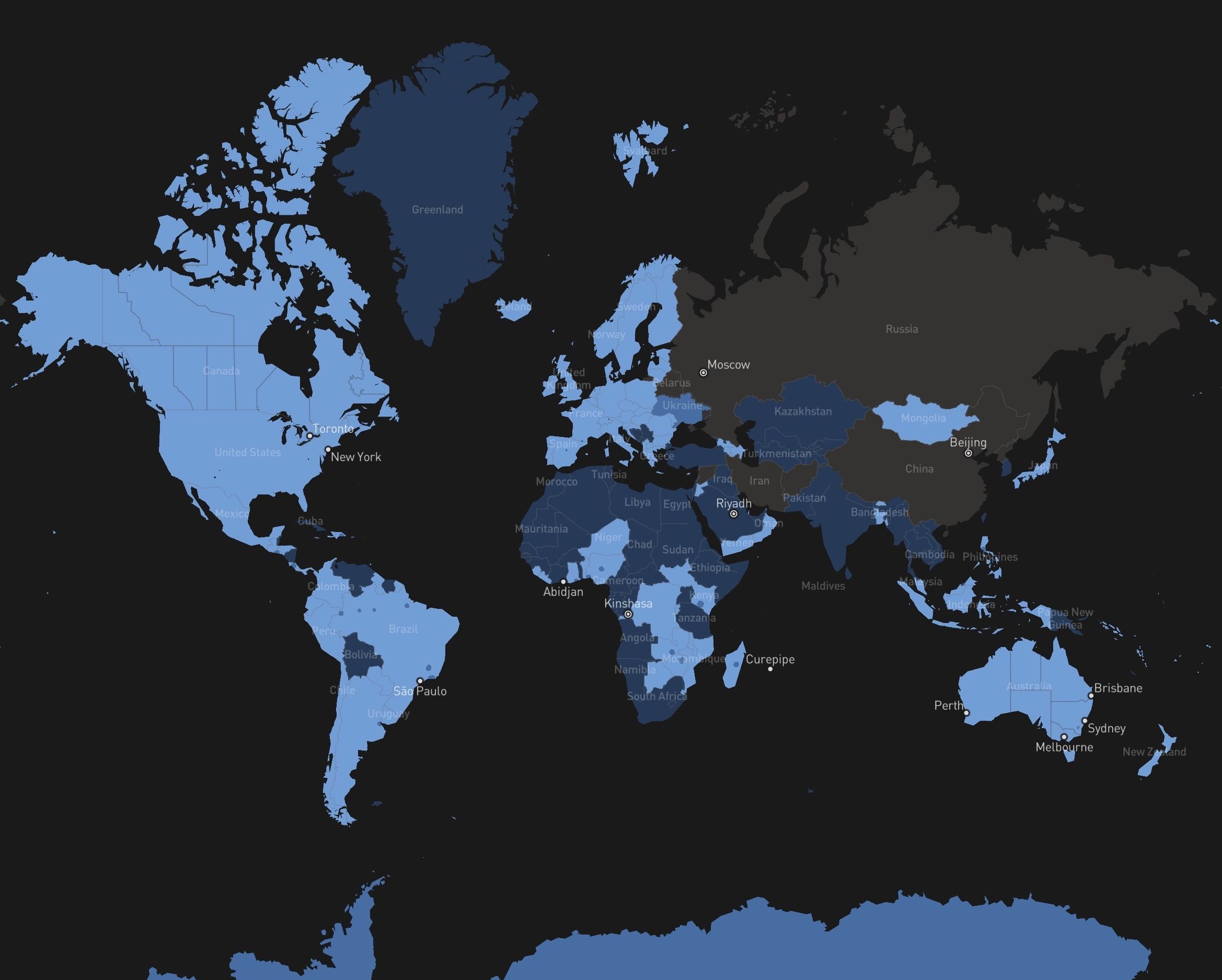
Starlink Global Coverage and Availability Report

Starlink Global Coverage and Availability Report

As of mid-2025, Starlink is available in over 110 countries and territories. In the United States, Starlink began with limited trials in August 2020 and the public beta “Better Than Nothing Beta” in November 2020, and now has nationwide commercial coverage including Puerto Rico and the U.S. Virgin Islands, with over 2.5 million subscribers as of early 2025. Canada went live in January 2021 after a late-2020 beta and now has broad coverage across all provinces. Mexico received a license in mid-2021, began service by November 2021, and by 2024 had over 160,000 subscribers, with the federal “Internet para Todos”
Starlink Satellite Internet FAQ

Starlink Satellite Internet FAQ

Starlink is SpaceX’s satellite-based broadband internet service, and by 2025 the constellation has launched over 7,500 satellites with about 6,750 active in orbit. The satellites orbit in low Earth orbit at roughly 550 km altitude, delivering typical download speeds of 50–200+ Mbps and latency around 20–40 ms. SpaceX began launching Starlink in 2019, and by early 2025 it served more than 5 million customers in 125+ countries. The residential Starlink kit costs about $599 in many regions, with US promotions as low as $349, and monthly service typically $90–$120, with occasional $0 hardware deals tied to multi-month commitments. There are
Satellite Internet FAQ

Satellite Internet FAQ

Traditional GEO satellite internet sends data roughly 22,000 miles to a satellite and back, yielding a round-trip latency of about 600–800 ms. Satellite internet can reach virtually anywhere with a clear view of the sky, including most of the continental United States. HughesNet uses geostationary satellites and advertises speeds up to 25 Mbps download and about 3 Mbps upload on all plans. Viasat offers downloads from roughly 12 Mbps up to 100 Mbps with uploads around 3 Mbps. Starlink uses a low-Earth orbit constellation and typically provides 50–200 Mbps download and 20–40 Mbps upload with latency around 20–40 ms. Amazon’s

Stock Market Today

CapitaLand Investment share price jumps as CapitaLand REIT payouts roll in — what’s next for 9CI

CapitaLand Investment share price jumps as CapitaLand REIT payouts roll in — what’s next for 9CI

7 February 2026
CapitaLand Investment shares rose 1.3% to S$3.12 on Friday, bucking a 0.8% drop in Singapore’s benchmark index. CapitaLand Integrated Commercial Trust reported a 16.4% jump in second-half distributable income, while CapitaLand Ascendas REIT posted a 1.4% full-year rise. CapitaLand China Trust saw full-year DPU fall to 4.82 cents amid weaker yuan and occupancy. CLI reports FY2025 results on Feb. 11.
Keppel stock holds near 12-year high after profit jump, special dividend; buyback adds support

Keppel stock holds near 12-year high after profit jump, special dividend; buyback adds support

7 February 2026
Keppel shares closed at S$11.64 on Friday, up 0.17%, after surging 6.1% the previous day on stronger FY2025 profit and a larger dividend plan. The company bought back 151,400 shares for about S$1.74 million. Keppel reported a 29% rise in full-year profit to S$1.02 billion and proposed a total distribution of 47 cents per share, including a special dividend partly paid in Keppel REIT units.
Go toTop