Browse Category

Space Technology News 20 June 2025 - 27 June 2025

Beaming the Watts Down: NASA × Ascent Solar’s Thin-Film Array Sets the Stage for Space-to-Earth Power Transmission

Beaming the Watts Down: NASA × Ascent Solar’s Thin-Film Array Sets the Stage for Space-to-Earth Power Transmission

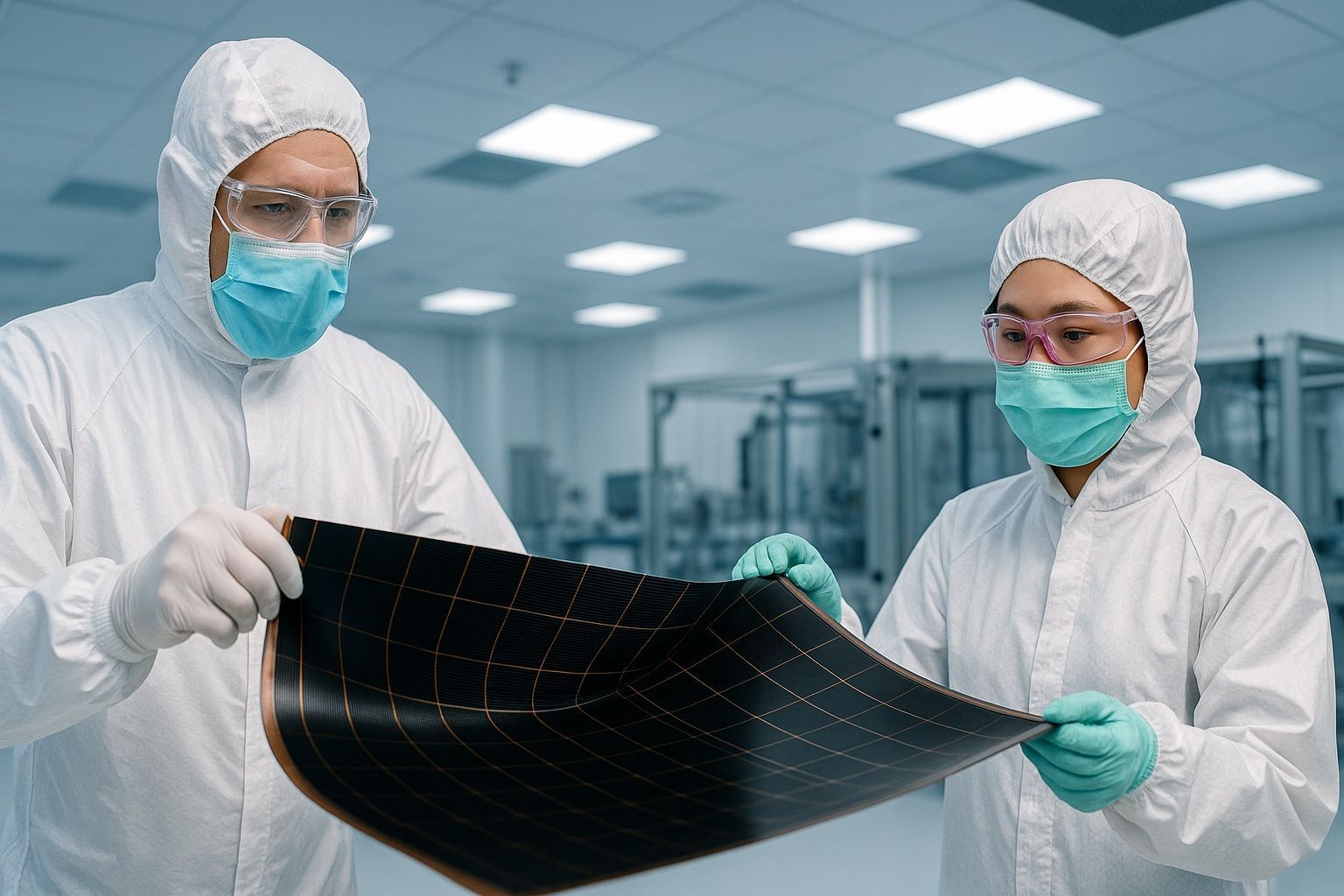
The space-based solar power (SBSP) concept was proposed in 1968 by Peter Glaser to place satellites in orbit and beam power to Earth. In 2023 Caltech’s Space Solar Power Demonstrator (SSPD-1) conducted three beaming tests in May, June, and July 2023 using the MAPLE flexible array to show ground reception of orbital power. In June 2025, Ascent Solar announced a 12-month Collaborative Agreement with NASA’s Marshall Space Flight Center (MSFC) and Glenn Research Center (GRC) to develop thin-film PV arrays for power beaming. Ascent’s copper-indium-gallium-selenide (CIGS) thin-film modules achieve about 15.7% production efficiency, with the Titan line targeting 17%+ efficiency

Scanning the Canopy: ESA’s Biomass Radar Craft Maps Global Forest Carbon with P‑Band Vision

Scanning the Canopy: ESA’s Biomass Radar Craft Maps Global Forest Carbon with P‑Band Vision

Biomass was selected in May 2013 as ESA’s seventh Earth Explorer mission to quantify forest carbon from space. The mission uses a P-band synthetic aperture radar at ~435 MHz (about 70 cm wavelength) with a 12-meter mesh reflector deployed in orbit to penetrate canopies and sense trunks. It employs fully polarimetric SAR (HH, HV, VH, VV) and SAR tomography to produce three-dimensional maps of forest structure and above-ground biomass. Biomass launched on 29 April 2025 aboard a Vega-C rocket (flight VV26) into a 666 km sun-synchronous orbit, carrying a ~1.25-tonne observatory. The project aims for wall-to-wall global biomass maps, delivering
27 June 2025
State of Space and Satellite Technologies in 2025 (Updated: June 27th, 2025)

State of Space and Satellite Technologies in 2025 (Updated: June 27th, 2025)

Artemis I launched on November 16, 2022, marking NASA’s Space Launch System (SLS) first flight and sending an uncrewed Orion around the Moon. The global space economy reached about $570 billion in 2023, with roughly 80% of that value produced by commercial activities. As of 2025, there are over 11,000 active satellites serving Earth, out of about 45,000 tracked objects including debris. In 2024 there were 259 orbital launches globally, with the United States conducting 154 and SpaceX responsible for 90. SpaceX conducted its first orbital Starship test on April 20, 2023 from Boca Chica, Texas; the flight ended with
From Orbit to Runway and Back: Lux Aeterna’s Delphi Platform and the Rise of Fully Reusable Satellites

From Orbit to Runway and Back: Lux Aeterna’s Delphi Platform and the Rise of Fully Reusable Satellites

Delphi is Lux Aeterna’s flagship fully reusable satellite bus designed to launch, operate in orbit, return to Earth, be refurbished, and relaunched. The Delphi demonstrator weighs about 200 kg and will carry a customer payload to low Earth orbit before re-entering and landing for recovery. Lux Aeterna has raised $4 million in pre-seed funding, led by Space Capital, to develop Delphi. A demonstration mission is planned for early 2027, launched as a rideshare on SpaceX’s Falcon 9. Delphi’s heat shield is integral to its structure, with the shield forming the main load-bearing body to survive multiple reentries. The design features
Orbiting Eyes: How Space-Based ADS-B Is Revolutionizing Air Traffic Surveillance

Orbiting Eyes: How Space-Based ADS-B Is Revolutionizing Air Traffic Surveillance

Space-based ADS-B became operational in 2019 with Aireon using Iridium NEXT’s 66 low Earth orbit satellites at about 780 km, each carrying an ADS-B receiver listening at 1090 MHz and delivering data to ground stations with latency under 1.5 seconds and updates often in the 2–5 second range. Before 2019 only about 30% of the globe had ADS-B surveillance and roughly 70% of airspace lacked real-time coverage, whereas space-based ADS-B now provides global coverage including oceans and the poles. On March 27, 2019, NAV CANADA and NATS deployed space-based ADS-B in the North Atlantic, reducing lateral separation from about 40
26 June 2025
Radar Vision Boom: Why High‑Res SAR Imaging is Skyrocketing Toward 2030

Radar Vision Boom: Why High‑Res SAR Imaging is Skyrocketing Toward 2030

The global high-resolution SAR imaging market was about $5.4 billion in 2024 and is forecast to reach about $11.6 billion by 2030, a CAGR of roughly 13%. Capella Space had around 10–15 satellites in 2024 delivering 0.5 m and 0.25 m resolution imagery, while ICEYE operates the world’s largest SAR constellation with 20+ satellites. Recent commercial SAR missions have achieved sub-meter resolution, with Umbra reporting ~25 cm imagery and Capella demonstrating ~30 cm and 25 cm-class products. NASA-ISRO’s NISAR mission will carry both an L-band and an S-band radar on the same satellite. North America accounted for about 33.8% of
26 June 2025
Orbital Quantum Leap: First Photonic Edge-Computing Satellite Set to Transform Space Data Processing

Orbital Quantum Leap: First Photonic Edge-Computing Satellite Set to Transform Space Data Processing

The ROQuET payload, a photonic quantum computer no larger than a shoebox, was developed by Philip Walther’s team at the University of Vienna and measures about 15 × 15 × 45 cm, weighing roughly 9.5 kg with an aluminum frame and a borosilicate glass optical circuit. The device was launched on June 23, 2025, aboard SpaceX’s Transporter-14 mission and hosted on D-Orbit’s ION platform as the SCV004 Upmik payload. The Falcon 9 rocket lifted off from Vandenberg Space Force Base and deployed around 70 satellites into a sun-synchronous orbit at about 550 km altitude. The mission demonstrates edge computing, enabling
Space Superpower Play: How ICEYE’s Radar Satellites Are Turbo-Charging NATO’s ‘Aquila’ Constellation – and Why It Could Change Intelligence Forever

Space Superpower Play: How ICEYE’s Radar Satellites Are Turbo-Charging NATO’s ‘Aquila’ Constellation – and Why It Could Change Intelligence Forever

NATO Allied Command Operations signed a multiyear agreement to receive 24/7 SAR imagery from ICEYE and feed it into the APSS Aquila constellation, announced on 24 June 2025. ICEYE’s 54-satellite Synthetic Aperture Radar fleet can be tasked within eight hours, and in some cases within one hour, for sea- and land-tracking. ICEYE satellites deliver 25 cm ground resolution and have revisit intervals under three hours at mid-latitudes. APSS Aquila pairs ICEYE’s 25 cm SAR with Planet Labs SkySat optical data at 50 cm RGB and supports sub-daily tasking. Contract value was not disclosed, but analysts estimate it is in the
24 June 2025
Space‑Laser Shockwave: Inside China’s 2‑Watt Orbital Beam That Claims to Outgun Starlink and Reshape the Security Balance in Space

China’s ‘Night‑Light’ Laser Satellite Leaves Starlink in the Dust—What It Means for the Future of Space Internet and Warfare

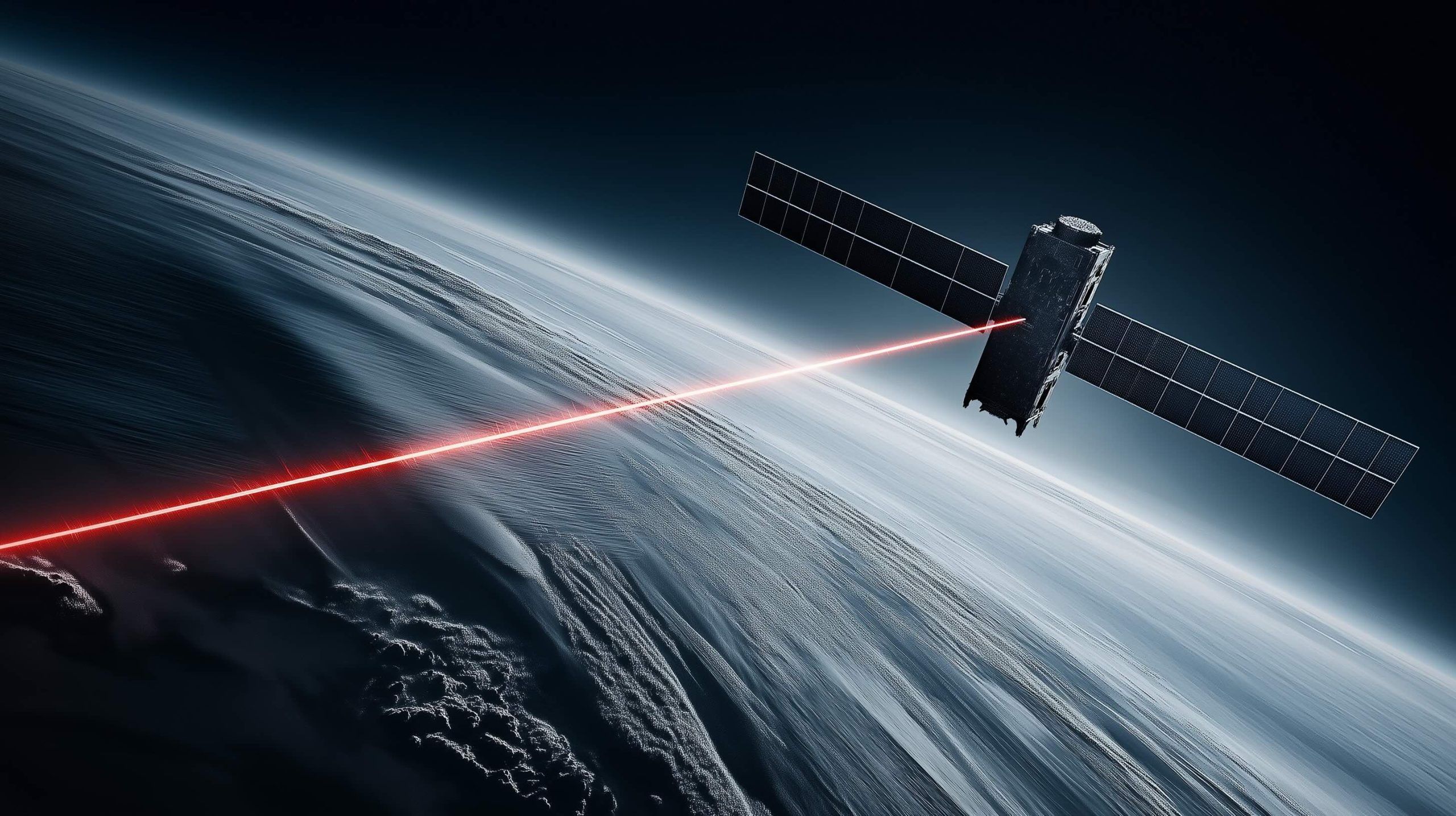
On 17 June 2025, Prof. Wu Jian of Peking University and Dr. Liu Chao of the Chinese Academy of Sciences down-linked 1 Gbps from an unnamed GEO satellite 36,705 km above Earth using a 2-watt laser. The AO‑MDR method combines 357 micro-mirrors on a 1.8 m telescope to reshape the wavefront and eight spatial modes, with a path-picking algorithm selecting the three cleanest channels and boosting usable signal probability from 72% to 91% in heavy turbulence. The Chinese GEO demo delivered 1 Gbps, about five times the throughput of typical Starlink down-links (100–300 Mbps, peaks ~600 Mbps) from 550 km
China’s “Night‑Light” Laser vs. Starlink: What a 2‑Watt Beam Really Means for the Coming Orbital Arms Race

China’s “Night‑Light” Laser vs. Starlink: What a 2‑Watt Beam Really Means for the Coming Orbital Arms Race

In June 2025, a Chinese team led by Prof. Wu Jian of Peking University of Posts & Telecommunications and Dr. Liu Chao of the Chinese Academy of Sciences down-linked 1 Gbps from a GEO satellite 36,000 km away using a 2 W infrared laser. The coverage framed the feat as pulverizing Starlink, but there is no evidence of destructive action; the achievement is a bandwidth demonstration. The key innovation is AO‑MDR synergy, combining adaptive optics with mode-diversity reception to correct atmospheric distortion. Adaptive optics reshape the wavefront with hundreds of deformable-mirror actuators, while MDR routes the beam through multiple spatial
22 June 2025
Sky Watchers: The 2025–2033 Boom in Weather & Climate Satellite Constellations

Sky Watchers: The 2025–2033 Boom in Weather & Climate Satellite Constellations

Over 5,400 Earth observation satellites are projected to be launched globally from 2024 to 2033, nearly triple the previous decade. NOAA’s GeoXO program will deploy at least three geostationary satellites (with options up to four more) to upgrade GOES-R and extend Western Hemisphere coverage, following a $2.27 billion contract awarded to Lockheed Martin in 2024. NOAA/NASA plan JPSS-3 for 2027 and JPSS-4 for 2032 to provide critical morning-orbit polar data for numerical weather models. Europe’s MTG and MetOp-SG programs will deliver six MTG satellites (four MTG-I imagers and two MTG-S sounders) and the MetOp-SG A1/B1 pair by 2025, with MTG
21 June 2025
Inside Israel’s Space Power: Satellites, Services, and the Secret Strength of the Israel Space Agency

Inside Israel’s Space Power: Satellites, Services, and the Secret Strength of the Israel Space Agency

On September 19, 1988, Ofek-1 became Israel’s first indigenous satellite, making Israel the eighth nation to orbit its own spacecraft. The Israel Space Agency (ISA) was established in 1983 under physicist Yuval Ne’eman to oversee Israel’s civilian space activities. The Shavit launch vehicle is a 20-meter-tall, three-stage solid-fuel rocket that can loft about 380 kg to a low Earth orbit when launching westward from Palmachim. The VENμS environmental satellite, launched in 2017 and operated through 2023, is a ~265 kg microsatellite built by Israel Aerospace Industries with France’s CNES to monitor vegetation and environmental parameters. AMOS-1, Israel’s first commercial telecom
1 6 7 8 9

Stock Market Today

Meta stock faces an AI split: ad gains vs a $135 billion bill

Meta stock faces an AI split: ad gains vs a $135 billion bill

7 February 2026
Meta shares dropped 1.3% to $661.46 on Friday after the company projected 2026 capital spending of up to $135 billion, raising investor concerns over cash flow. Meta reported Q4 revenue of $59.89 billion, up 24% year-over-year, with ad impressions rising 18%. Analysts remain divided on whether AI-driven ad gains can offset the steep spending ramp.
IAG share price jumps toward a 52-week peak — what to watch before London reopens

IAG share price jumps toward a 52-week peak — what to watch before London reopens

7 February 2026
IAG shares rose 4.33% to 438.50 pence Friday, near their 52-week high, ahead of full-year results due later this month. The company reported 162,073,135 treasury shares and total voting rights of 4,565,128,012. Brent crude fell 2.2% Thursday to $67.93 a barrel. South Europe Ground Services logged 712,340 operations in 2025 and seeks approval to operate in Portugal.
Go toTop