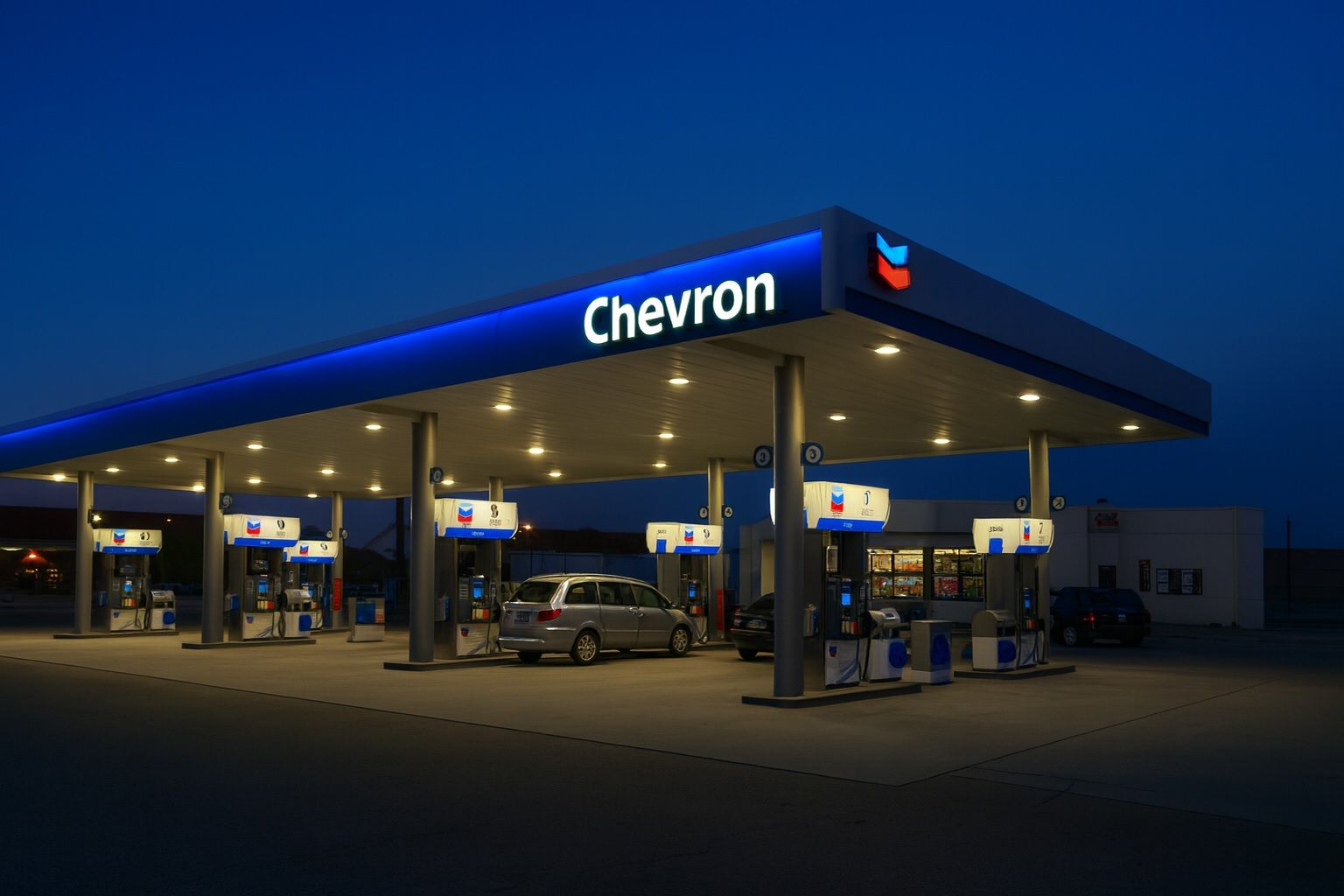
- Company Profile: Chevron Corp. (NYSE: CVX) is one of the world’s largest integrated oil & gas majors. It is the No. 2 U.S. oil producer and refinerreuters.com, with diverse operations in upstream (exploration/production) and downstream (refining & marketing). Its market capitalization is about $314 billion as of Oct 31, 2025reuters.com. CEO Mike Wirth leads a company that blends traditional oil/gas with growing investments in low-carbon fuels (e.g. hydrogen, renewables, CCS).
- Stock Price & Yield: CVX traded around $153–154 on Oct 31, 2025reuters.com, in the middle of its 52-week range (~$132–169)reuters.com. With a forward P/E of ~21.3reuters.com and yield ~4.5%reuters.com, Chevron’s valuation is similar to peers but offers a higher dividend payout. Its 4.5% yield is among the highest in Big Oil (Exxon ~3.5%, Shell ~4%, BP ~6%)ts2.techreuters.com. CVX’s stock has been relatively flat this year (roughly flat YTD) but yields provide a cushion.
- Recent News: Key developments include Chevron’s $55 billion acquisition of Hess Corp. (closed July 2025) adding oil/gas growth assets (Guyana Stabroek Block)reuters.comreuters.com, and a sale of ~$2 billion of Colorado pipeline assets in late Oct 2025reuters.com. Chevron also faced an October 2 refinery fire in El Segundo, CA (jet-fuel unit) – thankfully no injuries and units were quickly brought offline and containablets2.techreuters.com. Other moves: hiring a new VP of exploration (Kevin McLachlan at SVP level) to boost upstream growthts2.tech, and implementing significant cost cuts (targeting $3 billion by 2026) and workforce reductions (~20%) amid oil-price uncertaintyreuters.comreuters.com.
- Q3 2025 Results: Chevron reported strong Q3 earnings on Oct 31, 2025. Adjusted EPS came in at $1.85 vs. $1.68 consensusreuters.com. Production was a record 4.1 million boe/day (up from 3.4 M last year) after the Hess dealreuters.com. Upstream earnings fell (lower oil prices), but downstream/refining profit jumped (~+91%) on improved marginsreuters.com. Cash flow was robust ($9.9 B from operations, +20% YoY)reuters.com. CFO Eimear Bonner expressed “high confidence” in continued cash-flow growth with disciplined capexreuters.com.
- Analyst Consensus: Wall Street sentiment is broadly bullish. Roughly 70–80% of analysts rate CVX a “Buy”, with a one-year consensus price target around $170–173 (implying ~10–15% upside)ts2.tech. For example, UBS has a $197 target and Wells Fargo $190ts2.tech. Even neutral analysts put fair values in the mid-$160s (Raymond James $160, Scotiabank $165)ts2.tech. Analysts cite Chevron’s strong free cash flow, fat dividend (4–4.5% yield) and Guyana expansion as positivests2.tech. However, some warn that weak oil prices could drag results (Zacks recently cut estimates, giving a “Sell” rating)ts2.tech. Overall, Wall Street’s average 12-month target ($170) suggests moderate upside; the high end of forecasts ($190–197) hinges on oil and operational executionts2.tech.
- Dividend History & Yield: Chevron is a storied dividend champion with 38 consecutive years of payout increasesdividend.com. Its quarterly dividend is $1.71 (annualized $6.84/share)dividend.com, raised from $6.52 in 2024dividend.com (a ~5% increase). The stock’s forward yield is about 4.4%dividend.com, among the highest in the sector (exceeding Exxon and Shell, trailing only BP). This reliable yield cushions the stock; Chevron returned ~$3.4 B in dividends in Q3 2025reuters.com. In summary, Chevron’s dividend metrics are: YearAnnual Dividend/share (USD)YoY Change2024$6.52dividend.com+7.9%2025E$6.84dividend.com+4.9% (Forward yield ~4.4% at current pricedividend.com.)
- ESG & Sustainability: Chevron’s ESG profile is mixed. The company has increased low-carbon investments (pledging ~$10 B by 2028 for carbon capture, hydrogen, renewables)reuters.comts2.tech. In 2023 it acquired a major hydrogen storage facility in Utahreuters.com. However, Chevron does not have a firm 2050 net-zero emissions pledge, and focuses on lowering carbon intensity rather than eliminating fossil outputreuters.com. In May 2025 shareholders rejected resolutions demanding more climate-related disclosuresreuters.com, reflecting investor fatigue on ESG activism. Independent ESG ratings still classify Chevron as high-risk (given its oil-heavy business), though the firm publishes sustainability reports and has decade-long history of GHG data transparency. Overall, Chevron is boosting emissions reductions ($1.25 B/year through 2028reuters.com) but remains behind European peers on the energy transition.
- Peer Comparison: Among large oil majors, Chevron’s fundamentals are competitive. Its dividend yield (~4.5%) is higher than Exxon’s (~3.5%) and Shell’s (~4–5%), while BP’s yield (~6%) is even higher due to its depressed share pricets2.tech. In Q3 2025, Exxon Mobil also beat estimates (EPS $1.88 vs $1.82 expected) on record Permian/Guyana outputreuters.com, but it has a lower payout and P/E (~16.8)reuters.com. Shell’s Q3 profit fell ~10% to $5.4 B (still beating forecasts) on weaker oil, though its gas unit helpedreuters.com; Shell maintains heavy buybacks ($3.5 B qtrly) and ~4% yield. BP (London: BP) has seen a ~20% drop in its share price and yields ~6%, as it shifts toward renewables to offset low marginsts2.tech. All majors (Chevron, Exxon, Shell, BP) are cutting costs and scaling back buybacks under lower oil. Importantly, Chevron’s Hess acquisition gives it a stake in Guyana on par with Exxon’s (four deepwater oilfields), arguably strengthening its upstream outlook relative to many peersreuters.comts2.tech.
- Economic & Geopolitical Drivers: Global oil prices have been under pressure. As of Oct 31, 2025 Brent crude is about $64–65/barrel and WTI ~$60reuters.com (down roughly 3.5% in October)reuters.com. Contributing factors include a strong U.S. dollar (near 3-month highs, which makes oil more expensive for others)reuters.com, slower growth in China (factory PMI in contraction for 7th month)reuters.com, and ample supply. OPEC+ producers (Saudi, Russia, others) have signaled modest output increases ahead of meetings, keeping markets well-suppliedts2.tech. U.S. shale continues churning out oil at near-record rates. On the demand side, concerns about inflation and recession risk are dampening consumption growth. Geopolitical risks are mixed: U.S. policy under the current administration has generally favored oil & gas development (pipeline approvals, relaxed regulation), but uncertainties remain around Iran/Venezuela sanctions and Middle East conflicts. For example, recent negotiations hint at limiting Russian oil sales to India, which could tighten future supply flowsts2.tech. On the positive side for Chevron, Western refiners are under capacity constraints (California refinery closures), which could boost West Coast margins and benefit Chevron’s downstream.
In summary, as of Oct 31, 2025 Chevron stands as a dividend-rich, integrated energy leader navigating a weak-oil cycle. Its stock is trading near multi-month lows but backed by record production and cash flow. Short-term catalysts include the Hess synergies and any rebound in oil prices. Longer-term, Chevron emphasizes high-return oil projects (Guyana, Permian) and steady shareholder returns, while gradually investing in lower-carbon ventures. Key factors to watch are global oil demand trends (especially in Asia), OPEC supply decisions, and the results of Q4 earnings (including Exxon, Shell). Analyst consensus sees moderate upside if oil stabilizes, but Chevron – “one of the safest bets in oil,” as one strategist put itts2.tech – will still move with the commodity. For income investors, Chevron’s high yield and solid balance sheet offer a buffer, whereas others focus on whether it can sustain growth under pressure.
Sources: Company filings and Reuters (Oct 2025 news)reuters.comreuters.comreuters.comreuters.com; analyst reports and TS2.tech analysists2.techts2.techreuters.comreuters.com.