- In June 2025, a Chinese team led by Prof. Wu Jian of Peking University of Posts & Telecommunications and Dr. Liu Chao of the Chinese Academy of Sciences down-linked 1 Gbps from a GEO satellite 36,000 km away using a 2 W infrared laser.
- The coverage framed the feat as pulverizing Starlink, but there is no evidence of destructive action; the achievement is a bandwidth demonstration.
- The key innovation is AO‑MDR synergy, combining adaptive optics with mode-diversity reception to correct atmospheric distortion.
- Adaptive optics reshape the wavefront with hundreds of deformable-mirror actuators, while MDR routes the beam through multiple spatial modes to select the three cleanest channels.
- The test achieved an optical BER below 1e-5 under strong turbulence and a gigabit link with power comparable to a bicycle headlight.
- GEO communications offer continuous regional coverage because GEO satellites remain fixed over one longitude, unlike Starlink’s LEO constellation.
- A 2 W beam arriving at LEO is orders of magnitude below airplane-laser safety thresholds and far below kilowatt–megawatt ASAT concepts.
- Dr. Brian Weeden of the Secure World Foundation notes that many space-security programs are signaling efforts and that this 2 W link is primarily about bandwidth, not weapons.
- Compared with Starlink’s ~550 km altitude, 25–200 Mbps downlinks, and 20–40 ms latency, the GEO optical test delivered 1 Gbps with about 120 ms one-way latency.
- Future plans include 10 Gbps+ optical terminals and daylight links, with 24–36 months for GEO operators to trial AO‑MDR payloads and calls for international advance-notice codes of conduct.
China’s June 2025 demonstration of a 1‑gigabit‑per‑second laser down‑link from geostationary orbit sparked sensational headlines claiming a weak “candle‑bright” beam had “pulverized Starlink.” In reality, the 2‑watt transmission was a communications breakthrough, not an anti‑satellite strike. Yet the episode sits at the crossroads of two fast‑diverging trends: (1) a legitimate push to replace crowded radio channels with ultra‑fast optical links, and (2) a parallel scramble by major powers to field directed‑energy weapons in space. Below is a deep‑dive report that separates physics from hype, reviews the technology, and assesses the wider strategic stakes.
1. What Actually Happened
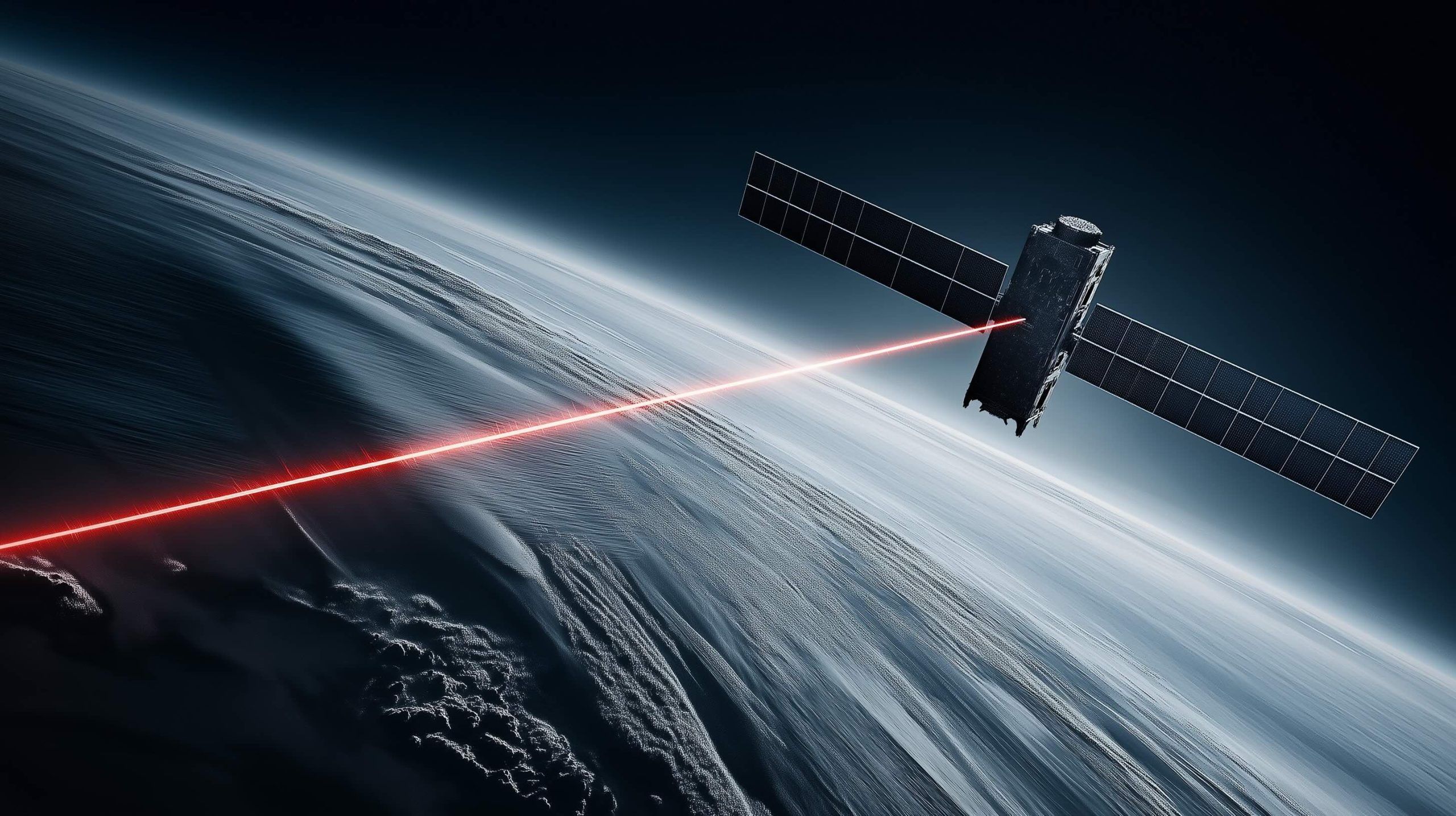
- The experiment. A Chinese research team led by Prof. Wu Jian (Peking University of Posts & Telecommunications) and Dr. Liu Chao (Chinese Academy of Sciences) down‑linked 1 Gbps of data from an unnamed GEO satellite—36,000 km above Earth—using only a 2 W infrared laser, five times faster than the best public Starlink speeds of a few hundred Mbps at 550 km altitude scmp.com interestingengineering.com.
- The headline. Daily Galaxy framed the feat as “Chinese Satellite Pulverizes Starlink,” implying a kinetic attack dailygalaxy.com. No evidence supports any destructive action; the phrase was clickbait, not fact.
- Key innovation. The team combined Adaptive Optics with Mode‑Diversity Reception (“AO‑MDR synergy”) to correct atmospheric distortion and capture scattered photons, lifting the “usable‑signal chance” to 91 percent interestingengineering.com samaa.tv.
2. Inside the 2‑Watt Laser Link
2.1 AO‑MDR Synergy Explained
Adaptive optics reshapes an incoming wavefront with hundreds of deformable‑mirror actuators, while MDR routes the beam through multiple spatial “modes,” selecting the three cleanest channels in real time interestingengineering.com. The result: optical BER plunged below 10⁻⁵ even under strong turbulence, enabling a gigabit link with power comparable to a bicycle headlight.
2.2 Why GEO Demonstrations Matter
GEO birds remain fixed over one longitude, allowing continuous regional coverage—something Starlink’s low‑Earth‑orbit (LEO) mesh cannot match without thousands of nodes. High‑altitude optical down‑links therefore promise smaller constellations and simpler ground infrastructure.
3. Fact‑Check: Can 2 Watts “Pulverize” Starlink?
- Physics check. A 2 W beam arriving at LEO would be orders of magnitude below the milliwatt safety threshold used in airplane laser‑pointer regulations, let alone the kilowatt–megawatt levels modeled for anti‑satellite dazzlers or ablation weapons en.wikipedia.org.
- Expert view. “Countries have recently been shifting away from destructive ASATs; many projects are now political signaling,” notes Dr. Brian Weeden of the Secure World Foundation breakingdefense.com. In other words, China’s 2 W link is about bandwidth, not blows.
4. Starlink vs. GEO Optical—Apples and Orbits
| Attribute | Starlink (LEO) | Chinese Demo (GEO) |
|---|---|---|
| Altitude | 550 km | 36,000 km |
| Typical Down‑Link | → 25‑200 Mbps | 1 Gbps |
| Latency (one‑way) | → 20‑40 ms | ≈ 120 ms |
| Beam Power | RF, W‑level | Laser, 2 W |
| Number of Satellites | ~6,000 on‑orbit | 1 prototype |
A gigabit from GEO is impressive, but latency still favors LEO for interactive apps; Starlink is not obsolete, merely out‑sped on raw down‑link rate in this test.
5. Beijing’s Growing Directed‑Energy Toolbox
- Submarine lasers. PLA naval researchers propose megawatt‑class lasers on submarines to covertly “dazzle or disable” LEO sats scmp.com timesofindia.indiatimes.com.
- High‑power microwave & “Death Star.” State media tout devices that converge microwave beams to fry satellite electronics thesun.co.uk.
- Orbital DEW preference. Analysts note China favors reversible, debris‑free techniques—jamming, cyber, dazzle—over kinetic strikes to avoid contaminating usable orbits dia.mil businessinfo.shephardmedia.com.
6. Western Concerns and Counter‑Moves
“The pace with which [China] puts counterspace capabilities into play is mind‑boggling.” — Gen. B. Chance Saltzman, U.S. Space Force Chief politico.eu
Washington is proliferating small‑sat constellations of its own and funding resilience measures such as mesh networking and on‑orbit servicing planes wired.com. Recent CSIS and DIA assessments likewise flag lasers and cyberattacks as primary near‑term threats csis-website-prod.s3.amazonaws.com dia.mil.
7. Strategic Implications
- Bandwidth Race. Optical GEO links could upend the global broadband market by offering gigabit rates without LEO’s swarm complexity—if terminals become cheap and weather‑resistant.
- Norms vs. Novel Weapons. Demonstrations blur the line between peaceful laser comms and latent ASAT potential, complicating any future treaty that tries to ban DEWs without stifling civil innovation.
- Escalation Risk. Misinterpreting a harmless down‑link test as an attack—exactly what the “pulverizes Starlink” headline suggested—could trigger retaliatory actions in space or on Earth.
8. What Comes Next?
- Follow‑on tests. Chinese state labs are already working on 10 Gbps + optical terminals and daylight links that would nullify cloud downtime interestingengineering.com iflscience.com.
- International response. The Secure World Foundation urges a global code of conduct requiring advance notice of high‑power laser experiments to avert miscalculation swfound.org.
- Commercial adoption. Expect GEO operators (ChinaSat, Inmarsat, ViaSat‑3) to trial AO‑MDR‑inspired payloads within 24–36 months, aiming at high‑throughput backhaul to 5G/6G towers.
Bottom Line
China did not fry any Starlink spacecraft on 22 June. It did, however, prove that even a night‑light‑level laser can push a gigabit through 36,000 km of turbulent air—an engineering feat with huge commercial promise and undeniable military overtones. The episode is less an act of aggression than a vivid reminder that communications and conflict are converging in orbit, and that the line between “faster internet” and “future weapon” can be thinner than a laser beam.