Shanghai / Beijing – December 5, 2025 – Chinese GPU designer Moore Threads made one of the most dramatic stock market debuts in recent memory on Friday, as its shares surged more than fourfold on the Shanghai Stock Exchange’s STAR Market after a roughly 8 billion yuan ($1.1–$1.13 billion) initial public offering.The Outpost+2Moneycontrol+2
The Beijing-based firm, frequently dubbed “China’s Nvidia”, opened around 650 yuan per share versus an IPO price of 114.28 yuan and traded near 600 yuan in early sessions – a gain of roughly 400–500% that at one point marked the biggest first‑day jump for a Chinese IPO over $1 billion since listing reforms in 2019.The Outpost+2Moneycontrol+2
At those levels, Moore Threads briefly commanded a market value of about 305 billion yuan (over $40 billion), catapulting a five‑year‑old startup into the ranks of China’s most valuable listed tech companies and crystallizing investor enthusiasm for domestic AI chip champions amid tightening U.S. export controls.The Outpost+2Moneycontrol+2
A record‑setting IPO fueled by AI and geopolitics
Moore Threads raised nearly 8 billion yuan in fresh capital by selling shares at 114.28 yuan apiece, making it the second‑largest onshore IPO in China this year, behind Huadian New Energy Group’s roughly $2.7 billion listing in July.Moneycontrol+1
Several features of the deal underline just how intense the hype has become around China’s homegrown AI chipmakers:
- Massive oversubscription: Ahead of the debut, the IPO was reportedly subscribed about 4,126 times, with total orders valued in the trillions of yuan-equivalent, according to Moneycontrol’s review of the order book.Moneycontrol
- Retail frenzy: Even after a clawback that shifted more shares to small investors, the retail allocation ratio was around 0.036%, meaning the average individual buyer got only a tiny sliver of what they requested.Moneycontrol
- Premium pricing: The IPO was priced at roughly 123 times Moore Threads’ 2024 sales, well above already-stretched multiples in China’s semiconductor sector.The Outpost+1
On debut, that premium only widened. Bloomberg data relayed via local outlets show Moore Threads’ first trading session could rank as the largest first‑day pop for any billion‑dollar IPO in China’s onshore market since the STAR board was created, cementing the listing as a milestone in the country’s long-running drive for chip self‑reliance.Moneycontrol+1
Inside the company behind the hype
Moore Threads was founded in October 2020 by Zhang Jianzhong (James Zhang), a former global vice president and head of Nvidia’s China operations.Wikipedia+1
Key elements of the company’s story have helped fuel the “China’s Nvidia” narrative:
- Founding team: Zhang spent roughly 14 years at Nvidia, giving Moore Threads a leadership team deeply familiar with the global GPU business and with strong relationships across China’s tech ecosystem.The Outpost+1
- Backers: Early investors include heavyweight venture and strategic funds such as Tencent, ByteDance, Sequoia Capital China (now HongShan), GGV Capital and Shenzhen Capital Group, aligning the startup with many of China’s most powerful internet players.Wikipedia+2Moneycontrol+2
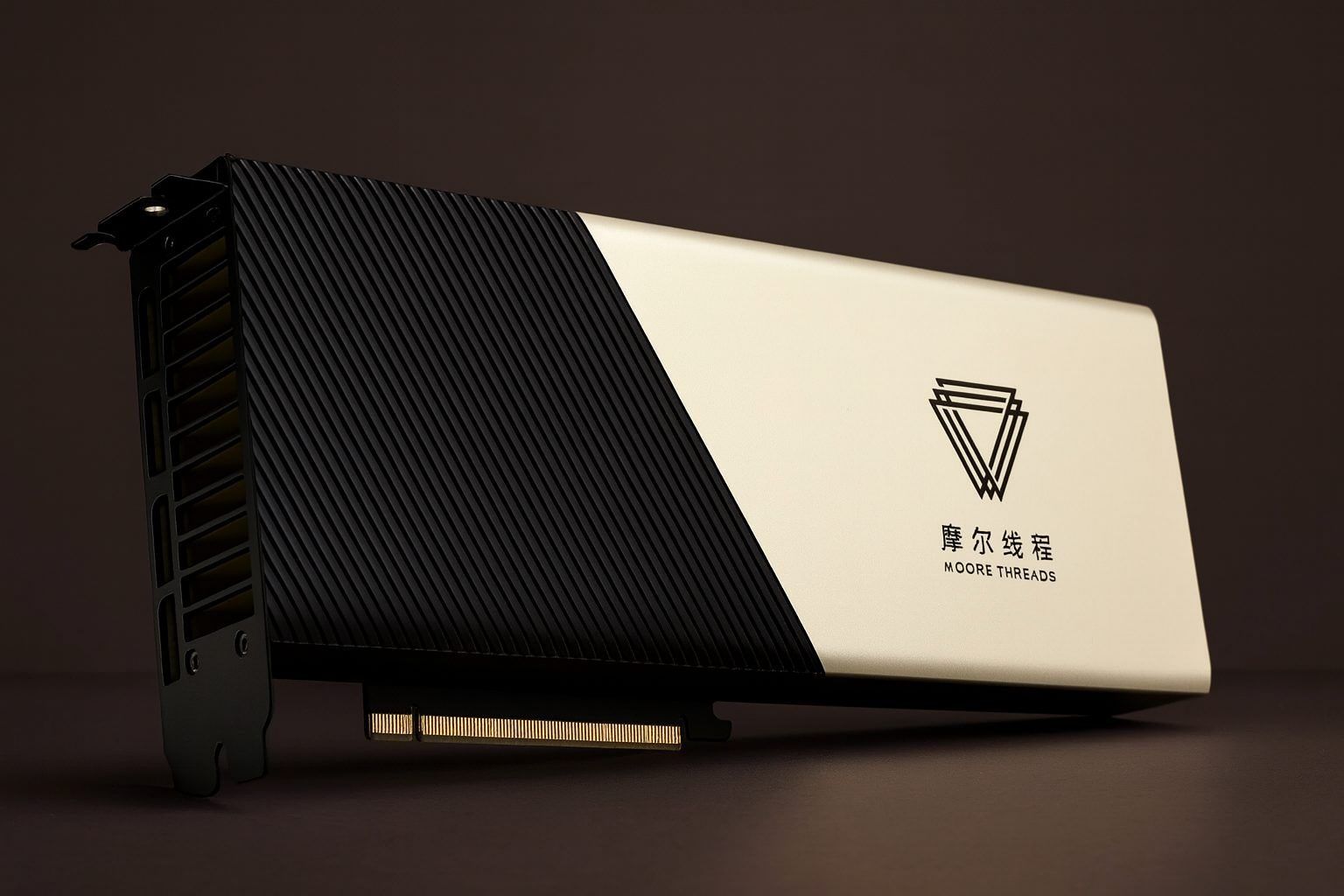
- Product focus: The company designs graphics processing units (GPUs) under its MUSA (Moore Threads Unified System Architecture) platform, targeting workloads from gaming and 3D rendering to AI model training, cloud graphics and digital twin simulations.Wikipedia+2Wccftech+2
Moore Threads initially gained attention for its desktop and workstation GPUs such as the MTT S60 and MTT S80, which deliver performance roughly comparable to mid‑range Nvidia and AMD chips from previous generations.Wikipedia+1
More recently, the company has pivoted hard toward AI and data‑center use cases, rolling out server‑class accelerators and multi‑GPU “cluster” systems aimed at Chinese cloud providers, state‑backed data centers and AI startups hungry for compute as U.S. export restrictions limit access to Nvidia’s latest products.The Outpost+2Financial Times+2
A sanctioned company at the center of the chip war
Ironically, Moore Threads’ spectacular rally comes even though it sits squarely in Washington’s crosshairs.
- In October 2023, the U.S. Commerce Department placed Moore Threads on its Entity List, restricting American companies from supplying the startup without a special license.Wikipedia+1
- As a result, the company was barred from using Taiwan Semiconductor Manufacturing Co. (TSMC) as a foundry partner and shifted much of its production to China’s Semiconductor Manufacturing International Corporation (SMIC), which primarily offers older process nodes and lower yields.Financial Times+1
Those sanctions run in parallel with broader U.S. moves to block exports of Nvidia’s most advanced AI GPUs to China, including high‑end data‑center products.Reuters+1
Analysts quoted by the Financial Times estimate that Nvidia’s sales in China could shrink from about $10 billion before export controls to around $2 billion, driving its local market share down from roughly 40% to just 8% in coming years. Over the same period, Moore Threads’ AI chip revenue is projected to climb from about $58 million in 2025 to $93 million in 2026, still tiny by global standards but growing fast.Financial Times
For Beijing, Moore Threads’ debut is therefore more than a stock market story: it is symbolic proof that domestic GPU design is viable at commercial scale, even under sanctions, and that China can build a homegrown ecosystem to support everything from generative AI to industrial simulation.
Growth rocket or valuation bubble?
Behind the euphoria, Moore Threads remains a loss‑making startup with a steep valuation curve.
According to financial disclosures summarized in Bloomberg and Reuters reports:
- The company recorded a net loss of about 724 million yuan in the first three quarters of 2025, even as revenue surged roughly 182% year‑on‑year to around 780 million yuan.Moneycontrol
- At the IPO price, Moore Threads was already valued at roughly 53.7 billion yuan (about $7.5 billion), equivalent to around 123 times its 2024 sales, compared with an average price‑to‑sales ratio of about 111 for domestic peers.Moneycontrol+2The Outpost+2
- Management and bankers have guided that 2025 sales could jump as much as 242% to 1.5 billion yuan, implying investors are effectively paying upfront for several years of aggressive growth.The Outpost+1
Even before trading began, Moore Threads asked its lead sponsor to remind investors about valuation risks, and local brokerage Sinolink Securities – while initiating coverage with a “buy” rating and describing the company as a potential “key force” in China’s chip independence push – also highlighted the possibility of short‑term froth.Moneycontrol+1
More broadly, China’s SSE STAR Chip Index trades at roughly 118 times earnings, nearly ten times the multiple of the broader Shanghai Composite, underscoring how AI‑linked chip stocks have become a magnet for speculative capital.The Outpost+1
Can Moore Threads really challenge Nvidia?
From a technology standpoint, Moore Threads still faces a considerable gap to Nvidia and AMD:
- Publicly disclosed GPUs such as the MTT S80 and S90 offer performance closer to earlier‑generation Western cards, and independent benchmarks of Moore Threads’ software stack and driver ecosystem remain limited.Wccftech+1
- Many of the company’s chips are manufactured on older 12nm or similar processes, while Nvidia is already shipping 4nm and moving toward even more advanced nodes for its latest AI accelerators.Wikipedia+1
- For AI developers, software and ecosystem support – compilers, libraries, frameworks and tooling – matter as much as raw FLOPS. Analysts note that Moore Threads’ MUSA architecture and associated software are still maturing compared with Nvidia’s CUDA, which dominates enterprise AI today.Wccftech+1
That said, Moore Threads does not need to “beat” Nvidia globally to be a success. U.S. export controls have created a captive pool of Chinese customers who:
- Can no longer easily buy Nvidia’s top chips, and
- Are under political and regulatory pressure to prioritize domestic suppliers.Reuters+2The Outpost+2
In that environment, even a technically inferior but “good enough” domestic GPU can gain real traction, especially in price‑sensitive or politically important sectors such as state‑owned data centers, provincial AI projects and industrial AI deployments.
A broader wave of Chinese AI chip IPOs
Moore Threads’ blockbuster debut is not happening in isolation. It is the flagship deal in a broader wave of AI chip listings reshaping China’s capital markets:
- The Shanghai Stock Exchange has fast‑tracked multiple semiconductor IPOs this year, including domestic GPU designer MetaX, chip packaging firm SJ Semiconductor and Xiamen‑based UX IC, as authorities explicitly encourage fund‑raising for “strategic and emerging industries”.The Outpost+1
- Other AI accelerator startups, such as Biren Technology and Enflame, are also preparing to go public in China or Hong Kong, according to recent Reuters and local media reports. Both design chips aimed at training and inference workloads similar to Nvidia’s data‑center GPUs.Wikipedia+2Reuters+2
And on the same day as Moore Threads’ debut, another major Chinese AI chip name stepped toward the public markets:
Baidu’s Kunlunxin lines up a Hong Kong listing
Kunlunxin, the AI chip subsidiary of internet giant Baidu, is planning an IPO in Hong Kong after a recent funding round that valued the unit at 21 billion yuan (about $2.97 billion).Reuters
According to investment materials reviewed by Reuters:
- Kunlunxin raised over 2 billion yuan in its latest round, with investors including a China Mobile fund.
- The company aims to file a listing application as early as Q1 2026, targeting an IPO by early 2027.
- Revenue is expected to grow to more than 3.5 billion yuan this year, with the company reaching break‑even after posting a net loss of around 200 million yuan on 2024 revenue of about 2 billion yuan.Reuters
- Its flagship P800 AI chip is already being deployed in state‑backed data‑center projects, and two new products – the M100 inference chip and M300 training/inference chip – are slated for 2026 and 2027 respectively.Reuters
Kunlunxin’s trajectory underscores how China is building a layered ecosystem of AI chip providers: Moore Threads in GPUs, Kunlunxin and Cambricon in AI accelerators, plus a growing cluster of specialized startups.Reuters+2Wikipedia+2
What Moore Threads’ debut means for investors and the AI chip race
For Chinese policymakers, Moore Threads’ explosive listing is a powerful signal that:
- Domestic GPU design can attract huge pools of capital even under U.S. sanctions.
- The STAR Market is doing what it was built for: channeling savings into strategically important, high‑risk tech companies.
- China’s AI chip ecosystem – spanning Moore Threads, MetaX, Biren, Enflame, Kunlunxin and others – is increasingly able to fund itself at home, rather than relying on foreign investors or offshore listings.The Outpost+2Reuters+2
For investors, however, the message is more nuanced:
- Upside potential is enormous if Moore Threads can translate its new capital into competitive AI chips, a robust software ecosystem and sticky customer relationships.
- But the stock is already priced for perfection, with triple‑digit price‑to‑sales multiples, rapid sales growth baked into expectations, and a business that remains loss‑making in a notoriously cyclical, capital‑intensive industry.Moneycontrol+1
- History offers plenty of examples – in both China and Silicon Valley – of “hot” semiconductor IPOs that soared on day one only to grind lower as reality caught up with lofty narratives.
For the global AI chip race, Moore Threads’ debut reinforces a key trend:
Rather than a single, integrated GPU market dominated by U.S. and Taiwanese suppliers, export controls are pushing the world toward parallel ecosystems – one centered on Nvidia and its peers, another increasingly centered on Chinese players backed by state support and domestic capital.Reuters+2The Outpost+2