
NEW YORK, August 18, 2026, 15:35 EDT — Circle shares slid 3.8% after progress on the CLARITY Act stalled, revealing a 4.7-fold difference between analyst outlooks.
- Circle shares dropped 3.8% as the CLARITY Act continued to be stalled.
- Analyst price targets spanned from $37 to $175, representing a 4.7-fold difference.
- Circle generated 95% of its second-quarter revenue from reserve income.
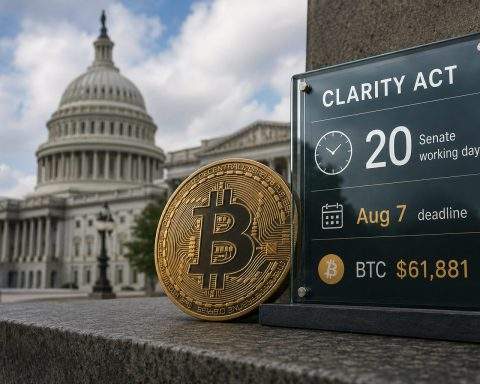
Shares of Circle Internet Group, Inc. NYSE:CRCL declined 3.8% to $71.79 in afternoon trading on Tuesday. The CLARITY Act remains stalled in the Senate, as U.S. regulators look to address regulatory gaps with agency rules.
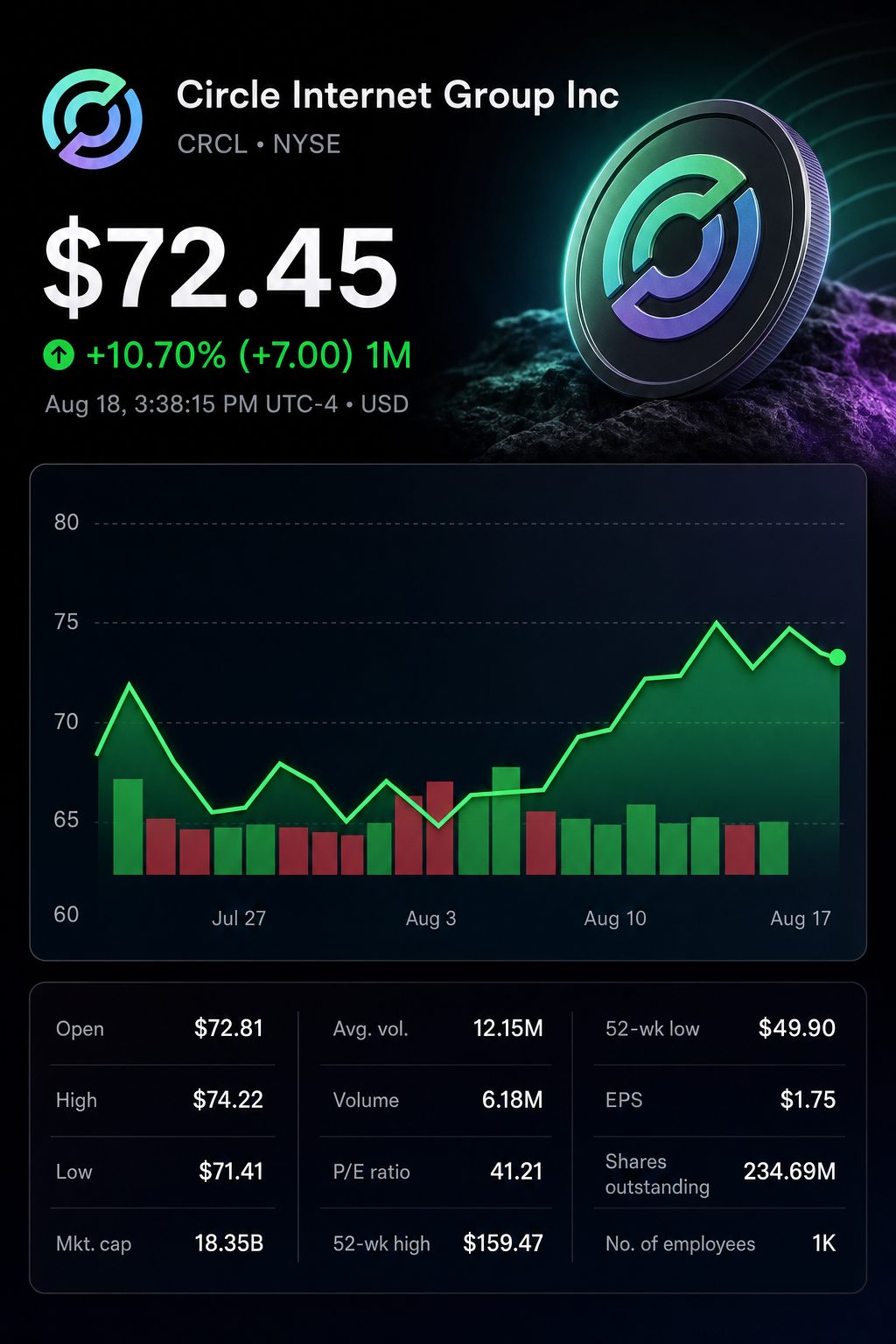
The deadlock is significant since agency regulations can be more easily overturned or disputed. Circle’s value already accounts for this ambiguity. Analyst targets on Wall Street range from $37 to $175, presenting a 4.7-fold difference.
The $138 spread amounts to 192% of Circle’s present share price. This is not a standard dispute about a single quarter. Optimists and pessimists are assigning different values to anticipated regulatory stability.
| Policy route | Immediate role | Durability | Circle investor impact |
|---|---|---|---|
| Congress: CLARITY Act | Specifies definitions for securities, commodities, and regulatory bodies | Highest | May offer greater certainty for legal matters over time |
| SEC rulemaking | Potentially allows certain token offerings outside securities regulations | Lower | Might make issuance easier, though it risks legal challenge and reversal |
| CFTC rulemaking | Creates standards for crypto assets tied to commodities | Lower | May increase available compliant products but also faces potential reversal |
“The agencies … seemingly are ready to act,” said Miller Whitehouse-Levine, CEO of Solana Policy Institute. Reuters noted that lawmakers in Congress face limited time to finalize an agreement before 2027. Reuters
Policy represents just one aspect of Circle’s economic model. In the second quarter, reserve income contributed $667.7 million out of total revenue of $701.3 million. This accounted for 95.2% of Circle’s overall revenue.
| Q2 2026 measure | Result | Year-on-year change | Investor reading |
|---|---|---|---|
| Total revenue and reserve income | $701.3 million | +7% | Growth fell below USDC trend |
| Reserve income | $667.7 million | +5% | Made up 95.2% of revenue |
| Revenue less distribution costs | $288.8 million | +15% | Economic retention improved |
| Net income | $48.2 million | From a $482.1 million loss | Back in the black |
| Adjusted EBITDA | $143 million | +8% | Margin compressed 329 basis points |
USDC average circulation increased by 25% to $76.5 billion. However, the reserve return rate declined by 66 basis points, reaching 3.5%. As a result, reserve income saw only a 5% rise.
This introduces another point of valuation. For every one-point shift in yield applied to $76.5 billion, there is roughly $765 million in annual gross reserve income. This is an initial estimate of sensitivity, excluding distribution expenses and shifts in balances.
| Reserve-yield movement | Projected yearly gross impact | Corresponding amount per quarter | Portion of Q2 overall revenue |
|---|---|---|---|
| -100 basis points | -$765 million | -$191 million | -27.3% |
| -50 basis points | -$383 million | -$96 million | -13.6% |
| No change | $0 | $0 | 0% |
| +50 basis points | +$383 million | +$96 million | +13.6% |
Usage expanded rapidly. Onchain transaction volume for USDC surged 151% to $14.8 trillion. Circulation at the end of the quarter reached $73.3 billion, up 19%. However, the stablecoin’s circulation still fell short of analysts’ forecast of $79.3 billion.
| USDC operating measure | Q2 2026 | Comparison |
|---|---|---|
| Quarter-end supply | $73.3 billion | +19% from previous year |
| Average supply | $76.5 billion | +25% from previous year |
| Onchain payment volume | $14.8 trillion | +151% from previous year |
| Return on reserves | 3.5% | down 66 basis points |
| Share of fiat-backed dollar stablecoins | 27% | down 66 basis points |
Chief Executive Jeremy Allaire described the move toward practical blockchain applications as “a tipping point moment.” The stalled policy does not stop this adoption, but it does postpone the lasting regulatory structure that investors had anticipated. Wall Street Journal
Analysts are generally optimistic but show a clear division in outlook. According to Google Finance, there are 13 buy ratings, five holds, and three sell recommendations. The consensus price target stands at $98.61, which suggests a potential upside of 37%.
| Analyst | Firm | Rating | Target | Implied move |
|---|---|---|---|---|
| Gustavo Gala | Monness | Buy | $175 | +143.8% |
| Gautam Chhugani | Bernstein | Buy | $140 | +95.0% |
| Jeff Cantwell | Seaport Global | Buy | $100 | +39.3% |
| Brian Bedell | Deutsche Bank | Hold | $58 | -19.2% |
| James Faucette | Morgan Stanley | Sell | $37 | -48.5% |
| 21-analyst consensus | — | 13 Buy / 5 Hold / 3 Sell | $98.61 | +37.4% |
Risks: The CLARITY Act may return for consideration prior to Congress adjourning. Agency regulations could also be more resilient than anticipated. The rate sensitivity remains early-stage and does not account for altered reserves, shifts in distribution arrangements or hedging activities.
Circle continues to have potential policy advantages. Currently, though, its profits rely chiefly on returns from reserves. The 4.7-fold target gap reflects both uncertainties simultaneously.
Related articles: NYSE:CRCL