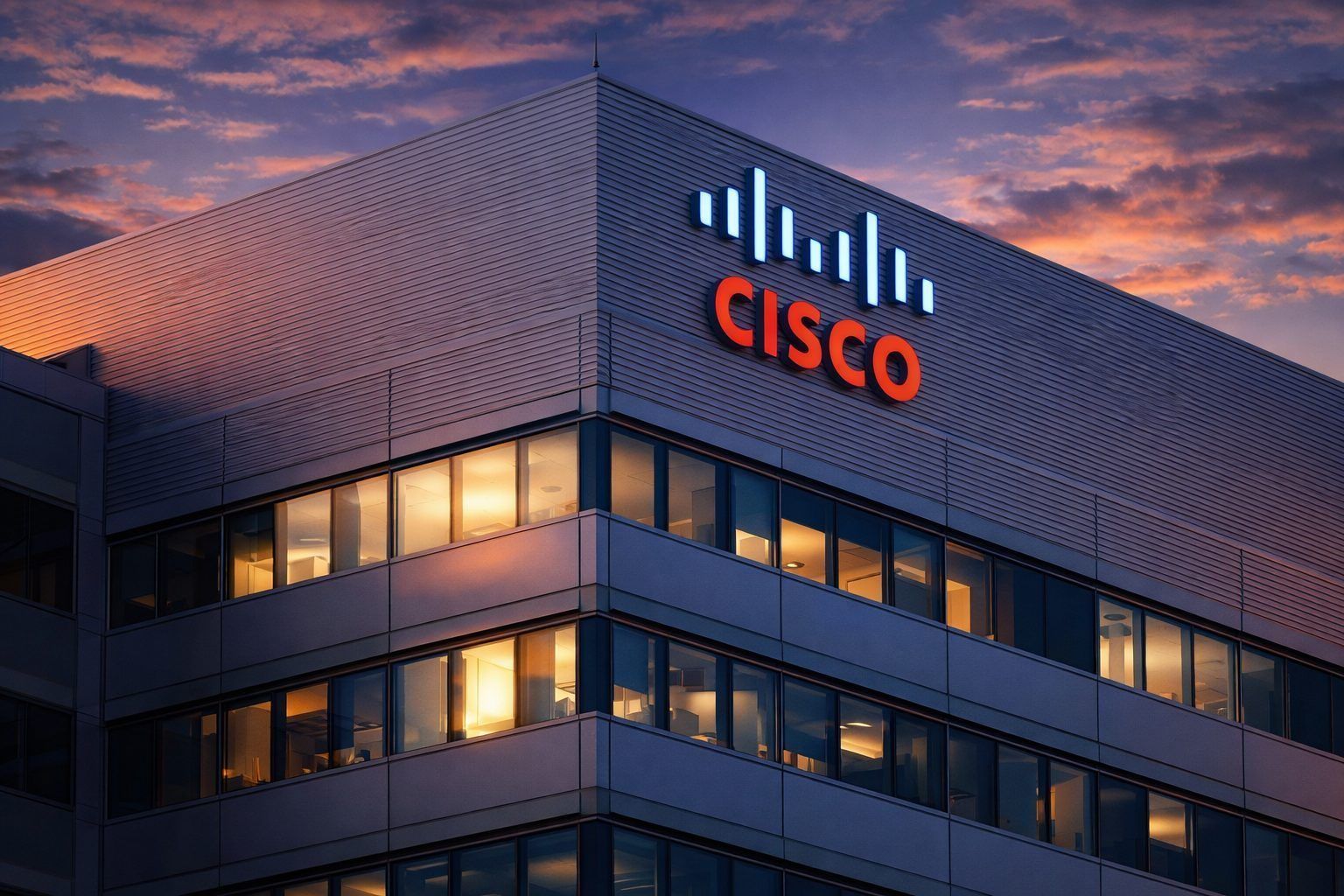
Cisco Systems, Inc. (NASDAQ: CSCO) ended Wednesday, December 17, 2025, on a down note in regular trading, then steadied slightly after the bell—setting up a headline-driven setup for Thursday’s open (December 18, 2025).
In the regular session, CSCO closed at $76.00, down 2.00%, after trading between roughly $75.93 and $78.18. In late trading, the stock was indicated around $76.25 in after-hours, a modest rebound from the close.
What investors are digesting tonight isn’t just price action. It’s a stack of market-moving developments from today (Dec. 17)—including a new, actively exploited zero-day tied to Cisco email security products, a CISA “known exploited” listing, a shareholder vote expanding Cisco’s equity incentive plan, and fresh Wall Street target updates that arrive while sentiment across tech wobbles.
CSCO stock recap after the bell: what the tape said on Dec. 17
Cisco’s session reflected a broader risk-off tone in U.S. equities, with the S&P 500 down 1.16% on the day while Cisco fell 2.00% to $76.00.
Key pricing levels from Wednesday (Dec. 17):
- Close: $76.00 (−2.00%)
- Day range: about $75.93 to $78.18
- After-hours (later evening indication): about $76.25
The direction tomorrow morning may come down to whether the market treats today’s cybersecurity developments as:
- Contained and product-specific (a short-lived headline), or
- A broader brand/trust issue that keeps pressure on multiples and enterprise demand assumptions.
The biggest Cisco headline today: a new zero-day tied to Secure Email products
The dominant story moving through markets and security circles on Dec. 17 is Cisco’s disclosure of an actively exploited vulnerability affecting certain Cisco email security appliances.
What Cisco Talos says is happening
Cisco’s own threat intelligence team, Cisco Talos, published details today on a campaign targeting:
- Cisco AsyncOS Software for Cisco Secure Email Gateway (ESA)
- Cisco Secure Email and Web Manager (formerly SMA)
Talos assesses with moderate confidence that the adversary—tracked as UAT-9686—is a Chinese-nexus APT actor, and says the activity has been ongoing since at least late November 2025.
Talos also describes tooling consistent with longer-term access and stealth, including a custom persistence mechanism called “AquaShell,” plus tunneling and log-manipulation tools. Cisco Talos Blog
Why it matters for markets, not just security teams
For investors, the immediate questions are not whether Cisco can “survive” an exploit story (it can), but:
- How quickly the exposure can be contained (mitigations now; patches later)
- How many customers are affected and whether incidents become publicly visible
- Whether the event changes buying behavior in security/networking refresh cycles
- Whether remediation costs (support, response, services) become meaningful
Cisco is not a “single product” story. But security headlines can still hit sentiment—especially when they involve active exploitation and no immediate patch for some environments.
TechCrunch reported today that Cisco said attackers are exploiting a critical vulnerability and that patches were not available at the time, with Cisco’s current guidance including rebuilding affected systems.
CVE-2025-20393: severity 10.0 and “known exploited” status adds urgency
Multiple reports today point to the vulnerability being tracked as CVE-2025-20393, described as allowing attackers to execute commands with root privileges on affected appliances in certain conditions.
- Cisco’s advisory listing for the issue shows CVE-2025-20393 with a CVSS base score of 10.0 (Critical).
- CRN reported the issue is being exploited against Cisco Secure Email Gateway and Secure Email and Web Manager and reiterated that patches were not yet available for Cisco at the time of reporting.
- The Register emphasized Cisco’s language about a “limited subset” and described the exploit impact as arbitrary command execution with root privileges. The Register
CISA KEV listing: why traders should pay attention
The U.S. Cybersecurity and Infrastructure Security Agency (CISA) Known Exploited Vulnerabilities (KEV) Catalog includes CVE-2025-20393 as “known exploited.” CISA
This matters because a KEV listing tends to:
- Accelerate customer response timelines
- Increase executive-level visibility at affected enterprises and government agencies
- Drive short-term scrutiny of vendor mitigation quality (even if long-term fundamentals are unchanged)
Bottom line: even if the financial impact ends up modest, the urgency and visibility of a KEV-tagged issue can influence near-term stock sentiment.
Shareholder vote: Cisco expands its stock incentive plan pool
Separately from the security storyline, Cisco disclosed results tied to its shareholder meeting.
According to reporting based on Cisco’s SEC filing, shareholders approved an amendment and restatement of Cisco’s 2005 Stock Incentive Plan, increasing the number of shares authorized for issuance under the plan by 57,490,000 shares.
Cisco’s proxy materials describe the increase as raising authorized shares under the plan to 928,040,000 shares, while maintaining governance features such as no repricing/buyouts of underwater awards without shareholder consent and no “evergreen” automatic share increases. SEC
What this means for investors (and what it doesn’t)
This kind of authorization is usually about future equity compensation flexibility, not an immediate issuance tomorrow morning. Still, investors often watch for:
- Long-run dilution dynamics
- Whether equity awards are balanced by buybacks
- Whether compensation structures align with performance and margin goals
In other words: it’s typically a slow-burn governance factor, not a same-night trading catalyst—unless investors believe dilution risk is rising faster than expected.
Wall Street forecasts updated today: Morgan Stanley lifts target to $91
One of the more market-friendly data points today came from the analyst side.
Benzinga’s compiled analyst feed shows Morgan Stanley maintaining an Overweight rating on Cisco on Dec. 17, 2025, while raising its price target from $82 to $91.
MarketBeat similarly summarized Morgan Stanley’s move today (Overweight maintained; target raised to $91) and framed it as implying upside versus the prior close.
Benzinga’s broader snapshot also lists:
- A consensus price target around $77.45 (as displayed on its page at the time)
- A range of targets, with high $100 and low $50 (noting the high was issued in November 2025 on that page)
Why this matters tonight
After a 2% down day, a higher target from a major bank can act as a sentiment stabilizer—but it doesn’t erase the real-time driver: the cybersecurity situation and how quickly Cisco can move customers from “mitigation” to “remediation.”
Options and positioning check: “mixed,” slightly constructive tone
The options market didn’t flash full-blown panic today, but it did reflect uncertainty.
A TipRanks repost of TheFly noted:
- About 64k options contracts traded
- Calls leading puts, with a put/call ratio ~0.68 versus a typical level near 0.63
- Implied volatility (IV30) around ~20.97
- An expected daily move around $1.01
- Skew described as flattening, suggesting a modestly bullish tone despite the down move
For tomorrow’s open, this reads like: investors are watching and hedging, but not capitulating.
What to know before the stock market opens Thursday, Dec. 18
Here’s the practical checklist traders and long-term holders will likely run through before the opening bell:
1) Any new Cisco updates on CVE-2025-20393 overnight
The biggest near-term swing factor is whether Cisco (or Cisco Talos) posts:
- Clearer scope (how many customers / environments)
- Updated mitigation steps
- A timeline or status for permanent remediation
Cisco Talos’ write-up already highlights that observed compromises appear tied to non-standard configurations, which may help contain the perceived blast radius—if validated by further details.
2) Whether more agencies and enterprises echo CISA’s urgency
Because the vulnerability appears in CISA’s KEV catalog, security teams may accelerate actions that can temporarily disrupt normal operations—sometimes creating short-term noise (support tickets, rebuilds, services demand) that investors then try to translate into dollars.
3) Watch early headlines for “customer impact” disclosures
The market often reacts more to:
- a named large customer incident, or
- a wave of confirmations by third-party responders
than to the original advisory itself.
The Register noted Cisco declined to answer questions about how many appliances were affected and when a fix would arrive—so incremental clarity may move the stock.
4) Analyst narrative: can “AI + subscriptions” stay dominant over “security incident”?
Today’s market commentary still contains the longer-term bull case: Cisco’s transition toward subscriptions, software, security, and AI-adjacent infrastructure positioning.
But tomorrow’s tape will likely decide which storyline dominates:
- Structural transformation + dividend + analyst targets, or
- Exploit headlines + patch uncertainty
5) Simple technical levels traders will watch at the open
Even without charts, a few levels stand out from today’s tape:
- ~$75.93: today’s low area
- ~$76.00: the close (psychological “line in the sand”) Yahoo Finance+1
- ~$78.18: today’s high area (where sellers showed up)
If pre-market headlines are quiet, traders often anchor to these levels early.
The takeaway: tonight is about cybersecurity execution and message control
Cisco stock’s after-hours steadiness following a down session suggests investors are not immediately pricing in a major financial hit.
But the headline mix going into Dec. 18 is unusually dense for a single day:
- A critical, actively exploited vulnerability (CVE-2025-20393) tied to email security appliances
- A CISA KEV listing that raises urgency
- A shareholder-approved expansion of the stock incentive plan pool
- A fresh $91 price target from Morgan Stanley (Overweight maintained)
- Options positioning that reads as mixed but not fearful