Updated: December 14, 2025
A rare messenger from another star system is sliding through our solar system right now—and it’s putting on a subtle but scientifically rich show.
Comet 3I/ATLAS (also designated C/2025 N1 (ATLAS)) is only the third confirmed interstellar object ever observed inside our solar system. Over the last several days, fresh reporting and new datasets have sharpened the picture: the comet’s coma has taken on a faint green glow, and X-ray observatories are now seeing the interaction between its escaping gases and the solar wind—an unusual multiwavelength campaign that’s turning 3I/ATLAS into one of the most intensively monitored comets of 2025. NASA Science+2European Space Agency+2
Most importantly for anyone seeing headlines fly by on social media: NASA says there is no danger to Earth. On December 19, 2025, the comet’s closest approach will still be about 1.8 astronomical units away—roughly 270 million kilometers (170 million miles)—nearly twice the Earth–Sun distance. NASA Science+1
What is Comet 3I/ATLAS—and why “3I” matters
The name is a clue to the history.
- “3I” means third interstellar object ever confirmed in our solar system (after 1I/ʻOumuamua in 2017 and 2I/Borisov in 2019). NASA Science+1
- “ATLAS” refers to the NASA-funded Asteroid Terrestrial-impact Last Alert System survey telescope that reported it to the Minor Planet Center on July 1, 2025, from Rio Hurtado, Chile. NASA Science
- Its path is hyperbolic, meaning it’s moving too fast to be gravitationally captured by the Sun. It’s a one-time visitor that will head back into interstellar space. NASA Science
NASA’s current “quick facts” also underscore just how fast this object is: it was traveling around 137,000 mph (221,000 km/h) when discovered, sped up to about 153,000 mph (246,000 km/h) at perihelion, and will ultimately depart at roughly the speed it arrived. NASA Science
The Dec. 14 headline: the comet is getting greener—and that’s chemistry in motion
The most eye-catching recent change is color.
New images and coverage circulating in today’s news cycle emphasize that 3I/ATLAS has shifted from a redder appearance earlier in 2025 to a faint greenish glow in more recent observations. A key idea behind that change is straightforward comet physics: as sunlight heats the nucleus, ices sublimate and release gases and dust into the coma—sometimes revealing new molecules that weren’t obvious earlier. The Economic Times+2Live Science+2
Multiple reports tie the green emission to diatomic carbon (C₂), a highly reactive molecule that can glow green in comet comae. Phys.org+2Live Science+2
What makes this especially interesting is the timing. The images drawing attention now were taken after the comet’s late-October perihelion (its closest approach to the Sun). In other words, we’re seeing how an interstellar comet behaves after a solar “stress test,” when heat can penetrate deeper and trigger delayed changes. Live Science+1
Could there be more outbursts?
Possibly—but not in a doomsday way.
Astronomers often talk about thermal lag: the Sun heats a comet’s surface quickly, but it can take time for warmth to reach pockets of volatile material inside. That delayed heating can sometimes trigger new jets or brief outbursts later. Recent coverage frames that as a key unknown worth watching in the days and weeks after the December 19 flyby. Live Science+2Sci.News: Breaking Science N…
X-rays enter the story: XRISM and XMM-Newton follow the solar wind collision
The most genuinely “new to most readers” development in this mid-December news wave is that 3I/ATLAS is not just being photographed in visible light—its environment is being probed in X-rays.
XRISM: a tentative first look at X-rays from 3I/ATLAS
Japan’s XRISM mission reported a Target of Opportunity observation carried out from November 26 to November 28, 2025, with an effective exposure of 17 hours. xrism.jaxa.jp
In quick-look processing, the XRISM team saw a faint X-ray glow extending about 5 arcminutes, corresponding to roughly 400,000 km around the comet. They explicitly caution that careful analysis is still needed, because instrumental effects can mimic extended structures. xrism.jaxa.jp
Even with that caution, XRISM noted spectral hints consistent with charge-exchange reactions—the same basic mechanism responsible for X-rays around many “ordinary” solar system comets, produced when solar wind ions interact with neutral gas in the comet’s coma. xrism.jaxa.jp
ESA’s XMM-Newton: a clearer X-ray glow, and why it matters
The European Space Agency’s XMM-Newton observed 3I/ATLAS on December 3 for about 20 hours, when the comet was roughly 282–285 million km from the spacecraft. European Space Agency
ESA explains the physics cleanly: gas molecules streaming off the comet collide with the solar wind, producing X-rays. And the payoff is more than a pretty detection—X-ray observations can be especially sensitive to gases that are hard to measure at other wavelengths, potentially including hydrogen (H₂) and nitrogen (N₂), which are “almost invisible” to many optical and ultraviolet instruments. European Space Agency
Together, XRISM and XMM-Newton turn 3I/ATLAS into an unusually well-instrumented laboratory for studying how an interstellar comet’s coma behaves when it meets our Sun’s particle environment. xrism.jaxa.jp+1
Spacecraft snapshots: Hubble and JUICE add close-up context
While ground-based telescopes are tracking the comet’s changing appearance, spacecraft are capturing it from vantage points that are hard to replicate on Earth.
A recent roundup highlights observations by:
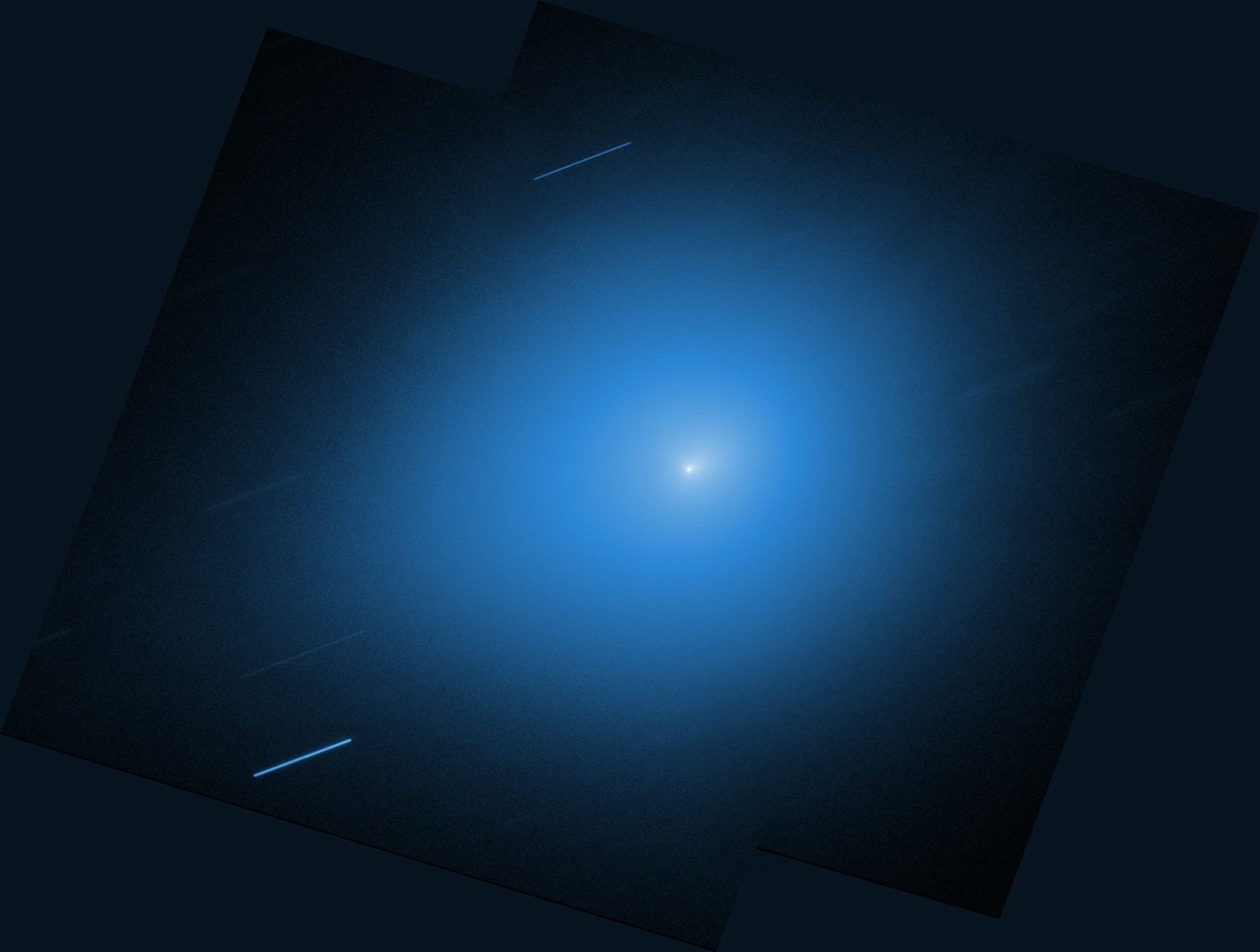
- the Hubble Space Telescope, which imaged the comet again in late November, tracking its motion so background stars streak in the frame, and
- ESA’s JUICE (Jupiter Icy Moons Explorer), which obtained a teaser view with a navigation camera—valuable because it shows the coma/tail geometry from a different observing geometry, even if the “serious” science data will take longer to download. Space+1
Space reporting also points to early hints of unusual chemistry from a broader NASA-led campaign—such as a relatively high carbon-dioxide-to-water ratio in dust and gas described as rich in nickel compared with iron—potential clues that this object formed under conditions not typical of many well-studied solar system comets. Space+1
What the chemistry could reveal: “message in a bottle” science
Why are astronomers sprinting to gather data now?
Because with a hyperbolic trajectory, there’s no second pass. Every week of data is a piece of a forensic puzzle: what did planetary building blocks look like around other stars?
One detailed recent interview with an observing team in Santiago, Chile, explains the strategy in simple terms: the comet’s inbound journey can preserve surface chemistry shaped by interstellar space, while the outbound journey may reveal chemistry from deeper layers as solar heating processes the nucleus—so timing matters. Time and Date
That same reporting highlights how researchers identify molecules via spectroscopy, and describes interest in features that may indicate nickel—not unheard of in comet science, but noteworthy in context and still under active study. Time and Date+1
International coverage has also discussed results pointing to elevated carbon dioxide in the coma and mentions additional molecule detections (including methanol and hydrocarbons) from powerful facilities such as ALMA, plus reports of gas-and-dust jets around perihelion. El País
No, Dec. 19 is not “judgment day”—and NASA is explicit about the risk
Some of today’s most widely shared headlines aren’t about spectroscopy or orbital mechanics; they’re about fear.
A Dec. 14 news story reflects how social media has attached religious or apocalyptic themes to the December 19 date, asking whether people should be worried. The Economic Times
Here’s what the science agencies say:
- NASA states there is no danger to Earth from this comet. NASA Science
- The closest approach is still about 270 million km (170 million miles) away. NASA Science+1
- NASA also notes that 3I/ATLAS’s observed characteristics—its coma, icy nucleus, and behavior—are consistent with what scientists expect from a comet, not something exotic. NASA Science
In other words: Dec. 19 is a calendar milestone for closest approach, not a collision course.
How to see Comet 3I/ATLAS (and what to expect)
If you’re hoping for a dramatic naked-eye spectacle like some famous comets of the past, it’s best to set expectations now: this is a faint, telescope-oriented target, not a bright sky-show for casual stargazing.
NASA says the comet can be observed with a small telescope in the pre-dawn sky and should remain observable into spring 2026. NASA Science
NASA’s December skywatching guide also flags December 19 as the key date for closest approach and includes a sky chart placing the comet near familiar bright sky landmarks (useful for star-hopping with a finder scope). NASA Science+1
A practical approach, if you’re trying to spot it:
- Use a sky map app (or a star chart) and search “3I/ATLAS” or “C/2025 N1 (ATLAS)”. Time and Date
- Plan for a dark location with minimal light pollution.
- Expect a faint fuzzy patch rather than a vivid tail unless you’re imaging with long exposures.
What happens next—and why scientists are treating this like a once-per-generation opportunity
By late December and into early 2026, the story of 3I/ATLAS will likely keep evolving in two parallel tracks:
- Public visibility: it will remain a niche observing challenge for amateurs with the right equipment and dark skies. NASA Science+1
- Scientific payoff: multiwavelength follow-up—from optical spectra to X-rays—will refine what we know about the comet’s gas inventory, dust properties, and interaction with the solar wind. Early XRISM results, in particular, have already helped guide subsequent observation planning, according to the mission team. xrism.jaxa.jp
For scientists, the excitement is simple to summarize: 3I/ATLAS is a fast-moving sample of another planetary system’s leftovers, delivered briefly into our backyard. The details—green-glowing carbon chemistry, possible exotic volatiles, and a coma that can shine even in X-rays—are exactly the kinds of clues that could widen what we think “typical” comet formation looks like across the Milky Way. European Space Agency+2Live Science+2