
On December 15, 2025, the solar system’s most talked-about “visitor” is back in headlines for two very comet-like reasons: it’s brightening and it’s glowing green.
The object is Comet 3I/ATLAS—often shortened to “3I/Atlas comet”—the third confirmed interstellar object ever found passing through our neighborhood, after 1I/ʻOumuamua (2017) and 2I/Borisov (2019). Space+1
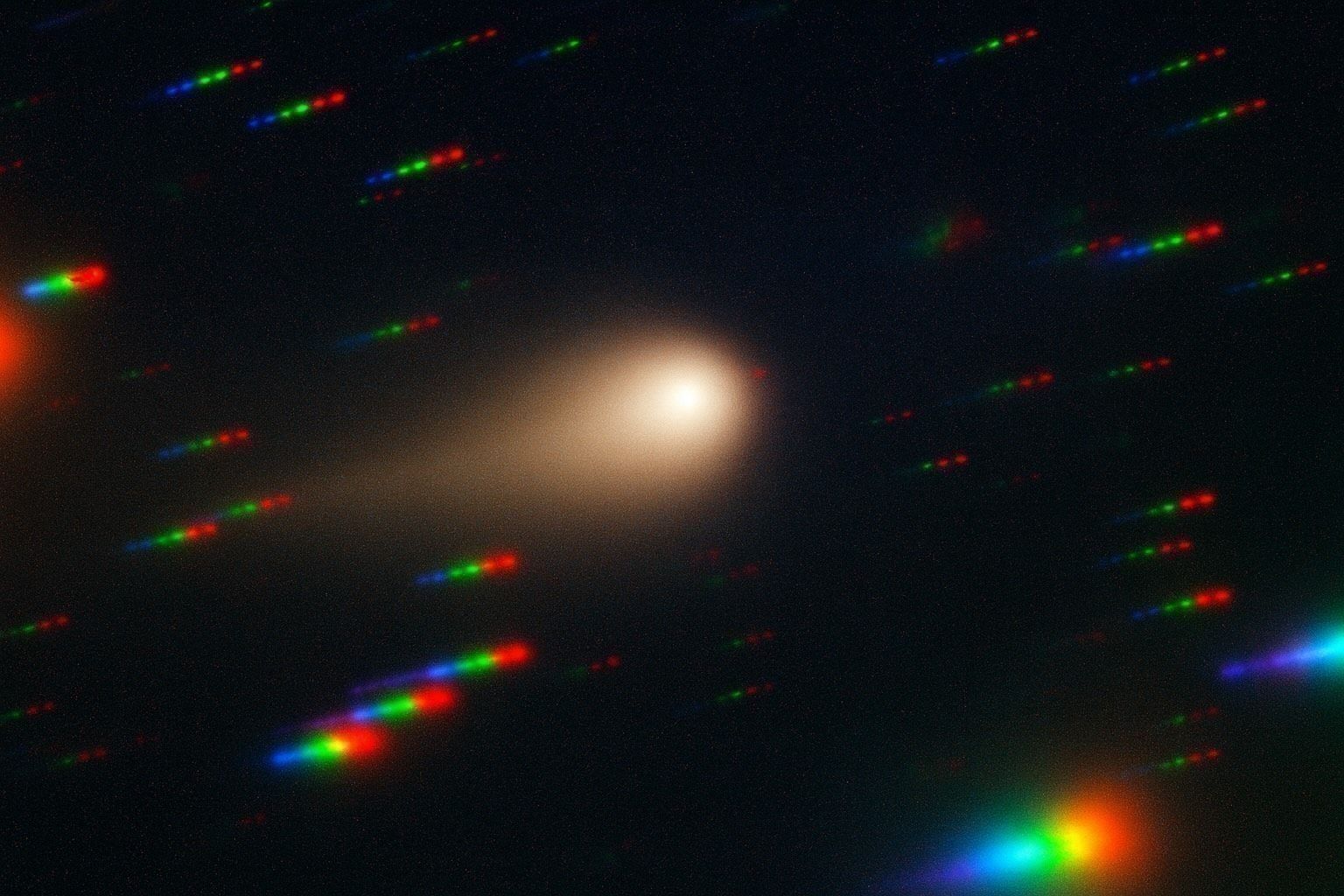
Today’s coverage is focusing on what observers are seeing now that 3I/ATLAS has re-emerged for sustained viewing after its late-October solar passage: a more active coma, a greener tint, and renewed discussion of a quirky-looking feature known as an anti-tail.
With the comet set to make its closest approach to Earth on December 19—still a very safe ~270 million kilometers (170 million miles) away—this is the last “prime-time” stretch for astronomers to study a body that formed around another star and will never return. Live Science+2The Times of India+2
What’s new today: 3I/ATLAS is brighter, greener, and drawing fresh attention
Two Dec. 15 explainers are driving much of today’s conversation:
- The comet’s “green glow” is intensifying in recent telescope images, with reports emphasizing that this is a natural chemical signature commonly seen in active comets. The Times of India+2Live Science+2
- The “anti-tail” effect is getting more attention, as skywatchers notice what looks like a tail pointing sunward—an optical/geometry effect that can happen when dust spreads along the comet’s orbit and Earth’s viewing angle lines things up just right. Digit
The Times of India notes that the green color is likely linked to diatomic carbon (C₂)—a classic source of green emission in comet comae—appearing more strongly now than earlier in the year, when the comet looked redder.
Digit’s Dec. 15 update leans into what many readers are wondering: How do we know it’s truly interstellar? and What does that anti-tail mean?—while stressing that the comet’s flyby poses no risk to Earth.
Quick facts: what Comet 3I/ATLAS is (and why it matters)
Comet 3I/ATLAS was first reported on July 1, 2025 by the NASA-funded ATLAS survey telescope in Chile, and its trajectory showed it is on a hyperbolic, unbound path—meaning it did not originate in our solar system and won’t be captured into orbit around the Sun.
A few key points that researchers keep emphasizing:
- It’s the third confirmed interstellar object ever observed here.
- It behaves more like a “classic comet” than ʻOumuamua did, with a coma and dust. Space+1
- Hubble observations have constrained its nucleus size to an upper limit of about 5.6 km (3.5 miles), though it could be much smaller.
- NASA and partners have coordinated observations across an extraordinary range of spacecraft and telescopes to take advantage of a fleeting opportunity.
The scientific appeal is simple: comets are time capsules. An interstellar comet is a time capsule from another planetary system—material shaped by a different star’s chemistry, radiation, and history.
Why 3I/ATLAS is turning green
The “green comet” headline is catnip for the internet, but the underlying explanation is standard comet physics.
Recent imagery from the Gemini North telescope (taken Nov. 26 and highlighted widely in December reporting) indicates the coma has shifted from a redder appearance earlier in the year to a faint greenish glow after the comet’s close solar passage.
The leading explanation in today’s reporting: as sunlight heats the comet, ices sublimate and release gases—among them diatomic carbon (C₂)—which can emit green light when energized by sunlight.
That doesn’t make 3I/ATLAS “ordinary,” though. What’s notable is the timing and the shift: early observations showed a different overall color impression, and now the post-perihelion coma looks greener—suggesting that fresh material may be venting from beneath surface layers that were processed during its long interstellar journey. Live Science+1
Another reason astronomers are watching closely: comets can respond to heating on a delay, which can trigger sudden changes or outbursts.
The anti-tail: why a “tail toward the Sun” can appear
A comet’s tail normally points away from the Sun because sunlight and the solar wind push dust and ionized gas outward. So why do some observers see what looks like a tail going the “wrong” way?
Today’s Dec. 15 explainer coverage points to the anti-tail effect: a perspective-driven feature that can appear when dust spreads along the comet’s orbital plane, and Earth’s line of sight makes that dust sheet look like a sunward spike.
Digit emphasizes that anti-tails have been seen in other comets, but spotting the effect in an interstellar object is especially interesting because it gives researchers another way to study dust behavior and particle properties in material that didn’t form around our Sun.
A solar-system-wide observing campaign is tracking 3I/ATLAS
While Dec. 15 headlines highlight visible-light changes, the broader 3I/ATLAS story is the scale of the observing effort.
NASA’s 3I/ATLAS hub notes that a long list of assets have collected data on the comet—ranging from Hubble and Webb to missions stationed throughout the inner solar system, plus Mars orbiters and more.
Recent standout observations include:
Hubble’s re-visit (Nov. 30)
NASA reports that Hubble reobserved 3I/ATLAS on Nov. 30, 2025, continuing to refine estimates of the nucleus and coma.
JUICE’s “sneak peek” (November)
Space.com reports that ESA’s JUICE spacecraft took a targeted look in early November and trickled home a limited preview image via its smaller antenna, with the full high-resolution dataset expected later (because of mission constraints near the Sun).
XMM-Newton’s X-ray detection (Dec. 3)
In one of the more dramatic scientific angles this month, ESA says its XMM-Newton observatory observed 3I/ATLAS on Dec. 3 for about 20 hours, detecting low-energy X-rays produced when cometary gas interacts with the solar wind.
Together, these datasets help scientists connect what we see visually (coma brightness, tail structure, color) with what’s actually happening physically (gas production, dust composition, interaction with solar particles).
The Mars angle resurfacing today: HiRISE and an interstellar comet “photo op”
Another item appearing in the Dec. 15 orbit of coverage: the HiRISE camera team’s outreach about a Mars-based observation.
The University of Arizona’s HiRISE site featured an “Exocomet 3I/ATLAS” item in its Picture of the Day lineup for Dec. 15, 2025, pointing readers to the special-release page. uahirise.org
That release explains that on Oct. 2, 2025, the Mars Reconnaissance Orbiter (MRO) turned away from Mars to image 3I/ATLAS. HiRISE detected the comet at about 30 km/pixel in a 3.2-second exposure from roughly 30 million kilometers (19 million miles) away—close enough (for Mars) to capture coma structure, even though the nucleus is far too small to resolve at that scale.
It’s a reminder of something easy to miss in Earth-centric headlines: while the comet won’t come especially close to Earth, it had a comparatively closer encounter with Mars—and that geometry gave Mars orbiters a unique view during a period when Earth-based telescopes struggled because the comet was too close to the Sun in our sky.
Will Comet 3I/ATLAS hit Earth? Here’s what scientists say
The short answer remains: no.
Multiple current explainers stress that December’s “close approach” language is astronomical, not alarming. The comet’s closest approach on Dec. 19, 2025 is expected to be around 270 million km away. Live Science+2The Times of India+2
NASA officials have also publicly emphasized there is no threat to Earth, and that the solar system “will be just fine” as the comet passes through and exits. Space
How to see Comet 3I/ATLAS in mid-December 2025
If you’re hoping for a naked-eye spectacle, this likely isn’t that kind of comet.
Even optimistic observing guides put 3I/ATLAS in the range of a faint telescopic object in mid-December—often around magnitude ~12–13, which typically requires a telescope or sensitive camera setup and dark skies.
If you want the best shot at spotting it:
- Use a skywatching app (SkySafari, Stellarium, etc.) and search “3I/ATLAS” or “C/2025 N1” to get real-time positioning for your location.
- Plan for dark conditions (moonlight and haze matter a lot for faint comets).
- Bring stability: binoculars may not be enough, but a small telescope on a steady mount—or a camera on a tracking mount—can help.
- Expect it to look like a small fuzzy patch, not a dramatic tail by eye.
And remember: a faint comet can still be scientifically thrilling. 3I/ATLAS isn’t competing with bright “Great Comets.” It’s competing with history.
What scientists are most eager to learn next
The next few days matter because 3I/ATLAS is actively evolving. As it cools and continues outward, observers will be watching for:
- Whether the green emission strengthens, fades, or shifts as different volatiles dominate.
- Whether the comet produces an outburst as heat penetrates deeper layers (a known delayed effect in comet activity).
- More constraints on composition from coordinated campaigns. Space.com reports NASA scientists have discussed signs of unusual chemistry (including a higher carbon-dioxide–to–water ratio and nickel-rich gas) from multi-instrument observations—possible hints that 3I/ATLAS formed under conditions unlike those that shaped most familiar solar system comets.
The bottom line for Dec. 15, 2025
Today’s 3I/ATLAS news cycle is less about a single “big reveal” and more about a rare convergence:
- A green-glowing interstellar comet is active and changing on a human timescale.
- It’s approaching a well-timed Dec. 19 flyby—close enough to focus the world’s telescopes, far enough to be harmless.
- Researchers are stitching together observations from Earth and space—from visible-light images to X-rays—to read the chemistry and physics of a body born around another star.
If the green glow and anti-tail get you to look up, that’s the win. If they get you to look closer—through a telescope, through data, through the idea that our solar system is not sealed off from the galaxy—that’s the real story of Comet 3I/ATLAS.