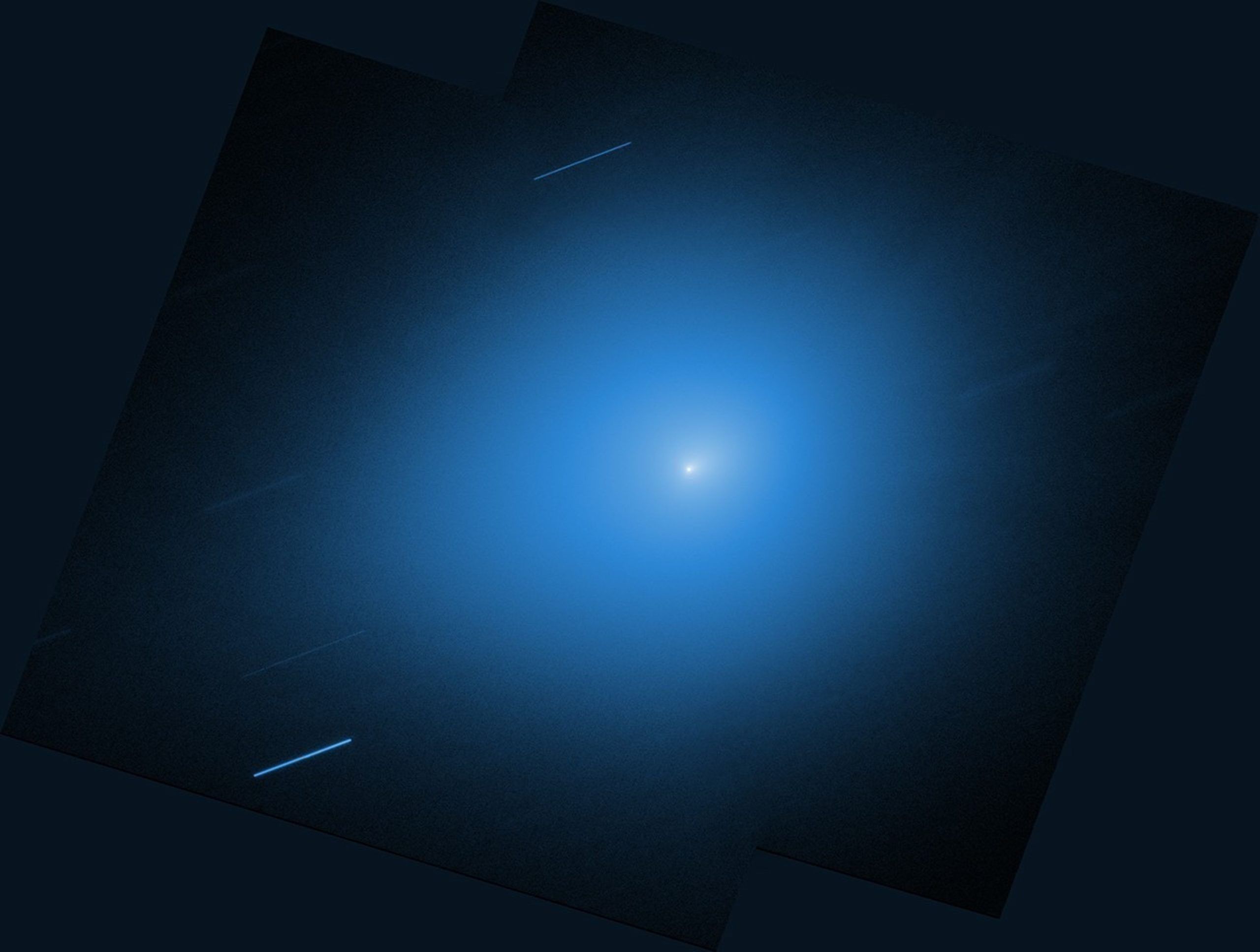
As of Tuesday, December 16, 2025, the interstellar comet known as 3I/ATLAS—a rare visitor from beyond our solar system—is drawing intense attention ahead of its closest approach to Earth on Friday, Dec. 19. Despite dramatic headlines and online rumors, reputable agencies are consistent on the key point: 3I/ATLAS poses no threat to Earth, and will remain about 1.8 astronomical units (AU) away—roughly 170 million miles (270 million kilometers). NASA Science+1
Below is what’s happening today, what scientists know, what observers can realistically expect to see, and why this fleeting flyby matters for space science.
What’s new today: Dec. 16 coverage focuses on the flyby, safety, and a narrow observing window
Today’s reporting has converged on three storylines:
- The timing: 3I/ATLAS reaches its closest Earth distance on Dec. 19, making this week the best window for follow-up observations before it continues fading as it heads outward. AP News+1
- The reassurance: NASA and other trackers emphasize the comet stays far away and cannot impact Earth. NASA Science+1
- The why-now urgency: because it’s an interstellar object on a one-time pass, every high-quality measurement collected now becomes part of a tiny global dataset that may not expand again for years—or decades. NASA Science+2Space+2
Several outlets updated fresh explainers today (including India Today and LiveMint), reflecting the spike in reader interest as the flyby date approaches. India Today+1
What is 3I/ATLAS—and why its name matters
3I/ATLAS is named for two reasons:
- “3I” means it is the third confirmed interstellar object ever observed passing through our solar system (after 1I/‘Oumuamua in 2017 and 2I/Borisov in 2019). NASA Science+1
- “ATLAS” refers to the NASA-funded ATLAS survey telescope in Rio Hurtado, Chile, which discovered it and reported it to the Minor Planet Center on July 1, 2025. NASA Science+1
NASA describes it plainly: it looks and behaves like a comet, with an icy nucleus and a coma (a cloud of gas and dust released as sunlight warms it). NASA Science
The most important dates: perihelion, closest approach to Earth, and what comes next
Here’s the timeline that matters most right now:
- July 1, 2025: Discovery reported after detection by the ATLAS survey telescope in Chile. NASA Science+1
- Oct. 30, 2025: 3I/ATLAS made its closest approach to the Sun (perihelion) at about 1.4 AU, just outside Mars’ orbit (with Earth on the opposite side of the Sun at that time). NASA Science
- Dec. 19, 2025: 3I/ATLAS makes its closest approach to Earth at about 1.8 AU (~270 million km)—still extremely far away. NASA Science+1
- March 2026: It is expected to pass significantly closer to Jupiter, which is one reason scientists are tracking how its trajectory evolves as it moves through the outer solar system. AP News+1
- Mid-2030s: NASA-linked experts quoted in current coverage say it will take until the mid-2030s before it is back out in interstellar space, never to return. AP News
The headline takeaway is simple: Dec. 19 is a milestone, not a close call—a scientific opportunity, not a hazard. NASA Science+1
How big is 3I/ATLAS? NASA’s current estimate
With comets, “size” is tricky because the bright coma can make the object appear larger than the solid nucleus. NASA’s current bounds—based on Hubble observations from Aug. 20, 2025—estimate the nucleus diameter is at least 1,400 feet (440 meters) and at most 3.5 miles (5.6 kilometers). NASA Science
That wide range is normal at this stage, and it’s one reason scientists are eager to keep refining measurements while the comet remains observable. NASA Science+1
How fast is it moving—and why its path proves it’s interstellar
NASA says that at discovery, 3I/ATLAS was traveling at about 137,000 mph (221,000 km/h), speeding up to about 153,000 mph (246,000 km/h) near perihelion due to the Sun’s gravity. NASA Science
Crucially, it’s on a hyperbolic trajectory—moving too fast to be captured into a closed orbit around the Sun—so it is effectively a “drive-by” from another star system. NASA Science
NASA also notes it approached from the general direction of the constellation Sagittarius, toward the Milky Way’s central region (a directional clue, not a specific “home star” identification). NASA Science
Why scientists care: a rare sample of another solar system’s “building blocks”
Interstellar comets are scientifically valuable because they are time capsules from elsewhere in the galaxy—material shaped by a different protoplanetary disk, different chemistry, and potentially a different era of star formation.
NASA frames 3I/ATLAS as important because differences between it and our solar system’s comets may reveal insights into the composition of other solar systems. NASA Science+1
That’s why today’s coverage keeps calling this flyby a “one-time” opportunity: you can’t send a mission to it on short notice, so scientists are effectively turning the entire solar system into a distributed observatory. India Today+1
A solar system–wide observing campaign: NASA missions and ESA’s X-ray view
NASA: a multi-mission effort
NASA’s official comet page emphasizes that multiple missions are working together to track and study 3I/ATLAS, and lists a wide range of assets involved or relevant (including Hubble, James Webb, Lucy, Perseverance, MAVEN, MRO, and others). NASA Science
India Today similarly describes major observatories—including Hubble and James Webb—training instruments on the comet, and notes NASA expects various missions around Mars and beyond to contribute observations. India Today
ESA: XMM-Newton observes 3I/ATLAS in X-rays
One of the most distinctive recent science updates comes from the European Space Agency: ESA reports that XMM-Newton observed 3I/ATLAS in X-rays on Dec. 3, 2025 for almost 20 hours, calling it the first confirmed interstellar comet to be seen in X-rays. European Space Agency
ESA explains that cometary X-rays occur when the solar wind interacts with gas surrounding the comet, producing characteristic emission. These measurements can help identify elements and, notably, can be used to trace water-related chemistry. European Space Agency
ESA also notes that other observatories—including JWST and SPHEREx—have detected gases such as water vapor, carbon dioxide, and carbon monoxide in relation to the comet’s activity. European Space Agency
UN-backed tracking exercise: what the International Asteroid Warning Network is doing (and what it isn’t)
Today’s interest in 3I/ATLAS has also boosted attention on how the world tracks fast-moving objects.
The International Asteroid Warning Network (IAWN)—a global coordination body focused on detection and assessment—has an active Comet Astrometry Campaign targeting 3I/ATLAS. IAWN explicitly states that the comet poses no threat, and explains that the campaign is an observing exercise because comets are “fuzzy” extended objects that can be harder to measure precisely than point-like asteroids. IAWN
IAWN lists the observing window as running from Nov. 27, 2025 through Jan. 27, 2026, with the goal of improving comet position measurements and orbit prediction methods. IAWN
In other words: this is best understood as practice and calibration, not an emergency response. IAWN
Can you see Comet 3I/ATLAS from Earth? What to expect on Dec. 19
This is where many headlines can mislead readers. The flyby is “close” only in astronomical terms.
India Today reports that 3I/ATLAS will not be a naked-eye spectacle and is effectively a faint target for experienced observers with good amateur telescopes under dark skies. India Today+1
It also notes the comet is expected to fade to around magnitude 12 or dimmer during December—too faint for binocular viewing in most conditions—and describes it tracking through Virgo and Leo. India Today+1
For people who want to follow along without equipment, Space.com reports a planned online livestream around the close-approach window (weather permitting), scheduled for 11 p.m. EST on Dec. 18 (0400 GMT Dec. 19) via the Virtual Telescope Project. Space+1
The “alien comet” rumors: why they’re spreading, and what credible sources say
A predictable side effect of any rare interstellar visitor is a surge of speculation. Today’s reporting explicitly references that dynamic:
- India Today notes that the comet has attracted rumors about “alien origins,” and says NASA has repeatedly deniedclaims that it is an alien spaceship. India Today+1
- Reuters previously summarized NASA’s position even more directly, reporting that NASA officials dismissed speculation that 3I/ATLAS is an alien spacecraft, describing it as a comet and emphasizing evidence consistent with natural behavior. Reuters+1
The key scientific point for readers: comets can show complex motion and changing structure because they vent gas and dust as they warm—effects that can look “strange” in isolation but are well understood in comet science. NASA Science+1
About those “anti-tail” headlines: what it is, and why it’s under discussion
Some Dec. 16 coverage has highlighted a so-called “anti-tail”—a dust feature that can appear to extend sunward, seemingly pointing the “wrong” way.
Moneycontrol describes an “anti-tail” as unusual and reports that anti-tails can appear due to viewing geometry (for example, when Earth crosses a comet’s orbital plane), while also stating that some scientists quoted in its coverage argue that the standard geometry explanation may not fully account for what’s being seen in this case. Moneycontrol+1
What’s safe to conclude right now: the anti-tail discussion is active, and the scientific community is still testing explanations—including ideas involving dust/ice fragment behavior near the comet—using continued Hubble analysis and other observations. Moneycontrol+1
What’s not supported by evidence in credible reporting: that the feature implies artificial propulsion or intent. India Today+1
What happens after Dec. 19: the comet fades, but the data will keep paying off
Even though 3I/ATLAS will remain observable for some time with the right instruments, the public “moment” centers on Dec. 19 because it’s the week of maximum practical interest: the comet is relatively nearer (while still extremely far), and researchers can compare measurements across many telescopes and wavelengths.
After that, it continues outbound, with attention shifting toward how it behaves as it travels deeper into the outer solar system—particularly ahead of its Jupiter pass in 2026 and its eventual return to interstellar space in the mid-2030s. AP News+1
For scientists, the enduring value is straightforward: every spectrum, position measurement, and time-series image collected now becomes a reference point for the next interstellar object—whenever it arrives. IAWN+1