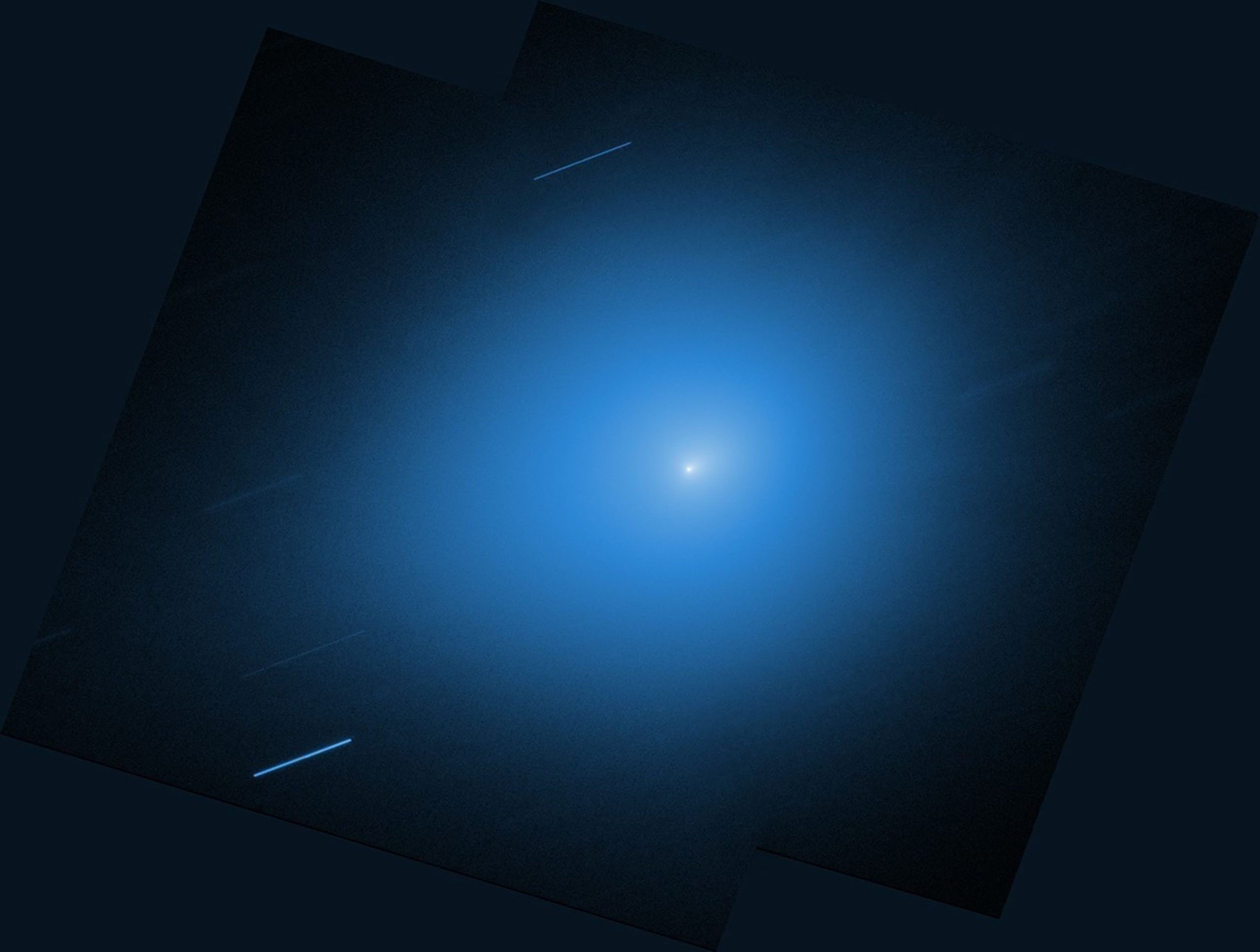
December 20, 2025 — The rare interstellar visitor known as Comet 3I/ATLAS is now past its closest approach to Earth and heading back out toward the outer solar system. But “past” doesn’t mean “gone.” Today’s updates include a new research release describing ultraviolet measurements from NASA’s Europa Clipper that captured the comet when Earth- and Mars-based observers had limited views, plus fresh details on how NASA’s Parker Solar Probe tracked the comet near the Sun—right through the glare that normally hides objects like this from ground-based telescopes. ScienceDaily+2NASA Science+2
For skywatchers, 3I/ATLAS remains a telescope target rather than a naked-eye spectacle. For scientists, it’s something far bigger: a fast-moving, chemically revealing sample of comet material formed around another star—delivered straight through our celestial neighborhood for a limited time. NASA Science+1
What is Comet 3I/ATLAS, and why is it such a big deal?
3I/ATLAS is officially categorized as an interstellar comet because its orbit is hyperbolic—an open trajectory that is not gravitationally bound to the Sun. Tracing its path backward shows it came from outside our solar system, making it the third confirmed interstellar object discovered passing through our region of space, after 1I/ʻOumuamua (2017) and 2I/Borisov (2019). NASA Science+1
The comet was first reported on July 1, 2025 by the NASA-funded ATLAS survey telescope in Rio Hurtado, Chile, and follow-up work quickly showed it was on an unbound path. NASA Science+1
Early orbital solutions and physical characterization papers put 3I/ATLAS’s orbit in the “extremely hyperbolic” category (eccentricity around ~6), and estimate a hyperbolic excess speed on the order of ~57–58 km/s—about ~130,000 mph—which is far too fast for a solar-system native comet to remain captured by the Sun. arXiv+1
Where is Comet 3I/ATLAS today?
As of December 20, 2025, tracking ephemerides place 3I/ATLAS at roughly 1.8 AU from Earth and about 2.33 AU from the Sun, moving away after yesterday’s close approach. Estimated brightness today is around magnitude ~12.8 (faint—telescope territory), and it’s positioned in the sky near the Leo region (an area many guides have highlighted for current observing). astro.vanbuitenen.nl+1
Key “today” snapshot (Dec. 20):
- Distance from Earth: ~1.799 AU
- Estimated magnitude: ~12.8
- Sky position (ephemeris): around RA ~10h38m, Dec ~+07° (approx.) astro.vanbuitenen.nl
The exact brightness you’ll see depends on your telescope, sky conditions, and how the comet’s diffuse coma is measured—but the practical takeaway is consistent across sources: it’s not a naked-eye comet. astro.vanbuitenen.nl+1
The “today” headline: Europa Clipper caught a rare ultraviolet view when Earth couldn’t
The newest major scientific update dated December 20, 2025 focuses on a lucky geometry: NASA’s Europa Clipper spacecraft—en route to Jupiter—was in the right place at the right time to observe 3I/ATLAS with its Ultraviolet Spectrograph (Europa-UVS) during a window when Earth and Mars vantage points were strongly compromised. ScienceDaily+1
According to a Southwest Research Institute release carried by ScienceDaily, Europa-UVS captured an unusual perspective—effectively looking from a sunward position that let it view the comet’s tails from “behind” the flow, helping map out the dust and plasma tail geometry from an angle rarely available to observers on or near Earth. ScienceDaily
The ultraviolet data identified oxygen and hydrogen along with dust-related signatures, supporting broader evidence that the comet went through a period of strong outgassing shortly after perihelion. One of the most direct ways to explain those UV signatures is the breakdown of water-related species into atomic hydrogen and oxygen in sunlight—exactly the kind of process UV instruments can diagnose. ScienceDaily+1
A short quote from the release captures why scientists are excited: Europa-UVS can detect fundamental transitions that show gas release and molecular breakup—“We can see gases come off the comet, and water molecules break apart into hydrogen and oxygen atoms.” ScienceDaily
Just as important: the same release notes that ESA’s JUICE mission also has ultraviolet capability that can complement the geometry from a more typical anti-sunward view, potentially letting researchers reconstruct the comet’s tail structure in 3D across multiple viewpoints. ScienceDaily
Parker Solar Probe’s hidden-angle look: imaging through the Sun’s glare
NASA also highlighted a separate “gap-filling” dataset: Parker Solar Probe observed comet 3I/ATLAS from Oct. 18 to Nov. 5, 2025, using its WISPR camera. The spacecraft captured around 10 images per day, during a time when 3I/ATLAS was near the Sun in the sky from Earth’s perspective—precisely when ground-based observers typically lose track. NASA Science
NASA notes the WISPR images are still in processing and calibration steps, but they already provide a valuable time series across a period when the comet’s appearance could not be monitored well from Earth. NASA Science
The Parker viewpoint also comes with a practical reminder: observing near the Sun often requires unconventional geometry (including spacecraft rolls) and careful image processing to remove coronal brightness—work that can reveal changes in a comet’s dust and tail structure that would otherwise be missed. NASA Science
X-rays confirm a high-energy interaction with the solar wind
While ultraviolet reveals key atomic species and tail geometry, X-ray observatories add another layer: the comet’s interaction with the solar wind.
ESA reports that its X-ray space observatory XMM-Newton observed 3I/ATLAS on Dec. 3, 2025 for around 20 hours, at a time when the comet was about 282–285 million km from the spacecraft. European Space Agency
ESA also released details that XRISM observed the comet for 17 hours between Nov. 26–28, 2025, adding a second X-ray perspective. European Space Agency
Coverage summarizing these releases emphasizes the scientific payoff: X-rays from comets are produced when solar-wind ions interact with neutral gas in the coma, and the observations showed X-ray emission extending on the order of hundreds of thousands of miles/kilometers from the nucleus—an indicator of substantial gas interaction over a large region. Space+2European Space Agency+2
What we’ve learned about its chemistry so far: a CO₂-rich interstellar comet
Long before this week’s UV and X-ray updates, 3I/ATLAS already surprised astronomers with its composition.
A NASA Goddard “science nugget” summarizing James Webb Space Telescope (JWST) observations reports that Webb observed 3I/ATLAS on Aug. 6 using NIRSpec, detecting an asymmetrical, gas-and-dust-rich coma and identifying water ice, plus gas-phase H₂O, CO₂, and CO via infrared spectral features. NASA Science
Crucially, NASA notes the CO₂ relative to H₂O is among the highest observed in a solar-system comet, implying a comet that is unusually CO₂-rich—and possibly shaped by different formation conditions (or radiation exposure) than typical comets born around the Sun. NASA Science
A detailed arXiv preprint (“JWST detection of a carbon dioxide dominated gas coma…”) goes further, reporting a CO₂/H₂O mixing ratio of ~8.0 ± 1.0, describing it as among the highest seen and statistically elevated relative to trends for many comet populations, and discussing possible formation near a CO₂ ice line or with ices exposed to stronger radiation environments. arXiv
On top of Webb, NASA’s SPHEREx team reported mapping a bright CO₂ coma extending out to at least ~348,000 km, based on Aug. 8–12 observations, while also detecting water ice in the nucleus—evidence that this interstellar visitor is both chemically distinctive and still recognizably “comet-like” in how it releases volatiles. SPHEREx
Why a UN-backed asteroid warning network is tracking a harmless comet
Even though NASA stresses 3I/ATLAS poses no threat to Earth, it has become the focus of a coordinated observing exercise: the International Asteroid Warning Network (IAWN) is running a comet astrometry campaign from Nov. 27, 2025 through Jan. 27, 2026. IAWN+1
The reason is technical and future-facing: comets are hard to measure precisely because their fuzzy comae and tails can bias centroid measurements compared with point-like asteroids. IAWN’s campaign uses 3I/ATLAS as a high-profile test case to refine observing and data-submission techniques that could matter for future hazard assessment and rapid-response astronomy. IAWN
Forecast: what happens next for visibility and brightness
Late December 2025: fading, but still trackable with the right gear
Forecast ephemerides show 3I/ATLAS around magnitude ~12.8 today and fading steadily toward ~13.7 by Dec. 30, as it increases its distance from both Earth and the Sun. astro.vanbuitenen.nl
That means it’s likely to remain an amateur telescope target for observers with larger apertures, dark skies, and accurate tracking—while smaller optics may struggle as the coma spreads out and the overall surface brightness drops.
Online observing and community tracking
If weather or equipment is a barrier, online observing is still part of the story: the Virtual Telescope Project has scheduled live coverage tied to the close-approach window (with a noted start time of 04:00 UTC on Dec. 20 for one of its sessions). The Virtual Telescope Project 2.0
What’s next after today: a Jupiter flyby in 2026, then the long exit
Now that the Earth close-approach window has passed, the next major waypoint is Jupiter. Forecasts indicate a relatively close pass of Jupiter in mid-March 2026 (commonly described as around tens of millions of miles / ~0.3–0.4 AU), which could offer another round of spacecraft and big-telescope observing opportunities—before the comet continues outward for good. astro.vanbuitenen.nl+1
Over the longer term, NASA’s core message remains unchanged: 3I/ATLAS is an interstellar object on a one-time pass through our neighborhood, and the current multi-mission “all hands” observing effort is about extracting the maximum science before it fades beyond practical reach. NASA Science+1
The bottom line on Comet 3I/ATLAS today
On December 20, 2025, Comet 3I/ATLAS is a fading but still active, still measurable interstellar comet—one that just delivered a high-impact week of updates:
- Europa Clipper’s UVS helped reveal tail geometry and atomic signatures tied to strong outgassing. ScienceDaily+1
- Parker Solar Probe tracked it near the Sun when Earth-based observers couldn’t. NASA Science
- XMM-Newton and XRISM showed the comet glowing in X-rays via solar-wind interaction. European Space Agency+2European Space Agen…
- JWST and SPHEREx established that it’s unusually CO₂-rich while still unmistakably cometary. NASA Science+2SPHEREx+2
For the public, the headline is simple: the “alien comet” isn’t a threat—but it is an exceptionally rare chance to watch modern space science dissect a messenger from another star system in real time. NASA Science+1