Updated: November 10, 2025 — No threat to Earth; closest approach remains mid‑December.
Key points at a glance
- First radio detection: South Africa’s MeerKAT radio telescope has detected OH (hydroxyl) absorption lines at 1665/1667 MHz from 3I/ATLAS, a classic signature of natural comet activity. The observation was made Oct. 24 and reported to The Astronomer’s Telegram; it’s being widely covered today. The Astronomer’s Telegram+1
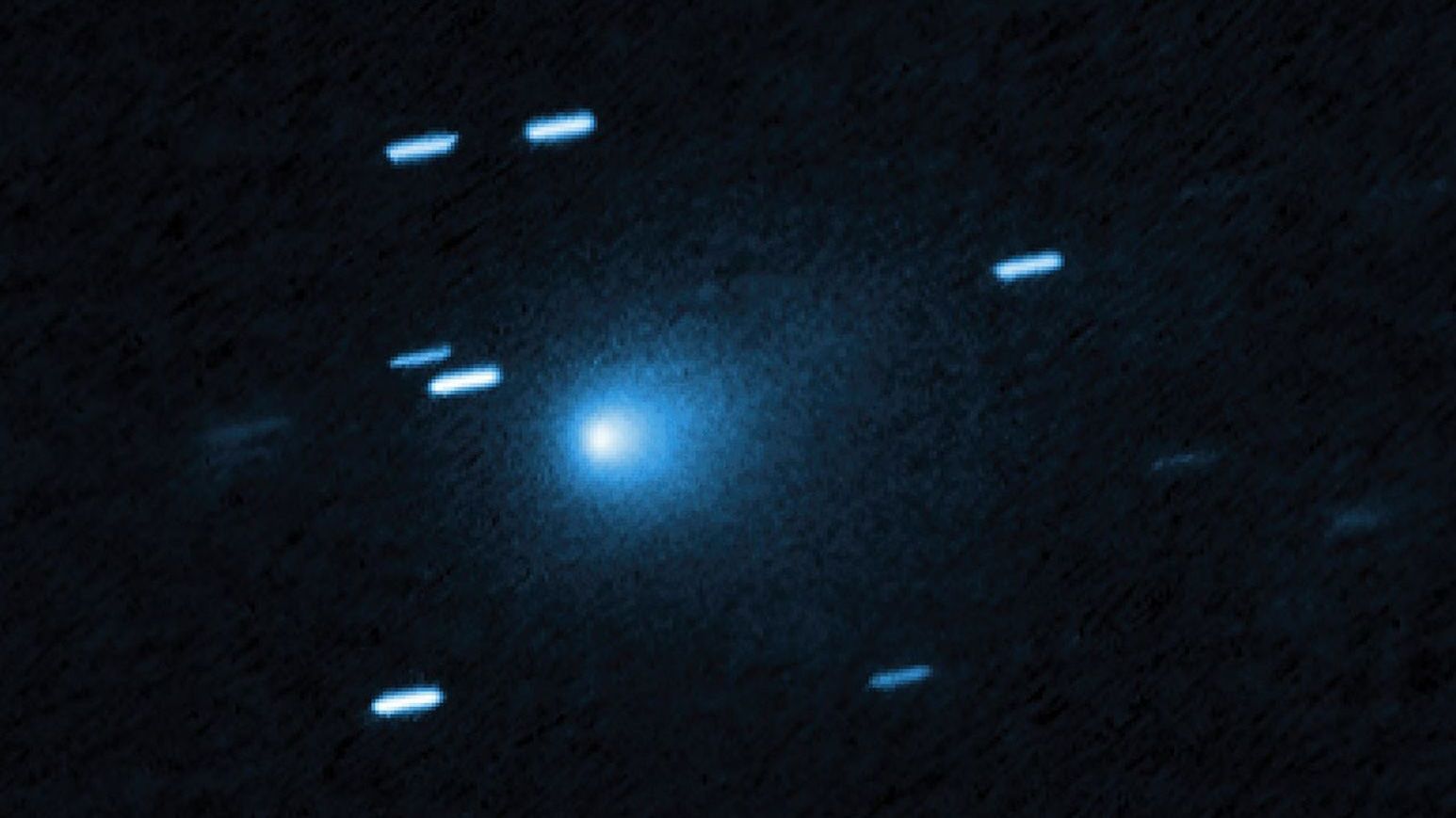
- New post‑perihelion imagery: Images captured Oct. 31–Nov. 9 reveal a complex, multi‑jet structure; today (Nov. 10) the ion tail is clearly visible in fresh telescopic shots. Sci.News: Breaking Science News+1
- Trajectory & safety: 3I/ATLAS passed perihelion around Oct. 30 (~1.4 AU from the Sun) and will remain ~270 million km (1.8 AU) from Earth at closest approach on Dec. 19, 2025—comfortably distant. NASA Science+1
- Not the other comet in the news: A newly found object, C/2025 V1 (Borisov), is trending but is unrelated to 3I/ATLAS despite superficial similarities. Live Science
- Rumor control: Claims that 3I/ATLAS “changed color” are not supported by data, according to researchers analyzing recent observations. Space
What’s new today (Nov. 10)
Radio proof of “cometness.” After weeks of speculation, astronomers have the clearest radio evidence yet that 3I/ATLAS behaves like a normal comet: MeerKAT detected hydroxyl (OH) absorption at 1665 and 1667 MHz during a deep observation on Oct. 24 while the object was near the Sun in the sky. OH is produced when water from a comet’s coma is broken apart by sunlight, and these specific radio lines are a textbook marker of that process. The team also notes earlier non‑detections on Sept. 20 and 28, underscoring that activity ramped up near perihelion. The Astronomer’s Telegram
Fresh images, fresh structures. Post‑perihelion images compiled this week show at least seven jets, including “anti‑tails” that point sunward due to viewing geometry and dust dynamics. A British Astronomical Association composite from Nov. 9 shows a long “smoking” tail with twin anti‑tail features, making 3I/ATLAS an unusually rich target for ongoing Hubble and Webb follow‑ups. Sci.News: Breaking Science News
Tail recovered today. In pre‑dawn Europe today (Nov. 10), the Virtual Telescope Project reports a distinct ion tail as the object moves into a more favorable morning‑sky geometry—explaining why some earlier images looked “tailless.” The Virtual Telescope Project 2.0
Where 3I/ATLAS is now—and the road ahead
- Perihelion: ~Oct. 30, 2025 at ~1.4 AU (just inside Mars’ orbit). NASA Science
- Visibility window: Professional observers have already recovered the comet in the morning sky as of today; broader Northern‑Hemisphere observing windows improve later in November as elongation increases. (ESA notes a late‑November reappearance for general observing after the Sun gap.) The Virtual Telescope Project 2.0+1
- Closest to Earth:Dec. 19, 2025 at roughly 270 million km (1.8 AU)—still far. Expect continued professional imaging and spectroscopy; this is not a naked‑eye spectacle. European Space Agency
How to (realistically) observe it
- Expect a telescope target, not a sky show. At this distance and activity level, naked‑eye viewing is not expected; amateur imaging will favor moderate to larger apertures under dark, steady pre‑dawn skies and a low eastern horizon. (Professionals and advanced amateurs are already resolving the ion tail.) The Virtual Telescope Project 2.0
- Timing: Aim for pre‑dawn, as elongation increases through November; consult updated ephemerides or sky‑simulation tools for your latitude to ensure safe, Sun‑aware pointing. (General safety/trajectory context via NASA.) NASA Science
What scientists are focused on
- Activity drivers & jet physics. Multi‑jet morphology and anti‑tails offer a laboratory for dust‑gas coupling, rotation states, and surface heterogeneity on a truly interstellar body. New images from Oct. 31–Nov. 9 are fueling these analyses. Sci.News: Breaking Science News
- Chemistry in radio & IR. The MeerKAT OH detection cements water‑related activity; complementary spectra from space telescopes (Hubble/Webb) are probing CO₂, H₂O, CO and ices to trace how deep‑frozen volatiles behave after eons in interstellar space. The Astronomer’s Telegram+1
- No threat, but a trove of data. Agencies emphasize zero impact risk and a substantial multi‑mission campaign (Hubble, Webb, Mars orbiters/rovers, ESA’s Juice later this month, and more) to capture a rare, third‑ever interstellar visitor. NASA Science+1
Rumor control: color changes, “no tail,” and alien talk
- Color claims: Headlines suggesting 3I/ATLAS “changed color” multiple times aren’t supported by the data. Researchers say recent brightening simply indicates the gas coma contribution to overall brightness, not a verified chromatic flip. Space
- “No tail” images: Near perihelion, viewing geometry can hide or foreshorten tails; today’s pre‑dawn imaging shows an ion tail as geometry improves. The Virtual Telescope Project 2.0
- Artificial‑object speculation: While individual commentators continue to hypothesize exotic origins, the OH radio detection and the multi‑jet/tail morphology are entirely consistent with a natural comet. The Astronomer’s Telegram+1
Frequently asked questions
What is 3I/ATLAS?
The third confirmed interstellar object observed in our solar system, discovered July 1, 2025 by the NASA‑funded ATLAS survey. It follows a hyperbolic (unbound) path and is leaving the solar system after this pass. NASA Science
How close will it get to Earth? Is it dangerous?
It will pass at about 270 million km (1.8 AU) on Dec. 19, 2025—no threat. European Space Agency
Why is the radio detection important?
OH lines at 1665/1667 MHz are a hallmark of cometary water chemistry; detecting them from 3I/ATLAS is strong, independent evidence of natural comet activity. The Astronomer’s Telegram
Can I see it without a telescope?
No—optical brightness will remain faint. Skilled amateurs may record it with telescopes and sensitive cameras under dark, steady, pre‑dawn skies. The Virtual Telescope Project 2.0
What’s next for spacecraft observations?
Hubble and Webb continue spectral monitoring; ESA’s Juice is attempting observations in November, with data likely downlinked in early 2026 due to geometry and antenna constraints. European Space Agency
Bottom line for Nov. 10, 2025
The story today is confirmation and clarity: a radio detection that dovetails with fresh jet/tail imagery, steady agency guidance on safety and dates, and a reminder not to confuse 3I/ATLAS with today’s unrelated newcomer, C/2025 V1. Science—not speculation—is winning the day. Live Science+3The Astronomer’s Telegram+3S…