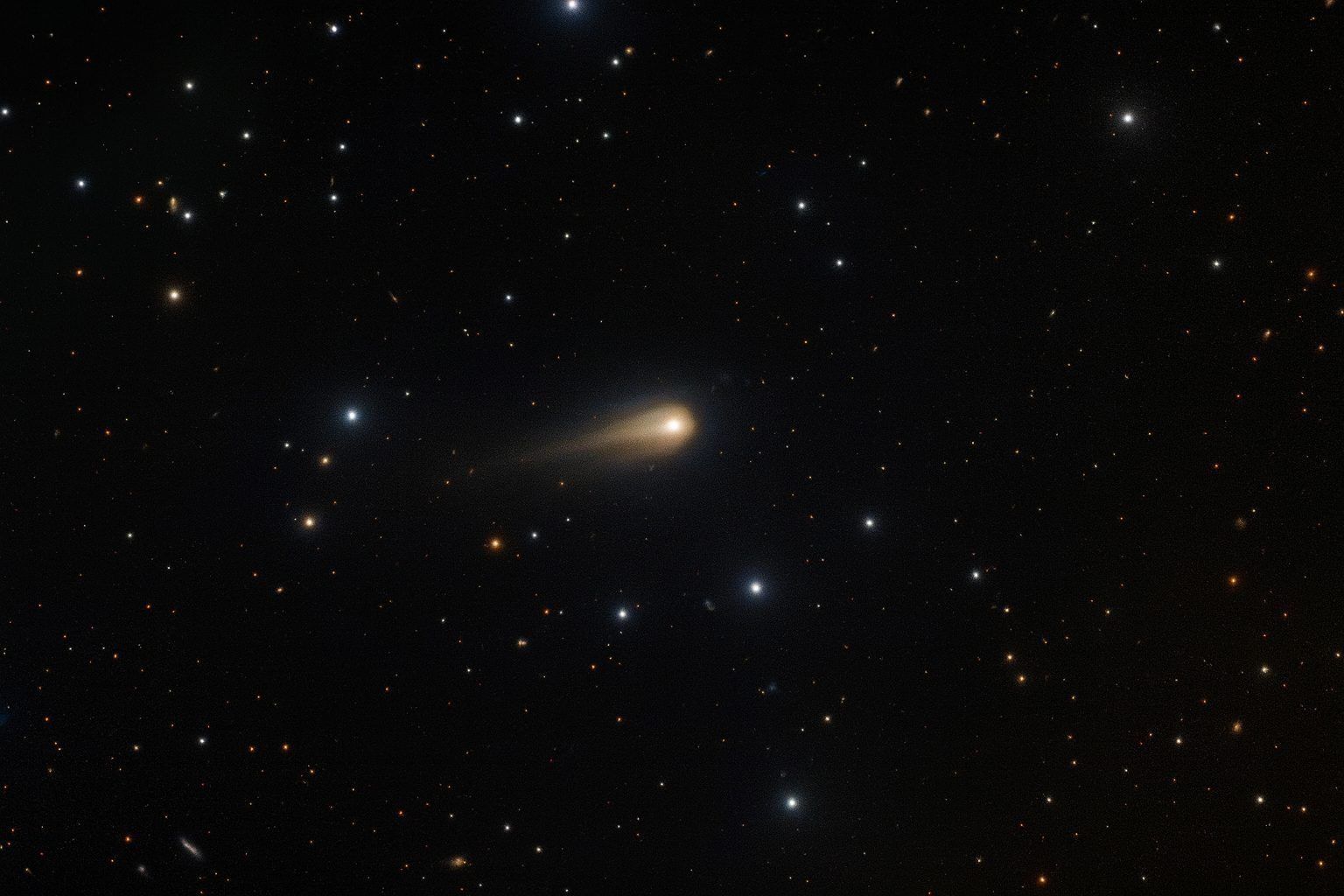
On December 13, 2025, Comet 3I/ATLAS—the third confirmed interstellar object ever found crossing our solar system—is back in the headlines as astronomers release fresh observations that deepen the mystery (and the science) of this rare cosmic flyby. It’s not just “another comet”: 3I/ATLAS is an outsider from beyond the Sun’s gravitational family, racing through on a hyperbolic path that proves it wasn’t born here. NASA Science+1
Today’s developments add two eye-catching chapters to the story:
- New Gemini North observations show 3I/ATLAS growing brighter and distinctly greener, a classic comet signature linked to gases released after solar heating. Phys.org+1
- ESA’s XMM‑Newton has now captured the comet glowing in X‑rays, while Japan’s XRISM mission reports a faint, extended X‑ray halo that may reveal how the solar wind interacts with interstellar comet gases. European Space Agency+1
All this arrives just days before the comet’s closest approach to Earth on December 19, 2025—a safe but scientifically valuable alignment that researchers are treating as a once-in-a-generation opportunity. NASA Science+2European Space Agency+2
What is Comet 3I/ATLAS and why is it such a big deal?
3I/ATLAS is officially an interstellar comet, meaning it comes from outside our solar system and is not gravitationally bound to the Sun. The “3I” label is historic: it’s only the third such confirmed visitor, following 1I/ʻOumuamua (2017) and 2I/Borisov (2019). European Space Agency+1
It was first detected on July 1, 2025 by the ATLAS survey telescope in Río Hurtado, Chile, and quickly flagged as interstellar because of its unusual trajectory. European Space Agency+1
If you’ve seen the other name floating around—C/2025 N1 (ATLAS)—that’s the alternative comet designation under the International Astronomical Union’s naming system. European Space Agency
What makes interstellar comets so valuable is simple: they’re “foreign samples.” Every comet formed around the Sun shares some common chemistry and history. An interstellar comet carries clues about the formation of worlds around another star, delivered straight into our observational range—briefly. European Space Agency
The key dates: where 3I/ATLAS has been—and where it’s going
Here’s the timeline scientists are working against:
- July 1, 2025: Discovery by ATLAS (Chile). European Space Agency+1
- September 2025: NASA notes the comet was visible to ground-based telescopes through September before becoming too close to the Sun’s glare. NASA Science
- Oct. 29–30, 2025: Closest approach to the Sun (perihelion), just inside Mars’s orbit. European Space Agency+1
- Early December 2025: The comet reappears for renewed observations after passing behind the Sun from Earth’s viewpoint. NASA Science+1
- Dec. 19, 2025: Closest approach to Earth—about 270 million km (170 million miles) away, roughly 1.8 AU, with no threat to the planet. NASA Science+2European Space Agency+2
- Spring 2026: The comet continues outward, with observers pivoting to how much more can be learned as it exits the inner solar system. European Space Agency+1
New today: Gemini North sees a greener, changing interstellar comet
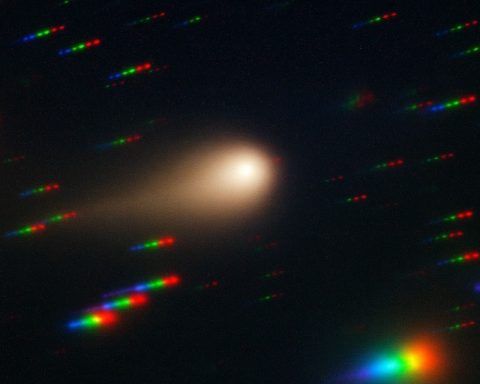
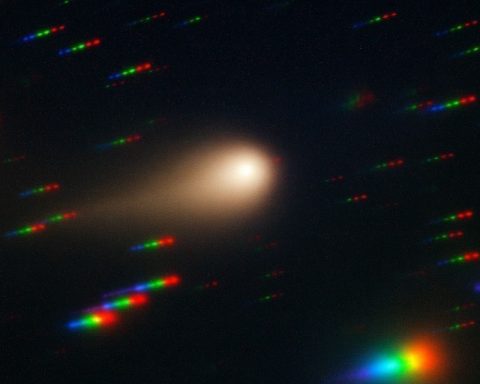
One of the most discussed updates on December 13 is the release of new Gemini North telescope images showing 3I/ATLAS with a noticeably greenish glow after it re-emerged from behind the Sun. The observations were taken on November 26, 2025 using the Gemini Multi‑Object Spectrograph (GMOS) at Maunakea, Hawaiʻi. Phys.org
Why does the comet look green?
Multiple reports point to the same culprit: diatomic carbon (C₂)—a molecule that can emit a greenish light as sunlight energizes the comet’s expanding coma. This doesn’t require anything exotic; it’s a known behavior seen in many “homegrown” solar system comets too. Live Science+1
What’s intriguing is the change. Researchers note that 3I/ATLAS appeared redder in earlier Gemini observations, but now looks significantly greener—evidence that the comet is releasing different molecules as it responds to its trip through the inner solar system. Live Science
Why this matters scientifically
Color shifts aren’t just pretty—they can be clues to composition and activity. As interstellar material heats up near the Sun, buried volatiles can start to vent, and new chemical species can dominate the coma’s glow. These are precisely the kinds of signatures scientists want before the visitor fades into the outer solar system again. European Space Agency+1
The other headline: 3I/ATLAS is now an X‑ray comet too
This week’s most significant instrument story may be the shift from visible-light images to X‑ray astronomy—a rare angle for comet science, and especially rare for interstellar objects.
ESA’s XMM‑Newton detects X‑rays from 3I/ATLAS
ESA reports that its XMM‑Newton space observatory observed 3I/ATLAS on December 3, 2025 for around 20 hours, when the comet was about 282–285 million km from the spacecraft. The observation used XMM‑Newton’s highly sensitive EPIC‑pn camera. European Space Agency
Why would a comet emit X‑rays? ESA explains that X‑rays are expected when gas streaming from the comet collides with the solar wind, producing X‑ray emission. European Space Agency
The payoff is that X‑ray observations can help probe gases that are hard to detect in optical/UV—ESA specifically highlights sensitivity to hydrogen (H₂) and nitrogen (N₂), which can be almost invisible to many other instruments. European Space Agency
JAXA’s XRISM reports a faint, extended X‑ray glow—cautiously
Japan’s XRISM mission (X‑Ray Imaging and Spectroscopy Mission) published a detailed update earlier this month (Dec. 6) describing a dedicated Target of Opportunity campaign: XRISM observed from Nov. 26 to Nov. 28, 2025, with an effective exposure of 17 hours using its Xtend soft X‑ray instrument. xrism.jaxa.jp
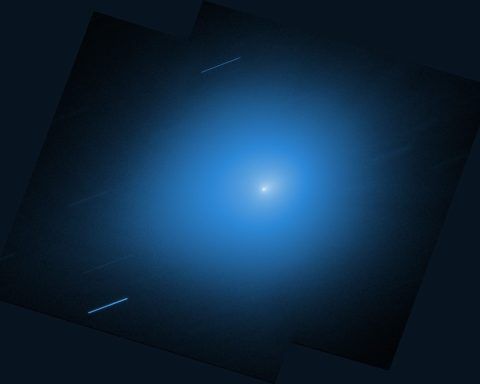
XRISM’s quick-look analysis found a faint X‑ray glow extending roughly 5 arcminutes, corresponding to about 400,000 km around the comet—suggesting a possible diffuse gas cloud interacting with the solar wind. xrism.jaxa.jp
But XRISM also stresses caution: similar extended structures can be produced by instrumental effects (like vignetting or detector noise), so additional analysis is required before confirming the emission is truly cometary in origin. xrism.jaxa.jp
A solar-system-wide chase: spacecraft at Mars, near the Sun, and beyond
3I/ATLAS isn’t being watched by one telescope. NASA describes an unusually broad observation campaign involving multiple spacecraft and space telescopes, with particularly close views obtained from Mars. NASA Science+1
Mars provided some of the closest looks
NASA says the closest imagery came from Mars orbit, where three NASA assets observed the comet. The Mars Reconnaissance Orbiter (MRO) captured one of the closest images, and MAVEN collected ultraviolet observations useful for composition studies. NASA Science
Seeing what Earth couldn’t during solar glare
When the comet passed behind the Sun from Earth’s perspective, heliophysics missions helped bridge the gap. NASA notes that SOHO observed the comet Oct. 15–26, and describes how processing and stacking were used to tease out a signal that was expected to be too faint. NASA Science+1
Psyche joined the campaign too
NASA also reports that the Psyche mission tracked 3I/ATLAS for eight hours on Sept. 8–9, 2025, when the comet was about 33 million miles (53 million km) from the spacecraft—data that helps refine the comet’s trajectory. NASA Science
How close will Comet 3I/ATLAS get to Earth—and can you see it?
Despite the hype, 3I/ATLAS is not a “close call” in any practical sense. NASA and ESA emphasize it will remain far away.
- ESA lists the closest approach to Earth as about 270 million km on December 19, 2025 and states it poses no danger. European Space Agency
- NASA similarly says the comet remains far from Earth, and its December 19 passage will still be about 170 million miles away. NASA Science+1
Where to look (and what you’ll need)
NASA’s December skywatching guidance is clear: this is telescope territory. For observers, the best opportunity is around the closest-approach window, looking east to northeast in the early pre-dawn, with the comet appearing near Regulus (Leo). NASA suggests a telescope aperture of at least 30 cm. NASA Science
Timeanddate.com also underscores that it will be too faint for the naked eye, even at its closest approach. Time and Date
The “alien comet” chatter—and NASA’s response
As 3I/ATLAS becomes more widely discussed, a parallel narrative has trailed it: claims that it could be artificial.
NASA has directly addressed that speculation. In a widely cited November Reuters report, NASA officials said they have not observed “technosignatures,” and described the object as behaving like a comet—while outside scientists quoted in the piece rejected the alien-spacecraft idea as unsupported. Reuters
That pushback matters because the real story is already extraordinary: we are watching a natural interstellar body—likely formed around another star—react to our Sun in real time, across wavelengths from ultraviolet to X-rays. Reuters+2European Space Agency+2
What scientists hope to learn next
Even with major telescopes and spacecraft on the case, the biggest questions remain open—especially for a comet that may represent chemical conditions from a completely different planetary system.
Among the research directions now in focus:
- Composition under heating: ESA notes JWST observations of the coma have revealed gases including carbon dioxide, water, carbon monoxide, carbonyl sulphide, and water ice as the comet warmed. European Space Agency
- Metal signatures like nickel: Reuters reports scientists have seen familiar comet molecules plus “lots of nickel,” which is surprising but not unprecedented in comet studies. Reuters
- X‑ray diagnostics for hydrogen and nitrogen: ESA frames X‑rays as a way to detect gases that optical and ultraviolet instruments struggle to see—potentially crucial for understanding what 3I/ATLAS is made of, and how it compares to earlier interstellar visitors. European Space Agency
- Better orbit and prediction skills: ESA notes that spacecraft observations from Mars helped refine the comet’s predicted location, and that this kind of multi-point tracking is useful rehearsal for planetary-defense readiness—even when the object poses no threat. European Space Agency+1
And beyond 3I/ATLAS itself, agencies are also drawing lessons about preparedness. ESA points to future systems like Neomir, designed to reduce the Sun-direction blind spot that makes fast visitors hard to track early. European Space Agency
Bottom line for Dec. 13, 2025: a rare visitor, now seen in green light and X‑rays
As of today, Comet 3I/ATLAS is delivering exactly what astronomers hoped for: new data, new wavelengths, and new clues—right on schedule for its December 19 Earth-distance milestone. Gemini North is showing an evolving coma that has turned greener with fresh outgassing signatures. ESA’s XMM‑Newton adds the X‑ray perspective, while XRISM’s preliminary results hint at an extended halo that could teach scientists how interstellar comet gases interact with our solar wind environment. Phys.org+2European Space Agency+2
The window won’t stay open long. But for now, 3I/ATLAS is doing something very few objects in human history have done: letting us study a piece of another star system—without leaving home. European Space Agency+1