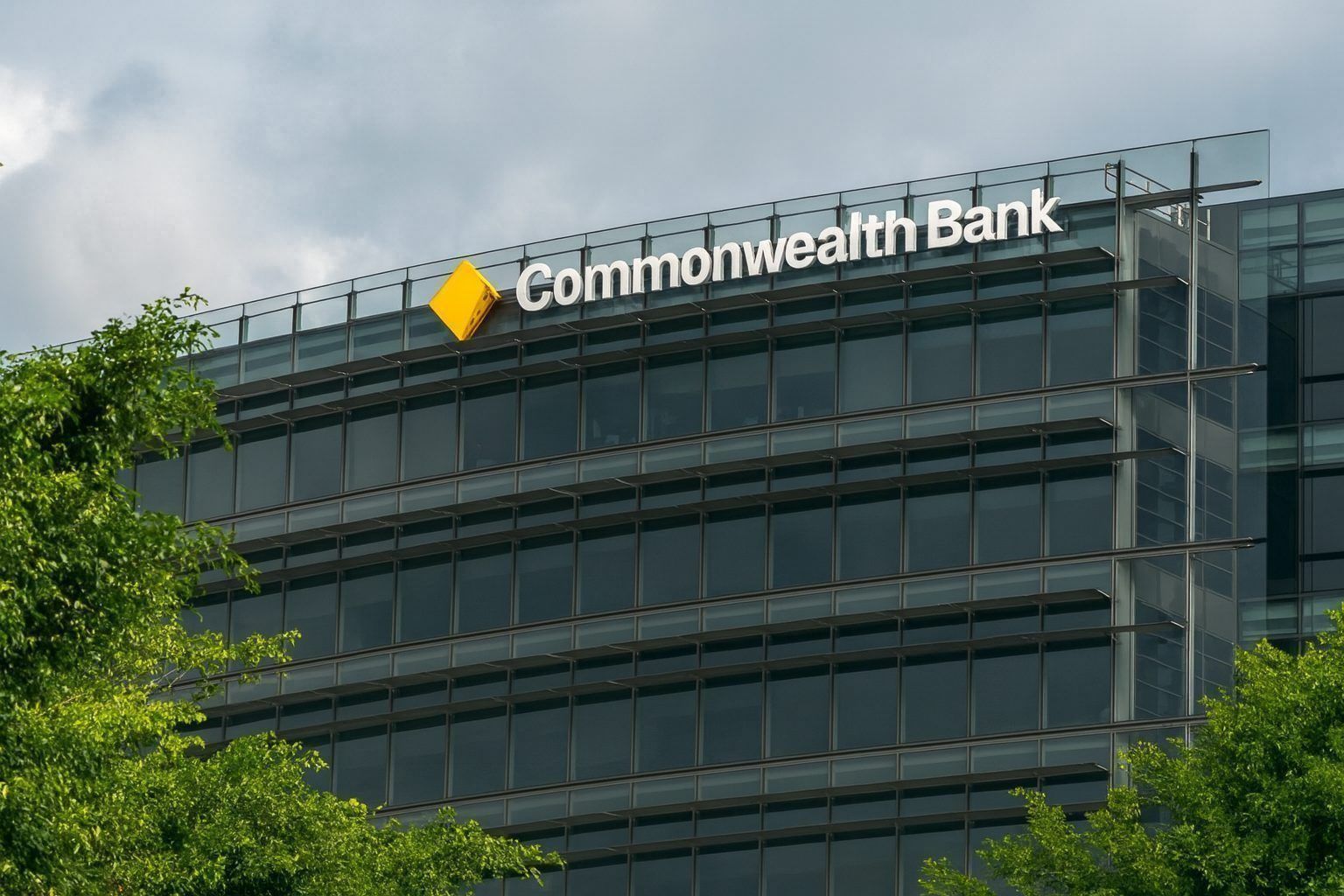
Updated: 5 December 2025
Commonwealth Bank of Australia (ASX: CBA) shares are trading modestly higher on Friday as investors digest government housing reforms, fresh economic signals and a still‑heated debate over whether Australia’s biggest bank is simply too expensive.
At around midday AEST, CBA was changing hands near A$154.26, up about 0.7% from Thursday’s close of A$153.22. That leaves the stock roughly 20% below its late‑June peak near A$192, but still on a rich valuation of about 25x trailing earnings and more than 3x book value. StockAnalysis+2ABC+2
Below is a detailed look at the latest share‑price action, the government’s new Help to Buy scheme, recent results, analyst forecasts and the key risks investors are weighing today.
Key points
- Share price today: CBA is trading around A$154 on 5 December 2025, with a 52‑week range of A$140.21–192.00 and a market cap near A$256 billion. StockAnalysis
- Earnings and dividends: FY25 delivered record cash profit of about A$10.25 billion and a record A$4.85 per share dividend, but the share price fell on concerns about “lofty” valuations. Reuters+1
- Macro pressure: A weaker first‑quarter update in November showed margin pressure and rising costs, triggering another sell‑off and reinforcing worries about earnings momentum into FY26. Reuters+1
- Housing policy catalyst: From 5 December 2025, CBA is one of only two lenders initially offering the federal Help to Buy shared‑equity scheme, a potential driver of mortgage growth but also a new policy and reputational risk focal point. Housing Australia+2CommBank+2
- Valuation and forecasts: Most broker and model‑driven fair‑value estimates sit well below today’s price, with several data sets pointing to 20–30% downside on a 12‑month view, even as some long‑term models see higher levels by 2029–2030. Value Investing+3TechStock²+3MarketBeat+3
Note: This article is general information only and is not financial advice.
CBA share price on 5 December 2025: off the highs, still on a premium
Real‑time data from StockAnalysis shows CBA trading at A$154.26 at 12:19pm AEST on Friday, up A$1.04 (0.68%) on the day. The day’s range sits between A$151.60 and A$154.28, against a 52‑week range of A$140.21 to A$192.00. StockAnalysis
On these numbers, CBA is valued at:
- Price/earnings (P/E): ~25.3x trailing earnings
- Price/book (P/B): just over 3x book value (book value per share around A$47) StockAnalysis+1
- Dividend yield (trailing): about 3.2%, based on A$4.85 of dividends in the past year
For context, CBA’s share price hit an all‑time high near A$192 in late June 2025, before sliding as investors questioned whether even record profits could justify the multiple. ABC+1
Over the last 12 months, CBA is actually down around 1.7%, underperforming the broader ASX 200 despite strong operational results. StockAnalysis
Today’s trading comes against a softer backdrop for Australian financials. A Reuters‑syndicated piece on Friday notes that financials are down about 0.5% this week, with CBA slipping about 0.7% as investors fret over “premium valuations” and the prospect that bank earnings growth will be relatively tepid from here. mint
From record FY25 profits to a softer first quarter
FY25: record numbers, but “priced for perfection”
In August, Commonwealth Bank reported record full‑year cash earnings of about A$10.25 billion, up from A$9.84 billion a year earlier, helped by strong lending growth and a higher net interest margin of 2.08%. Reuters+1
Key highlights from FY25:
- Final dividend: A$2.60 per share
- Total FY25 dividend: A record A$4.85 per share, up 4% year‑on‑year
- Lending growth: Total lending volumes grew more than 5%, led by business and institutional banking
- Net interest margin: Expanded 9 basis points to 2.08%
Despite those numbers, investors sold the stock aggressively on the day of the result. Reuters reported that CBA’s shares fell about 5% to the lowest level since May, as fund managers argued that the bank’s valuation — trading on around 30x earnings and more than triple the sector’s median price‑to‑book ratio — was simply too high. Reuters
An ABC analysis described the stock as “priced for perfection”, noting that even a A$10+ billion profit “didn’t cut it” in the eyes of the market, given concerns about future margin pressure and the end of the rate‑hike tailwind. ABC
Q1 FY26: margin squeeze and cost growth
The tone darkened further in November’s first‑quarter trading update, when CBA reported:
- Cash profit of A$2.6 billion for July–September, up 2% year‑on‑year and 1% versus the previous two quarters
- Operating costs up 4%, driven by wage inflation and higher technology spend
- Net interest margin lower, with the bank citing deposit switching, intense competition and a lower cash‑rate environment
CBA did not disclose the exact net interest margin in the update, which prompted some analysts to worry about the scale of the decline. The share price dropped nearly 5% on the day to about A$166.31, with one adviser telling Reuters the stock remained “expensive on any metric” and that some investors were rotating into cheaper banks. Reuters+1
ShareCafe later summed up the mood: the Q1 result was broadly solid, but valuation concerns and margin pressures overshadowed the headline profit growth. sharecafe.com.au
Dividend snapshot and today’s record date
For income‑focused investors, CBA remains a core dividend name:
- Trailing 12‑month dividends: A$4.85 per share (A$2.25 interim + A$2.60 final)
- Trailing yield: ~3.2% at today’s price, or just above 4.5% on a grossed‑up basis for eligible investors, given full franking Market Index+1
- Payout ratio: About 79% of earnings over the past year Market Index
MarketIndex data shows that CBA’s dividend per share has steadily climbed since the COVID‑era cut in 2020, with FY25’s A$4.85 the highest on record. Market Index+1
A fresh dividend distribution notice lodged in mid‑September set an ex‑dividend date of 4 December 2025, a record date of 5 December 2025, and payment later in the month, underlining the bank’s commitment to high cash returns. TipRanks
That means today’s register close is important: investors on the record as of 5 December will be entitled to the latest dividend, while new buyers after the ex‑date do not.
Help to Buy launches today – and CBA is front and centre
What the scheme does
From 5 December 2025, the Australian Government’s Help to Buy shared‑equity scheme officially opens, and Commonwealth Bank is one of only two participating lenders at launch, alongside Bank Australia. Housing Australia+2Housing Australia+2
Key features of Help to Buy:
- Government contributes up to 40% of the purchase price for new homes and 30% for existing homes
- Eligible buyers can purchase with a minimum 2% deposit, with the government’s equity contribution plus the deposit bringing total equity to at least 20%
- Income caps: A$100,000 for single applicants and A$160,000 for joint applicants or single parents
- Property price caps vary by region (for example, A$1.3 million in Sydney/NSW capital cities, lower caps in regional areas) CommBank+1
- The government is registered as a second mortgagee, and buyers may later need to buy back the government’s share if their circumstances change
Housing Australia expects the scheme to help up to 40,000 households over four years, easing the deposit hurdle for low‑ and middle‑income Australians. Housing Australia
Why it matters for CBA’s stock
Commonwealth Bank’s own Help to Buy page emphasises its position as “Bank of the Year – First Home Buyers” and “Bank of the Year – Digital Banking” in 2025, and pitches the scheme as part of its broader strategy to support younger buyers using digital channels. CommBank+1
Potential implications for shareholders:
- Loan growth: Help to Buy could support incremental owner‑occupier mortgage growth at CBA, particularly in capital cities where deposits are the main constraint.
- Margins: Shared‑equity loans may carry slightly different risk‑weights and pricing. The scheme’s 2% minimum deposit and government equity contribution change the economics compared with standard low‑deposit lending.
- Credit quality and headlines: Higher‑leverage borrowers and complex shared‑equity structures can attract regulatory and media scrutiny, especially if house prices fall or borrowers struggle.
Separate media coverage has already highlighted mixed reactions among mortgage brokers, with some praising improved access to housing and others warning that a 2% deposit structure could encourage households to take on too much debt relative to income. Yahoo Finance
All of this folds into the broader concern regulators and CBA’s own economists have raised: housing credit growth may already be too hot.
Macro backdrop: hot housing, sticky inflation and APRA’s lending caps
In a recent parliamentary hearing, CBA CEO Matt Comyn told lawmakers that home loan demand is “too high” and is contributing to rising property prices. While acknowledging the bank benefits from strong mortgage growth, he argued that a slower pace would be healthier for long‑term financial stability and housing access. Reuters
Comyn also said the bank no longer assumes rate cuts are imminent, expecting the Reserve Bank of Australia’s cash rate to remain around 3.6% through 2026 because inflation remains above target. Reuters+1
CBA’s own economic research pieces have turned more cautious over 2025, suggesting:
- Persistent services inflation, with trimmed‑mean inflation only gradually moving back into the 2–3% target band
- Australia’s “speed limit” growth rate at roughly 2.1%, implying that growth beyond that could reignite inflation rather than justify more cuts TechStock²
At the same time, the banking regulator APRA has introduced debt‑to‑income (DTI) caps on new home‑loan flows to pre‑empt a build‑up of risk in highly leveraged borrowers. Ratings agency Fitch described the move as only marginally negative for near‑term bank earnings but clearly aimed at cooling aggressive growth. TechStock²
For CBA – which controls roughly a quarter of Australia’s A$2.2 trillion mortgage market – this mix of high valuations, strong but constrained housing demand, and tighter lending rules is precisely what makes the stock so sensitive to macro headlines. Reuters+1
AI, cloud and technology: big ambitions, big spend
Beyond traditional banking, Commonwealth Bank is investing heavily in technology and artificial intelligence, positioning itself as one of the sector’s digital leaders:
- In FY25, CBA committed an additional A$300 million to technology, including AI initiatives, on top of an already large multi‑year tech investment program. ABC
- The bank has moved its entire core banking system into Amazon’s cloud, a move described in Australian financial press as one of the largest core‑bank migrations to the cloud globally. StockAnalysis
- A new Chief AI Officer, Ranil Boteju, formerly of Lloyds Banking Group, has been appointed to lead AI strategy from early 2026, signalling that AI is now a board‑level strategic focus. MarketScreener+1
- CBA is also among the major enterprise customers benefiting from NextDC’s new partnership with OpenAI, highlighting its role as an early adopter of large‑scale AI infrastructure in Australia. The Motley Fool
These initiatives support the bull case that CBA can maintain above‑peer returns by automating processes, improving credit analytics and enhancing digital customer experiences. However, they also increase operating costs in the near term and raise social and regulatory questions — evident in recent media reports on AI‑related job cuts and system outages. StockAnalysis
Governance and reputation: CEO continuity, “Shonky” awards and conduct risk
On the governance front, shareholders received clarity in October when CBA confirmed CEO Matt Comyn will remain in the role until at least 2028, with the board emphasising satisfaction with his performance and a long‑term approach to succession. Nasdaq
At the same time, conduct and reputation remain important parts of the investment story:
- Consumer group Choice gave Commonwealth Bank a special award in its 2025 “Shonky” list for failing low‑income customers, after the bank was found to have charged around A$270 million in unfair fees to concession‑eligible customers who should have been on low‑ or no‑fee accounts. The Guardian
- While other major banks issued broad refunds, CBA initially resisted, before later promising case‑by‑case “goodwill adjustments” and pausing certain fees for eligible customers. Choice noted that this is the fourth time CBA has featured in the Shonky awards, making it the “most awarded” company in the list’s 20‑year history. The Guardian
Alongside ASIC enforcement and ongoing debates about bank fees, these stories feed into a non‑financial risk narrative that investors cannot ignore, especially at premium valuations.
Valuation and analyst sentiment: premier franchise, demanding price
What the numbers say
Using today’s intraday price and widely cited data:
- P/E ratio: ~25x trailing earnings
- P/B ratio: just over 3x
- Dividend yield:3.1–3.2% cash, fully franked StockAnalysis+1
That makes CBA one of the most expensive major banks globally. Reuters data in August put the bank on a P/E roughly double that of many global peers, including large US names like JPMorgan, and a price‑to‑book multiple more than three times the industry median. Reuters
Independent dividend and statistics platforms such as Digrin show similar figures: a P/E near the high‑20s, sub‑3% trailing yield at prices around A$152–153, and an elevated payout ratio close to 90% based on certain estimates. TechStock²
What analysts are saying
Across recent commentary:
- Several fund managers quoted by Reuters and ABC say they “would sell here” based purely on valuation, despite acknowledging CBA’s strong franchise and leadership in digital banking. Reuters+1
- An AFR report described CBA as still the “premier bank” for many fund managers even after a A$25 billion wipe‑out in market value, but emphasised that the sell‑off has been driven by multiple compression, not a collapse in fundamentals. Australian Financial Review
- Morningstar’s Nathan Zaia has repeatedly flagged CBA’s valuation as “stretched”, arguing that while the bank is high quality, the price already bakes in much of that quality. sharecafe.com.au
- A recent piece on ASX bank stocks from The Motley Fool noted that most major brokers currently rate CBA a “sell”, viewing its share price as “far too expensive and overdue a correction” relative to other big banks. The Motley Fool
Meanwhile, data aggregators that compile broker targets often show average 12‑month price targets for ASX:CBA in the low‑A$120s, implying roughly 20–25% downside from current levels if those targets prove accurate. TechStock²
On the US over‑the‑counter ADR (ticker CMWAY), MarketBeat reports an average price target of about US$130.18, roughly 29% above the recent ADR price of around US$101.13 — though that figure reflects both currency and share‑ratio differences and is based on only two analyst estimates. MarketBeat
Some valuation models go even further. One value‑oriented site applying a Peter Lynch‑style formula suggests a “fair value” near A$30 per share, far below the current market price, though such extreme outputs are highly sensitive to the assumptions used and are not representative of mainstream broker research. Value Investing
Forecasts: what models and forecasters see for CBA
Forecasts are always speculative, but they give a sense of the range of expectations currently in the market.
Short‑term price projections
- Technical site StockInvest.us estimated a “fair opening price” of about A$152.27 for 5 December 2025, only slightly below Thursday’s close, and has recently described CBA as a stock where short‑term signals have turned modestly more positive after a sharp pullback. StockInvest+1
- Retail‑focused forecast provider Economy Forecast Agency (CBA page on AUDToday) projects the share price drifting mostly in the A$140–165 range over December, with a bias towards the lower half of that band into late month and early January.
These near‑term projections broadly align with the idea that volatility remains elevated and that further de‑rating is possible if macro or regulatory news disappoints.
Medium‑ to long‑term scenarios
- Analytics site Traders Union projects that by the end of 2026, CBA’s share price could sit in a range roughly between A$144 and A$176, with an average just under A$160, and suggests potential levels around A$208–209 by 2029 if earnings growth is maintained. Traders Union
- Consensus‑style target compilations for the ASX listing, by contrast, cluster closer to the low‑A$120s, signalling that many traditional brokers expect some further de‑rating, even if they are constructive on CBA’s operational quality. TechStock²
The gap between model‑driven upside scenarios and broker targets implying downside underlines how unusually contentious CBA’s valuation is in late 2025.
What to watch after 5 December 2025
With the Help to Buy scheme now live and CBA’s dividend record date in the rear‑view mirror, investors are likely to focus on several catalysts:
- RBA decisions and inflation data
Every monthly CPI and labour‑market print will feed into expectations for whether rates truly stay “higher for longer”, directly affecting CBA’s net interest margin and bad‑debt outlook. TechStock²+1 - Implementation of APRA’s DTI cap
Updates from management on how much of CBA’s mortgage book sits above the new debt‑to‑income thresholds — and whether growth slows — will be closely watched. - Impact of Help to Buy and housing policy
Early data on uptake, borrower profiles and arrears will shape the narrative around whether the scheme is a safe growth opportunity or a new pocket of risk on the balance sheet. Housing Australia+1 - AI and technology execution
As the new Chief AI Officer takes the reins and cloud migration deepens, investors will look for hard evidence that technology investments are reducing unit costs, improving risk metrics or driving revenue, rather than simply inflating the expense line. MarketScreener+2StockAnalysis+2 - Next earnings update – February 2026
CBA’s next scheduled earnings date is around 11 February 2026. The market will focus on:- Net interest margin trends after a full quarter under the new rate and competition environment
- Cost growth, including wages and tech spend
- Capital management, buyback or DRP settings
- Any commentary on Help to Buy and APRA’s lending rules StockAnalysis+1
Bottom line
As of 5 December 2025, Commonwealth Bank of Australia remains:
- Operationally strong, with record profits, dominant market share and heavy investment in technology and AI.
- Central to policy debates on housing affordability, financial stability and consumer protection, particularly through the new Help to Buy scheme and ongoing conduct issues.
- Valuation‑rich, trading at one of the highest earnings and book multiples of any major global bank, with a dividend yield that is solid but not spectacular relative to the risks.
Whether CBA’s premium is still justified is ultimately the core question for investors. Bulls argue that a high‑quality franchise deserves a premium multiple; bears counter that the margin of safety has largely evaporated at current prices.