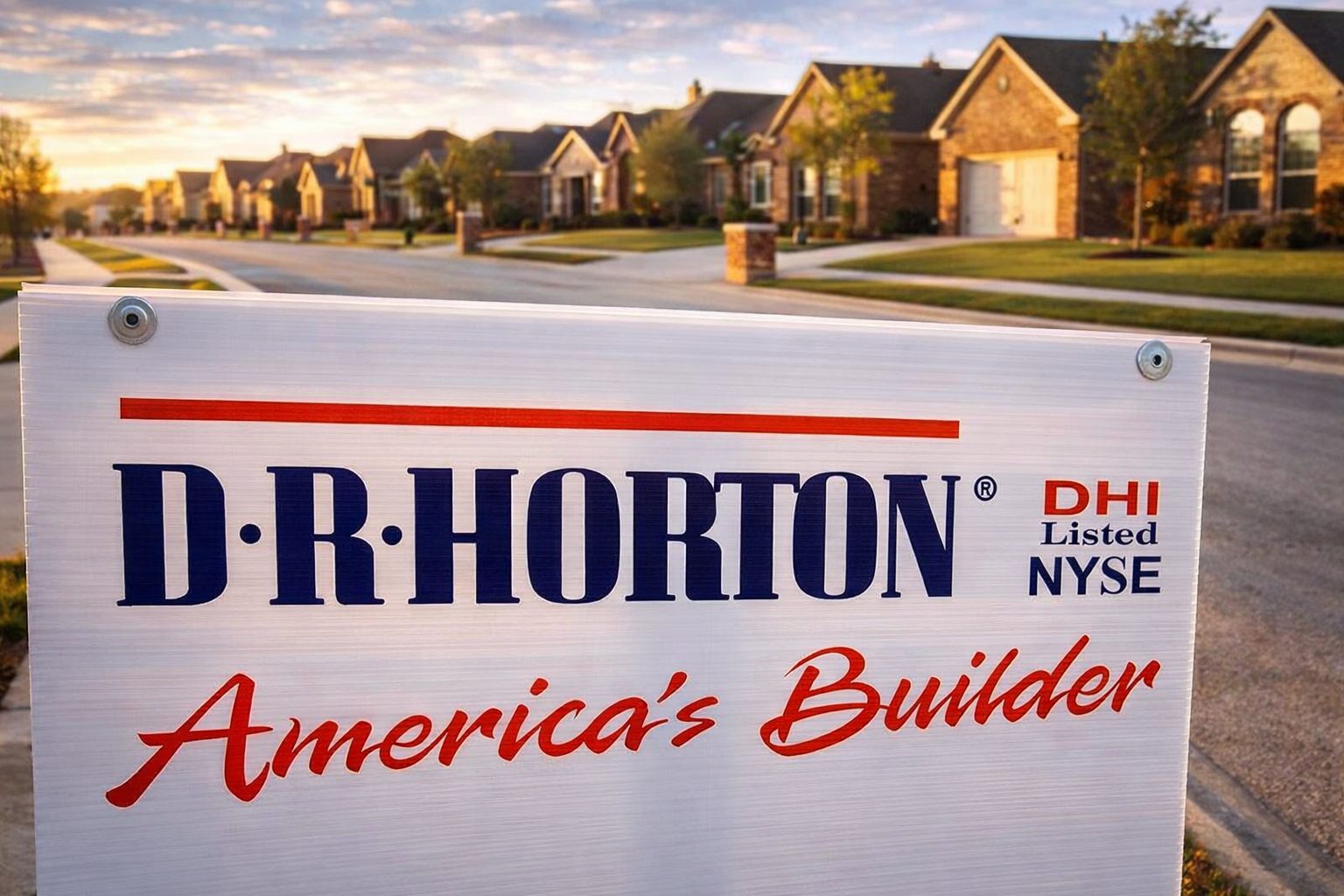
D.R. Horton, Inc. (NYSE: DHI) stock is sliding on Friday, December 19, as the U.S. housing market continues to send investors a familiar message: demand is there, but affordability and supply constraints keep turning the dial between “hopeful” and “headache.”
In afternoon trading, DHI shares were down about 3.2% at roughly $146.49, after trading in a wide range between approximately $146.10 and $151.39.
For investors following homebuilder stocks, today is less about a single headline and more about the collision of three forces:
- Fresh U.S. housing data (existing-home sales) that improved modestly,
- Rates and affordability that still define the sector’s ceiling, and
- A mixed analyst backdrop—with price targets implying upside, but ratings clustering around “Hold” and “In-Line.”
Below is what’s moving D.R. Horton stock today, what the latest forecasts say, and what catalysts could matter next.
D.R. Horton stock price today: what the market is saying in real time
DHI is under pressure today despite a stream of evidence that housing demand hasn’t disappeared—it’s just highly rate-sensitive and incentive-driven.
As of the latest available pricing snapshot, D.R. Horton stock traded near $146.49, down about $4.91 on the day (roughly -3.2%).
Zooming out, DHI has been trading below its 2025 highs, after peaking near $184.55 earlier in the year, according to MarketWatch’s recent tracking of the stock’s 52-week range. MarketWatch
That “down from the highs” positioning matters because homebuilders often behave like a leveraged bet on mortgage rates: when rate expectations shift, the stocks can reprice quickly—even if the companies themselves are still profitable and buying back shares.
Today’s biggest macro driver: existing-home sales rise, but supply tightens
One of the most market-relevant pieces of news dated Dec. 19, 2025 is the latest U.S. existing-home sales report.
Reuters reports that existing-home sales increased 0.5% in November to a seasonally adjusted annual rate of 4.13 million units, the highest level in months—but the improvement came with an asterisk: inventory fell to 1.43 million units, an eight-month low, which continues to constrain supply and support prices. Reuters
Key takeaways from the same report:
- Median existing-home price: $409,200, up 1.2% year over year Reuters
- Mortgage rates: Reuters notes rates eased into late November (citing a move down to ~6.19% late in the month), which helped at the margin Reuters
- Macro drag: ongoing economic uncertainty and a weaker labor backdrop (Reuters cites unemployment at 4.6%) keep buyers cautious Reuters
For D.R. Horton, this matters in a slightly counterintuitive way:
- Tight existing-home inventory can push some buyers into new construction (a relative advantage for builders).
- But if affordability remains stretched, builders may need to keep using incentives (rate buydowns, price adjustments), which can pressure margins.
Barron’s coverage of the same release emphasizes the buyer experience: listings can ebb even as sales stabilize, creating a market where affordability “improves” on paper but inventory limitations still bite. Barron’s
Builder confidence is improving—yet cost pressures remain
Earlier this week, Reuters reported U.S. homebuilder sentiment edged up to an eight-month high in December, but activity remained constrained by rising construction costs linked to tariffs on imports. Reuters
That’s the homebuilder sector’s current paradox in one sentence: the mood improves, but the math (costs + rates) is still annoying.
For D.R. Horton, which operates at massive national scale, costs and supply-chain dynamics matter because small changes in materials and labor costs can swing profitability when incentives are elevated.
What D.R. Horton itself is projecting: fiscal 2026 guidance and incentive expectations
The most “official” forecasting framework for DHI still starts with the company’s own guidance from its fiscal 2025 results package (issued Oct. 28, 2025).
Fiscal 2026 guidance (from D.R. Horton)
In its earnings release, D.R. Horton provided initial fiscal 2026 guidance including:
- Consolidated revenue: $33.5 billion to $35.0 billion
- Homes closed (homebuilding operations): 86,000 to 88,000
- Operating cash flow: at least $3.0 billion
- Share repurchases: approximately $2.5 billion
- Dividend payments: approximately $500 million D.R. Horton Investor Relations
That guidance is investor catnip because it combines volume, cash generation, and shareholder returns in one place.
Why incentives remain the key swing factor
In the same earnings materials, D.R. Horton explicitly framed the current market as incentive-heavy, noting affordability constraints and cautious sentiment—and signaling that sales incentives are expected to remain elevated in fiscal 2026, depending on market conditions. D.R. Horton Investor Relations
In plain English: even the best-run builders are still “buying down” the market to keep sales moving.
Fiscal 2025 snapshot: profits + buybacks + dividend growth
From the fiscal 2025 highlights in the earnings release:
- Fiscal 2025 net income: $3.6 billion ($11.57 EPS)
- Fiscal 2025 revenue: $34.3 billion
- Homes closed (FY2025): 84,863
- Operating cash flow: $3.4 billion
- Share repurchases: 30.7 million shares for $4.3 billion
- Book value per share: $82.15 (up 5%) D.R. Horton Investor Relations
This matters for today’s stock story because a company can have a down day in the market while still returning billions via buybacks and dividends—and DHI has been doing exactly that.
Analyst forecasts for D.R. Horton stock: price targets point higher, ratings stay cautious
Here’s where Dec. 19, 2025 gets particularly relevant: multiple analysis and “consensus” updates hit today.
MarketBeat (Dec. 19): “Hold” consensus, $161 average target
A MarketBeat roundup dated December 19, 2025 says:
- Average rating: “Hold” (from 15 analysts)
- Breakdown: 2 sell, 6 hold, 6 buy, 1 strong buy
- Average 1-year price target:$161.08 MarketBeat
If DHI is trading around the mid-$140s today, a ~$161 target implies meaningful upside—but the rating mix suggests analysts aren’t unanimously convinced the next leg is “easy money.”
MarketBeat also lists examples of recent targets/ratings in the mix, including:
- BTIG initiating with a Buy and a $186 target (Dec. 1)
- UBS lifting a target to $195 with a Buy rating (Oct. 29)
- Evercore ISI set $169 with an “In-Line” rating (Oct. 7)
- RBC raising to $118 but keeping Underperform (Oct. 29) MarketBeat
Reuters snapshot: valuation and Street view (compiled metrics)
Reuters’ company overview data for D.R. Horton shows a Street view that sits between neutral and constructive, including a mean rating in the “hold-ish” zone and valuation metrics such as trailing and forward P/E figures. Reuters
(Analyst models differ on how quickly margins recover if incentives stay elevated—so you’ll often see “upside targets” paired with “neutral ratings.” That’s not hypocrisy; it’s uncertainty with a spreadsheet.)
Zacks: average price target near the mid-$160s (access-limited page)
Zacks’ summarized data (as surfaced in search results) shows an average price target around $164.27 for DHI, again pointing above current levels. Zacks
Today’s published analyses: value vs. cycle risk
Several investor-facing analysis pieces dated Dec. 19, 2025 lean into the same debate:
- A Simply Wall St analysis asks whether DHI looks like value after a pullback, explicitly framing it as “shares trading below the average analyst target” versus cycle risk. Simply Wall St
- A Seeking Alpha contributor upgraded D.R. Horton, arguing for “Fed upside potential from 2026 onwards” (a rates/affordability thesis). Seeking Alpha
- MarketBeat’s Dec. 19 write-up reinforces the “Hold” consensus while highlighting dividend and institutional ownership. MarketBeat
The through-line: valuation looks more attractive after the drop, but the housing cycle is still doing housing-cycle things.
Sector context: Lennar’s results and the “incentive era” reality check
D.R. Horton doesn’t trade in isolation—homebuilders get judged as a pack.
Two days ago, Reuters reported Lennar posted weaker-than-expected quarterly profit, pointing to affordability pressures and weak confidence, and noting that builders have leaned on incentives like mortgage-rate buydowns while margins compress. Reuters
Even though Lennar is a competitor, the message influences the whole group: if the sector is competing with incentives, the market will worry about margins across builders—even the leaders.
What’s next for DHI stock: the earnings date and the catalyst calendar
The next major company-specific catalyst is close enough to matter for positioning.
D.R. Horton announced it will release fiscal 2026 first-quarter earnings (quarter ended Dec. 31, 2025) on Tuesday, Jan. 20, 2026, before the market opens, followed by a conference call at 8:30 a.m. ET. D.R. Horton Investor Relations
D.R. Horton’s investor calendar also lists that Q1 2026 earnings conference call date, alongside the rest of fiscal 2026’s quarterly schedule. D.R. Horton Investor Relations
What investors typically watch in a DHI print (especially in this market):
- Order trends and cancellations (demand quality)
- Incentive intensity (margin pressure)
- Community count and pace (volume durability)
- Commentary on mortgage availability and buyer traffic
The bull case and bear case for D.R. Horton stock right now
This isn’t investment advice—just the logic tree the market keeps climbing.
Why bulls stay interested
- Scale + execution: D.R. Horton says it has been the largest homebuilder by volume since 2002, with broad national operations. D.R. Horton Investor Relations
- Shareholder returns: DHI’s fiscal 2026 plan includes large buybacks and dividends, and it raised the quarterly dividend to $0.45 in the fiscal 2025 results cycle. D.R. Horton Investor Relations+1
- Rate leverage: if mortgage rates fall meaningfully, demand can rebound quickly—homebuilders are “high beta” to affordability.
Why bears (and neutral analysts) keep their guard up
- Affordability still rules: even with easing rates, Reuters notes demand is constrained by uncertainty and labor market softness. Reuters
- Incentives aren’t going away (yet): D.R. Horton itself expects incentives to remain elevated in fiscal 2026. D.R. Horton Investor Relations
- Cost risks: Reuters flagged tariff-linked construction cost pressures even as sentiment improves. Reuters
In short: the business is strong, the macro is weird, and the stock price is where those two argue in public.
Bottom line: why DHI stock is in focus on Dec. 19, 2025
D.R. Horton stock is down today, but the broader story isn’t “company trouble” so much as “housing math.” Existing-home sales improved modestly, yet inventory tightened and affordability remains the swing factor. Reuters
Meanwhile, analysts see upside in price targets around the low-to-mid $160s on average, but the consensus rating still lands in “Hold” territory—a sign that Wall Street sees opportunity, but not certainty. MarketBeat
The next hard catalyst is Jan. 20, 2026 earnings, which should give the market fresh data on orders, incentives, and how D.R. Horton is navigating the incentive-heavy phase of the cycle. D.R. Horton Investor Relations