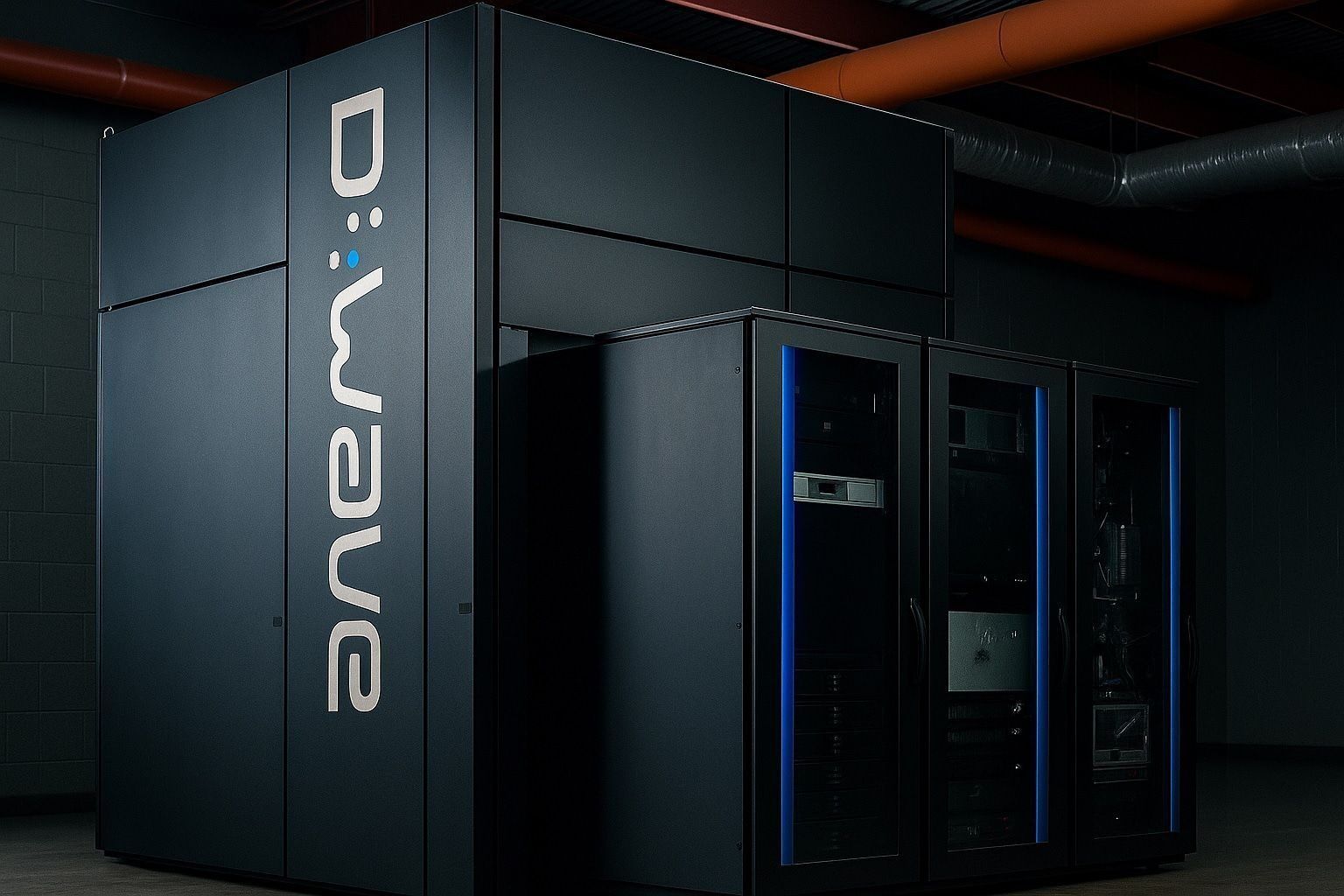
D-Wave Quantum Inc. (NYSE: QBTS) is closing out 2025 exactly the way it spent the year: at the center of the most speculative corner of the AI ecosystem.
As of intraday trading on December 8, QBTS is changing hands around the high‑$20s (about $28), up more than 3% on the day. The stock has surged from roughly $2.50 at its 52‑week low to as high as $46.75, giving D-Wave a market capitalization near $9.7 billion despite still‑modest revenue and persistent losses. Webull+1
Today’s headlines add more fuel to the debate over whether D-Wave is a breakthrough quantum leader being re‑rated by the market, or a poster child for a looming bubble in quantum computing stocks.
Below is a structured look at all the major news, forecasts and analyses around QBTS dated December 8, 2025 (plus the closely related December 2 government announcement) and what they mean for investors following the story.
1. Where D-Wave Quantum Stock Stands Today
- Price & trading stats (Dec 8, 2025 intraday)
- Price: ~$28.04
- Day range: $26.64 – $29.15
- Previous close: $27.00
- 52‑week range: $2.50 – $46.75
- Market cap: ~$9.7 billion
- P/E (TTM): negative (~‑20.8), reflecting ongoing losses Webull+1
- Performance
- D-Wave is up well over 200% in 2025 according to multiple outlets, and more than 1,000% since early 2024 depending on the starting point used. Investors+2Nasdaq+2
- CoinCodex estimates the stock’s value grew by about 455% over the last 12 months. CoinCodex
- Volatility
- CoinCodex flags very high 30‑day volatility (~17–18%) and a “bullish” technical sentiment despite a “Fear” reading on its own Fear & Greed index. CoinCodex
- Quiver Quant notes recent single‑day moves of ~13% and that the stock is still down over the last month despite dramatic spikes, underscoring the trading‑heavy, momentum‑driven character of QBTS. Quiver Quantitative
This is the backdrop against which today’s news is landing: a tiny-revenue, loss‑making company that the market is pricing like a high‑growth AI platform.
2. Fresh Catalyst #1: Qubits 2026 User Conference Announced
On the morning of December 8, D-Wave filed an 8‑K and issued a Business Wire release announcing Qubits 2026, its annual quantum computing user conference. Stock Titan+1
Key points from the announcement:
- Event details
- Dates: January 27–28, 2026
- Location: Boca Raton, Florida
- Format: Talks from D-Wave executives, customers, industry leaders and scientists.
- Strategic messaging
- The company explicitly frames the event as a showcase of:
- Its “energy‑efficient” annealing quantum computers
- Hybrid‑quantum solvers that blend classical and quantum resources
- Real‑world customer success stories showing “measurable impact today”
- The technology roadmap for both annealing and gate‑model quantum efforts, pitched as commercial‑grade superconducting quantum technology. Stock Titan
- The company explicitly frames the event as a showcase of:
- Why it matters for the stock
- After a year in which the share price has moved far faster than fundamentals, Qubits 2026 is positioned as evidence‑day: a chance to show enterprises, governments and investors that D-Wave’s tech is actually solving valuable problems at scale, not just generating press releases.
- The 8‑K filing underscores that the conference information is being furnished to investors, signaling that management sees it as material to the investment case. Stock Titan
Today’s price action is modest relative to recent spikes, but this conference announcement is one of the core December 8 headlines around QBTS.
3. Fresh Catalyst #2: U.S. Government Business Unit (Dec 2, 2025)
Just a few days earlier, on December 2, D-Wave announced the formation of a U.S. government business unit focused on federal customers. D-Wave Quantum+1
Highlights from the company release:
- New division & leadership
- Dedicated unit to drive adoption of D-Wave’s quantum systems and services across the U.S. government.
- Led by Jack Sears Jr., a veteran of federal contracting and defense/aerospace markets with >25 years of experience managing multi‑billion‑dollar pipelines and complex federal compliance environments. D-Wave Quantum
- Strategic rationale
- The unit is explicitly aimed at national security, defense and infrastructure challenges where optimization and logistics are central (routing, scheduling, resource allocation, etc.).
- The press release points to a D-Wave Advantage2 quantum system now operational at Davidson Technologies in Alabama, with a roadmap toward handling sensitive U.S. government applications. D-Wave Quantum
- Market reaction & analysis
- Insider Monkey and other outlets note that QBTS jumped ~19% as the market digested the government push and related deal pipeline. Insider Monkey+1
- Simply Wall St points out the stock is up ~26% since the federal unit was launched, arguing that the move fits squarely into D-Wave’s long‑running narrative:
- Convert small commercial pilots (e.g., with BASF) into larger contracts.
- Convince deep‑pocketed partners in defense, AI and advanced computing that D-Wave’s hybrid quantum approach is worth backing despite heavy losses. Simply Wall St
The government unit and Qubits 2026 together frame D-Wave as pushing hard to anchor its story in real customers and federal demand, just as U.S.–China competition in quantum technology intensifies. Simply Wall St+1
4. Fundamentals After Q3 2025: Rapid Growth, Massive Losses
D-Wave’s Q3 2025 results (reported November 6) are central to every serious analysis of QBTS, and they’re being repeatedly cited in today’s coverage. Barron’s+3Seeking Alpha+3WallStreetZen+3
Top‑line growth
- Q3 2025 revenue: $3.7 million, up ~100% year‑on‑year from ~$1.9 million and ~21% sequentially from $3.1 million in Q2.
- For the first nine months of 2025, revenue reached $21.8 million, up about 235% from $6.5 million in the same period of 2024.
Margins and operating expenses
- Q3 GAAP gross margin: 71.4%, up sharply from 55.8% a year earlier; non‑GAAP gross margin reached 77.7%.
- Q3 GAAP operating expenses: $30.4 million, up 40% year‑on‑year, driven by higher personnel, fabrication and stock‑based compensation.
Losses and warrant effects
- Q3 GAAP net loss: $140 million, versus $22.7 million a year earlier.
- The jump is largely due to ~$122 million in non‑cash, non‑operating charges linked to the remeasurement and exercise of warrants as the stock price exploded. Seeking Alpha+1
- Adjusted net loss strips out these warrant effects and comes to $18.1 million, an improvement from $23.2 million a year before.
- Adjusted EBITDA loss: $20.6 million, larger than last year but tied to higher investment in R&D and go‑to‑market.
Balance sheet
- Barron’s reports D-Wave ended Q3 with $836 million in cash, after raising nearly $61 million via warrant exercises. Barron’s+1
This is the core contradiction in the D-Wave story: very fast revenue growth and improving gross margins, but still a business burning tens of millions per quarter, with GAAP net losses distorted by derivative accounting and a share count being pushed higher through warrants and equity financing.
5. Analyst Coverage and Price Targets (Updated Through Dec 8)
Analyst sentiment is one of the most striking aspects of QBTS right now.
- Wall Street ratings
- Quiver Quant tracks 7 firms with Buy/Overweight ratings and zero Sells. Quiver Quantitative
- StockAnalysis and other aggregators show a “Strong Buy” consensus drawn from roughly 9–12 analysts. StockAnalysis+1
- Key recent initiations & target hikes
- Evercore ISI (Dec 3) initiated D-Wave with an “Outperform” rating and a $44 price target, its first coverage of a quantum computing name. The note highlights:
- D-Wave’s status as one of the only pure‑play quantum firms with commercial revenue today
- A differentiated full‑stack offering (hardware, cloud platform, solvers, services)
- “Strong liquidity” given the >$800 million cash figure after warrant exercises. Investors+1
- Other recent price targets summarized by Quiver include:
- Benchmark: $35
- Canaccord Genuity: $41
- Cantor Fitzgerald: $40
- Rosenblatt: $40
- B. Riley Securities: $33
- Piper Sandler: $13 (earlier, lower baseline) Quiver Quantitative+1
- Evercore ISI (Dec 3) initiated D-Wave with an “Outperform” rating and a $44 price target, its first coverage of a quantum computing name. The note highlights:
- Consensus range
- Quiver reports a median 12‑month target of $35 across 9 analysts. Quiver Quantitative
- TipRanks’ coverage, reflected in the CFO‑sale article, pegs the average target around the high‑$30s, implying roughly 40–50% upside from current levels. TipRanks
In other words, public‑market analysts are, almost uniformly, bullish on QBTS despite the extremely speculative nature of the business.
6. Quant, Technical and AI‑Based Forecasts (Dec 8 Updates)
Beyond Wall Street, several data‑driven platforms updated their D-Wave forecasts today.
CoinCodex technical model
CoinCodex’s December 8 update shows: CoinCodex
- Current price: ~$28.06
- Short‑term forecast: mild downside to about $27.00 over the coming days, a ~3.5% pullback.
- 30‑day stats:
- 17 “green days” out of 30 (~57%).
- Volatility: ~17.75% (very high).
- Overall technical sentiment: “Bullish”, even as its Fear & Greed Index sits in the “Fear” zone (reflecting anxiety around the run‑up).
Intellectia AI forecast
Intellectia’s AI‑driven model offers a more dramatic long‑term view: Intellectia
- 1‑day, 1‑week and 1‑month forecasts: small negative returns (‑1.9% to ‑3.3%), reflecting short‑term overextension.
- 2026 price projection: about $47.7, implying ~77% upside from current levels.
- 2030 projection: an eye‑popping $875+ per share, a highly speculative scenario that assumes massive value creation and is best treated as a model output, not a realistic base case.
- Their qualitative verdict: “Strong Buy candidate” in the near term, while warning that mid‑term technicals lean more bearish and volatility is high.
These models underline the split between short‑term mean‑reversion risk and very aggressive long‑term bullish narratives built into quant and AI tools.
7. Sentiment Check: Hedge Funds, Short Sellers and Insiders
Hedge funds and institutions
Quiver’s latest holdings data (updated through Q3) show intense institutional activity: Quiver Quantitative
- 314 institutions have increased positions in D-Wave; 149 have reduced.
- Big recent additions include:
- Vanguard Group (+11.2 million shares, +41.2%)
- UBS Group (+10.2 million shares, +541.6%)
- Price T. Rowe Associates (+3.7 million shares, +448.3%)
- BlackRock (+3.0 million shares, +12.8%)
On December 8, a widely shared Motley Fool piece highlighted that billionaire Ken Griffin’s Citadel Advisors bought 122,600 QBTS shares in Q3, noting that every Wall Street analyst following D-Wave and Rigetti sees upside from current levels—even though Citadel’s stake is small relative to the company’s float. Nasdaq+1
Short interest
At the same time, short sellers have not gone away:
- Benzinga reports that as of the latest exchange data, 42.25 million shares are sold short, equal to 12.25% of D-Wave’s free float, with a days‑to‑cover ratio of about 1.0 based on average volume. Benzinga
- Short interest as a percentage of float has fallen by 4.3% since the last report, but remains significantly above the ~9.3% peer‑group average. Benzinga
That’s a classic pressure cooker: rising institutional ownership and bullish analysts versus heavily engaged short sellers betting the story has run too far.
Insider activity
Insider behavior is one of the biggest red flags in today’s commentary:
- Quiver tallies 31 insider trades in the past six months: 30 sales and just 1 tiny purchase. Quiver Quantitative
- CEO Alan Baratz has sold about 1.0 million shares for roughly $28.5 million over that period; CFO John Markovich has sold about 756,000 shares for ~ $16.8 million; other executives and directors have also been consistent net sellers. Quiver Quantitative
- A December 8 TipRanks article notes that the CFO alone sold 400,000 shares over two days in early December after the stock rose more than 220% year‑to‑date, though he still retains about 1.58 million shares. TipRanks
Critics—including a new Motley Fool analysis syndicated on Nasdaq—argue that this level of insider selling, especially by the CEO and CFO, is hard to square with the idea of a de‑risked, long‑run compounding story. Nasdaq+1
8. Bull vs. Bear Narrative in Today’s Commentary
The bullish side (growth, government, and “first mover” status)
Bullish pieces and notes published or highlighted today focus on several themes:
- Commercial traction and revenue growth
- Q3 revenue up 100% year‑on‑year; nine‑month revenue up 235%. Seeking Alpha+1
- Improving gross margins suggest the core business might scale with better economics over time.
- Strengthened balance sheet
- Cash of ~$836 million after warrant exercises gives D-Wave substantial runway to fund R&D and sales before needing new capital. Barron’s+1
- Government and defense exposure
- The new U.S. government business unit and an operational Advantage2 system at a defense contractor facility in Alabama position D-Wave to benefit from rising U.S. spending on quantum technologies tied to national security and logistics. D-Wave Quantum+1
- Analyst and quant support
- All tracked Wall Street analysts are in the Buy/Overweight camp with median targets in the mid‑$30s and some as high as $44. Quiver Quantitative+1
- AI‑driven platforms like Intellectia project large upside by 2026 and beyond, albeit with very speculative assumptions. Intellectia
More promotional commentary (e.g., some Zacks pieces and newsletter marketing) even frames D-Wave as a potential multi‑bagger that could “make you a millionaire” if the quantum market plays out as hoped, though such language is clearly speculative. Finviz
The bearish side (bubble warnings, execution risk, valuation)
On the other side, several prominent bear‑ish analyses dropped or circulated on December 8:
- “Quantum bubble” thesis
- A Motley Fool article syndicated via Finviz argues that quantum computing pure plays—IonQ, Rigetti and D-Wave—have all risen over 1,000% since the AI boom without matching breakthroughs in enterprise adoption. Finviz
- The author compares their price‑to‑sales multiples to the late‑1990s dot‑com era, claiming quantum stocks now trade at far richer multiples than many pre‑crash internet darlings and warning that these valuations are unlikely to be sustainable. Finviz
- The piece explicitly predicts that quantum computing stocks, including D-Wave, are likely to “crater in 2026”, turning recent buyers into bag holders. Finviz
- Nasdaq/Motley Fool caution on fundamentals
- A separate December 7 article (“Why I Wouldn’t Touch D-Wave Quantum Stock With a 10‑Foot Pole”) points out that:
- D-Wave sold its first quantum computer over a decade ago, but 2024 revenue ($8.8M) was still below that initial single sale, highlighting the slow pace of commercialization.
- Through Q3 2025, revenue of ~$22M is growing fast but from a very small base, and remaining performance obligations (RPO) and bookings are not clearly accelerating (Q3 RPO was down year‑on‑year and bookings for 2025 year‑to‑date are down ~7% vs 2024). Nasdaq+1
- With tech giants like Alphabet, Intel and Microsoft also pursuing quantum, the author questions whether D-Wave has a durable edge. Nasdaq
- A separate December 7 article (“Why I Wouldn’t Touch D-Wave Quantum Stock With a 10‑Foot Pole”) points out that:
- Valuation and dilution worries
- Simply Wall St emphasizes that D-Wave is still losing over $300 million a year on a GAAP basis, that the stock has already had a huge 1‑year run, and that ongoing dilution plus insider selling increase downside risk. Simply Wall St+2Seeking Alpha+2
- Community fair‑value estimates on Simply Wall St range from $0.23 to nearly $38 per share, which nicely captures just how divergent opinions are on what this business is worth. Simply Wall St
- Insider selling as a signal
- Both the Finviz bubble piece and the Nasdaq article underline that D-Wave’s CEO, CFO and multiple board members have been aggressive sellers into the rally, suggesting they may see current prices as an opportunity to take profits rather than a bargain. TipRanks+3Finviz+3Nasdaq+3
Together, the bear case boils down to: tiny revenue, intense cash burn, fierce competition and euphoric valuation, in a sector that may be years away from large‑scale commercial adoption.
9. Key Risks for Investors to Watch
Drawing on today’s news and recent filings, several risk factors stand out:
- Execution risk in a nascent market
Commercial quantum computing is still in its early days. Q3’s $3.7M revenue, while growing quickly, is tiny relative to the company’s market value. A few delayed or lost deals can materially affect growth trajectories. Seeking Alpha+1 - Dependence on capital markets and dilution
Much of the company’s $800M+ cash balance comes from warrant exercises, which increase share count. Future financing—if needed—may further dilute existing shareholders. Barron’s+1 - Insider selling and governance perceptions
Heavy selling by the CEO, CFO and other insiders over the last six months risks undermining investor confidence, especially when combined with a promotional narrative about long‑term potential. Quiver Quantitative+2TipRanks+2 - Valuation compressions if the “quantum bubble” thesis takes hold
If sentiment turns on high‑beta AI and quantum names, D-Wave’s extremely rich multiples and high short interest could translate into severe downside volatility. Finviz+1 - Competition from larger players
Tech giants and rival quantum startups are racing to build different architectures (ion traps, superconducting qubits, photonics). D-Wave’s mixed history converting “first‑mover” advantage into sustained revenue traction leaves open the risk that others leapfrog its technology or capture key customers. Nasdaq+1
10. Bottom Line: A High‑Risk Quantum Pure Play at a Turning Point
As of December 8, 2025, D-Wave Quantum stock is a collision of powerful forces:
- Narrative tailwinds
- A new U.S. government unit and the upcoming Qubits 2026 conference give the company credible catalysts to showcase real‑world use cases, especially in defense and logistics. D-Wave Quantum+2Stock Titan+2
- Q3 results confirm rapid revenue growth, improving margins and a very large cash buffer. Seeking Alpha+1
- Analysts are uniformly bullish, and some quant models envision dramatic long‑term upside.
- Risk and skepticism
- Insider selling is heavy; short interest remains high; and multiple analysts and commentators warn that quantum computing stocks, including D-Wave, may be caught in a classic speculative bubble. Nasdaq+3Finviz+3Benzinga+3
- Even sympathetic observers like Jim Cramer frame D-Wave’s latest quarter as a reminder that these names are “tough to game”: the numbers are improving, but the business is still tiny relative to the hype. Insider Monkey
For investors and readers tracking QBTS on Google News and Discover, the current setup looks less like a conventional growth stock and more like a venture‑style bet priced in public markets—one where narrative, policy (especially U.S. government adoption) and investor psychology may matter as much as quarterly metrics for some time.