- Shares Surge to Multi-Year Highs: Denison Mines (NYSE:DNN) recently climbed to new heights, hitting about $3.14 intraday on October 13, 2025, before settling near $3.05 – more than double its January level ts2.tech ts2.tech. This October rally (about +15% in two weeks ts2.tech) drove DNN to a 52-week high on heavy volume, despite a pullback into the week of Oct. 19.
- Year-to-Date Performance: DNN has more than doubled in 2025, vastly outperforming major indices ts2.tech. The surge tracks a historic uranium rebound: spot uranium jumped above $83/lb in early October – its highest since 2011 ts2.tech – amid widening supply deficits and robust demand from nuclear power expansion.
- Analysts Bullish, But Already Trading High: Five covering analysts now rate DNN a “Buy,” with an average 12-month target around C$2.75 ts2.tech (roughly US$2.00). Notably, Desjardins Capital Markets recently gave DNN a C$5.00 price target insidermonkey.com. These bullish views come even as the stock has already climbed past most targets, underscoring analysts’ confidence in the uranium upcycle. (A technical model cited by an investing site even projects a further ~30–45% rally by early 2026, implying a $3.7–$4.7 range under current trends ts2.tech.)
- Key Project Milestones: Denison’s recent achievements are major drivers. In July 2025 its McClean Lake JV resumed uranium mining (first output since 2008), producing ~250 tonnes of high-grade ore and its first “yellowcake” concentrate ts2.tech. In Saskatchewan, the flagship Wheeler River project cleared its provincial environmental assessment this year – one of the last hurdles before construction ts2.tech. (Federal hearings are set for Oct/Dec 2025 to finalize Canadian Nuclear Safety Commission approval for Wheeler River’s Phoenix ISR mine ts2.tech.) Denison also released an upbeat PEA for its Midwest deposit, projecting all-in costs of ~$11.69/lb U₃O₈ and >80% IRR ts2.tech, highlighting the company’s low-cost potential.
- Stock Metrics & Ownership: DNN trades around $2.92 as of Oct. 19, 2025 investing.com, down from last week’s highs. The company’s market capitalization is roughly $2.6 billion investing.com. About 36.7% of Denison’s shares are held by institutions marketbeat.com, signaling growing investor interest. (Note: Denison remains unprofitable; its trailing P/E is negative ~–48× marketbeat.com, reflecting that it is still largely a development-stage miner.)
- Broader Uranium Rally: Denison is riding a sector-wide upswing. Many nuclear-related stocks (e.g. Cameco, Energy Fuels, Uranium Energy) have hit multi-year highs alongside DNN ts2.tech. This “nuclear renaissance” is driven by a global push for carbon-free energy: over 30 countries have pledged to triple nuclear capacity by 2050 ts2.tech, and utilities are scrambling to lock in uranium under long-term contracts. Industry analysts note the market faces a structural shortage (primary production ~130 M lbs vs. demand ~180 M lbs annually) ts2.tech, a gap largely unbuffered by secondary supplies. In this environment, major producers like Cameco and Kazatomprom are seen benefiting, but so too are juniors: “Denison Mines…is experiencing renewed investor interest and improved prospects…as higher prices make previously uneconomical deposits viable,” as one analysis observes ts2.tech.
Stock Performance and Recent Price Action
Denison’s U.S.-listed shares have been on a tear in October. The stock leapt about 15% over two weeks (mid-Sep to early Oct) ts2.tech. On Monday Oct 13 it spiked intraday to around $3.14, closing near $3.05 for the day ts2.tech. The rally continued into mid-week: on Oct 15, DNN traded between about $3.05 and $3.35 intraday before settling near $3.17 ts2.tech. Such 10% intraday swings highlight the volatility in uranium names as markets react to new data.
Year-to-date, Denison is up over 100%, dwarfing broader indices ts2.tech. This rally tracks uranium’s own comeback – a once-slumping commodity that is now among 2025’s best performers. For context, uranium spot prices recently breached $83 per pound, the highest level in more than a decade ts2.tech. That surge in raw material price has lit a fire under uranium miners.
As of October 19, 2025, DNN trades around $2.92 (previous close $3.09) investing.com, giving it a market capitalization near $2.6 billion investing.com. The stock’s 52-week range is roughly $1.08–$3.42 investing.com. Notably, on October 17 the stock gapped down at the open, falling from $3.09 to $2.91 on heavy volume (~18.9M shares) marketbeat.com. This pullback (about –6%) came despite positive project news, reflecting broader market jitters. Regardless, Denison’s technical indicators remain strong: its 50-day moving average is ~$2.49 and the 200-day ~$1.95 marketbeat.com, suggesting the uptrend is intact.
Company Catalysts and Project Updates
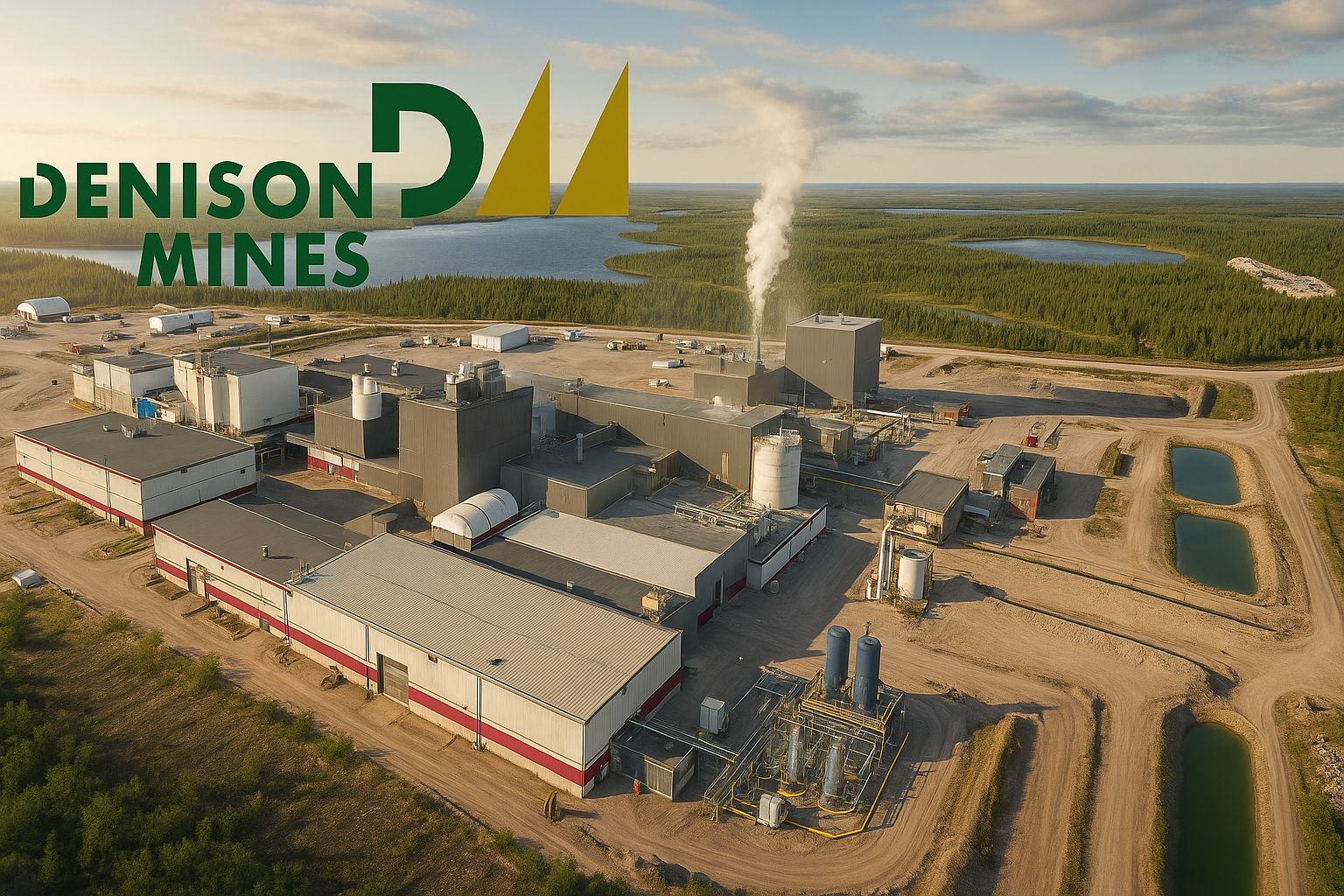
Denison’s share gains aren’t happening in a vacuum – recent company milestones have significantly de-risked its pipeline. In July 2025, Denison’s 22.5%-owned McClean Lake joint venture began mining uranium ore using the innovative SABRE in-situ method. About 250 tonnes of ultra-high-grade ore (>10% U₃O₈) were pulled from the first borehole cavity, and the first yellowcake concentrates were produced at the McClean mill ts2.tech. This was Denison’s first active mining since 2008, effectively returning the company to uranium producer status. CEO David Cates hailed the SABRE startup as “a significant milestone…as the joint venture returns to active mining operations for the first time since 2008.” ts2.tech. Although initial output is modest, Denison says it will market its share of the production in the coming quarters, generating revenue for the first time in over a decade ts2.tech ts2.tech.
Meanwhile, Denison’s flagship Wheeler River project has moved closer to a construction green light. In August 2025, Saskatchewan granted provincial approval for Wheeler River’s environmental assessment (Phoenix ISR deposit) ts2.tech. Crucially, the federal approval is in sight: Canada’s nuclear regulator (CNSC) has scheduled public hearings on Oct 8 and Dec 8–12, 2025 to review Wheeler’s federal assessment and construction licence application ts2.tech. Denison reports it is now “in the final months of the process” to obtain all approvals for the Phoenix in-situ recovery mine ts2.tech. The company has already completed roughly 80% of detailed engineering for Phoenix’s facilities ts2.tech. If everything proceeds on schedule, Denison could begin site prep in early 2026 and target first production from Phoenix by 2028 (as per past guidance denisonmines.com). Given that Phoenix is expected to be Canada’s first ISR uranium mine (with extremely high ore grades), these approvals would transform Denison from explorer to developer-producer.
Denison also released an updated study (a Preliminary Economic Assessment) for its Midwest deposit (in which it holds 25.17%). Although smaller in size, this report grabbed attention by showing ultra-low costs. The Midwest PEA assumes ISR mining and projects an all-in operating cost around US$11.69 per pound U₃O₈ with an after-tax IRR above 80% (for Denison’s stake) ts2.tech. Denison’s management voluntarily published this PEA “to showcase additional hidden value” and boost transparency ts2.tech. In short, it suggests Denison’s portfolio contains projects that can remain economical even at uranium prices far below today’s levels.
Denison’s CEO David Cates sums up the momentum: “This summer has been highly productive for Denison. We’ve achieved key milestones at McClean Lake and Wheeler River and delivered results on multiple projects that showcase the potential to add value within our portfolio,” he recently stated ts2.tech. These words reflect that most of Denison’s news flow has been favorable – which is why the stock is zooming.
Analyst Views and Stock Forecasts
With the uranium sector heating up, Wall Street analysts have been taking notice of DNN. In recent months, at least five firms (Scotiabank, National Bank, Raymond James, TD, Desjardins) have reiterated “Outperform/Buy” opinions on Denison marketbeat.com. MarketBeat reports the consensus across analysts is a Buy, with an average 12-month target of about C$2.75 ts2.tech marketbeat.com (roughly US$2.00). In fact, at least one analyst model suggests even more upside: using technical trend assumptions, DNN could rise another ~45% by early 2026 (to ~$3.7–4.7) if uranium prices keep climbing ts2.tech.
Some analysts have set high targets. For example, Desjardins Capital Markets’ Bryce Adams reiterated a C$5.00 target in early October (and rated the stock a Buy) insidermonkey.com. (On the Toronto Stock Exchange DNN trades as “DML”, where C$5 would be about US$3.65.) TD Securities and Scotiabank have also been bullish, noting that Denison’s milestones and the uranium bull market justify a premium valuation ts2.tech.
That said, not everyone is blindly bullish at current levels. Some models and commentators caution that the recent run-up already prices in much of the good news. Denison is still a pre-production company (aside from McClean’s small output), with ongoing operating losses and heavy future capital needs. Its trailing P/E is deeply negative (~–48) marketbeat.com and its price/book is quite high (over 6x). Analysts at Simply Wall St note these “weak financials, unprofitability, high valuation multiples” and warn that unless uranium prices or project catalysts continue to surprise to the upside, “some of the easy gains may have already been realized” ts2.tech. In other words, investors should be aware of execution risks – such as obtaining final permits, securing financing, and navigating construction – even as upside potential remains large.
Uranium Market Outlook and Sector Context
Denison’s story is unfolding in a broader uranium bull market fueled by global nuclear expansion. After years of oversupply, the industry now faces a multi-year structural shortage. Primary uranium production (≈130 million lbs/year) is well below reactor demand (~180 million lbs/year) ts2.tech, and utilities have found a surprising 25–30% of their near-term requirements uncontracted in 2025 ts2.tech. As secondary stockpiles deplete, buyers have flooded the spot and contract markets, pushing prices sharply higher. Geopolitical factors (e.g. sanctions on Russian uranium, unrest in key mining countries) have further tightened supply.
On the demand side, nuclear power is enjoying a renaissance. Many countries are extending reactor lifetimes, building new plants, and pursuing advanced designs (SMRs). Over 30 nations have pledged to triple their nuclear capacity by 2050 as part of clean energy goals ts2.tech. This policy shift has led utilities worldwide to lock in uranium supply for the late 2020s and 2030s. In short, fundamental demand for uranium is expected to grow strongly.
Most industry analysts conclude that this combination of growing demand and lagging production will keep uranium prices elevated for years. Some forecast prices reaching $90–$100+ per pound by late 2025 ts2.tech. As prices rise, large producers like Cameco and Kazatomprom stand to gain, but so do junior miners. One recent analysis notes that “major players… will see substantial increases in revenue,” while “junior uranium miners and developers, such as…Denison Mines, are also experiencing renewed investor interest and improved prospects for financing new projects, as higher prices make previously uneconomical deposits viable.” ts2.tech In other words, the uranium tide is lifting all boats – especially companies like Denison that hold large, high-grade Athabasca Basin assets.
However, it’s worth remembering that higher prices will also attract new supply. Several dormant projects could restart if the rally continues, and even Kazakhstan (world’s top producer) has signaled output cuts to stabilize prices. Additionally, developing a uranium mine is a long process (often 10+ years from discovery to production) ts2.tech. Denison’s timeline (first production aimed in the latter half of this decade) aligns well with the expected supply crunch peak, but any delays could be costly if the cycle cools. Constraints in conversion/enrichment capacity also mean new mine supply won’t instantly translate into reactor fuel.
Expert Perspectives and Outlook
Industry experts are generally optimistic on uranium’s long-term outlook, but emphasize patience and selectivity. Denison Mines, in particular, is seen as a high-leverage play on uranium. Its large, high-grade Wheeler River deposits (Phoenix and Gryphon) could make it one of the world’s lowest-cost producers once built, giving it big upside if the market remains tight. CEO David Cates and other executives have frequently pointed out that the current nuclear energy upturn is a “once-in-a-generation” opportunity, suggesting Denison’s blend of near-term catalysts (McClean production) and long-term bombs (Wheeler) could justify a premium valuation.
In recent conference calls and interviews (e.g. CruxInvestor podcast, World Nuclear Symposium), management has highlighted Denison’s strong balance sheet (tens of millions in cash and available credit) and readiness to raise project funding. Analysts note this: Denison raised about $50M in 2023 and secured a $75M credit line earlier this year to help build Wheeler ts2.tech. The company has said that if uranium remains strong, it could finance construction through a mix of streaming deals, joint ventures, or strategic investors (minimizing share dilution) ts2.tech.
On October 17, a trading newsletter observed that Denison “trading around $2.93 as of late” (in line with market data) and stressed that investors should balance optimism with caution given the company’s cash burn and funding needs stockstotrade.com. Meanwhile, MarketBeat and other data services note that despite the recent pullback, institutional interest remains high: U.S. hedge funds hold roughly 36–37% of the float marketbeat.com, a figure that has been rising.
Outlook and Key Events
Looking ahead, the next 6–12 months will be critical for Denison. Key upcoming milestones include:
- CNSC Hearing Results: If the October 8, 2025 hearing (Phase 1) yields a favorable report, it would clear a major hurdle for the Phoenix ISR project. The December 2025 session could finalize the license. A positive outcome could send DNN higher.
- Financing Moves: Denison may announce project financing plans (e.g. partnerships or streaming) next year. How it prices those deals will influence stock sentiment.
- Uranium Price Trajectory: Any significant move toward or away from the elusive $100/lb mark will likely move DNN. Higher sustained spot/term prices would boost the stock, while a sharp pullback could trigger volatility.
In summary, Denison Mines is trading on optimism and execution. Its share price is up over 100% in 2025 thanks to skyrocketing uranium prices and solid company news. Many analysts remain upbeat, but most stress that much depends on continued progress on Wheeler River and the broader nuclear demand picture. As one market commentary notes, Denison’s fate is “tied to both its own progress and the broader uranium cycle” – a combination that offers outsized rewards if executed, but comes with volatility ts2.tech.
Sources: Recent Denison Mines corporate releases and financial reports denisonmines.com denisonmines.com; market data (MarketBeat, Investing.com) investing.com marketbeat.com; industry news and analysis (TS2.Tech, MarketBeat, InsiderMonkey) ts2.tech ts2.tech ts2.tech insidermonkey.com; uranium market research ts2.tech ts2.tech ts2.tech.