
NEW YORK, August 5, 2026, 18:10 EDT
- Second-quarter adjusted EBITDA surpassed the consensus estimate from London Stock Exchange Group LON:LSEG by 8.6%. GAAP EPS fell short of FactSet Research Systems NYSE:FDS consensus by one cent.
- The Q3 midpoint suggests an adjusted EBITDA-to-GOV margin of 3.06%, approximately 30 basis points higher than in Q2.
- Shares ended the session up 2.4%, with an additional gain of about 1% after the bell.
DoorDash’s third-quarter outlook indicated profit is growing more rapidly than order value. This is significant for a stock trading at nearly 99 times its trailing earnings. U.S. regular trading session had ended, but the shares remained up in after-hours trading.
At the midpoint guidance, adjusted EBITDA is set to climb 12.1% from Q2, while marketplace gross order value (GOV) is projected to rise only 1.3%. The gain in profit is roughly 9.5 times larger than the increase in GOV.
The EBITDA midpoint exceeds the LSEG consensus by 4.6%. The GOV midpoint is ahead by 2.6%. The profit advantage in the guidance is nearly double the increase seen in the order-value premium.
The quarter surpassed the majority of operational expectations:
| Q2 metric | Actual | Street estimate | Surprise | Year-on-year |
|---|---|---|---|---|
| Total orders | 970 million | 933 million, FactSet | +4.0% | up 27% |
| Revenue | $4.454 billion | $4.34 billion, FactSet | +2.6% | up 36% |
| Marketplace GOV | $33.078 billion | $32.08 billion, LSEG | +3.1% | up 36% |
| Adjusted EBITDA | $914 million | $841.8 million, LSEG | +8.6% | up 40% |
| GAAP diluted EPS | $0.46 | $0.47, FactSet | -$0.01 | down 29% |
Company results; FactSet estimates as listed by The Wall Street Journal; LSEG figures as stated by Reuters.
The beat had a price. Free cash flow jumped to $742 million, more than twice the previous level. However, GAAP net income dropped 30% to $200 million amid a 52% rise in research expenses and a 39% increase in administrative outlays. DoorDash continues to project $1.2 billion to $1.3 billion in stock-based compensation for the year.
Expansion outside the restaurant sector is “beginning to bear fruit,” according to eMarketer analyst Rachel Wolff. Wolff pointed to growing demand from grocery and retail segments, as well as increased frequency and user retention driven by DashPass. Reuters
DashPass embodies the core trade-off as well. Around 75% of U.S. grocery and retail orders were made by its members. DoorDash reported that orders from members generate a lower gross-margin percentage compared to those from non-members.
The updated guidance clarifies the trade-off:
| Metric | Q2 actual | Q3 midpoint | Street consensus | Investor read-through |
|---|---|---|---|---|
| Marketplace GOV | $33.078 billion | $33.500 billion | $32.640 billion | +1.3% q/q; 2.6% above consensus |
| Adjusted EBITDA | $914 million | $1.025 billion | $979.6 million | +12.1% q/q; 4.6% ahead of consensus |
| EBITDA/GOV | 2.76%, calculated | 3.06%, implied | 3.00%, implied | Roughly 30 basis points higher q/q |
Company guidance and LSEG consensus are used to determine midpoints and implied margins.
The progression of margins is not linear. DoorDash anticipates the ratio will decrease in Q4 compared to the prior quarter. Costs for Dasher pay, insurance, technology, and autonomy are projected to increase. As a result, the Q3 outlook does not set a lasting minimum for margins.
DoorDash outperformed other delivery-platform stocks in Wednesday’s trading session:
| Company | Aug. 5 close | Session move | After-hours move | Trailing P/E |
|---|---|---|---|---|
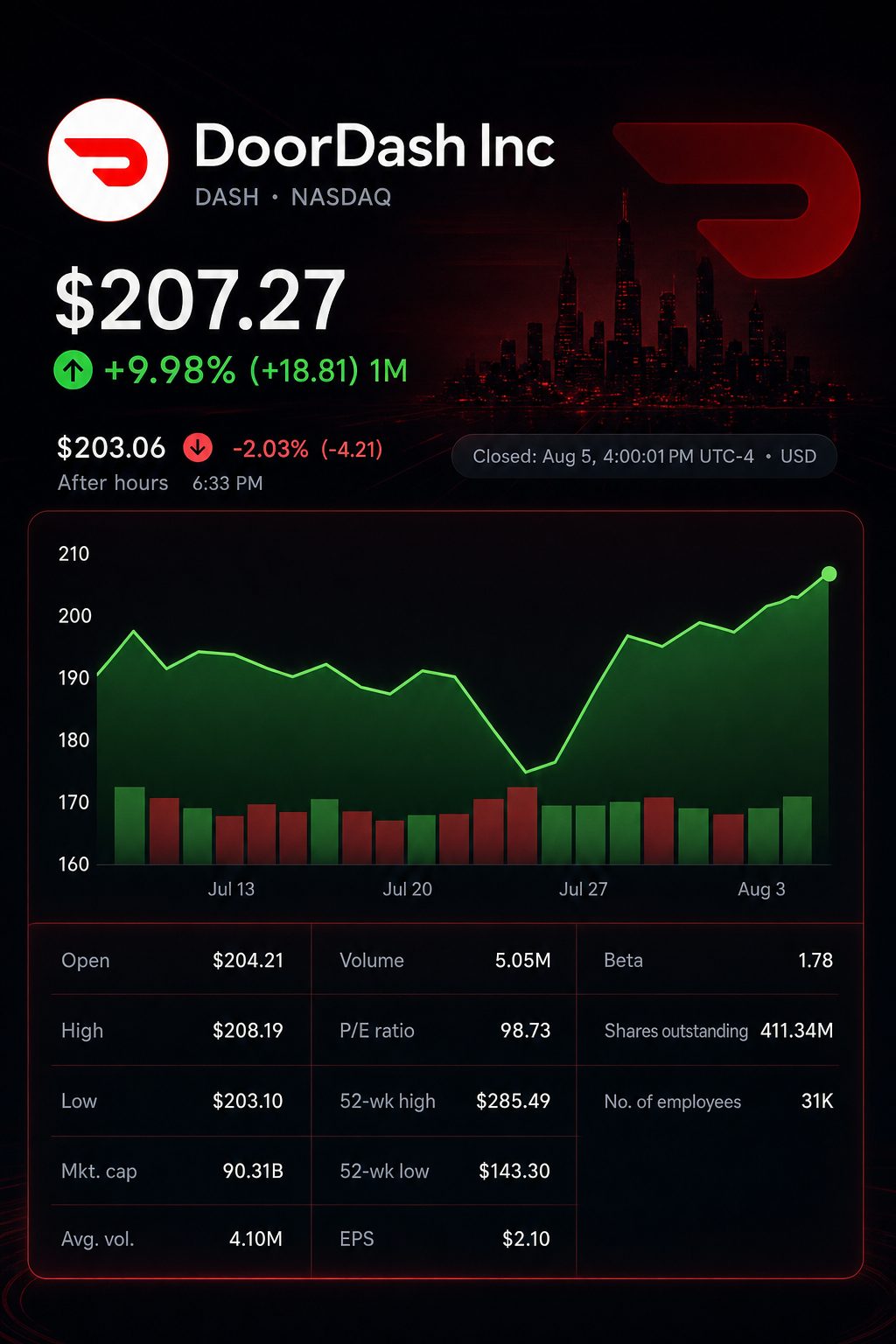
| DoorDash NASDAQ:DASH | $207.27 | rose 2.42% | gained 1.30% after the bell | 98.73x |
| Uber Technologies NYSE:UBER | $68.18 | dropped 5.29% | slipped 0.26% post-market | 16.94x |
| Maplebear, owner of Instacart NASDAQ:CART | $45.35 | fell 0.66% | added 0.44% after hours | 25.37x |
Quotes and post-market activity were noted soon after 18:00 EDT.
P/E ratios are directional due to varying business compositions. Yet, DoorDash is valued at 5.8 times Uber’s multiple and 3.9 times Maplebear’s, limiting potential for a short-term margin increase.
DoorDash rose 7.1% between July 29 and the close on Wednesday, yet the stock is still trading 27.4% under its 52-week peak of $285.49. Last week’s rebound improved momentum without eliminating valuation concerns.
Analyst sentiment ahead of earnings was largely positive, though not consistent across the board:
| Analyst | Firm | Date | Recommendation | Target | Versus $207.27 |
|---|---|---|---|---|---|
| Nikhil Devnani | Bernstein | Aug. 3 | Buy | $270 | +30.3% |
| Mark Zgutowicz | Benchmark | Aug. 3 | Buy | $270 | +30.3% |
| Stephen Ju | UBS Group NYSE:UBS | Aug. 3 | Hold | $223 | +7.6% |
| Justin Post | Bank of America NYSE:BAC | July 29 | Buy | $272 | +31.2% |
| Ygal Arounian | Wedbush | July 15 | Hold | $205 | -1.1% |
| 30-analyst consensus | — | Past three months | 22 Buy, 8 Hold, 0 Sell | $236.26 average | +14.0% |
The actions mentioned occurred prior to the earnings report released on Wednesday.
The upcoming scheduled sector catalyst is set for Thursday. DoorDash’s response during regular trading will gauge margin expectations. Maplebear will release second-quarter results after market close, providing further insights into demand for grocery delivery.
Risks persist. The outlook is based on steady demand and currencies. Integration of Deliveroo, along with labour and insurance expenses, regulatory factors, and autonomy investment, could weigh on margins. The timing of payments to merchants is projected to lower 2026 reported free cash flow by $700 million to $800 million.
DoorDash provided the operational update sought by investors. Its current valuation means maintaining Q3 margin conversion is now essential.
Related articles: Earnings






![Australia Stock Market Today 26/08/2026 [UPDATE: 10:37 AEST] [Woolworths and Lovisa Lift ASX Before CPI]](https://ts2.tech/wp-content/uploads/2026/08/AU-market-dashboard-2026-08-26-1037-480x384.jpg "Australia Stock Market Today 26/08/2026 [UPDATE: 10:37 AEST] [Woolworths and Lovisa Lift ASX Before CPI]")