- Nanotyrannus is real: New research published on October 30, 2025 confirms that Nanotyrannus lancensis – a smaller tyrannosaur long debated by paleontologists – was a distinct species that lived alongside Tyrannosaurus rex, rather than a juvenile T. rextheguardian.comscientificamerican.com. This finding settles a 30+ year-old mystery about the so-called “teenage T. rex” fossils.
- “Dueling Dinosaurs” reveal the truth: Scientists analyzed the famous “Dueling Dinosaurs” fossil (discovered in Montana in 2006), which preserves a Triceratops and a tyrannosaur locked in combattheguardian.com. Detailed study shows the tyrannosaur died at ~20 years old and was fully mature – with bone growth rings, fused vertebrae, and fixed anatomical features – proving it wasn’t a growing T. rexnews.ncsu.edutheguardian.com. Its anatomy (larger arms, extra teeth, different skull sinuses, shorter tail, etc.) is “incompatible with the hypothesis that this skeleton is a teenage T. rex,” said Dr. Lindsay Zanno of North Carolina State Universitytheguardian.com.
- Tiny tyrant vs. T. rex – big differences: Nanotyrannus earned its “dwarf tyrant” name. It was roughly half the length and one-tenth the weight of an adult T. rex (about 18 ft long, ~1,500 lbs, versus 40 ft and ~15,000 lbs for T. rex)reuters.com. Yet it wasn’t just a mini-rex – it had more teeth, longer and stronger arms, a slimmer build and a unique skull structure not seen in any age of T. rextheguardian.comreuters.com. Researchers describe Nanotyrannus as a swift, agile predator that “could have run circles around the tyrant king” T. rexreuters.com, likely hunting smaller prey with its blade-like teeth and long legs while the bulkier T. rex specialized in large preyreuters.com.
- Not one but two new species: In examining over 200 tyrannosaur fossils, the team found that another small tyrannosaur skeleton (nicknamed “Jane,” found in 2001) also wasn’t T. rex. They have named it a new species, Nanotyrannus lethaeus, distinct from N. lancensisnews.ncsu.edureuters.com. This means at least two species of Nanotyrannus existed. The confirmation of Nanotyrannus’ validity indicates multiple tyrannosaur species coexisted with T. rex in the late Cretaceous, painting a richer picture of the ecosystem than the one-big-predator modelnews.ncsu.edunews.ncsu.edu.
- Decades of T. rex research upended: Experts say this discovery “flips decades of T. rex research on its head,” forcing paleontologists to revisit past studiesnews.ncsu.edu. For years, many assumed small tyrannosaur fossils were adolescent T. rexes and based models of T. rex’s growth, speed, and behavior on themtheguardian.com. Those studies “need a second look” in light of the new evidence that they were examining two different animalstheguardian.com. Some scientists caution the debate isn’t entirely over – e.g. a few believe Nanotyrannus might be a close cousin or “sister species” of T. rex rather than a wholly separate lineagewral.com. But even skeptics acknowledge this “solid evidence” proves at least one distinct small tyrannosaur species lived alongside T. rextheguardian.comtheguardian.com.
A Decades-Long Dinosaur Mystery
For over 40 years, paleontologists have wrangled over mysterious tyrannosaur fossils that didn’t quite fit the mold of T. rex. The controversy began with a small skull found in 1942 in Montana’s Hell Creek Formation – the same Late Cretaceous deposit that yielded T. rex. In 1988, some researchers formally named that skull Nanotyrannus lancensis, meaning “dwarf tyrant,” proposing it was a new pygmy tyrannosaur speciesnationalgeographic.com. However, many experts argued these remains (and others like them) were simply juvenile T. rex specimens that hadn’t grown to full sizenationalgeographic.com. The question — teenage T. rex or new dinosaur? — became one of paleontology’s most polarizing debates.
Over the years, additional discoveries fueled the fire. A relatively complete skeleton nicknamed “Jane,” unearthed in 2001 by the Burpee Museum in Montana, showed a mid-sized tyrannosaur with long legs and slender proportions. Was Jane a teenage T. rex or a grown Nanotyrannus? Opinions diverged. The biggest break came with the 2006 discovery of the “Dueling Dinosaurs” fossil: an extraordinarily preserved fossil pairing of a horned dinosaur (Triceratops) and a smaller tyrannosaur, seemingly intertwined in battletheguardian.com. This 67-million-year-old find remained in legal and private limbo for years, inaccessible to sciencebusinessinsider.com. Finally acquired by the North Carolina Museum of Natural Sciences (with donors paying $6 million to bring it to the museumbusinessinsider.com), the Dueling Dinosaurs presented a unique opportunity: a nearly complete skeleton of the mystery tyrannosaur to study at last.
New Evidence from the “Dueling Dinosaurs” Fossil
With the Dueling Dinosaurs specimen in hand, paleontologist Lindsay Zanno and her colleagues set out to answer the Nanotyrannus question once and for all. “We decided to just make sure that we tested this question from every angle,” Zanno saidnationalgeographic.com. The team, including anatomist James Napoli, conducted a comprehensive analysis of the tyrannosaur’s bones using modern tools and techniques.
Growth rings in the bones – akin to tree rings that record annual growth – revealed the animal’s age at death. The rings were tightly packed near the bone’s outer edge, indicating growth had plateaued. The tyrannosaur was about 20 years old and had reached physical maturity when it diednews.ncsu.edu. If it were merely a juvenile T. rex, its bones should show rapid, ongoing growth; instead, they show it had already slowed down and stopped growinglivescience.comlivescience.com. “For Nanotyrannus to be a juvenile T. rex, it would need to defy everything we know about vertebrate growth… It’s impossible,” explained Napolinews.ncsu.edu. In other words, no known animal suddenly hits full size at only one-tenth its species’ typical mass – a clear red flag that this was not a baby T. rexnews.ncsu.edu.
The researchers also examined skeletal fusion patterns. In young dinosaurs (and young vertebrates in general), certain bones like vertebrae are not fully fused; they fuse only upon reaching adulthood. In the Dueling Dinosaurs tyrannosaur, key bones were fused, again signifying an adult, not an adolescent.
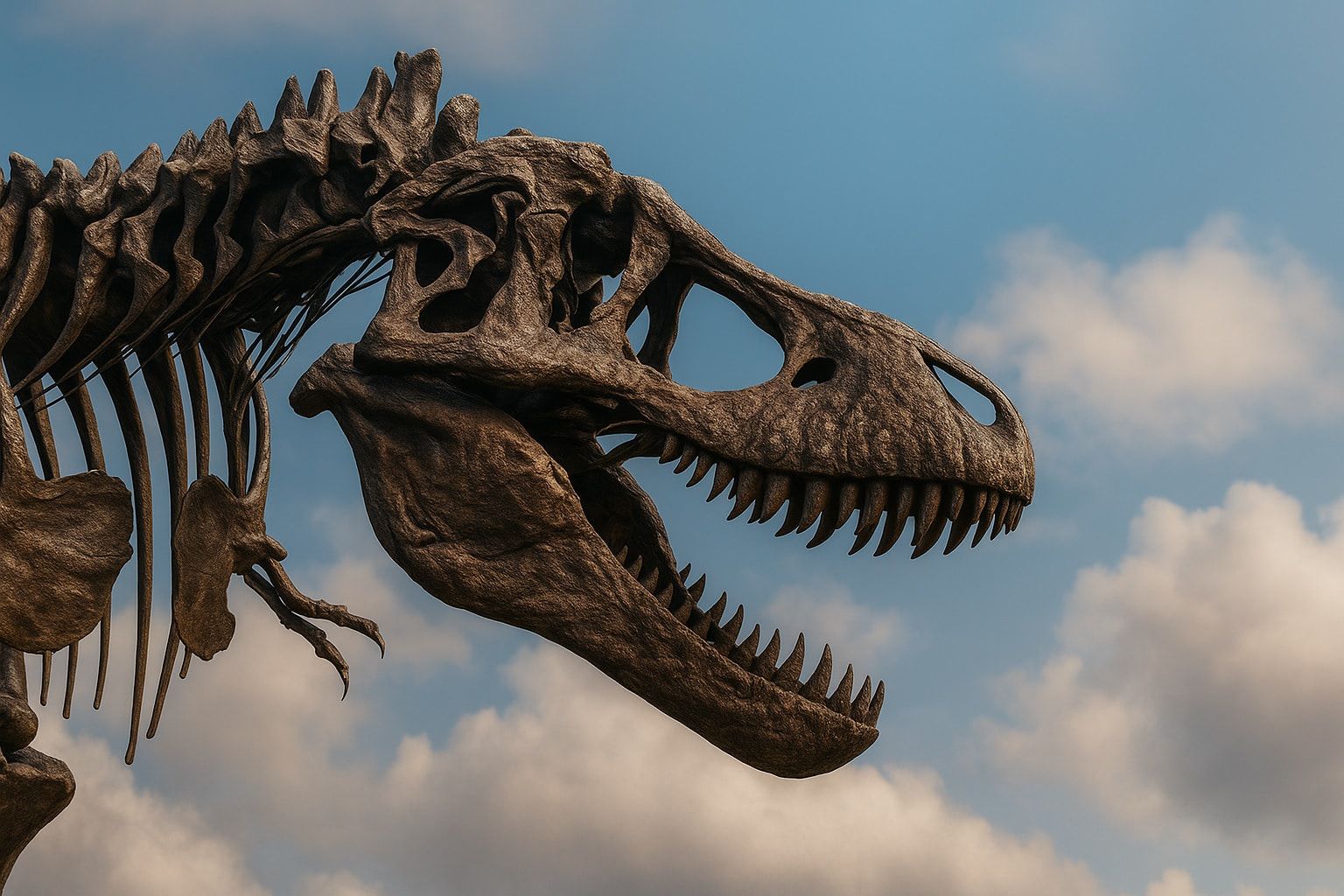
Perhaps most striking were a suite of anatomical features that set the specimen apart from T. rex. These traits aren’t like superficial differences that could change as a T. rex grew – they are fundamental characteristics established early in development. For example, the specimen’s skull CT scans showed an extra sinus cavity and distinct cranial nerve pathways that T. rex lacks. It also had larger hands/forelimbs with an extra finger bone (a vestigial third finger), whereas T. rex famously had only two functional fingers. The tooth count was higher than any known T. rex of comparable size – Nanotyrannus packed more but smaller teeth in its long snout. Even the tail told a tale: Nanotyrannus’ tail had fewer vertebrae (shorter relative to body length) than a young T. rex’s would, giving it a stubbier tail – another feature that wouldn’t make sense if it were destined to grow into a long-tailed T. rex.
All these lines of evidence converged to the same conclusion. Zanno put it bluntly: “Simply put, the Dueling Dinosaur Nanotyrannus is fully grown at half the length and one tenth the body mass of a mature T. rex. There is no scenario in which this animal morphs into a T. rex.”scientificamerican.com In other words, the mystery dinosaur is Nanotyrannus, not T. rex. The research team published their results in the journal Nature, effectively declaring the debate settledtheguardian.com.
The “Tiny Tyrant” – How Nanotyrannus Lived and Looked
With Nanotyrannus confirmed as a distinct genus, scientists can finally flesh out its identity. It lived in the same time and place as T. rex – the Hell Creek ecosystem in the final million years before the end-Cretaceous asteroid strike ~66 million years ago. But it filled a very different niche from its giant cousin.
Physically, Nanotyrannus was far smaller. Zanno and colleagues report it reached roughly 5–6 meters (18 ft) in length and weighed about ~700 kg (1,500 lbs), compared to T. rex’s ~12 m (40 ft) and 6,000–7,000 kg (~15,000 lbs) in adulthoodreuters.com. This huge size gap earned Nanotyrannus the nickname “Teacup T. rex” in some media, since it was essentially a pint-sized tyrant relative to the 7-ton T. rex heavyweightreuters.com. But aside from size, Nanotyrannus was not simply a scaled-down T. rex – it had a different build and likely different behavior.
Paleontologists describe Nanotyrannus as a “slender, agile pursuit predator”reuters.com. Its legs were long in proportion to its body, suggesting it could run faster than the stocky-legged T. rex. Its arms, while still not huge, were proportionally larger and stronger than T. rex armsreuters.com. “T. rex was a massive predator adapted to wielding incredible bite forces. Nanotyrannus was a slender, agile pursuit predator that could have run circles around the tyrant king,” said Dr. Zannoreuters.com. In practice, this likely means Nanotyrannus targeted smaller, faster prey and could rely more on its arms to grasp or manipulate victimsreuters.com. By contrast, T. rex used its immense bulk and bone-crushing jaws to take down large prey (like triceratops or hadrosaurs), and had much reduced arms that contributed little to huntingreuters.com.
Anatomically, aside from the limb proportions and skull differences already noted, Nanotyrannus had a few distinctive traits:
- Higher tooth count: Nanotyrannus jaws contained more but smaller teeth compared to T. rex. This could indicate a different feeding style – possibly slicing flesh from smaller prey rather than the bone-crunching bite of T. rex.
- Skull crest and sinuses: Researchers noted a crest of bone in front of the eyes and an additional air sinus in a skull bone, features absent in T. rex. These might have implications for muscle attachment or sensory differences.
- Three-fingered arm (vestigial third finger): While T. rex’s lineage lost the third finger, Nanotyrannus appears to have retained a tiny third finger (though likely not very functional). This hints at evolutionary divergence between the two tyrant dinosaurs.
- Shorter tail: A Nanotyrannus tail (based on the new fossil, which fortunately includes the first complete tail ever found for this dinosaur) had fewer vertebrae, making it proportionally shorter than a T. rex tail. A shorter tail can relate to balance and agility – useful for a spry hunter – whereas T. rex’s long heavy tail counterbalanced its huge head.
All these differences underscore that Nanotyrannus wasn’t a juvenile stage of anything, but a fully adapted adult predator in its own right. In fact, the new study’s evolutionary analysis places Nanotyrannus in its own branch of the tyrannosaur family tree – a distinct lineage (dubbed Nanotyrannidae) just outside the direct line of T. rex ancestryscientificamerican.com. It may even have originated from a different geographical population; researchers suggest the “dwarf tyrant” line could have roots in eastern North America, implying Nanotyrannus and Tyrannosaurus evolved separately before sharing the same habitatscientificamerican.com.
Rewriting T. rex’s Story – and Late Cretaceous Ecology
The confirmation of Nanotyrannus carries big implications for how we understand T. rex and its world. For decades, paleontologists have been puzzling over T. rex’s growth and life history using what we now realize were misidentified fossils. Many of those sleek “teenage T. rex” skeletons used in past research (for example, studies of how T. rex’s speed or feeding habits changed as it matured) were likely not T. rex at all, but Nanotyrannus. “For decades, paleontologists have unknowingly used Nanotyrannus specimens as a model for teenage T. rex… Those studies need a second look,” Dr. Zanno saidtheguardian.com. Indeed, one long-held hypothesis in dinosaur science – that young T. rexes filled a different ecological niche (fast pursuit hunter) before growing into slow adult super-predators – might be upended. It now appears that role was actually filled by Nanotyrannus, while T. rex juveniles may have been fewer or hard to find in the fossil recordtheguardian.comscientificamerican.com.
The new finding also transforms our picture of the Hell Creek ecosystem at the end of the Age of Dinosaurs. Previously, textbooks often noted that T. rex was the singular apex predator of its time and place – the uncontested “king.” Now we know T. rex did not reign alonenews.ncsu.edunews.ncsu.edu. “This discovery paints a richer, more competitive picture of the last days of the dinosaurs,” said Zannonews.ncsu.edu. In those days, a full-grown T. rex (the giant bone-cruncher) shared its territory with at least one smaller tyrannosaur, Nanotyrannus (the fleet-footed hunter). Dr. Thomas Holtz, a tyrannosaur expert not involved in the study, points out this situation isn’t unprecedented – in Late Cretaceous Asia, fossils show the huge tyrannosaur Tarbosaurus coexisted with a smaller relative (Alioramus), seemingly splitting the predator roles in a similar wayscientificamerican.com.
The presence of multiple predator species suggests dinosaur biodiversity was high right up to the end of the Cretaceous. “The finding that Nanotyrannus and Tyrannosaurus shared the same landscape… offers the latest evidence that dinosaur diversity was rich prior to the asteroid impact,” Napoli notedreuters.com. This challenges earlier notions that dinosaur faunas were dwindling before the mass extinction. Instead, tyrannosaurs were still evolving new forms (Nanotyrannus being an example) in the final million years. “This discovery shows us that dinosaurs continued to evolve, innovate and diversify right up until their reign was cut short,” said Napolireuters.com.
Another intriguing outcome is the identification of two species of Nanotyrannus. Zanno’s team determined that the Dueling Dinosaurs skeleton and the 1940s Cleveland skull are the same species (N. lancensis), but the skeleton “Jane” has subtle differences – enough to warrant being classified as a new species named Nanotyrannus lethaeusnews.ncsu.eduscientificamerican.com. (The name “lethaeus” references Lethe, the Greek mythological river of oblivion, since this species was “hidden in plain sight” and overlooked for so longnews.ncsu.edu.) This means the debate wasn’t just about one upstart species, but a potential clade of small tyrannosaurs. It raises the possibility that other fragmentary fossils in museums might belong to Nanotyrannus or its kin. Napoli suggests there “may be many more [small tyrannosaur] species awaiting recognition” now that researchers know what to look forscientificamerican.com.
Reactions: Debate Resolved, But a Few Skeptics Remain
The new study has been met with excitement by many in the paleontology community – but, true to scientific debate, also some caution. Dr. Steve Brusatte of the University of Edinburgh, a leading tyrannosaur specialist who was not involved in the research, admitted the evidence convinced him that Nanotyrannus is real. “For many years… I had considered [the] smaller skeletons… to be T. rex juveniles. I think new evidence from this exquisite specimen shows that I was wrong – at least in part,” Brusatte saidtheguardian.com. He called the study “solid evidence” that Nanotyrannus existed as a separate speciestheguardian.com. However, Brusatte still urges some restraint. “I’m not yet ready to proclaim every smaller tyrannosaur skeleton to be Nanotyrannus,” he cautioned, noting that if Nanotyrannus was a distinct genus, we still need to explain “where are the juvenile T. rexes?” – surely T. rex had young too, which might resemble these smaller fossils in some casestheguardian.comscientificamerican.com. He suspects some known specimens could indeed be true juvenile T. rexes, meaning paleontologists will have to carefully distinguish which is which going forwardtheguardian.com.
Another skeptic-turned-conceder is Dr. Holly Woodward Ballard, an Oklahoma State University paleohistologist who previously argued against Nanotyrannus. She praises the new study’s thoroughness (“They left no stone unturned, no fossil unexamined”nationalgeographic.com) and finds the growth-ring evidence that the specimen is adult to be “strong support” for Nanotyrannus’ validitynationalgeographic.com. Still, Woodward Ballard points out that this saga may have “twists and turns” yetnationalgeographic.com. “What seems like the answer one day can be falsified the next with new data,” she says, reminding colleagues that science is always subject to revisionnationalgeographic.com. She, along with Brusatte, is particularly not fully convinced that all other contested specimens (like Jane) must be separate species – some could be biological variation or different growth stages of T. rex. In fact, Dr. Thomas Carr of Carthage College – a staunch proponent of the juvenile T. rex interpretation – remains the most skeptical. Carr acknowledges that the Dueling Dinosaurs tyrannosaur is an adult, but he suggests it might be a small “sister species” or subspecies of T. rex rather than a wholly distinct genuswral.com. He argues that just being mature isn’t enough to define a new species if we lack a good sample of confirmed juvenile T. rexes for comparisonscientificamerican.com. Carr points to lingering similarities in skull shape between known T. rex fossils and the Nanotyrannus specimens that “keep him from switching camps” entirelywral.com. “I don’t think this study settles everything,” Carr said plainlywral.com.
In summary, the majority view is that this discovery “settles the score in favor of Nanotyrannus”scientificamerican.com, ending one of paleontology’s longest-running debates. Yet a healthy scientific discourse continues, with some experts wanting to see even more fossils (for instance, genuine baby T. rex bones, if they can be found) to definitively close every loophole. The good news is that the newfound clarity on Nanotyrannus will guide paleontologists in the right direction as they hunt for those answers.
Future Outlook: New Questions in the Dinosaur World
Far from closing the book, the confirmation of Nanotyrannus opens exciting new chapters of research. One immediate “next step” is to re-examine museum collections and past discoveries. Paleontologists now have diagnostic criteria to identify Nanotyrannus – tooth count, limb proportions, bone histology, etc. – so they may discover that fossils sitting in storage (previously labeled as young T. rexes or other tyrannosaurs) actually belong to Nanotyrannus or related species. As Napoli suggested, there could be more “hidden” tyrannosaurs waiting to be recognizedscientificamerican.com. “Now that we’ve corrected the record on Nanotyrannus, we think it’s possible that other smaller tyrannosaur fossils are misidentified and that there may be many more species awaiting recognition,” Napoli saidscientificamerican.com.
Researchers will also have to update growth models of T. rex. For example, previous estimates of T. rex’s growth rate – how fast it went from a hatchling to a 7-ton adult – might have been skewed by including Nanotyrannus data. One prevailing theory was that young T. rexes were relatively slender and fast (like “turkey-sized” juveniles that hunted differently) before an adolescent growth spurt. Now, with Nanotyrannus removed from the equation, scientists may find T. rex’s true growth pattern was different. It’s possible T. rex juveniles were rarer (perhaps due to high mortality or low fossil preservation), or that they grew even faster than thought to reach gigantic size more quickly, since we don’t find many mid-sized T. rexes (those gaps might actually have been Nanotyrannus all along). These are hypotheses that can be revisited with fresh eyes.
Another intriguing line of inquiry is how Nanotyrannus and T. rex coexisted without out-competing each other. Zanno notes this is “a completely new question” now on the table for dinosaur ecologyscientificamerican.com. In modern ecosystems, it’s common to have multiple predators of different sizes (for instance, lions and cheetahs in Africa’s savannah) that partition the environment and prey. Scientists will study whether Nanotyrannus occupied a different habitat or hunted at different times or targeted different prey than T. rex to reduce direct competition. Dr. Holtz’s analogy to Tarbosaurus and Alioramus in Asia suggests Nanotyrannus might have specialized in preying on smaller herbivores or juveniles of larger species, leaving the biggest prey for T. rexscientificamerican.com. There’s even speculation that Nanotyrannus could have lived in packs (some artwork depicts packs of Nanotyrannus attacking larger dinosaurscoronatodays.com), though hard evidence for pack behavior is elusive. The Dueling Dinosaurs fossil itself – a one-on-one battle – doesn’t show pack hunting, but it does prove these two species at least occasionally interacted (likely competing over a kill or as predator and prey in that fatal encounter).
The North Carolina Museum of Natural Sciences, which now houses the Dueling Dinosaurs fossil, is poised to be at the forefront of these ongoing studies. The fossil is currently on display and in active study at the museum’s labs, where researchers and even the public (through observation windows and live streams) can watch the scientific process unfoldwral.combusinessinsider.com. New high-resolution scans, 3D modeling, and even searches for preserved biomolecules are all possibilities as the team digs deeper into these fossils. Every bone of the Dueling Dinosaurs specimen will be scrutinized for clues – for instance, are there healed injuries or bone pathologies that indicate how Nanotyrannus lived or fought? Are there stomach contents or parasite traces? Even the Triceratops paired with it might yield information on whether these two actually died in combat or were swept together by a river (a “dinosaur murder mystery” yet to be fully solvedbusinessinsider.com).
In paleontology, it’s rare to have a clear-cut resolution to a long debate, but this appears to be one of those landmark moments. As National Geographic wrote, the study comes as an “inflection point that finally settles the decades-long debate”nationalgeographic.com over Nanotyrannus. Going forward, the story of Tyrannosaurus rex – the most famous dinosaur of all – must be rewritten to include its smaller tyrant neighbor. Rather than envisioning a juvenile T. rex honing its skills on small prey, we now see an ecosystem where a “tiny tyrant” and the giant tyrant each had their own domain. It’s a more dynamic and vibrant Cretaceous world than we knew. And it serves as a reminder that even in the well-trodden field of dinosaur research, big surprises (or in this case, little tyrants) can still be hiding in the ground, waiting to upend our assumptions.
Sources:
- CNN/Reuters – “Agile and vicious Nanotyrannus was not just a teenage T. rex”, Oct. 30, 2025reuters.comreuters.com
- The Guardian – “Researchers discover new tyrannosaur species in ‘duelling dinosaurs’ fossil”, Oct. 30, 2025theguardian.comtheguardian.com
- NC State University News – “Nanotyrannus Confirmed: Dueling Dinosaurs Fossil Rewrites the Story of T. rex”, Oct. 30, 2025news.ncsu.edunews.ncsu.edu
- Associated Press (via WRAL) – “Young T. rex or a new dinosaur? New bones add to the debate”, Oct. 30, 2025wral.comwral.com
- National Geographic – “Teen T. rex or totally different dinosaur? Nanotyrannus debate gets a new twist.”, Oct. 30, 2025nationalgeographic.comnationalgeographic.com
- Scientific American – “‘Dueling Dinosaurs’ Fossil Solves the Mystery of a ‘Mini T. rex’”, Oct. 30, 2025scientificamerican.comscientificamerican.com
- Reuters – “At the twilight of the dinosaurs, a ‘dwarf tyrant’ prowled alongside T. rex”, Oct. 30, 2025reuters.comreuters.com