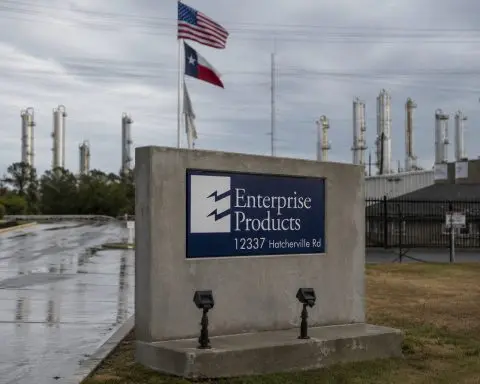

- Strong Dividend & Yield: Enterprise Products Partners NYSE:EPD boasts an attractive ~7% distribution yieldmarkets.financialcontent.comstockanalysis.com. In October 2025 it declared a $0.545/unit Q3 payout (annualized $2.18), up 3.8% YoYmarketscreener.com – marking 27 consecutive years of payout increasesmarkets.financialcontent.com.
- Price Action & Valuation: EPD trades around $31 (Oct 24–25, 2025), mid-range in its 52-week $27.8–$34.6 bandmarketbeat.com. The stock’s P/E is low (~11.5), reflecting its steady, income-oriented profilemarketbeat.com. Consensus targets (~$35–36) imply ~15–20% upside from current levelsmarketbeat.comstockanalysis.com.
- Analysts & Ratings: Most analysts rate EPD a “Buy.” Weiss Ratings reaffirmed a “B (Buy)” on Oct 25marketbeat.com, and the average 12-month price target is ~$35.8marketbeat.com. Long-term track records and income stability make it “moderate buy” favorite among dividend investors.
- Latest Earnings & Forecasts: Q2 2025 results showed modest growth: distributable cash flow (DCF) rose ~7% to $1.8 billion, covering distributions ~1.6×markets.financialcontent.com. EPS was $0.66 (roughly matching expectations) on lower revenues (seasonally down ~15% YoY)marketbeat.com. The next report is due Oct 30, 2025; analysts project ~$0.67/unit (roughly +3% YoY) on ~$12.7 B revenuesnasdaq.com. (Notably, EPD is 90% fee-based contracts, so earnings aren’t tightly tied to oil pricesmarkets.financialcontent.com.)
- Growth Investments: EPD has a massive project pipeline. It plans ~$6 billion of organic capex by end-2025, with ~$7.6 B in work through 2026markets.financialcontent.com. Key assets coming online include two new Permian gas plants, a large Texas NGL export terminal (Neches River), a Mont Belvieu fractionator, and the Bahia NGL pipelinemarkets.financialcontent.comts2.tech. EPD also completed a $580 M acquisition of Occidental’s Permian gas gathering systemmarkets.financialcontent.com. These projects, largely under long-term contracts, should boost volumes and cash flow into 2026–27.
- Capital Return: Besides distributions, EPD is rewarding investors via buybacks. About $80 M of common units were repurchased in Q3, ~$250 M year-to-datemarkets.financialcontent.com. Management has guided ~1.4% of shares bought back in H1 2025markets.financialcontent.com. Analysts view the combination of hikes and buybacks as a signal of strong free cash flowmarkets.financialcontent.com.
Recent News & Industry Context
The past week’s headlines have been upbeat for midstream energy. On Oct 7, EPD announced its Q3 distribution of $0.545/unit (payable Nov 14, record Oct 31)marketscreener.com – reinforcing a 27-year growth streakmarkets.financialcontent.com. Shortly after, a MarketBeat alert (Oct 25) noted that Weiss Ratings reaffirmed EPD at a “Buy” with an average $35.8 price targetmarketbeat.com. Insider buying news in late July (SEC filings) and reports of big institutional buys have also hinted at confidence.
Broadly, pipeline and infrastructure stories dominated the energy news. Industry conferences (e.g. the Pennsylvania Shale Insight in early Oct) highlighted U.S. gas bottlenecks. As Expand Energy’s CEO Nick Dell’Osso warned, Appalachian producers are “maxed out on pipeline capacity” – “If we had more pipelines evacuating gas, this would be an easy problem to solve”broadandliberty.com. In Washington, new Trump administration policies promise to streamline pipelines: on Oct 24, President Trump appointed energy lawyer Laura Swett as FERC Chairferc.gov. Swett pledged to advance “America’s energy priorities at such a critical moment”ferc.gov, indicating support for midstream infrastructure. In late Oct, OPEC producers reacted to U.S. moves on Russia: Kuwait’s oil minister said U.S. sanctions would “certainly have a positive impact on prices”reuters.com, and OPEC+ agreed to modestly hike output (+137,000 bpd in Nov)reuters.com – developments that should keep oil prices firm and U.S. volumes flowing.
At the same time, domestic policy poses mixed signals. A partial U.S. government shutdown (from Oct 1) creates uncertainty. Trade groups caution that prolonged funding gaps could slow permitting and data processingspglobal.comspglobal.com. Notably, FERC currently runs on carryover funds so immediate effects are limited, but industry leaders warn a lengthy shutdown would stall cross-agency approvals. NGSA CEO Dena Wiggins notes FERC can operate short-term, but “as [a shutdown] lingers… work FERC does with other agencies could be impacted”spglobal.com. Gas-Assoc CEO Karen Harbert similarly warned long delays would stall Congress’s push for permitting reformspglobal.com. Overall, though, the sector remains in focus: conventional pipelines are viewed as essential for reliable U.S. energy supply, even as renewables grow.
Stock Performance & Financial Health
Enterprise’s stock has been trading near $31 in late Oct 2025marketbeat.com, slightly above its 50-day and 200-day moving averages (~$31.3)marketbeat.com. That is down from its spring highs (~$34.5) but up from the early-2025 lows (~$27.8)marketbeat.com. Year-to-date the share price is relatively flat. With a market cap ~$67 billionmarketbeat.com, EPD is one of the largest midstream MLPs.
Financially, EPD looks solid. It had record 2024 EBITDA ($9.9B) and DCF ($7.8B)markets.financialcontent.com, retaining ~$3.2B cash to fund projects. Coverage ratios are strong – over 1.6× in 2025markets.financialcontent.com – well above rating agencies’ 1.2× comfort level. All three major agencies (S&P, Fitch, Moody’s) rate EPD at A-markets.financialcontent.com, earning it a “financial fortress” reputationmarkets.financialcontent.com. Balance-sheet metrics are conservative: debt-to-equity ~1.0marketbeat.com, current ratio ~0.96marketbeat.com. Cash flows come largely from fee-based contracts (purchasers pay fixed fees), so EPD weathers commodity swings better than producers.
In Q2 2025, EPD beat cash-flow estimates – DCF was up 7% to $1.8Bmarkets.financialcontent.com – though headline revenue and EPS were down as commodity prices fell. EPS was $0.66 on $11.36B revenues, about flat YoYmarketbeat.com. (Analysts note last year’s Q2 revenue was unusually high due to processing fee timing, so comparisons are tricky.) Notably, EPD’s net margin (~10.7%)marketbeat.com is much higher than peer midstream margins, reflecting its tolling model and downstream assets.
Looking back further, EPD’s total returns over the past decade have been driven largely by distributions, not stock price growth. The unit price is roughly where it was 5 years ago, so investors rely on the ~7% cash yieldmarkets.financialcontent.com (compared with ~4% average S&P 500 yield). The long-term track record of steady raises (almost 5% annualized in recent yearsmarkets.financialcontent.com) and the structural need for pipelines have made it a “dividend aristocrat” in energymarkets.financialcontent.com.
Expert Views & Forecasts
Market analysts are mostly upbeat. As of late Oct 2025, the consensus stance is “Moderate Buy”marketbeat.com. Weiss Ratings reiterated a B/Bullish rating on Oct 25marketbeat.com. Twelve analysts cover EPD, with two “Strong Buy,” eight “Buy,” and five “Hold” ratingsmarketbeat.com. The average 12-month price target (~$36) suggests ~15–20% upsidemarketbeat.com. (Of course, price targets assume normal market conditions and could move based on energy prices or macro events.)
Forthcoming earnings and distributions are focal points. The market expects Q3 2025 EPS ~$0.67/unit, slightly above last year’s $0.65nasdaq.com. On Oct 24, Zacks noted about 3% EPS growth but an ~8% revenue decline expectednasdaq.com. Zacks also currently ranks EPD a #4 (Sell) heading into earnings, due to a lack of positive EPS revisionsnasdaq.com. That skepticism partly reflects a cautious outlook on commodity headwinds and a lack of near-term surprises. In contrast, TechStock² (ts2.tech) on Oct 20 published a bullish analysis: noting EPD’s 12% drop from April, ts2.tech pointed out EPD’s raised 7% Q2 cash flow, $750M excess cash flow after payouts, and $6B planned capexts2.tech – concluding the “dip” looks buyable given future growth projects. In summary, experts see EPD as a yield play with stable cash flows: a bit boring maybe, but attractive for income-oriented portfolios in a low-yield world.
Dividend and Buybacks Outlook: Consensus is that distributions will continue modestly rising. EPD’s Q3 per-unit payout was hiked ~3.8%marketscreener.com, similar to the ~4–5% annual growth it has averaged latelymarkets.financialcontent.com. Many analysts forecast low single-digit increases each year, as DCF growth allows. Importantly, with a 7% yield, every 1% raise is valuable income. Buyback programs (recently paused for 2024) have resumed; the company spent $80M on buybacks in Q3markets.financialcontent.com. If oil and gas volumes rise, DCF could grow faster, supporting faster payout growth or special distributions. Conversely, if production falls (e.g. due to drilling slowdowns), DCF could stall – but EPD’s backlog of projects suggests manageable growth.
Broader Implications & Macroeconomics
EPD’s story reflects larger U.S. energy infrastructure themes. The midstream sector is a bellwether: EPD’s health signals how well pipelines are keeping up with production. So far, the picture is positive. Domestic crude and gas production remain near record highs, and EPD is adding capacity. Its focus on natural gas liquids (NGLs) – the Gulf Coast fractionators and export terminals – ties into America’s growing petrochemical exports. For example, new ethane export facilities will let U.S. producers sell abroad more easily; EPD’s Neches River NGL terminal (coming online soon) aims to capture that demand.
At the same time, regulatory and political factors loom. The new FERC leadership and a generally pro-infrastructure federal government (in this scenario) bode well for pipeline approvals and rules. The Oil and Gas Pipeline Safety Admin (PHMSA) is said to be streamlining regulations, and investors are watching Permitting Reform bills in Congress. One wild card is the partial government shutdown: while FERC itself is funded off-cycle, agencies like Interior and EPA are pausedspglobal.com. Industry groups warn this could delay new project approvals if it drags onspglobal.com. For now, big projects already under construction (many EPD projects are under long-term contracts) should stay on track, but future expansions could slow.
Global energy markets also matter. Recent news (e.g. U.S. sanctions on Russian oil majors) caused oil to jump ~5%reuters.com. Higher oil prices tend to boost demand for U.S. pipeline capacity (both inland and export), as domestic production often rises with price. OPEC+’s decision to raise output slightly suggests prices may stay in a comfortable range. Meanwhile, gas markets have eased (lower LNG exports in summer) which has temporarily hurt gas transmission volumes. If winter gas demand or LNG exports pick up, that could significantly raise flows through pipelines and processing plants. EPD’s volume mix is broad (oil, gas, NGLs, petrochem), so it benefits from any uptick in North American energy production or exports.
On the financial side, interest rates and the economy are factors. In late Oct, markets expect the Fed to cut rates slightly, which could make high-yield names like EPD more attractive relative to bonds. Conversely, a recession could cut energy demand in the medium term. However, most of EPD’s income comes from contracted fees (not spot prices), which provides some defense in a downturn. In a U.S. inflation environment, EPD’s contracts often have inflation-linked fee escalators, which helps protect cash flow.
Conclusion
As of Oct 25, 2025, Enterprise Products Partners stands out for its fat yield, strong balance sheet, and growth runway. While its share price is below last spring’s peak, analysts note that recurring cash flows and ongoing projects justify optimism. The next catalyst will be the Oct 30 earnings report; positive guidance (or volume beat) could send the stock higher, especially given the heavy yield and moderate valuation. Longer term, EPD’s fortunes will track U.S. energy flows – and current trends suggest more pipelines and terminals are needed, which plays to EPD’s strengths.
Investors and analysts we’ve seen emphasize EPD’s reliable income and role in the energy system. As one report summarized, EPD’s “consistent dividend growth and robust financial performance” make it “an attractive option for income-focused investors”markets.financialcontent.com. Put differently, in an uncertain market, EPD is viewed as a “financial fortress” in midstream energymarkets.financialcontent.com. Of course, stock risks remain – regulatory delays, commodity slumps, or a policy shift could change things. But on balance, the news flow in late Oct 2025 paints a picture of a stock quietly gathering strength: a high yield, a solid backlog of projects, and institutional support could combine to ignite a strong year-end push upward.
Sources: Recent press releases and analyses by Enterprise Products and financial mediamarketscreener.commarkets.financialcontent.commarketbeat.commarkets.financialcontent.com (Enterprise’s IR data via BusinessWire/Capital IQ), MarketBeat and StockAnalysis data on price/ratingsmarketbeat.commarketbeat.comstockanalysis.com, sector news from Reuters, S&P Global, etc. on infrastructure trendsbroadandliberty.comreuters.comspglobal.com, and expert analysis (ts2.tech, Zacks, SeekingAlpha)ts2.technasdaq.commarkets.financialcontent.com. (All specific figures and quotes are cited accordingly.)