WASHINGTON, January 7, 2026, 14:24 (EST)
NASA’s Europa Clipper spacecraft caught interstellar comet 3I/ATLAS in ultraviolet light while the object was hidden from Earth-based and near-Earth observatories, the SETI Institute said on Tuesday. It detected hydrogen and oxygen in the comet’s coma — the cloud of gas around its nucleus — pointing to water-ice sublimation, and saw no sign the comet broke apart. Europa Clipper used an ultraviolet spectrograph built for Jupiter’s moon Europa in what SETI described as a rapid repurpose. SETI Institute
That matters because 3I/ATLAS is only the third known object seen passing through the solar system from outside it, after 1I/’Oumuamua and 2I/Borisov, NASA says. It was reported on July 1, 2025 by the NASA-funded ATLAS survey in Chile — short for Asteroid Terrestrial-impact Last Alert System — and it will not come close enough to pose a hazard to Earth. The comet is on a hyperbolic trajectory, meaning it is not bound to the sun, and NASA says it should remain observable from the pre-dawn sky until spring 2026. NASA Science
The hunt for fast movers is set to get noisier. Rubin Observatory’s 10-year Legacy Survey of Space and Time is expected to start in the coming months, and Aaron Roodman, the project’s deputy head, called Rubin a “discovery machine for the universe” in a release on Wednesday. SLAC National Accelerator Laboratory
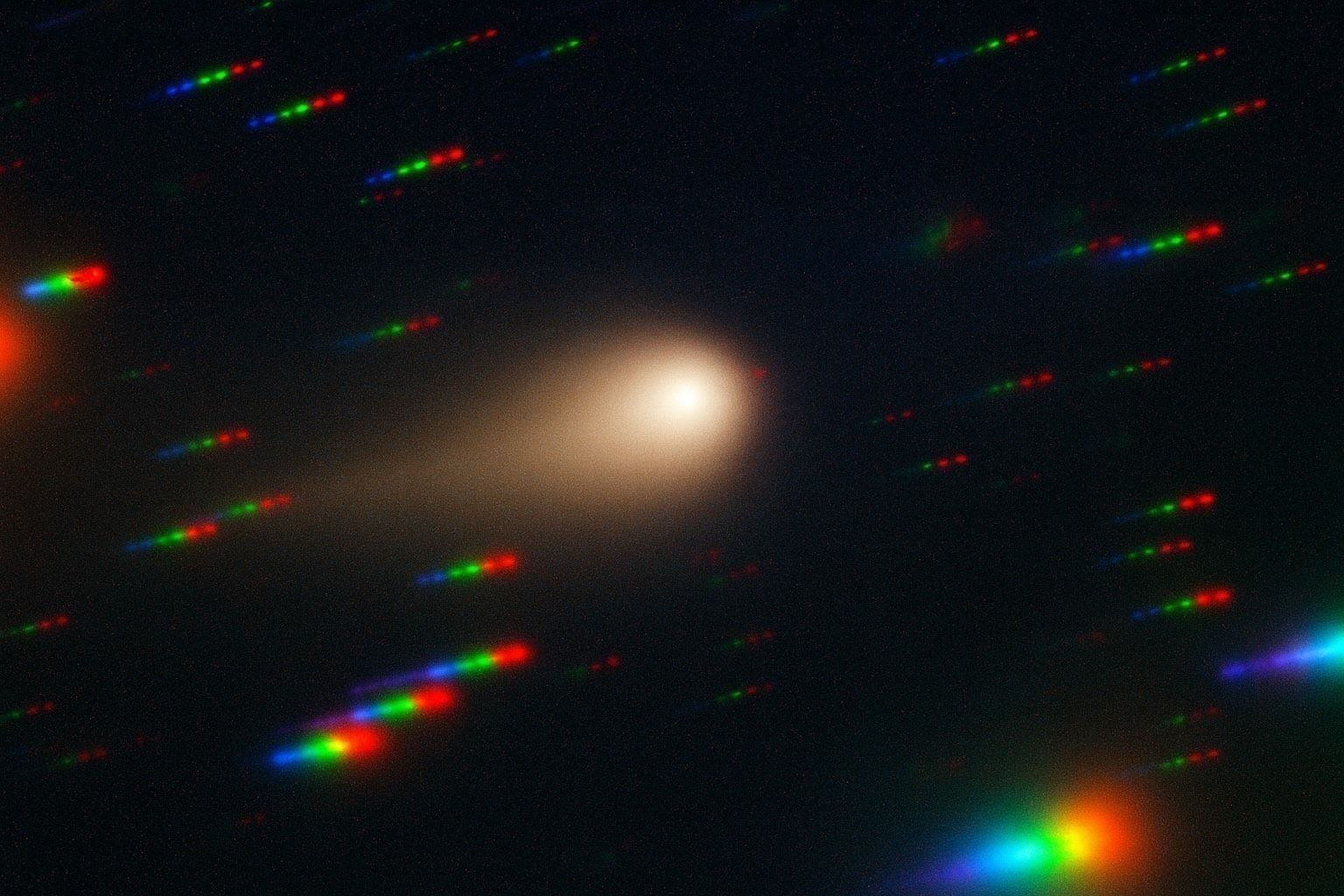
Europa Clipper’s Europa-UVS instrument observed 3I/ATLAS for about seven hours on Nov. 6, 2025, from roughly 102 million miles away, NASA’s Jet Propulsion Laboratory said. A composite image shows gas in blue and green and dust in red, with streaks aligned to the dust and ion tails. Europa Clipper launched in 2024 and is heading to Jupiter, with arrival planned for 2030, JPL said. NASA Jet Propulsion Laboratory (JPL)
Europe’s JUICE mission also watched the comet in November using five instruments and snapped it with its navigation camera, the SETI Institute said in a separate post on Wednesday. The image, taken on Nov. 2, showed the coma and hints of a plasma tail and a dust tail, ahead of JUICE’s Nov. 4 close approach at about 66 million km. SETI Institute
On the radio side, the Breakthrough Listen program aimed the 100-meter Robert C. Byrd Green Bank Telescope at 3I/ATLAS on Dec. 18, a day before the comet’s closest approach to Earth, according to a preprint. The authors reported a nondetection of candidate signals down to the 100 milliwatt level in observations spanning 1–12 gigahertz. After filtering, the analysis left nine events, but all were attributed to radio-frequency interference, and the team said there were no isotropic continuous transmitters above 0.1 watt at the comet’s location. arXiv
Lead researcher Benjamin Jacobson-Bell of the University of California, Berkeley said the null result was the one he expected. “We all would have been thrilled to find technosignatures coming from 3I/ATLAS, but they’re just not there,” he told Space.com. “Its sensitivity enables us to verify the absence of transmitters down to 0.1 watts,” he added. Space
But the science case will not be settled by one pass and a handful of instruments. Ultraviolet and radio data capture only slices of a comet’s behavior, and the same jet of gas can look different when you view it from another angle. For 3I/ATLAS, the downside is simpler: the observing window closes, and some questions — like how its activity evolves as it fades — may stay only partly answered.