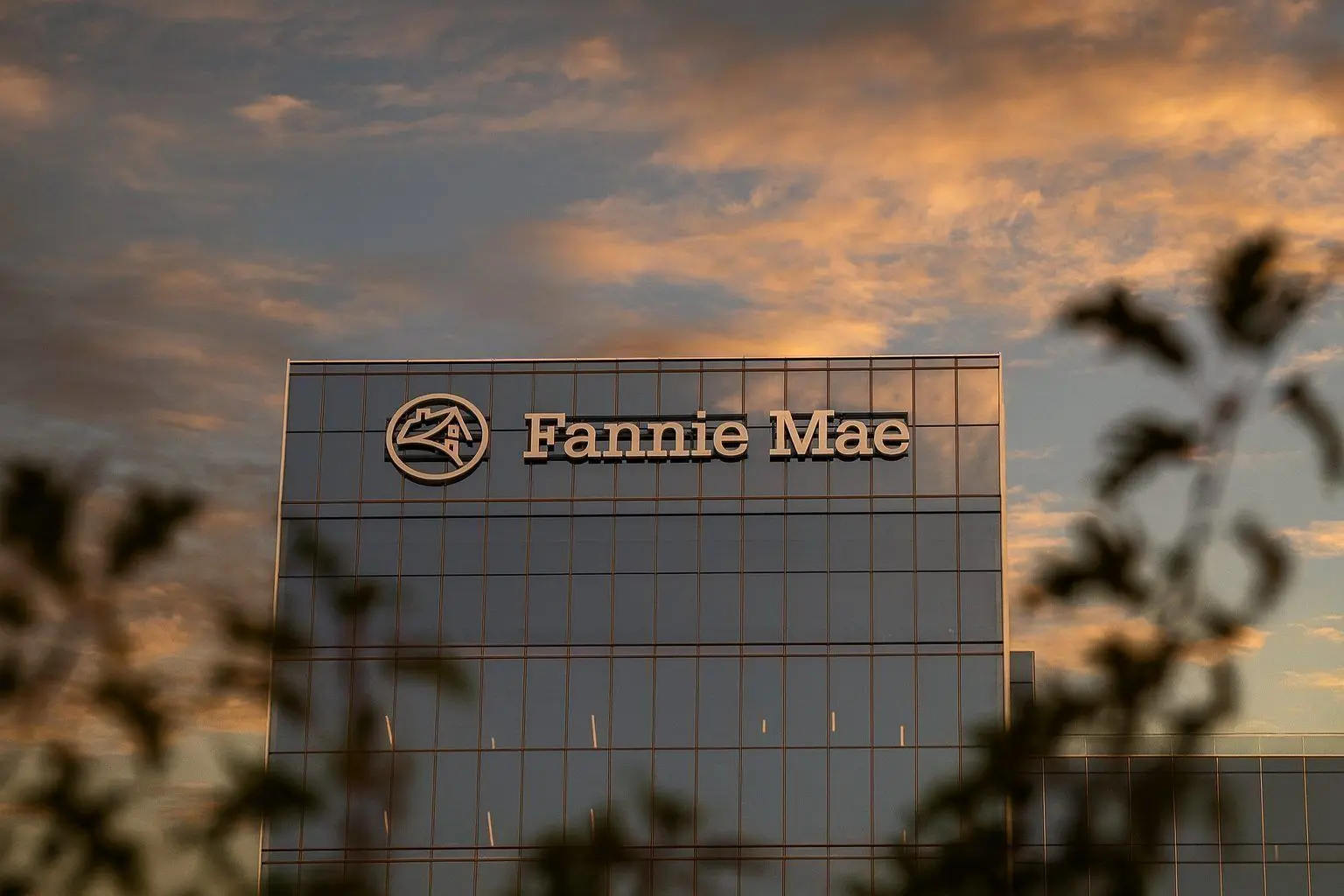
Federal National Mortgage Association — better known as Fannie Mae (OTC: FNMA) — is back in the spotlight. The government‑sponsored mortgage giant’s over‑the‑counter shares have surged again in early December, powered by:
- A highly publicized Michael Burry thesis on relisting Fannie Mae and Freddie Mac
- Ongoing Trump‑era spin‑off talk about taking the GSEs public
- Fresh product and policy changes announced December 10, 2025
- A widening gap between lofty market prices and deeply skeptical valuation models
As of the December 9 close, Fannie Mae’s common stock traded at $11.95, up about 4.5% on the day and roughly 21% over the past two weeks, with intraday highs touching $12.39. StockInvest+1
Fannie Mae’s own investor relations page showed the stock recently quoted around $11–12 on December 10, with daily volume in the low millions of shares. fanniemae.gcs-web.com
Below is a structured overview of all major current news, forecasts and analyses relevant as of December 10, 2025, and what they may mean for FNMA shareholders.
1. Why FNMA Is Moving: Michael Burry + IPO Speculation
Burry’s “good‑size” bet on Fannie Mae
In a detailed ~6,000‑word Substack post published this week, Michael Burry (yes, the Big Short guy) disclosed that he owns a “good size” stake in both Fannie Mae (FNMA) and Freddie Mac (FMCC). Proactiveinvestors NA
Key points from coverage of Burry’s thesis:
- He is bullish on a potential return to major public markets for the GSEs via IPOs, arguing that plans to relist may be getting close. Proactiveinvestors NA+1
- Burry believes that once capital restraints are lifted after IPOs, Fannie and Freddie could accelerate growth naturally, leveraging their dominant market share (roughly 62% of U.S. home loans combined). Proactiveinvestors NA
- However, he also warns that without key regulatory and capital changes — easing capital rules, converting preferred stock to common, and reducing the government’s stake — existing common shares could end up with little economic value. Simply Wall St+1
A fresh analysis from Simply Wall St on December 10 frames the stock this way: to own FNMA today, an investor is essentially betting that Washington eventually loosens the tight conservatorship framework, giving common shareholders a meaningful claim on future profits. Simply Wall St
Trump’s spin‑off comments: the “macro catalyst” in the background
Burry’s thesis sits on top of an already charged political backdrop. On May 22, 2025, Reuters reported that Fannie and Freddie’s OTC shares jumped to their highest levels since 2008 after President Trump said he was seriously considering spinning them off and taking them public, and would discuss the issue with Treasury and FHFA leadership. Reuters
That report highlighted:
- The U.S. Treasury still holds preferred shares and warrants for about 80% of Fannie’s common stock, a legacy of the 2008 bailout. Reuters
- Fannie and Freddie’s OTC shares had already gained over 260% in the past year, much of it following Trump’s election. Reuters
Burry’s entry effectively adds a celebrity catalyst on top of the Trump spin‑off narrative, helping explain why FNMA has ripped higher again in December.
2. Stock Price Snapshot and Technical Picture
Short‑term trading indicators are firmly in “momentum story” territory:
- On December 9, 2025, FNMA gained 4.46% to close at $11.95, with intraday swings between $11.55 and $12.39. Volume jumped to about 8 million shares, roughly 4 million more than the prior day. StockInvest+1
- Over the last 10 trading days, the stock has risen in 7 sessions, leaving it up around 21% in two weeks. StockInvest+1
- Over the last 30 days, FNMA’s range runs from roughly $7.49 on the low end to $12.39 on the high end, with a 52‑week range of about $2.24 to $15.98 — a reminder of how violently this name moves. StockInvest
Technical research site StockInvest.us currently classifies FNMA as a “Buy or Hold candidate” (since December 1), noting that:
- The stock price has broken upward out of a wide, falling short‑term trend, which can be an early sign of a trend reversal.
- Potential support sits near $10.65, with a next possible short‑term trend top projected around $13.61, though there’s no guarantee that level will be reached or held. StockInvest
In other words: this is a momentum trade layered on top of policy roulette.
3. Fundamentals: Q3 2025 Results and Capital Hole
Despite the drama around conservatorship and IPOs, Fannie Mae is still a gigantic, profitable machine.
Earnings and portfolio
Summaries of Fannie Mae’s Q3 2025 earnings call and 10‑Q filing show: GuruFocus+2fanniemae.com+2
- Net income of about $3.9 billion in Q3
- Up 16% versus Q2
- Down about 5% year‑on‑year, mainly because of changes in credit‑loss provisions
- Net revenues around $7.3 billion
- A guaranteed mortgage book of roughly $4.1 trillion, which continues to generate steady guarantee‑fee income
- Net worth of about $105.5 billion
At the same time, Fannie faces a capital deficit of about $25.4 billion relative to the FHFA’s total capital requirements, needing around $190 billion of eligible capital to be fully compliant. GuruFocus
The multifamily segment has seen a modest uptick in seriously delinquent and non‑performing loans, and the single‑family book is slowly shrinking as new acquisitions don’t fully offset runoff. GuruFocus
Product and credit assumptions
Fannie’s Q3 10‑Q includes internal forecasts for 30‑year mortgage rates that hover in the low‑to‑mid‑6% range through 2025–2027, figures used to model future credit losses and prepayment behavior. fanniemae.com
Those assumptions matter because:
- Higher‑for‑longer mortgage rates slow prepayments, prolong exposure to credit risk and can affect home prices.
- Credit loss allowances are very sensitive to both home‑price forecasts and interest‑rate paths, something Fannie itself emphasizes in its risk disclosures. fanniemae.com+1
So beneath the IPO drama sits a very conventional question: can Fannie generate enough sustainable earnings, in a fairly tough rate environment, to fill a very large capital hole?
4. Leadership Shake‑Up: Akwaboah Named Acting CEO
In mid‑November, Fannie Mae announced a major leadership pivot: Peter Akwaboah, a long‑time financial‑services executive, was named Acting CEO while retaining his Chief Operating Officer role. StocksToTrade
Coverage of the changes noted: StocksToTrade+1
- Q3 net income of about $3.86 billion, down from $4.04 billion a year earlier, with revenue near $7.31 billion — figures broadly consistent with Fannie’s own filings.
- Promotions of Jake Williamson and Tom Klein into more senior leadership roles (including responsibilities over Single‑Family and legal functions).
- Akwaboah’s appointment is framed as part of a wider strategy to tighten risk management and push for operational and technological modernization.
For equity holders, the takeaway is less about personalities and more about this signal: Fannie is preparing for some kind of structural transition, whether that’s a long grind under conservatorship or a push toward the public markets.
5. Fresh Policy Moves on December 10, 2025: ARMs, Renovation Loans and More
On December 10, 2025, Fannie Mae made concrete product and policy moves that go well beyond the stock‑ticker drama.
Selling Guide update: HomeStyle Refresh and broader flexibility
In Announcement SEL‑2025‑10, Fannie Mae’s Single‑Family business updated its Selling Guide, including: Fannie Mae
- Launching HomeStyle® Refresh, a rebranded and expanded version of HomeStyle® Energy, with broader financing options and streamlined requirements for energy‑related and improvement projects.
- Expanding upfront disbursements under HomeStyle® Renovation and removing the $50,000 renovation cap for manufactured homes, potentially boosting renovation lending in that segment.
- Clarifying how limited cash‑out refinances can be used to buy out a co‑owner’s interest, potentially smoothing transactions such as divorces or inheritance restructurings.
- Expanding eligibility for accessory dwelling units (ADUs) and manufactured homes, supporting modest infill density and affordability strategies.
- Tightening language and adding resources to reduce fraud, including clearer red flags and documentation expectations.
These changes collectively nudge Fannie toward more flexible, renovation‑friendly and ADU‑friendly lending, while attempting to keep a lid on fraud risk.
Immediate capital‑markets impact: ARMs constraint removed
On the same day, Fannie’s capital‑markets team separately announced that it has removed the 3% “acceptability” test for 7‑ and 10‑year ARMs used in its single‑family mortgage‑backed securities (MBS) program. Fannie Mae
Previously, lenders had to check that the difference between the initial note rate and the fully indexed rate at origination did not exceed 3 percentage points. That cap is now gone, and lenders can take advantage of the change immediately. Fannie Mae
Implications:
- Fannie can be more flexible in buying 7‑ and 10‑year ARMs, potentially supporting a shift away from standard 30‑year fixed loans for some borrowers.
- Depending on future rate paths and underwriting discipline, this could increase pricing competitiveness but also add some interest‑rate and payment‑shock risk to the portfolio.
For FNMA shareholders, these December 10 changes signal that Fannie is actively tuning its product mix to keep volume flowing in a high‑rate world — a necessary move if the company hopes to sustain earnings and justify any future IPO valuation.
6. Regulatory Guardrails: FHFA Caps and the Conservatorship Puzzle
2026 multifamily loan caps
On November 24, 2025, the Federal Housing Finance Agency (FHFA) announced its 2026 multifamily loan purchase caps: FHFA.gov
- $88 billion each for Fannie Mae and Freddie Mac
- $176 billion total across both GSEs
- At least 50% of their multifamily business must be “mission‑driven” affordable housing, with certain workforce‑housing loans excluded from the cap, as in 2025.
These caps:
- Limit how aggressively Fannie can grow multifamily volume, even if demand is strong.
- Reinforce that the GSEs are supposed to be tools of housing policy, not pure profit‑maximizing machines.
Big‑picture on conservatorship and recapitalization
A widely discussed analysis from the University of Florida’s Warrington College of Business, published December 9, 2025, walks through the structural problems of trying to fully “privatize” Fannie and Freddie: UF Warrington College of Business
- The GSEs’ combined mortgage securities and loans total roughly $7.7 trillion, making them the third‑largest issuer of financial securities globally, behind only the U.S. and Japan. UF Warrington College of Business
- They’ve been in FHFA conservatorship since 2008, with Treasury holding senior preferred shares and a large credit line. UF Warrington College of Business+1
- Congressional Budget Office (CBO) estimates suggest that by early 2027, combined GSE equity might be worth around $368 billion, which is not enough to both retire Treasury’s preferred stock and fully capitalize a new private entity. UF Warrington College of Business
The article’s core message: there is no easy path out of conservatorship. Administrative actions can help, but true clarity on any ongoing Treasury guarantee would likely require legislation — something Congress has failed to deliver for more than a decade. UF Warrington College of Business+1
This is exactly the knot that Burry, Trump and Wall Street are pulling on: how do you recapitalize and partially privatize a systemically critical duopoly without either blowing up mortgage costs or handing a massive windfall to existing speculators?
7. Forecasts and Valuation: Numbers All Over the Map
If you’re looking for a clean “fair value” for FNMA, the market has bad news: the range of published estimates is absurdly wide.
Growth forecasts: explosive EPS, modest revenue
Simply Wall St’s “Future Growth” page for Fannie Mae (OTCPK: FNMA.I) currently shows: Simply Wall St
- Earnings growth forecast: about 118% per year
- EPS growth forecast: also about 118% per year
- Revenue growth forecast: only about 1.1% annually
- Sector earnings growth: roughly 9–10% per year
- Analyst coverage: “Low”
High earnings growth with low revenue growth is a clue that forecasts are heavily influenced by capital‑structure assumptions, credit‑loss reversals and margin normalization, not a simple story of top‑line expansion.
DCF view: brutally overvalued
An in‑depth DCF analysis on Sahm Capital, drawing on Simply Wall St cash‑flow projections, reaches a much colder conclusion: Sahm
- Last‑twelve‑month free cash flow (FCF) is estimated around $5.6 billion.
- FCF is projected to decline sharply over the next several years, to about $1.8 billion by 2027, and trending toward just under $1 billion by 2035.
- Discounting those cash flows yields an intrinsic value near $2.00 per share.
- Compared to the current price near $12, the stock looks roughly 350% overvalued by that model.
The verdict there is explicit: OVERVALUED.
GuruFocus snapshot: strong margins, scary multiples
A recent GuruFocus analysis of FNMA, written in the context of IPO speculation, underlines how hard it is to reconcile today’s price with traditional valuation metrics: GuruFocus
- Revenue (trailing twelve months): about $30.1 billion
- Net margin: an eye‑watering ~50%, despite a three‑year earnings growth rate of –53.6%
- Debt‑to‑equity ratio: about 39.9, underscoring very high leverage
- Piotroski F‑score: 4 (only moderate financial health)
- Altman Z‑score: effectively 0, often interpreted as a sign of financial distress risk for ordinary corporates, though GSEs are a special case
- P/E ratio: around 2,800+, thanks to small reported common‑equity and complex capital structure
- P/S ratio: about 2.25, toward the high end of its historical range
- Average analyst recommendation: roughly “Hold”, with an average target price near $12.88
The message: phenomenal reported profitability, but valuation metrics are distorted and fragile.
Market‑based technical forecast
Short‑term technical forecasters like StockInvest.us, which lean more on price action than fundamentals, see FNMA as a short‑term bullish trend with high volatility, support in the low‑$10s and possible resistance in the mid‑$13s, but stress that the current move is already extended after a steep two‑week run. StockInvest+1
8. Data and Transparency: A New Warning Light
In parallel with all the cheerleading about IPOs, a quieter story dropped on December 9 from the National Association of Mortgage Underwriters (NAMU): Fannie Mae and Freddie Mac have been pulling back some of their public data and forecasts. NAMU
Highlights from that op‑ed:
- Fannie and Freddie have paused publication of several longstanding surveys and economic forecasts, including the survey underpinning the Home Purchase Sentiment Index (HPSI), which skipped its usual November release for the first time in over 15 years. NAMU
- Freddie Mac has reportedly stopped issuing its regular economic and housing outlook reports; Fannie’s economic‑research commentary has also gone quiet, with no public forecasts since early 2025, according to the article. NAMU
- Lenders and analysts worry that this creates a “visibility gap” in housing‑market data, especially for smaller lenders that relied on free GSE data.
Fannie Mae’s own website still hosts an Economic & Strategic Research (ESR) forecast page, describing its mission to provide economic and housing‑market forecasts. fanniemae.com
But if NAMU’s reporting is accurate, the volume and timeliness of those public forecasts has declined, just as policy and credit risks are rising.
For equity investors, less public data can mean:
- More uncertainty around Fannie’s internal view of rates, home prices and originations
- Greater reliance on third‑party models and political reading of tea leaves rather than transparent GSE guidance
Which is… exactly the opposite of what you would want if you’re trying to price FNMA based on fundamentals.
9. Key Risks for FNMA Stock Investors
Putting today’s news and forecasts together, FNMA is not a normal “value” stock. It’s a leveraged bet on a political and regulatory outcome. Key risks include:
- Regulatory / policy risk
- FHFA and Treasury control the rules of the game: capital requirements, conservatorship terms, and any IPO structure. Reuters+2UF Warrington College of Business…
- A change in administration or in FHFA leadership can dramatically reshape the path to any relisting.
- Dilution and capital‑structure risk
- Treasury’s warrants for ~80% of common shares and sizeable senior preferred stock mean common shareholders sit at the back of a very long line. Reuters+1
- Many proposed recapitalization paths involve heavy dilution of existing common and preferred holders.
- Valuation risk
- Credible DCF work shows FNMA could be worth a fraction of its current price under conservative assumptions, even while more optimistic models forecast explosive EPS growth. Sahm+2Simply Wall St+2
- The stock’s huge historical volatility and 52‑week range speak for themselves. StockInvest
- Credit and macro risk
- Fannie’s book is enormous and interest‑rate‑sensitive; a combination of home‑price declines and persistent high rates could raise credit losses beyond current allowance models. fanniemae.com+1
- Transparency risk
- If GSE data releases really are being curtailed, investors are flying with less public instrumentation, making mispricing more likely in both directions. NAMU+1
10. Bottom Line: FNMA as a Policy‑Options Trade
As of December 10, 2025, Fannie Mae’s stock embodies a very specific story:
- Bullish narrative:
- Michael Burry’s high‑profile bet and Trump’s spin‑off rhetoric hint that relisting is “nearly upon us”, potentially unlocking value if Treasury loosens its grip and capital rules are eased. Proactiveinvestors NA+2Seeking Alpha+2
- Fannie continues to generate billions in quarterly profit, fine‑tunes its product menu (HomeStyle Refresh, ADUs, ARMs), and operates at the core of a $7+ trillion housing‑finance complex. UF Warrington College of Business+3Fannie …
- Bearish narrative:
- Independent valuation models say current prices bake in aggressive assumptions about recapitalization and growth; some DCFs put fair value near $2 per share versus prices around $11–12. Sahm+2GuruFocus+2
- The capital deficit, high leverage, political uncertainty and possible data pullback make this less a conventional investment and more a binary policy bet. FHFA.gov+3GuruFocus+3NAMU+3
For anyone looking at FNMA today, the critical question isn’t just “Is Fannie Mae a good business?” — it’s “What exactly do I think Washington will do with it?”