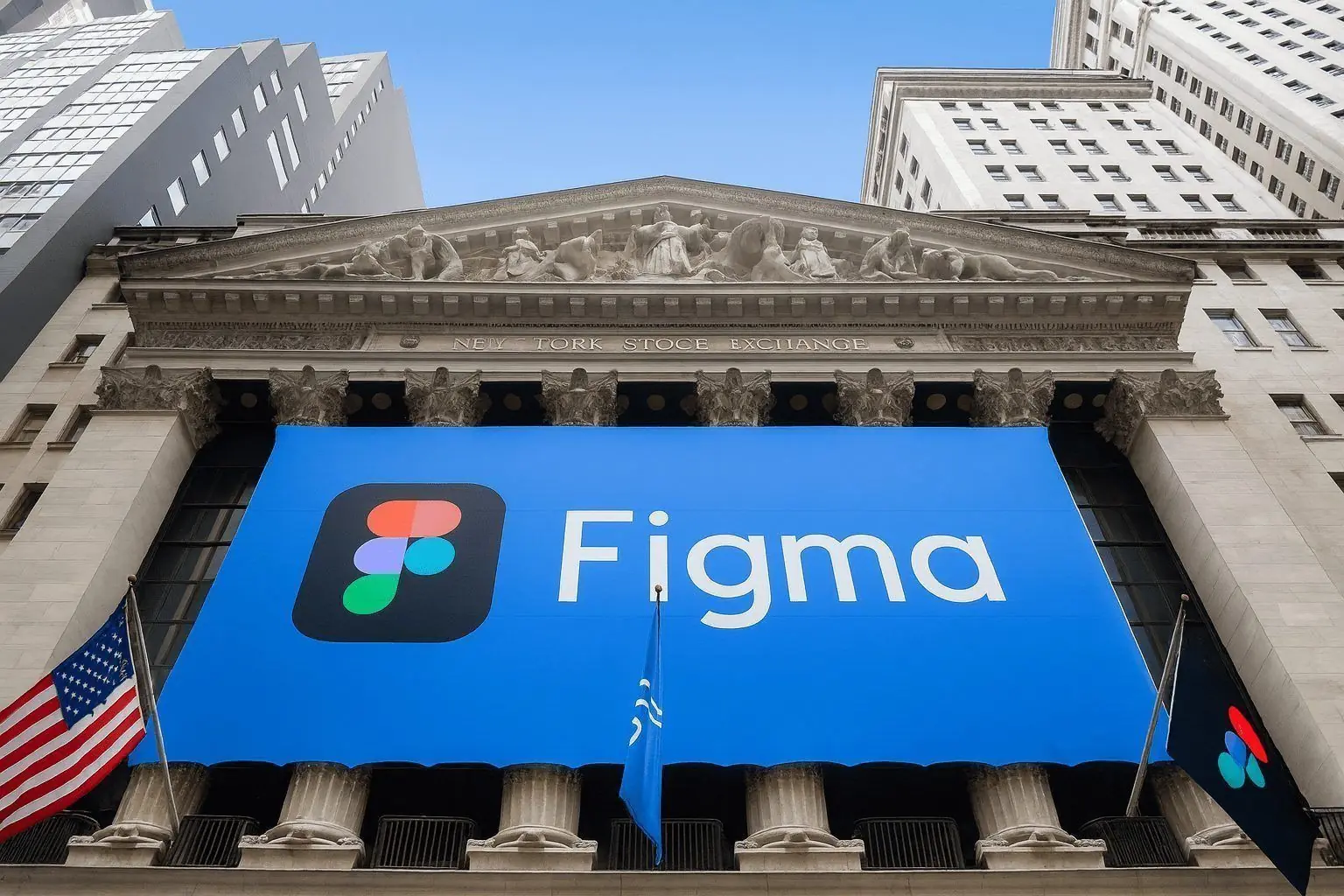
Figma’s blockbuster IPO in July 2025 briefly turned it into one of Wall Street’s hottest AI design plays. Just a few months later, the stock has given up most of those gains, is facing a high‑profile AI data lawsuit, and remains one of the most hotly debated software names on the market.
Below is a deep dive into where Figma stock stands on 2 December 2025, what the latest news and analyst commentary are saying, and how the bull and bear cases are evolving.
Figma stock today: price, valuation and 2025 performance
As of mid‑day on 2 December 2025, Figma (NYSE: FIG) is trading around $36.55 per share. That’s within a daily range of $35.83 to $36.65 and a 52‑week range of $32.83 to $142.92.
At this level, Figma’s market capitalisation is roughly $17.7 billion.
Despite the still‑hefty valuation, the stock has been crushed in recent months:
- A recent Simply Wall St analysis notes that FIG is down about 68.9% in 2025, and estimates a fair value of $19.70 per share based on a discounted cash flow (DCF) model—far below today’s mid‑$30s price.
- Figma’s price‑to‑sales (P/S) ratio is around 17x trailing 12‑month revenue, based on a $36.18 share price and $2.13 in revenue per share.
- A new Motley Fool piece published today argues that after the sell‑off, the stock now trades at roughly 15x expected 2025 revenue, making it cheaper than where it listed but still expensive versus many software peers.
Put simply: Figma stock has de‑rated sharply, but it’s still priced as a premium growth story.
How we got here: From IPO euphoria to a brutal reset
A historic IPO pop
Figma priced its IPO at $33 per share on 31 July 2025. The stock immediately exploded higher, closing its first day at $115.50, a roughly 250% gain and one of the biggest first‑day pops for a US$1 billion‑plus US IPO in decades.
That surge briefly valued Figma at more than $56 billion, putting it in the same league as much older software giants despite being newly public.
Early profit‑taking and a high bar
The comedown started quickly. Just days after the IPO, Reuters reported that Figma shares slumped 23% in a single session on profit‑taking, trimming about $11 billion from its market value as investors questioned how long the early euphoria could last.
By early September, the first earnings report as a public company showed strong but not spectacular growth:
- Q2 2025 revenue: $249.6 million, up 41% year over year, slightly ahead of consensus.
- Adjusted EPS: $0.09 vs. $0.08 expected.
Yet Reuters noted that shares plunged 19% on the day, as investors worried about:
- A valuation that implied nearly 300x forward earnings, far richer than Adobe or the broader market.
- A looming share lock‑up expiration for some employees, which threatened to increase supply and volatility in a relatively small free float.
Q3 2025: Fundamentals shine, stock still struggles
Operationally, Figma has continued to perform well.
In Q3 2025, reported on 5 November, the company delivered:
- Revenue: $274.2 million, up 38% year over year, and ahead of guidance.
- Non‑GAAP operating margin:12%, up from 5% in Q2.
- Annual revenue run‑rate: Crossed $1 billion for the first time.
Management raised full‑year 2025 revenue guidance to roughly $1.044–$1.046 billion, up from a prior range of $1.021–$1.025 billion, and boosted its non‑GAAP operating income outlook as well.
A MarketWatch piece highlighted that Figma’s AI‑driven strategy—especially Figma Make, which turns text prompts into prototypes and apps—helped drive the beat and higher guidance.
However, even after that strong quarter:
- Zacks pointed out that while growth and customer metrics remain robust, valuation concerns and broader tech volatility have kept the stock under pressure.
- By late November, multiple outlets were emphasising that Figma’s share price was down more than 50% from its post‑IPO peak, despite continued execution on the business side.
Fresh headlines on 2 December 2025: AI lawsuit, big drawdown and “bargain” debates
Class action over AI training looms large
One of the most significant new overhangs is legal, not financial.
On 21 November 2025, Reuters reported that Figma was hit with a proposed class action in California federal court, accusing the company of misusing customer designs and data to train its generative AI tools without permission.
Key allegations include:
- Figma allegedly auto‑opted users in to data‑sharing settings that allowed their design files and other intellectual property to be used for AI training, despite prior assurances it wouldn’t exploit customer data for internal purposes.
- The case frames this not just as a copyright issue but as theft of trade secrets and unlawful data access, potentially more serious for enterprise clients.
- Plaintiffs seek monetary damages and a court order stopping Figma from using AI models trained on misappropriated data.
Several follow‑up summaries in the tech and crypto press have amplified the case, stressing that it reflects broader concerns about how SaaS and AI companies use customer content to power generative models.
For a design platform used by big names like Alphabet, Microsoft and Netflix, the optics around data misuse are particularly sensitive.
November pain: Down 28% in a month
A new Motley Fool analysis published 1 December breaks down why Figma stock fell 28% in November.
The author points to several drivers:
- The AI‑data lawsuit, which spooked some institutional investors.
- A broader pullback in richly valued AI and software names, as investors debate whether there’s an AI bubble.
- Lingering worries that Figma’s high valuation leaves little room for error despite strong revenue growth.
In parallel, news aggregation on Yahoo Finance and MarketBeat has been highlighting that Figma shares are down nearly 70% from earlier 2025 highs, as analysts and bloggers debate whether the sell‑off has finally gone too far.
Is the crash an opportunity? New bullish takes today
Two fresh pieces out today are leaning more optimistic:
- “Is This AI Stock the Best Bargain on the Market Right Now?” (The Motley Fool) argues that after its 2025 plunge, Figma now trades at about 15x expected 2025 sales, much lower than during the IPO mania, and that its $1+ billion revenue run‑rate and rapidly growing AI product suite give it years of potential profitable growth.The Motley Fool+1
- “What Makes Figma (FIG) a Good Investment Choice?” (Insider Monkey) highlights that growth‑oriented funds like Baron and Sands Capital see Figma as a core long‑term holding, citing its category leadership in collaborative design and expanding AI functionality.Insider Monkey+1
Both pieces acknowledge that the valuation is still rich and volatility is extreme, but they frame the pullback as a possible entry point for investors with a multi‑year horizon.
What Wall Street and research firms are saying now
Zacks: Growth thesis intact, but rating stays “Hold”
Zacks Equity Research recently published “Figma’s Paid Customer Count Rises: Is the Growth Thesis Strengthening?”, noting that:Zacks+2Finviz+2
- Figma is seeing surging paid customer growth, especially among larger enterprise accounts.
- Adoption of new AI tools is strong, helping to reinforce the platform’s stickiness.
- However, the firm maintains a Zacks Rank #3 (Hold), reflecting concerns about valuation and stiff competition from Adobe, Atlassian and other design and collaboration platforms.
Insider Monkey: “Down 19% Since Q3, Wall Street Remains Bullish”
An Insider Monkey article from 28 November emphasises that, even after the recent drop, sell‑side analysts remain generally positive on Figma.
The piece points out that:
- FIG is still widely owned by high‑conviction tech and growth funds.
- Consensus analyst targets (based on aggregated data) imply upside from current levels, albeit with wide dispersion given the stock’s risk profile.
The Motley Fool: Volatile, but fundamentally strong
Across several Motley Fool articles over the past weeks, a consistent narrative emerges:
- Figma has more than 1,200 customers paying over $100,000 in annual recurring revenue, and over 11,000–13,000 customers paying more than $10,000 annually.
- Net revenue retention among customers with over $10,000 in ARR sits above 130%, a very strong figure in SaaS.
- AI‑driven tools like Figma Make and Figma Weave plus constant feature releases (over 50 new features in Q3 alone) strengthen the moat.
- Several Fool contributors see the stock as overvalued but high‑quality, suggesting it could reward patient investors if growth and margins continue to trend upward.
Under the hood: Figma’s growth, profitability and AI strategy
Revenue and profitability
From its own filings and press releases, Figma’s top‑line trajectory is undeniably impressive:
- Q2 2025: Revenue $249.6 million, up 41% year over year. Non‑GAAP operating margin 5%; free cash flow margin 24%.
- Q3 2025: Revenue $274.2 million, up 38% year over year. Non‑GAAP operating margin 12%; non‑GAAP net income $62.4 million.
The company also reports:
- Strong cash position (over $1.6 billion in cash and securities as of June 30, 2025).
- Increasing operating leverage as revenue scales, despite heavy AI and product investments.
Product and AI roadmap
On the product side, Figma has moved rapidly beyond its original core design tool:
- Figma Make – AI‑powered prototyping that turns natural‑language prompts into layouts and flows.
- Figma Draw, Sites, and Buzz – tools for illustration, live site publishing and marketing assets launched around Q2.
- Figma Weave – an AI‑native creation suite introduced in October, aimed at motion design, video, and VFX workflows.
- Dev Mode MCP server – integrates Figma’s design systems into developer tooling and LLM workflows to generate more context‑aware code.
These launches are central to the bull thesis: they expand Figma’s total addressable market from UI/UX into marketing, engineering and content teams, and deepen its integration into customers’ software development pipelines.
The key risks: Why bears still aren’t convinced
Despite strong operating metrics, a number of serious risks hang over the stock.
1. High valuation even after the crash
- GuruFocus pegs Figma’s P/S ratio at about 17x trailing revenue as of today.
- Simply Wall St’s valuation dashboard shows FIG trading at around 18x sales, well above many software peers, and rates the stock 0/6 on its valuation score, indicating that it appears overvalued on several metrics.
- A recent Yahoo/Simply Wall St article estimates fair value at $19.70 per share, implying the stock still trades at a large premium even after a 68.9% drawdown.
If growth slows or margins disappoint, another leg lower in the multiple is entirely possible.
2. Legal and reputational fallout from the AI data lawsuit
The class action accusing Figma of using customer designs to train AI models without consent could:
- Result in damages or an injunction that limits Figma’s ability to use proprietary data in AI systems.
- Make large enterprises more cautious about standardising on the platform if they’re unsure how their data is being handled.
- Increase compliance and engineering costs at a time when Figma is trying to scale AI features aggressively.
Even if Figma ultimately prevails, the lawsuit adds uncertainty and may slow down some deals.
3. Insider selling and lock‑up overhang
Multiple filings tracked by MarketBeat and other services show heavy insider selling in November, including substantial sales from the CEO and other senior executives as share lock‑ups roll off.
While it’s normal for insiders to take profits after an IPO, the sheer scale of sales—alongside a still‑limited free float—can weigh on price and amplify volatility.
4. Competitive pressure in design and collaboration
Figma’s biggest threats aren’t just legal or macro:
- Adobe remains a formidable rival and is building its own AI‑powered design features.
- Tools like Canva, Atlassian’s collaboration stack, and up‑and‑coming web and product‑design platforms are all targeting overlapping budgets.
Several analyst notes and articles stress that Figma must keep innovating quickly to maintain its lead, especially as AI could lower switching costs for some design workflows.
The bull case: Why some see a long‑term winner
Even after the slump, Figma has attributes that bulls love:
- Category leadership & network effects – Third‑party estimates cited by investment articles suggest Figma holds more than 40% market share in its niche, with Adobe XD a distant second.
- Sticky, expanding customer base – Net retention above 130% among larger customers and strong growth in six‑figure ARR accounts show that existing users are spending more over time.
- Profitable growth – Figma is already non‑GAAP profitable with rising margins, a rarity among recent software IPOs.
- AI as an accelerant, not a threat – Bulls argue that Figma’s AI tools will make designers and product teams more productive while deepening reliance on its ecosystem, rather than commoditising its core value.
- High‑conviction institutional holders – Funds profiled by Insider Monkey and other sources (such as Baron and Sands Capital) have highlighted Figma in their shareholder letters as a structural winner in digital product creation.
From this perspective, today’s lower multiple looks like a reset from “bubble” pricing to “just aggressive,” rather than the end of the story.
The bear case: Why caution (or avoidance) still makes sense
Sceptics counter with several points:
- Even after the sell‑off, valuation screens as expensive versus the broader software sector, leaving little margin of safety.
- The AI data lawsuit creates headline and regulatory risk that could spook enterprise buyers and constrain Figma’s ability to fully leverage user data.
- Volatility is extreme, with the stock swinging double digits on relatively modest news. Lock‑up expiries and insider sales can exacerbate these moves.
- Competitive threats—from Adobe’s AI push to new wave tools and open‑source alternatives—could compress pricing power over time.
A Yahoo/Simply Wall St note even suggests that, based on its DCF work, Figma could need years of flawless execution and sustained high growth to justify the current price, reinforcing the idea that the risk/reward might still be skewed to the downside for conservative investors.
2026 outlook: What the latest forecasts imply
Looking ahead:
- Figma itself is guiding for full‑year 2025 revenue just above $1.04 billion, with a meaningful uplift in expected non‑GAAP operating income versus earlier guidance.
- Analyst round‑ups referenced by Nasdaq and Insider Monkey note that the median 12‑month price target is still above the current share price, suggesting Wall Street expects a rebound over the next year, albeit with significant uncertainty.
- At the same time, Simply Wall St and other valuation‑focused platforms continue to flag FIG as overvalued relative to their fair‑value models, highlighting a wide gap between growth‑story optimism and DCF‑style conservatism.
In other words, the 2026 narrative hinges on your time horizon and risk tolerance:
- If you believe Figma can sustain 30%‑plus revenue growth, expand margins, and maintain its design and collaboration dominance, the current pullback may indeed look like a multi‑year buying opportunity.
- If you’re sceptical about premium valuations in a higher‑rate world, worried about legal risk around AI, or cautious about AI‑bubble dynamics, there are safer ways to play software and AI.
Bottom line: How to think about Figma stock right now
On 2 December 2025, Figma stock sits at a crossroads:
- Business: growing fast, increasingly profitable, and innovating aggressively in AI.
- Stock: down nearly 70% from its highs, still richly valued, and overshadowed by legal and technical overhangs.
For long‑term, high‑risk investors, the combination of category leadership, strong execution and a now‑lower (if still expensive) multiple may justify a small, speculative position.
For more conservative investors, Figma looks like a name to watch rather than chase—at least until the AI lawsuit and valuation picture become clearer.
Important: This article is for informational purposes only and does not constitute financial advice. Always do your own research or consult a licensed financial adviser before making investment decisions.