
NEW YORK, Dec. 27, 2025, 6:25 p.m. ET — Market closed (weekend)
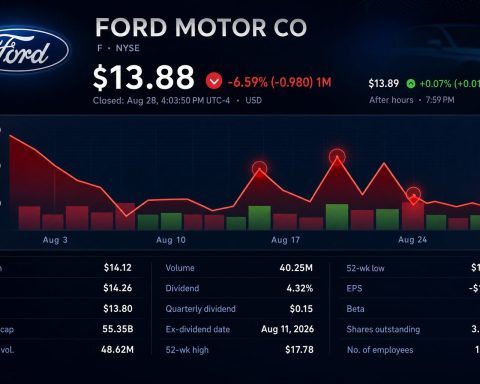
Ford Motor Company shares are heading into the final trading days of 2025 on steady footing after a quiet post-Christmas stretch for U.S. equities. Ford stock NYSE:F last traded at $13.31, down about 0.41% from the prior close, with roughly 22.5 million shares changing hands in the most recent session.
The broader market tone has been similarly muted as traders navigate thin year-end liquidity: large index-tracking ETFs tied to the S&P 500, Nasdaq-100, and Dow finished the latest session little changed.
With U.S. stock exchanges closed for the weekend, investors in Ford are digesting a tight cluster of developments from the last 24–48 hours—particularly around quality/recall scrutiny, EV supply-chain headlines, and fresh “buy” commentary from at least one research provider—while also weighing Ford’s larger strategic pivot toward trucks, hybrids, and extended-range EVs.
What’s driving Ford stock this weekend
1) Recall headlines keep quality in the spotlight
A major talking point over the past two days has been Ford’s outsized recall count in 2025. Fox Business, citing National Highway Traffic Safety Administration (NHTSA) data, reported that Ford logged 152 recalls during the year, far more than any other automaker mentioned in the report. The article frames the tally as a quality overhang and notes multiple recent recall actions across models.
Ford’s response in the same report is important for investors: the company said the number of vehicles recalled reflects an “intensive strategy to quickly find and fix” issues and highlighted that it has more than doubled its team of safety and technical experts over the past two years. Fox Business
Why it matters for the stock: recalls can pressure profitability through warranty costs, repairs, logistics, and reputational impact, but proactive fixes can also reduce regulatory risk and potentially limit longer-term damage. Markets tend to react most strongly when recall actions are unexpectedly large, involve high-margin vehicles, or signal deeper manufacturing/design problems.
2) Battery-industry contract cancellations ripple back to Ford’s EV reset
Reuters reported Friday that South Korea’s LG Energy Solution (LGES) canceled a large battery contract with Freudenberg Battery Power Systems—part of a broader string of battery-industry resets. Reuters also noted that LGES had recently lost a major battery deal with Ford amid Ford’s EV pullback and changing policy backdrop, linking the development to shifting demand and investment assumptions in the EV supply chain.
For Ford shareholders, the key takeaway isn’t that this specific LGES-Freudenberg cancellation directly changes Ford’s near-term deliveries. It’s that it reinforces the broader theme: the EV buildout is being recalibrated across the ecosystem, and Ford’s capital allocation decisions are increasingly judged on whether they protect cash flow and margins while still preserving a credible path to electrification.
3) A weekend “upgrade,” but consensus remains cautious
On Saturday, MarketBeat reported that Wall Street Zen upgraded Ford from “Hold” to “Buy.” At the same time, the report emphasized that overall analyst sentiment remains mixed, with Ford still broadly viewed as a “Hold” across the street and an average target below current levels in its summary data. MarketBeat
This kind of upgrade can help keep retail attention on the name—especially in a low-news, year-end environment—but institutional investors typically anchor more heavily to Ford’s execution milestones (pricing discipline, quality metrics, hybrid mix, Ford Pro margins, and EV loss trajectory) than to a single rating change.
The bigger backdrop: Ford’s strategic pivot and why it still matters for valuation
Ford’s stock narrative into early 2026 is still heavily influenced by the company’s December decision to redeploy capital toward higher-return areas and step back from select larger EV programs where management said the business case eroded.
In an official Ford release detailing the plan, CEO Jim Farley called the move a “customer-driven shift” aimed at a stronger, more profitable Ford, with emphasis on Ford Pro, trucks and vans, hybrids, and a new battery energy storage business. Ford From the Road
Key points Ford put on the record:
- Ford expects to record about $19.5 billion in EV-related special items, with about $5.5 billion of cash effects, largely in 2026 and the remainder in 2027.
- The company raised 2025 adjusted EBIT guidance to about $7 billion and reaffirmed adjusted free cash flow guidance, trending toward the high end of $2 billion to $3 billion.
- Ford said it plans to report Q4 and full-year 2025 results on Tuesday, Feb. 10—a key near-term catalyst for the stock.
Reuters’ reporting on Ford’s EV retrenchment also underscores how much the policy and demand environment has shifted; Reuters quoted Farley saying changes over recent months helped drive the decision, and described Ford’s move toward an extended-range approach for the F-150 Lightning alongside canceling several next-gen EV projects.
Ford executives also highlighted product-level intent: Doug Field, Ford’s chief EV, digital and design officer, described an extended-range next-generation Lightning concept with a “700+ mile range” estimate in Ford’s release. Ford From the Road
Analyst targets and forecasts: where Wall Street sees Ford heading
Consensus remains notably restrained versus the current share price.
StockAnalysis data shows Ford with a consensus “Hold” rating and a price target around $12.23, implying downside from the latest trade near $13.31. StockAnalysis
However, several widely followed analysts have lifted targets in recent weeks while still maintaining more neutral stances—an important nuance for investors:
- Chris McNally (Evercore ISI): maintained Hold while lifting target $12 → $14 (dated Dec. 22, 2025).
- Adam Jonas (Morgan Stanley): maintained Hold/Equal Weight while lifting target $11 → $14 (dated Dec. 8, 2025).
The pattern suggests analysts may be acknowledging improved near-term fundamentals (or a more defensible capital plan) without fully embracing a re-rating—often because Ford is still perceived as vulnerable to cyclical demand, pricing pressure, and execution risk tied to recalls and EV losses.
What investors should watch before the next session
U.S. equities reopen Monday, and the NYSE core trading session runs 9:30 a.m. to 4:00 p.m. ET. New York Stock Exchange With only a handful of sessions left in the year, headlines can move stocks more than usual simply because liquidity is thinner.
Here are the most practical items Ford investors may want on their checklist before Monday’s open:
- Any weekend follow-ups on recalls, investigations, or remedies
The market reaction to recall news depends on whether updates suggest an isolated fix—or broader quality-system strain. The “152 recalls” narrative is already in circulation, so incremental developments (new models added, larger unit counts, or regulator escalation) would be the swing factor. Fox Business - EV demand and policy sensitivity remains central to the thesis
Reuters tied Ford’s EV pullback to weakening EV demand and policy conditions impacting incentives and industry planning. If new policy signals emerge, they can quickly shift sentiment on Ford’s EV profitability timeline and capital spending expectations. - The next hard catalyst: Feb. 10 earnings
Ford itself has pointed investors to Feb. 10 for Q4/full-year results. That report is likely to sharpen guidance around cash flow, quality costs, and how quickly the company expects improvement in Model e losses under the new strategy. - Year-end market mechanics and the holiday schedule
Traders are heading into the final week of 2025 with New Year-related closures ahead. Investopedia reports U.S. stock markets are closed on Thursday, Jan. 1, 2026 (New Year’s Day). Investopedia This matters because shortened windows can amplify volatility in single names on incremental headlines.
Bottom line for Ford stock heading into Monday
Ford enters the next session balancing three forces:
- Supportive: a clearer “profit-first” strategy centered on trucks, hybrids, commercial (Ford Pro), and disciplined EV spending, with updated guidance and defined timing for the next earnings catalyst. Ford From the Road+1
- Challenging: ongoing quality and recall scrutiny that can weigh on margins and investor confidence, particularly if it translates into higher costs or brand pressure.
- Mixed sentiment: analysts are lifting some targets, but overall consensus remains “Hold” with targets clustering below the current price—suggesting the market wants proof of execution before paying a higher multiple. StockAnalysis
As markets reopen, Ford investors will be watching whether the stock can hold above the mid-$13 range on light year-end volume—or whether recall concerns and EV supply-chain uncertainty reassert themselves as the dominant narrative.
Related articles: NYSE:F