
New York, June 1, 2026, 05:02 EDT
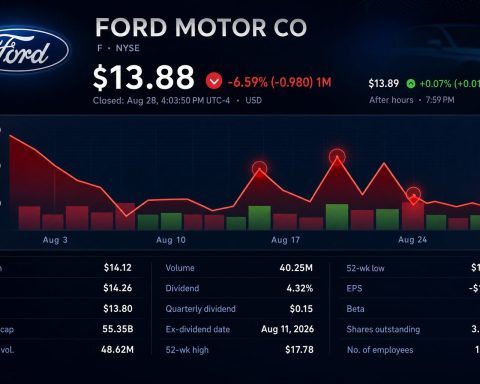
- Ford was last at $17.44. Shares closed up 4.74% on Friday, with investors buying after news on Ford Energy, the company’s battery storage unit.
- Ford Energy signed its first big customer deal, with EDF power solutions North America agreeing to buy up to 4 GWh a year—or 20 GWh total across five years—beginning in 2028.
- Ford gets an AI angle with the move, though it still faces high factory conversion costs, soft EV demand and ongoing battery supply risks from China.
Ford Motor stock traded at $17.44 ahead of the U.S. open Monday, sitting close to its high from late May after jumping Friday. Investors are still looking at the Dearborn company as more than just another cyclical car maker, with some treating it as a candidate in power infrastructure. At the latest level, Ford’s market cap was around $71 billion.
The stock’s move lately is less about F-150s and more about Ford Energy, the automaker’s new unit focused on battery energy storage systems, or BESS. These are big batteries used to store power and send it out when demand jumps or the grid gets stressed.
Ford Energy and EDF power solutions North America signed a five-year framework deal on May 18. EDF can get up to 4 GWh per year of Ford Energy DC Block systems for a total of 20 GWh. Deliveries start in 2028.
Data centers are the hook. Reuters said AI is driving more data center operators to look at backup and grid-support setups, as automakers aim to make use of battery networks first built for EVs.
Stocks ticked up on Friday. The S&P 500 added 0.2%, notching a ninth week in a row of gains. The Nasdaq rose 0.2%. The Dow finished 0.7% higher.
Morgan Stanley analyst Andrew Percoco said Ford could win energy-storage supply deals with “large commercial customers, and potentially hyperscalers,” the Economic Times reported, citing Bloomberg. Percoco called Ford’s partnership with CATL an “underappreciated strategic competitive advantage” for its storage efforts. The Economic Times
Ford Energy president Lisa Drake said the EDF deal pointed to demand for a BESS supplier that can handle industrial-scale output and offer support for the entire life cycle. “We’re not simply delivering hardware,” Drake said. EDF power solutions North America CEO Tristan Grimbert said the pact gave EDF “supply visibility and product confidence.” Business Wire
Ford is giving bulls some reasons to stay bullish on its core operations. The automaker posted first-quarter revenue of $43.3 billion, net income of $2.5 billion, and adjusted EBIT of $3.5 billion. Ford lifted its full-year adjusted EBIT outlook to between $8.5 billion and $10.5 billion. “The path to higher margins is clear,” CFO Sherry House said. Q4 Communications
Tesla is ahead in grid batteries, but that’s not the whole story. Reuters has reported legacy carmakers are still trying to catch Tesla’s storage unit, which is set to be more profitable than its EV arm in 2025. GM faces the same pressure from slowing EV battery demand. On Friday, Reuters said a GM-LG battery plant in Ohio held off bringing back hundreds of workers, citing weak demand for electric vehicles.
Execution is key here, not just having a good story. Reuters said it can take up to 18 months and cost several hundred million dollars to switch battery plants to lithium iron phosphate (LFP), the iron-based chemistry that’s cheaper and now common in storage. Reuters also noted that storage demand won’t soak up all the extra EV battery capacity carmakers have built. Ford still expects its Model e unit to lose $4.0 billion to $4.5 billion this year, with commodity headwinds around $2 billion and tariff costs near $1 billion, not counting a one-time tariff benefit.
Ford’s next challenge comes down to locking in real orders and margins off a framework deal that has analysts optimistic. The key will be on-time deliveries. For now, Ford shares are moving like the market thinks the company has revived an EV investment cycle that seemed like a drag just months back.
Related articles: NYSE:F