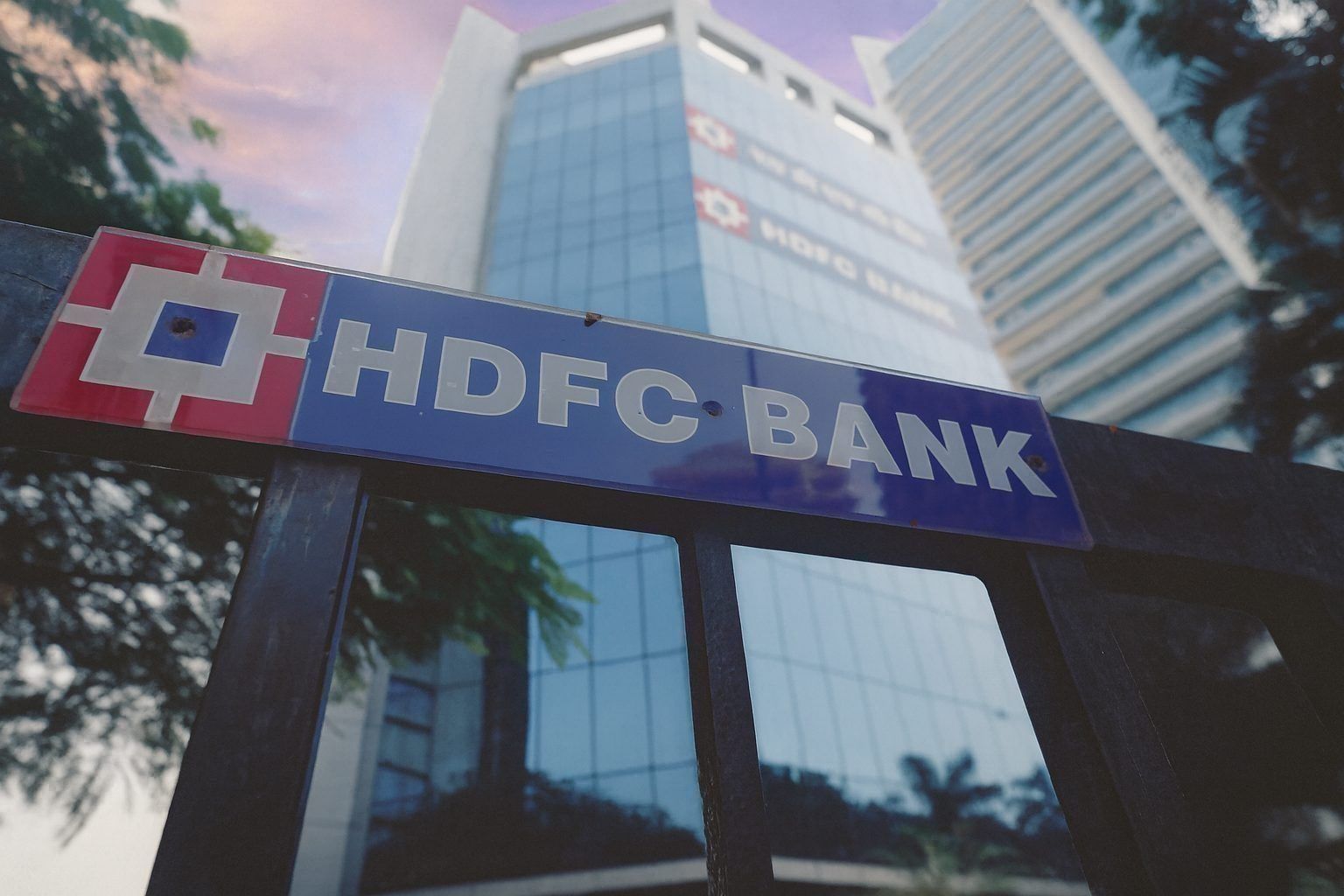
HDFC Bank Limited’s stock is hovering around the ₹1,000 mark on 9 December 2025, trading just below its all‑time high while sitting at the centre of India’s new rate‑cut cycle and a wave of bullish analyst forecasts. Here’s a deep dive into what’s driving HDFC Bank’s share price today, and how the latest news, forecasts and analyses fit together.
HDFC Bank share price today: steady around ₹1,000, near record highs
On the BSE, HDFC Bank (BSE: 500180, NSE: HDFCBANK) was quoted at about ₹1,000.95, down roughly 0.2% by late morning on 9 December 2025.Business Standard
The Economic Times liveblog shows intraday ticks around ₹1,002–1,003, with a one‑year return of just over 7%, a price‑to‑earnings (P/E) ratio near 21x, earnings per share (EPS) of about ₹47, and a six‑month beta of 0.89, indicating relatively stable behaviour versus the broader market.The Economic Times
Key price stats as of 9 December 2025:Business Standard+1
- Last traded (India): ~₹1,000–1,005
- 52‑week high: ~₹1,020 (also an all‑time high, hit in late October 2025)
- 52‑week low: ~₹812 (January 2025)
- 1‑year return: ~7–7.5%
- Market cap (India): ≈ ₹15.4 trillion (₹15.39–15.41 lakh crore)
- TTM EPS (consolidated): ~₹48.8
- P/E: ~20–21x
- P/B (price to book): ~2.8–3.0x
- Dividend yield: ~1.1%
In short: the stock is not exploding higher, but it is quietly parked near record territory, delivering mid‑single‑digit returns over the last year while the market digests a big merger, a rate‑cutting central bank and evolving regulatory scrutiny.
HDFC Bank ADR: U.S. investors see ~20% upside
For global investors, HDFC Bank trades on the NYSE under ticker HDB. As of early 9 December 2025 (India time), the ADR was around $35.16, down about 1.6% on the day, with a 52‑week range of $28.89–39.81.INDmoney
INDmoney’s aggregation of Wall Street analysts shows:INDmoney
- Analyst recommendation: 89.8% Buy, 10.2% Hold, 0% Sell (49 analysts)
- Average 12‑month target price: $43.92
- Implied upside from current levels: ~20%
The ADR therefore tells a similar story to the local shares: not distressed, not euphoric, but priced for quality with expectations of mid‑teens to low‑20s percentage upside over the next year.
Macro backdrop: RBI’s December rate cut and “too big to fail” status
RBI cuts rates and boosts liquidity
On 5 December 2025, the Reserve Bank of India cut the repo rate by 25 basis points to 5.25% and announced liquidity‑boosting operations of up to $16 billion equivalent, citing strong growth and unusually low inflation.Reuters
- The Monetary Policy Committee voted unanimously for the cut.
- RBI kept a “neutral” stance, leaving room for further easing if inflation stays below target.Reuters
- Economists highlight October retail inflation around 0.25% and Q2 FY26 GDP growth near 8.2%, giving RBI room to prioritise growth support.Forbes India
From a bank‑stock perspective, this is the classic “good but slightly uncomfortable” cocktail:
- Lower rates and more liquidity support loan growth, especially mortgages and consumption credit.
- But net interest margins (NIMs) can be squeezed in the near term, because lending rates adjust faster than deposit costs.
For a franchise like HDFC Bank, which already runs at scale and has a sticky retail deposit base, the market tends to treat rate cuts as a short‑term margin headwind, medium‑term growth tailwind – which is exactly how many broker notes are currently framing it.
Reaffirmed as a Domestic Systemically Important Bank (D‑SIB)
On 2 December 2025, RBI once again named HDFC Bank, SBI and ICICI Bank as Domestic Systemically Important Banks. HDFC Bank must maintain an extra 0.4% CET1 (core equity) buffer over the standard capital conservation buffer, a surcharge level raised from 0.2% in April 2025.TechStock²
This means two things:
- HDFC Bank is officially “too big to fail” in the Indian context.
- Regulators expect it to run with very strong capital ratios, which it already does – with capital adequacy near 20% and CET1 around 17.5%, well above regulatory minima.TechStock²
For equity holders, the D‑SIB tag is a double‑edged sword: it anchors perceptions of safety but also implies constant regulatory scrutiny.
RBI penalty: small cheque, loud signal
On 28 November 2025, RBI imposed a ₹91 lakh monetary penalty on HDFC Bank for several compliance breaches, including:The Economic Times+1
- Using multiple benchmarks within the same loan category
- A wholly owned subsidiary engaging in non‑permitted business
- Outsourcing certain KYC‑compliance tasks to external agents
The order emphasised that this action addresses compliance, not the validity of customer transactions. Financially, ₹91 lakh is microscopic relative to quarterly profits of over ₹18,000–20,000 crore, but it reinforces a recurring theme: RBI is watching large banks closely, particularly after the HDFC–HDFC Bank merger.
For investors, the penalty is less about the cheque and more about a reminder on governance and operational discipline.
Q2 FY26 results: double‑digit profit growth, softer margins, clean book
HDFC Bank’s latest quarterly numbers – for Q2 FY26 (July–September 2025) – were released on 18 October 2025 and form the backbone of most current analyst models.Upstox – Online Stock and Share Trading+2F…
Profit and revenue: strong, not spectacular
Across company disclosures and financial press reports:Upstox – Online Stock and Share Trading+2F…
- Standalone net profit: ~₹18,641 crore, up 10.8–11% YoY
- Consolidated net profit: ~₹20,364 crore, up about 9–9.5% YoY
- Net interest income (NII): ~₹31,550–31,552 crore, up ~4.8–5% YoY
- Net revenue: ~₹45,900 crore, up ~10.3% YoY
- Non‑interest income: up roughly 25% YoY to ~₹14,350 crore, driven by fee and trading income
So profits are comfortably in double‑digit growth territory, but NII is growing more slowly than the loan book – a key reason why markets obsess over margins.
Margins: the main sore point
The net interest margin (NIM) for Q2 FY26 came in around 3.27–3.3%, down from about 3.35–3.5% a year earlier and slightly below the immediately preceding quarter.Fortune India+2HDFC Bank+2
That might sound like a tiny change, but for a large bank, every few basis points of NIM translate into thousands of crores in earnings. Analysts widely describe this as a “margin adjustment phase” rather than a structural breakdown, but it remains the biggest talking point in institutional research.
Loan and deposit growth: still robust
Despite margin pressure, growth metrics remain healthy:Fortune India+2HDFC Bank+2
- Loan book growth: around 9–10% YoY, with solid traction in retail and small/mid‑market segments
- Average deposits: up ~15% YoY to roughly ₹27.1 lakh crore
- Average CASA (current and savings account) deposits: up ~8.5% YoY to about ₹8.77 lakh crore
The bank continues to lean on granular retail deposits – a key competitive advantage in an environment where funding costs can swing quickly.
Asset quality and capital: textbook‑clean
Q2 FY26 once again showcased HDFC Bank’s historically strong balance sheet.Smart Investing+3Upstox – Online Stock and…
- Gross NPA ratio: ~1.24%, down from about 1.36% a year earlier
- Net NPA: roughly 0.4–0.42%
- Provisions: up about 30% YoY to ~₹3,500 crore, including fresh floating provisions of ₹9,000 crore
- Return on assets (RoA): around 1.8–1.9%
- Return on equity (ROE): ~14–15%
- Capital adequacy ratio: near 20%, with CET1 ~17.5%
Data providers like Smart‑Investing also show consolidated net NPA ratios trending near zero for FY25 at the group level, underlining the bank’s reputation for a clean book.Smart Investing
The combined picture: growth is solid, margins are under pressure, but credit quality and capital remain best‑in‑class by Indian standards.
Valuation: high‑quality bank at a modest discount to fair value models
Market multiples
On current numbers, HDFC Bank trades at:Business Standard+1
- P/E (trailing, consolidated): ~20–21x
- P/B: ~2.8–3.0x
- P/S (price‑to‑sales): ~4.5x
That’s a clear premium to the broader Indian banking sector, where many lenders sit in the high‑single‑digit P/E range. Investors have historically accepted this premium because of HDFC Bank’s consistent growth, asset quality and governance record.
Intrinsic value estimates
What do fair‑value models say?
- Smart‑Investing estimates HDFC Bank’s median intrinsic value around ₹1,198 per share (based on a blend of EV/EBITDA, EV/Sales and Price/Sales models). At recent prices, it sees the stock trading at about a 16% discount to this intrinsic value.Smart Investing
- Simply Wall St pegs a fair value near ₹1.14k, implying roughly 10–12% undervaluation versus the current price.Simply Wall St
Both platforms stress that “fair value” is an estimate, not a recommendation – but the rough message is consistent: HDFC Bank is not cheap vs peers, but not obviously over‑priced versus its own fundamentals.
Analyst forecasts and stock‑picking lists as of 9 December 2025
Domestic analyst consensus: low‑teens upside
Compilations from broker and data sites (as summarised in early‑December research rundowns) show a broadly bullish sell‑side stance:TechStock²
- Trendlyne:
- Average target: ~₹1,125
- Based on 27 reports from ~10 analysts
- Implied upside: ~12% from ~₹1,000
- Investing.com (India):
- Around 39 analysts in sample
- Average 12‑month target: ~₹1,164 (range roughly ₹1,046–1,400)
- Overall recommendation: “Strong Buy” (majority “buy” or “strong buy”, very few “hold”, no “sell”)
- Livemint’s stock page similarly counts nearly 40 analysts on coverage, with a heavy skew toward buy recommendations.TechStock²+1
In late‑November commentary, Macquarie reiterated an “Outperform” rating with a target near ₹1,200, arguing that: loan growth should run ahead of the system by FY27, provisioning buffers are robust, and India’s shift to expected‑credit‑loss norms shouldn’t derail earnings.TechStock²
Taken together, most mainstream houses sit in the ₹1,100–1,200 target range – implying low‑to‑mid‑teens upside over 12 months, assuming no major negative surprise on margins or asset quality.
Axis Securities’ December picks: HDFC Bank in the large‑cap core
On the morning of 9 December 2025, Axis Securities published its high‑conviction stock picks for December, projecting a Nifty 50 target of 29,500 by December 2026 in a favourable “Goldilocks” scenario. HDFC Bank features among its top large‑cap ideas, alongside Bajaj Finance, Bharti Airtel, Avenue Supermarts and SBI.mint
Axis’ thesis highlights:mint
- Financials (including big private banks) as key drivers of Nifty earnings growth, estimated at 13% CAGR over FY23–28
- Preference for quality, growth and domestic cyclicals, with BFSI at the centre of that basket
- A view that India’s improving macro, rate cuts and fiscal tailwinds should favour well‑capitalised lenders like HDFC Bank
The takeaway from brokerage desks: HDFC Bank remains a “core holding” type stock in most portfolio strategies rather than a speculative play.
Global ADR consensus: still bullish
As noted earlier, ADR‑focused data from INDmoney shows:INDmoney
- Average target: $43.92
- Current price: around $35.16
- Implied upside: just under 20%
- Analyst stance: overwhelmingly Buy, with no Sell ratings in the sample
The overseas narrative largely mirrors domestic research: excellent franchise, cyclical margin pressure, premium valuation – but still room for mid‑teens or better total return if growth and asset quality hold.
Technical picture: support near ₹986, resistance around ₹1,020
Short‑term traders are watching well‑defined levels.
A weekly outlook from EquityPandit for 8–12 December 2025 notes that HDFC Bank fell about 1.4% in the previous week, and pegs:Equitypandit+1
- Immediate support: ₹986.4
- Major support: ₹969.4
- Immediate resistance: ₹1,018.9
- Major resistance: ₹1,034.4
- Expected weekly trading band: roughly ₹954–1,051
The Economic Times liveblog adds some useful context:
- One‑month return around 2.1–2.2%
- One‑year return near 7%
- Six‑month beta ~0.89, signalling that the stock tends to move less than the market in either direction.The Economic Times
Put together, the technicals say: trend still up, volatility moderate, and the ₹986–970 zone is where dip buyers are likely to get interested, while the ₹1,020–1,035 band is the ceiling bulls need to convincingly break.
Key risks investors are watching
Even in a broadly bullish consensus, several risk factors recur in current news, broker notes and quant screens:Simply Wall St+4TechStock²+4The Economic T…
- Net interest margin (NIM) pressure
- NIM has slipped into the low‑3.3% area, down from mid‑3s.
- The December RBI rate cut is good for growth but can compress margins further if deposit repricing lags again.
- Regulatory and compliance scrutiny
- The ₹91 lakh RBI penalty is tiny in rupee terms but signals closer examination of interest‑rate practices, outsourcing and KYC processes.
- Post‑merger, the entire HDFC group is under a brighter spotlight, and markets tend to punish any hint of governance slippage.
- Valuation risk
- At ~20–21x trailing earnings and nearly 3x book, HDFC Bank trades at a significant premium to most Indian banks.
- Intrinsic‑value models (Smart‑Investing, Simply Wall St) see 10–20% upside to “fair value”, but if growth disappoints – or margins compress more than expected – a de‑rating is always possible.
- Macro and competitive landscape
- RBI’s easing reflects not just comfort with low inflation, but also concern about slower growth and external‑sector risks.Reuters+1
- Other large private banks (ICICI, Axis, Kotak, etc.) are aggressively pursuing the same profitable customer segments, making pricing discipline vs market share a constant balancing act.
None of these are brand‑new problems, but they define the risk side of the ledger for the next 12–18 months.
Bottom line: how does HDFC Bank stock look on 9 December 2025?
As of 9 December 2025, the HDFC Bank story looks something like this:
- Price action: Stock is drifting just under all‑time highs around ₹1,000–1,020, with modest one‑year gains and relatively low volatility.Business Standard+1
- Fundamentals: Double‑digit profit growth, robust loan and deposit expansion, excellent asset quality and very strong capital ratios – but with noticeable NIM compression.Upstox – Online Stock and Share Trading+2F…
- Macro: RBI has begun a rate‑cut cycle and is flooding the system with liquidity, which usually supports credit growth but keeps pressure on bank margins.Reuters
- Regulation: D‑SIB reaffirmation and a small but symbolic RBI penalty underpin a narrative of “systemically important but closely watched”.TechStock²+1
- Valuation & forecasts: The stock trades at a premium multiple but sits 10–20% below several fair‑value models, and both domestic and global analyst consensus still sees low‑to‑mid‑teens upside over 12 months (and closer to 20% on the ADR).INDmoney+3Smart Investing+3Simply Wall St+…
- Technical setup: Support around ₹986, resistance in the ₹1,020–1,035 area, suggesting a defined range for traders and a buy‑on‑dips bias among many participants.Equitypandit+1
For long‑term investors scanning large‑cap Indian financials, HDFC Bank today looks less like a hidden bargain and more like a high‑quality compounder in the middle of a classic banking‑cycle trade – where the key question is not whether the bank will survive, but how much growth and margin strength you’re willing to pay for.