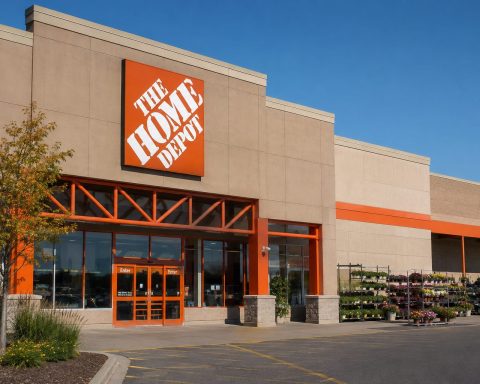

Home Depot, Inc. (The) stock (NYSE: HD) is back in focus on December 19, 2025, as investors weigh a cautious-but-still-growth outlook for fiscal 2026, a steady dividend profile, and a fresh wave of institutional ownership headlines and analyst target changes circulating into year-end.
In premarket trading early Friday, Home Depot shares were indicated around $355, essentially flat from Thursday’s $354.99 close.
What’s driving attention today isn’t a single blockbuster headline—it’s the accumulation of guidance, revisions, and positioning signals that have built since the company’s investor conference earlier this month.
Home Depot stock today: where shares stand on Dec. 19
Home Depot ended Thursday at $354.99, and early Friday indications showed the stock hovering around $355 in premarket action.
Several market mechanics may also matter for Friday’s tape. December 19 is a major options expiration session, which can amplify intraday swings and volume—especially in heavily owned blue chips that sit inside major indexes.
A separate data point that underscores HD’s “index weight” impact: on Thursday morning, MarketWatch’s Dow attribution data showed Home Depot as one of the meaningful contributors to the Dow’s climb at the time, with the stock up about 1.8% in that window. MarketWatch (That strength later faded by the close, reinforcing how choppy mega-cap trading can be into year-end positioning.)
The big fundamental anchor: Home Depot reaffirmed fiscal 2025 guidance
Investors are still digesting Home Depot’s messaging from its December 9, 2025 Investor and Analyst Conference, where the company reaffirmed its fiscal 2025 framework.
Key fiscal 2025 guideposts included:
- Total sales growth of approximately 3%
- Comparable sales slightly positive for the comparable 52-week period
- Operating margin approximately 12.6% (about 13.0% adjusted)
- Diluted EPS expected to decline ~6% from $14.91 in fiscal 2024 (adjusted diluted EPS down ~5% from $15.24) Home Depot Investor Relations
Management also highlighted that it views itself as positioned to grow share in a total addressable market the company estimates at roughly $1.1 trillion.
Home Depot’s preliminary fiscal 2026 outlook: modest growth, housing-dependent
The most market-moving piece in December has been the company’s preliminary fiscal 2026 outlook, which management framed against a still-muted home improvement backdrop.
Home Depot indicated it is planning around:
- A home improvement market in a range of roughly -1% to +1%
- Comparable sales growth of approximately flat to +2% Home Depot Investor Relations
- Total sales growth of approximately 2.5% to 4.5%
- Operating margin about 12.4% to 12.6% (about 12.8% to 13.0% adjusted)
- Diluted EPS growth approximately flat to +4% (and similarly for adjusted diluted EPS) Home Depot Investor Relations
Why the market cares: these ranges effectively tell investors that Home Depot expects incremental improvement, but not a dramatic snapback—especially in big-ticket projects tied to housing turnover.
Reuters reported that Home Depot’s early 2026 view came in below analyst expectations on key lines like comps and EPS growth, reflecting ongoing pressure in DIY demand and larger-ticket categories.
The upside scenario: “Market Recovery Case” points to stronger growth if housing rebounds
Alongside the baseline outlook, Home Depot published a Market Recovery Case—essentially the “if housing wakes up faster” framework.
That scenario envisions:
- Total sales growth approximately 5% to 6%
- Comparable sales growth approximately 4% to 5%
- Diluted EPS growth in the mid-to-high single digits Home Depot Investor Relations
In that recovery framing, the company tied upside to renewed momentum in housing activity and larger projects driven by pent-up demand.
Why Home Depot’s outlook is so sensitive to rates, housing turnover, and “big-ticket” demand
Home Depot’s business is often described as “home improvement,” but the investor debate tends to split into two drivers:
- Needs-based maintenance (more durable even when consumers pull back)
- Discretionary remodel and big-ticket projects (more cyclical, highly rate- and confidence-sensitive)
Reuters flagged that the company is still contending with higher borrowing costs, elevated home prices, and uneven housing demand—factors that can stall the bigger remodeling cycle.
This is the core tension behind HD shares into 2026: Home Depot remains a scale leader with strong customer reach, but the timing of the “next leg” in spending is closely tied to macro conditions it can’t control.
Wall Street forecasts today: consensus targets cluster above current levels, but revisions are mixed
The “street” view at a glance
Multiple aggregators show Wall Street sentiment as cautiously constructive. MarketBeat’s consensus snapshot lists a “Moderate Buy” stance with an average price target around $402.07, based on a mix of Buy/Hold/Sell ratings. MarketBeat+1
That target implies meaningful upside from the mid-$350s—while also signaling that analysts aren’t treating the near-term environment as a straight-line recovery.
Price target changes: a busy December for HD revisions
A MarketScreener roundup of analyst activity shows a heavy cluster of December price-target resets, including moves from firms such as Wolfe Research, UBS, Goldman Sachs, Wells Fargo, Piper Sandler, Jefferies, Baird, Stifel, Daiwa, and others.
The pattern matters more than any single adjustment: after investor-day guidance, many analysts recalibrated to reflect slower near-term growth but continued to emphasize HD’s strategic positioning for an eventual housing normalization.
Another view: “warning signs” framing from a mega-cap screen
A StockStory analysis circulating late Dec. 18 argued Home Depot shows “warning signs,” pointing to weaker same-store sales trends and competitive pressure typical of widely available retail categories, while citing a forward valuation around the mid-20s P/E range. FinancialContent
That’s not consensus research—but it illustrates the counter-argument that HD’s scale also limits rapid growth, and that investors may demand clearer evidence of acceleration.
Earnings recap: Q3 results showed resilient revenue, but EPS pressure
Home Depot’s most recent quarterly report (fiscal Q3, released Nov. 18) continues to shape forecasts because it showed a mixed picture:
- Reported EPS of $3.74, below the consensus cited in the MarketBeat summary
- Revenue of $41.35 billion, above the consensus cited there
- Year-over-year revenue growth of 2.8% MarketBeat
This “sales held up, profits tighter” setup fits the narrative that HD can still drive demand in a pressured market—but margins and mix remain sensitive, especially as consumers weigh discretionary projects.
Institutional positioning and insider activity: fresh filings hit the tape on Dec. 19
A notable chunk of Home Depot “news flow” on December 19 comes from institutional ownership filings and narrative summaries of those filings.
- MarketBeat reported that Montecito Bank & Trust opened a new Home Depot position during Q3, acquiring 3,818 shares valued at about $1.547 million.
- A separate MarketBeat filing summary said Osprey Private Wealth LLC increased its stake by 37.8% in Q3 to 24,295 shares (worth about $9.844 million in that report), making HD roughly 3.6% of its portfolio.
Those aren’t “hot money” signals—13F-style disclosures are backward-looking. But they reinforce a key reality: Home Depot remains a deeply institutional stock, and incremental positioning changes can influence flows around major events like guidance updates.
MarketBeat also flagged insider sales disclosures from December transactions involving executives (reported via SEC filings), which investors often watch for context but rarely treat as a standalone thesis.
Home Depot dividend: still a core part of the bull case
For many long-term holders, HD’s dividend is a major part of the story, especially when top-line growth is modest.
MarketBeat reported:
- A $2.30 quarterly dividend
- Paid December 18
- Ex-dividend date December 4
- Annualized dividend $9.20, implying roughly a 2.6% yield in that snapshot MarketBeat+1
This matters for valuation: when investors aren’t confident about rapid earnings growth, cash returns (dividends and buybacks) can do more of the heavy lifting in total return expectations.
What to watch next for Home Depot stock: the checklist investors are using now
As of Dec. 19, the most “actionable” investor questions around Home Depot stock tend to fall into a few buckets:
1) Evidence of a housing-driven pickup
Home Depot’s baseline 2026 outlook assumes only modest comp growth. A faster housing rebound could push results toward the company’s Market Recovery Case.
2) Mix shift back toward bigger projects
The market is listening for signs that large-ticket categories and complex projects are re-accelerating—because that’s where the operating leverage tends to show up.
3) Margin durability
With operating margin guidance in a relatively tight band (roughly 12.4%–12.6% for 2026 in the baseline outlook), any sustained pressure from promotions, supply chain, or labor could become the next swing factor.
4) Analyst target stability after a wave of revisions
December produced a dense run of price-target resets across Wall Street coverage. MarketScreener
Investors will watch whether those targets stabilize—or continue to drift lower if macro data softens.
5) Index and options-driven volatility into year-end
With options expiration dynamics and year-end rebalancing, daily moves may not always map cleanly to new fundamentals.
Bottom line: Home Depot stock is trading a “slow recovery” narrative—until housing changes the math
On December 19, 2025, Home Depot stock is being priced less like a high-growth retailer and more like a high-quality mega-cap that can hold the line through a sluggish housing backdrop—while positioning for the upside scenario if housing activity and larger projects return faster than expected.
The company’s own outlook framework captures the market’s debate clearly: flat-to-low single-digit comps in the baseline case versus meaningfully stronger growth in the recovery case.
For now, investors appear to be balancing that cautious growth view against HD’s scale advantages, dividend appeal, and the belief—shared by many analysts—that housing eventually normalizes, even if the timing remains the hardest variable to handicap.
Related articles: NYSE:HD