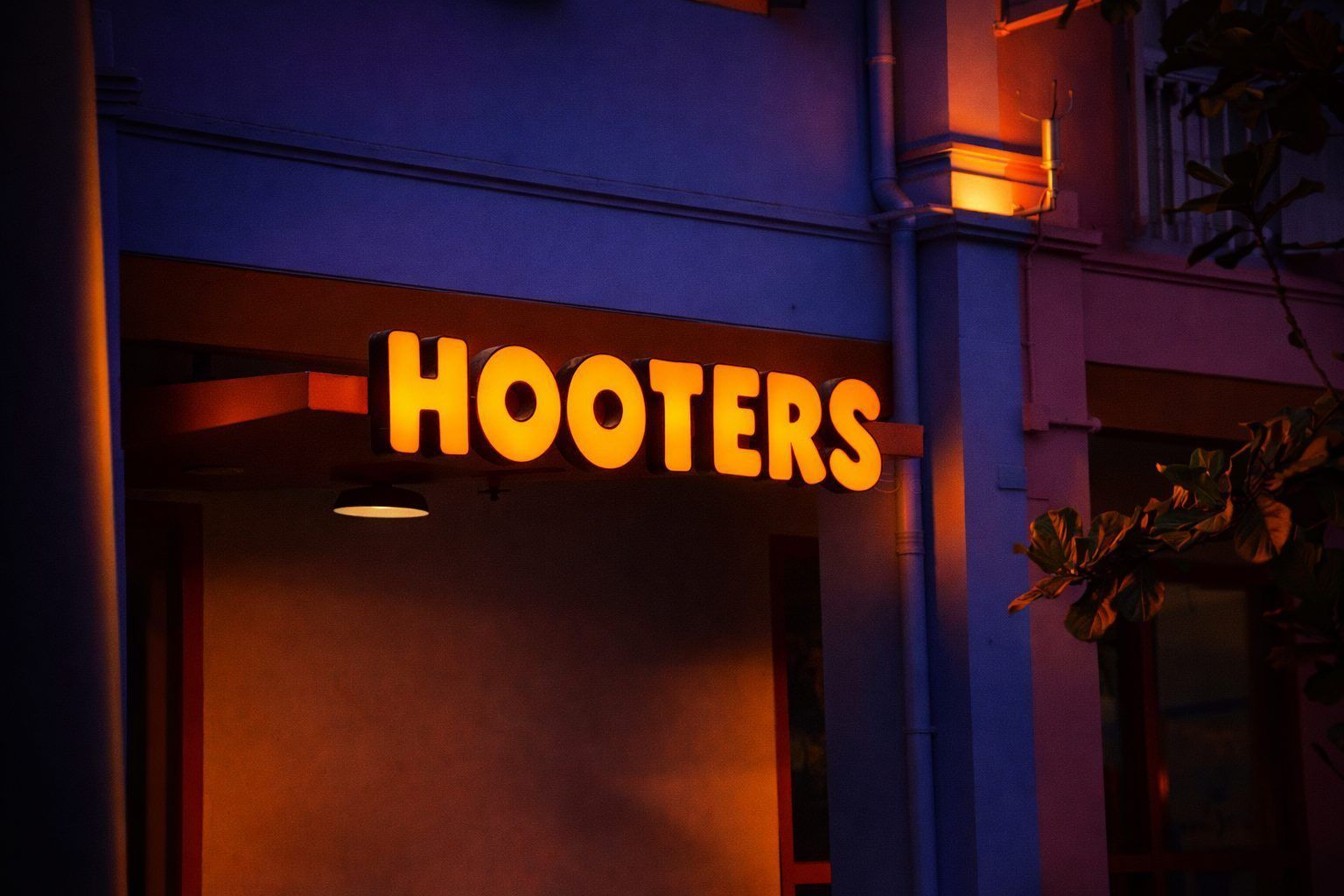
Hooters’ long-running Clarke Quay restaurant—its first and last remaining outlet in Singapore—will close on Jan. 31, 2026, ending a three-decade run on the Singapore River that began in the mid-1990s. Mothership
For locals, it’s a nostalgia-soaked footnote in the city’s ever-changing nightlife and dining map. For the brand globally, it lands in the middle of a high-stakes reset: in the U.S., Hooters has been navigating bankruptcy, a founder-backed takeover, store closures, and a back-to-basics campaign that the company’s new leadership has framed as a return to the chain’s original identity—right down to the recipe in its signature wing sauce. Reuters+2Nation’s Restaurant News+2
Below is what’s happening in Singapore, what Hooters leadership says it’s changing in the U.S., and why a Florida car meet at a Naples Hooters in January is a small but telling signal of how the brand hopes to stay relevant.
Clarke Quay Hooters is closing after 30 years—here’s why
According to Mothership, the Clarke Quay location will close because of a combination of operational strain and changing realities in the labor market: ongoing manpower shortages and consistently slow sales, with the owner also choosing to retire after what the managing director described as a “long run.” Mothership
Selena Chua, managing director of the restaurant, told Mothership the outlet has raised salaries over the years to keep up with cost-of-living pressures while trying to keep menu prices affordable—an increasingly difficult balancing act that squeezed the restaurant’s bottom line. Mothership
A few more details help explain why the closure hits differently than the typical restaurant shutdown:
- It marks Hooters’ exit from Singapore. Mothership
- The Clarke Quay outlet opened in 1996 and was described as the first international franchise outside North America and the first outlet in Asia. Mothership
- The restaurant currently employs 10 kitchen/floor staff and five office staff, with Chua also helping in the kitchen. Mothership
- There are plans for a smaller-scale bistro that will not be part of the Hooters brand, and most staff are expected to move over. Mothership
If you zoom out, the Clarke Quay closure also fits into a broader picture of restaurant churn in Singapore. In an earlier look at the city-state’s dining scene, Reuters cited government data showing F&B closures averaging 307 per month in 2025 (at the time of reporting), up from 254 per month in 2024, as operators grappled with high costs and softer spending. Reuters
Singapore’s closure story mirrors a global restaurant squeeze
It’s tempting to treat the Singapore closure as a standalone “end of an era” moment. But the economic pressures Chua described—labor tightness, costs rising faster than consumers’ willingness to pay—are familiar well beyond Singapore.
In the U.S., the National Restaurant Association has repeatedly emphasized how thin restaurant margins are and how quickly cost increases can destabilize even established operators. The group says that over the last five years, food and labor costs for the average restaurant have each risen 35%, while many operators typically net only 3%–5% pre-tax profit margins—leaving little room for error when traffic softens. NRA
On the labor side, the association also pointed to wage pressure: among full-service respondents in its Restaurant Operations Data Abstract, median labor costs were 36.5% of sales in 2024, higher than historic comparisons. NRA
That kind of math—costs up, margins tight, consumers cautious—helps connect why a legacy American chain can be trying to “re-found” itself at the same time a long-running international outpost decides it can’t keep stretching.
Hooters’ U.S. turnaround: bankruptcy, closures, and a founder-backed reset
While Singapore’s Clarke Quay closure is being attributed primarily to local operating realities, Hooters’ U.S. corporate story has been unusually turbulent—and well documented.
The bankruptcy filing and founder-led buyout plan
On March 31, 2025, Reuters reported that Hooters of America filed for bankruptcy in Texas, aiming to address $376 million in debt by selling company-owned restaurants to a franchise group backed by the company’s founders. Reuters
Reuters also reported that at the time, Hooters directly owned and operated 151 locations, with another 154 run by franchisees, and that the company expected to move through the process within months, supported by $35 million in financing. Reuters
Hooters itself framed the same moment as a strategic pivot to a pure franchise business model, saying it had entered a restructuring support agreement and expected to emerge in 90–120 days. Hooters
The mid-process closures
Despite messaging early in the bankruptcy process that restaurants would continue operating, closures did occur.
Nation’s Restaurant News (NRN) reported that about two months after filing for Chapter 11, Hooters of America abruptly closed more than 30 locations across multiple states effective June 4, 2025, citing a spokesperson’s statement about optimizing the business and continuing under a pure franchise model. Nation’s Restaurant News
The “founders reclaim” milestone
By late 2025, the narrative shifted toward “reclaiming” and rebuilding.
NRN reported that after the reorganization plan was approved, the founding group behind the concept reacquired the Hooters of America company, and after the transaction closed on Oct. 31, 2025, the group and its franchise partners took over 140 of 198 U.S. Hooters restaurants. Nation’s Restaurant News
NRN also summarized planned priorities under the new structure: upgrading stores, improving service and equipment, streamlining the menu, and re-emphasizing the brand’s “beachy vibe and heritage.” Nation’s Restaurant News
The wing sauce bombshell: “Most customers were served the wrong sauce” for 20 years
If the bankruptcy storyline is the financial reset, the sauce storyline is the brand reset—because it speaks to something casual-dining chains live or die by: consistency.
In a Dec. 23, 2025 interview with Fox News Digital, Hooters Inc. CEO Neil Kiefer said that in many locations his group took over, customers weren’t getting what they thought they were ordering. He claimed that among the stores they took over, the wings “haven’t had the original sauce…in 20 years,” and that some locations were using a “substitute sauce” instead. Fox News
Kiefer told Fox News the company cleared out inherited inventory that didn’t meet specifications and was restoring recipes to their original “taste profiles.” Fox News
He also described new governance designed to prevent a repeat: a food task committee that includes franchisees, plus a system of menu items categorized as mandatory, optional, and regional to rebuild uniformity without ignoring local preferences. Fox News
From an operations perspective, that’s not a small fix—it’s a tacit admission that in a franchise-heavy system, “same logo” can drift into “different product,” and that drift can quietly compound for years.
A “family-friendly” repositioning—without abandoning what made Hooters famous
Alongside recipes, Hooters’ new leadership has been emphasizing a change in tone and presentation.
A Fox Business report described uniform and atmosphere updates designed to return to the brand’s “beachy vibe,” including a shift back toward a more classic athletic style of the iconic orange shorts and discontinuing weekly bikini nights. Fox Business
In the same coverage, Kiefer framed the takeover as reasserting identity—positioning the brand as inclusive while still recognizably Hooters. Fox Business
This matters for international perception too: for years, Hooters has been both globally recognizable and culturally contested. A brand that wants to keep expanding (or even just stabilize) in diverse markets increasingly has to make the “why us?” case about food, service, and sports-bar energy—not only about the visual identity that originally made it famous.
Not everywhere is retreating: the Naples Hooters “Ferrari Show & Shine” event
While a Singapore outpost prepares to turn off the lights, Hooters locations in other markets are still being positioned as community hubs—especially in car culture and sports-heavy regions like Florida.
A listing on Fort Myers Patch promotes a “Ferrari Show and Shine” at Hooters Naples on Sunday, Jan. 11, 2026, from 11 a.m. to 1 p.m., at 3625 Gateway Lane, Naples. Patch
The Patch post also includes a quote attributed to Kristi Quarles, identified as Hooters of South Florida’s director of marketing, describing the event as a charity-linked partnership with the Ferrari Owners Club. Patch
Two additional sources reinforce that this isn’t a one-off:
- Hooters Florida’s “Upcoming Events” page lists “Ferrari Show & Shine” for 1/11/26 at Hooters Naples. Hooters Florida
- The Ferrari Owners Club of Naples events calendar also lists a Jan. 11, 2026 (11 a.m.–1 p.m.) “Show & Shine – All Cars Welcome – Hooters – Naples,” and shows similar events continuing into subsequent months. focnaples.com
In other words: at least in some U.S. markets, the playbook is still events + charity + regulars + sports—the kind of repeatable local programming that keeps a casual-dining brand feeling embedded, even when the larger corporate story is in flux.
What these three threads say about Hooters in 2026: fewer locations, tighter identity
Taken together, the Singapore closure, the sauce “correction,” and the Naples event point to the same underlying strategy:
- Cut what can’t be sustained (slow sales, staffing constraints, underperforming stores). Mothership+1
- Standardize what defines the brand (core menu, signature flavors, operational consistency). Fox News
- Recenter around community rituals—watching games, fundraising events, local car meets—where the brand can still feel like a neighborhood place rather than a relic. Patch+1
It’s also hard to ignore the parallel pressures on both sides of the world. In Singapore, Reuters quoted Maybank economist Brian Lee expecting closures to remain elevated amid high operating costs and shifting consumer priorities. Reuters In the U.S., industry economists have been blunt that cost inflation and labor pressure remain structural, not temporary. NRA+1
For Hooters, the challenge is making a decades-old concept feel current—without losing the familiarity that still draws core customers.
What to watch next
If you’re tracking Hooters as a business story (or simply as a cultural one), the next few signals will matter:
- Whether the “original taste profiles” rollout becomes measurable—not just a headline, but a consistent guest experience across markets. Fox News
- How aggressive the brand is about growth vs. stability. The post-bankruptcy stance from leadership has leaned toward getting fundamentals right, rather than rapid expansion. Fox News
- International footprint questions, especially in high-cost cities where staffing and rents punish any concept that can’t maintain steady traffic. Reuters+1
- Local-market resilience, where events and community partnerships can keep stores busy even when casual dining is under pressure. focnaples.com
For Singapore, the Clarke Quay closure is the concrete, dated milestone: Jan. 31, 2026. Mothership For Hooters globally, it’s part of a longer timeline—one where the brand’s future may depend less on how loudly it can be “delightfully tacky,” and more on whether it can be reliably good.
Sources and experts cited
- Mothership reporting and comments from managing director Selena Chua on the Clarke Quay closure Mothership
- Reuters reporting on Hooters’ U.S. bankruptcy filing and founder-backed buyout plan Reuters
- Nation’s Restaurant News reporting on closures and post-bankruptcy ownership and strategy Nation’s Restaurant News+1
- Fox News Digital interview with Hooters Inc. CEO Neil Kiefer on sauce consistency, inventory, and menu governance Fox News
- Fox Business reporting on uniform/menu positioning and brand reset messaging Fox Business
- National Restaurant Association economist research on restaurant inflation, margins, and labor-cost pressure NRA+1
- Reuters reporting on Singapore F&B closures, including commentary from Maybank economist Brian Lee and food blogger Seth Lui Reuters
- Event listings for the Naples Hooters “Ferrari Show & Shine” (Patch, Hooters Florida, Ferrari Owners Club of Naples) Patch+2Hooters Florida+2