NEW YORK, January 2, 2026, 13:44 ET
- New Hubble images show a three-jet pattern on interstellar comet 3I/ATLAS, Harvard astrophysicist Avi Loeb said.
- 3I/ATLAS, the third known interstellar object, is heading out of the solar system after a Dec. 19 close pass of Earth.
- A Breakthrough Listen radio search previously reported no candidate signals from the object in Green Bank Telescope observations.
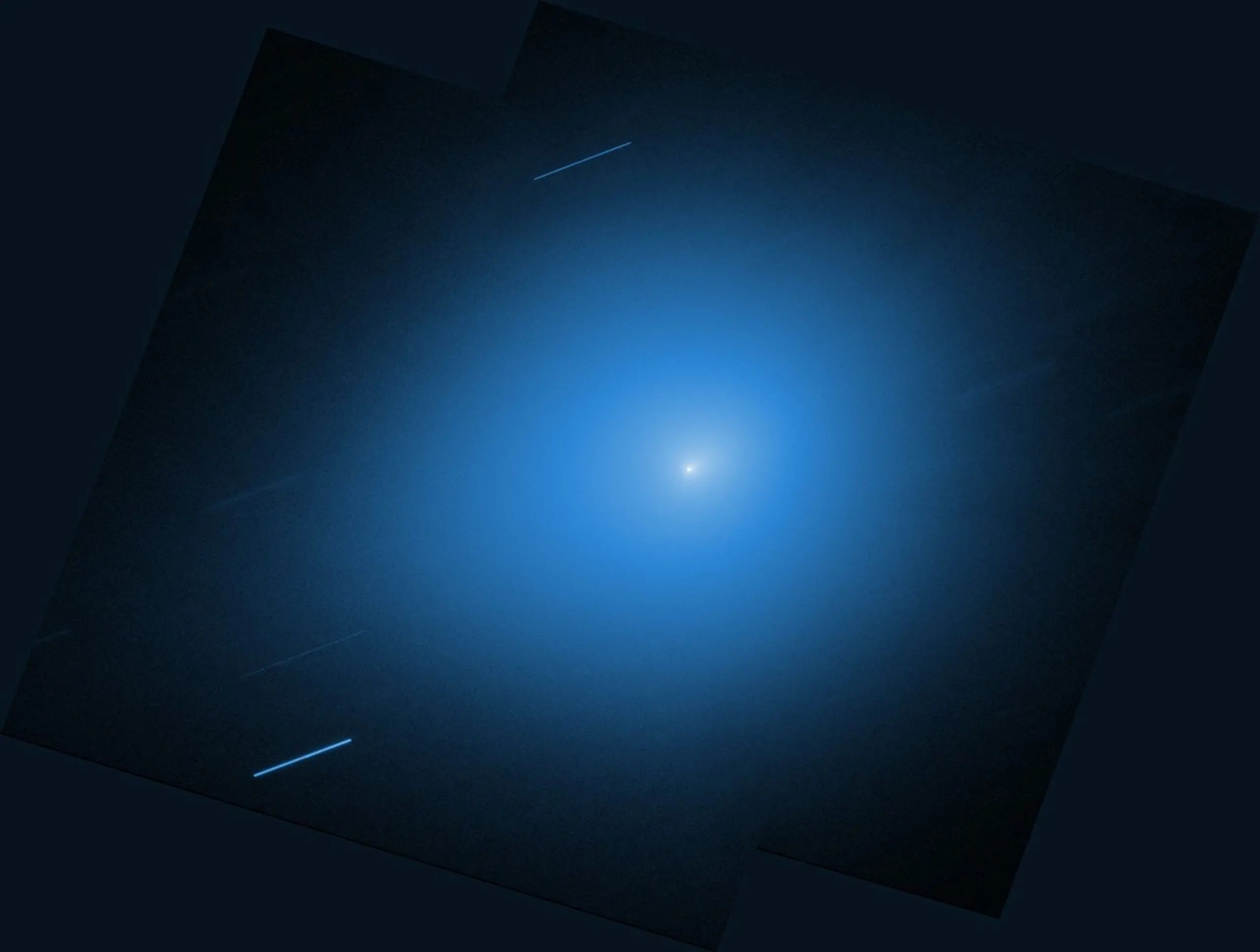
Harvard astrophysicist Avi Loeb said newly analyzed Hubble Space Telescope images show three evenly spaced jets on interstellar comet 3I/ATLAS, adding fresh intrigue to a rare visitor now leaving the solar system.
The timing matters because 3I/ATLAS is only the third known object from beyond the solar system — after 1I/ʻOumuamua and 2I/Borisov — and it is already receding after its closest approach to Earth on Dec. 19.
The comet’s unusual appearance has also become a flashpoint for claims that it might be artificial, a debate that has pushed some researchers to look for “technosignatures,” shorthand for evidence of extraterrestrial technology such as engineered radio transmissions.
In a post on Medium, Loeb said Hubble images taken on Nov. 30 and Dec. 12 and Dec. 27 show a dominant sunward “anti-tail” — a plume pointing toward the Sun — and three smaller jets closer to the nucleus. “The equal angular separations of 360 degrees divided by 3 among these three jet axes is puzzling,” he wrote. Medium
Jets are a common comet feature, driven when sunlight warms ice and releases gas that drags dust off the surface. Loeb said the symmetry, and changes in the jets’ orientation over time, could still fit a natural explanation tied to a rotating nucleus, but he argued the geometry warrants further scrutiny.
NASA has classified 3I/ATLAS as an interstellar comet on a hyperbolic path, meaning it is not bound to the Sun. The agency said the NASA-funded ATLAS survey telescope in Chile first reported the object to the Minor Planet Center on July 1, 2025, and that the comet poses no threat to Earth. NASA Science
Radio astronomers have also trained instruments on the object as it passed by. In an arXiv preprint, Ben Jacobson-Bell and co-authors said the Breakthrough Listen program used the 100-meter Robert C. Byrd Green Bank Telescope on Dec. 18, 2025, to search 1–12 gigahertz for narrowband signals and reported “a nondetection of candidate signals down to the 100 mW level.” ar5iv
A report by Phys.org said the search initially produced hundreds of thousands of candidate hits, but the team attributed the remaining events to radio-frequency interference rather than anything originating from 3I/ATLAS. Phys
Hubble itself has been revisiting the comet as it departs. ESA said Hubble reobserved 3I/ATLAS on Nov. 30 using its Wide Field Camera 3 instrument, when the comet was about 286 million kilometers from Earth, and that observations were expected to continue for several more months. ESA/Hubble
The debate has spilled beyond academic circles. In a Jan. 1 post on The Times of Israel’s blogging platform, writer Rafi Glick called 3I/ATLAS a “wake-up call” and argued for a coordinated global approach to future interstellar visitors, including a role for the United Nations. The Blogs at The Times of Israel
For most astronomers, the baseline assumption remains that 3I/ATLAS is a natural comet whose activity is being shaped by sunlight, rotation and viewing geometry. The puzzle is whether its jet structure is simply an extreme example of comet physics — or something that forces a rethink of what interstellar objects can look like.
Either way, the clock is running. Once 3I/ATLAS fades beyond reach, researchers will be left to parse the data already captured across wavelengths, looking for the most ordinary explanation that still fits the strange symmetry now emerging in Hubble’s images.