Interstellar comet 3I/ATLAS – also known as C/2025 N1 (ATLAS) – has just become the most closely watched visitor in the night sky. On 4 December 2025, a wave of new observations and images from NASA and ESA revealed that this third-known interstellar object is far more active and scientifically intriguing than astronomers first expected. NASA Science+2European Space Agency+2
Fresh Hubble photos, a surprise “teaser” image from ESA’s Juice spacecraft and new reports of vigorous activity around the comet are converging just as 3I/ATLAS heads toward its closest approach to Earth later this month, offering scientists and skilled amateur astronomers a rare chance to study a comet forged around another star. NASA Science+1
Key facts about 3I/ATLAS at a glance
- Type: Interstellar comet (designation 3I/ATLAS, also C/2025 N1) – the third confirmed interstellar object after 1I/ʻOumuamua and 2I/Borisov. NASA Science+1
- Origin: On a strongly hyperbolic orbit that clearly traces back to interstellar space, arriving from the direction of the constellation Sagittarius near the Milky Way’s center. Wikipedia
- Closest approach to the Sun (perihelion): Around 30 October 2025, at about 1.4 AU (130 million miles / 210 million km), just inside Mars’ orbit. NASA Science
- Closest approach to Earth: Around 19 December 2025, at roughly 1.8 AU (~170 million miles / 270 million km) – no threat to Earth. NASA Science+1
- Brightness: Around magnitude ~10–11; never naked‑eye, but within reach of decent amateur telescopes under dark skies. Wikipedia+1
- Age: Likely older than the Solar System, with estimates ranging from about 3 to 14 billion years. Wikipedia
Today’s new 3I/ATLAS updates (4 December 2025)
1. Hubble revisits 3I/ATLAS from 178 million miles away
NASA has released new Hubble Space Telescope images of 3I/ATLAS, taken on 30 November with the Wide Field Camera 3 (WFC3) instrument and published today. NASA Science
In the latest image:
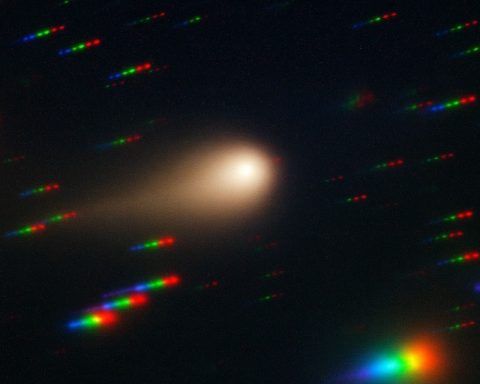
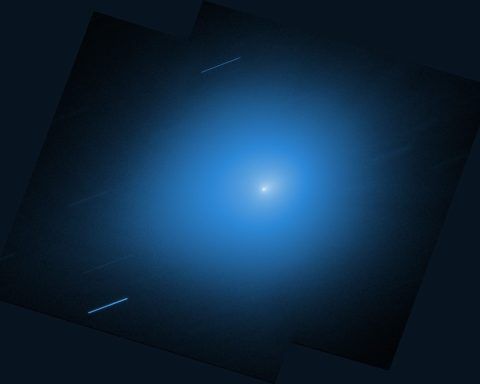
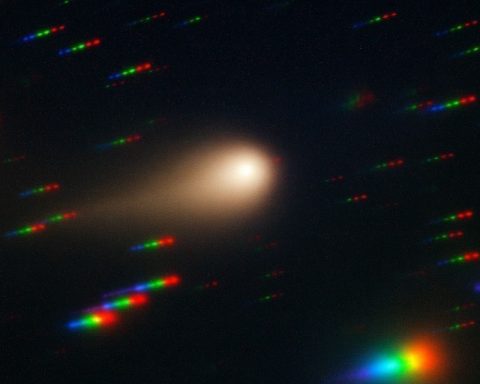
- 3I/ATLAS appears as a compact bright core wrapped in a fuzzy halo, or coma, of dust and gas.
- Because Hubble tracks the comet as it moves, the background stars are stretched into streaks, emphasizing just how fast the interstellar visitor is traversing our sky.
- At the time of the observation, the comet was about 178 million miles (286 million km) from Earth, already outbound after its October perihelion. NASA Science
Hubble previously imaged the comet in July, soon after discovery. The new observations are part of a longer campaign that NASA says will continue for several more months as 3I/ATLAS leaves the solar system, providing one of the most detailed datasets ever gathered on an interstellar object. NASA Science+1
2. ESA’s Juice spacecraft catches an unexpectedly active comet
Also today, the European Space Agency (ESA) published a striking teaser image from its Jupiter Icy Moons Explorer (Juice) mission. Although Juice is still on its way to Jupiter, it devoted observing time in November 2025 to watch 3I/ATLAS. European Space Agency
Key details from ESA’s release:
- Juice used five science instruments to study 3I/ATLAS, but those high‑quality datasets won’t arrive on Earth until February 2026 because the spacecraft is currently using its main antenna as a Sun shield. European Space Agency
- Impatient to see something sooner, the team downloaded just a quarter of a single image from the spacecraft’s navigation camera (NavCam), taken on 2 November 2025.
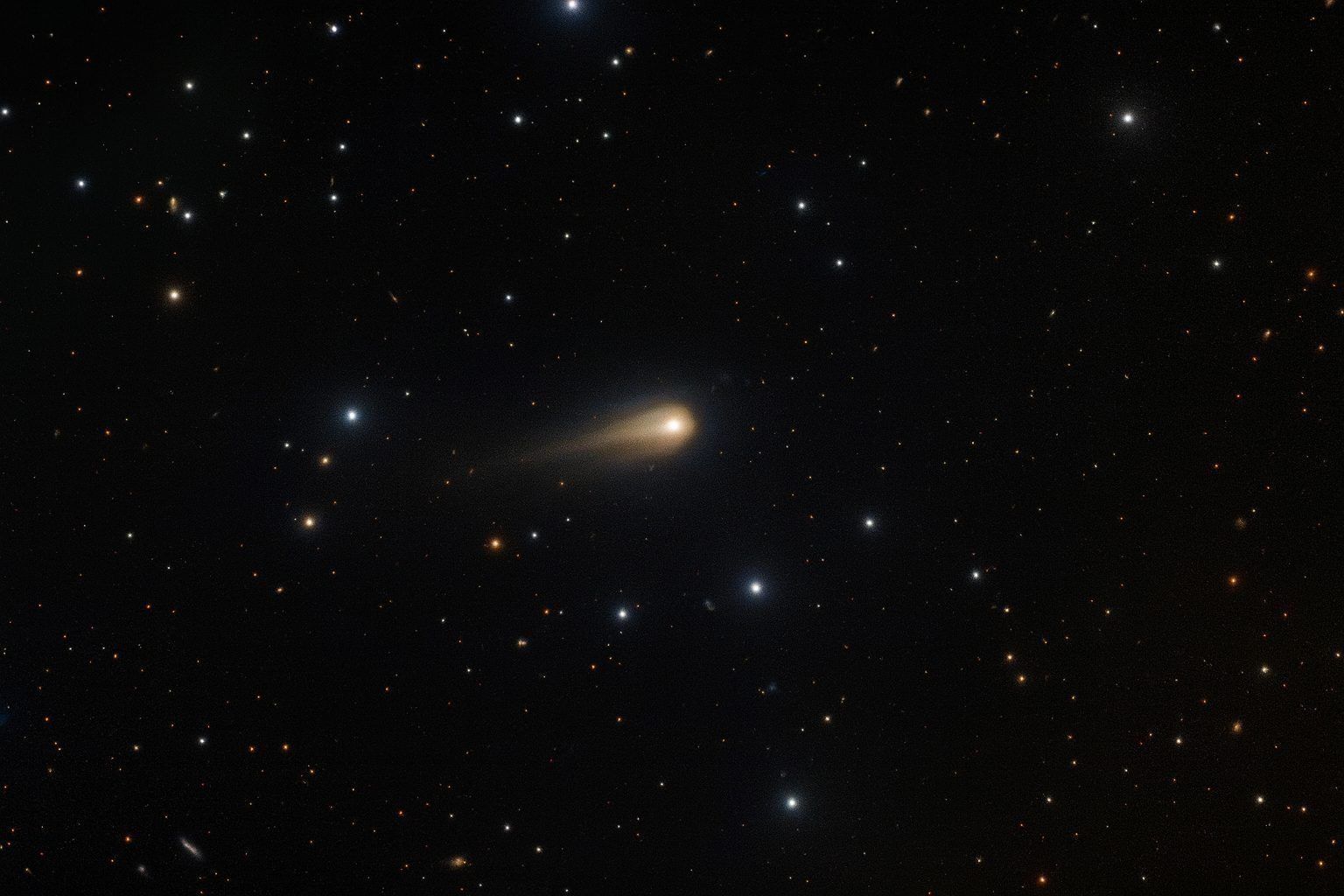
- Even in this low‑resolution frame, the comet is clearly visible, surrounded by a bright coma and what appear to be two distinct tails:
- a plasma tail of ionized gas stretching upward, and
- a fainter dust tail of tiny solid particles trailing off to the lower left. European Space Agency
Scientists were “surprised” by how active 3I/ATLAS already looked so soon after its closest approach to the Sun. Futurism’s coverage of the image emphasizes that the comet is “surrounded by signs of activity” as solar heating drives gas and dust away from its surface. Futurism+1
3. A flood of new NASA images from across the Solar System
Another story published this morning highlights a new batch of NASA images taken between late September and mid‑October by a fleet of spacecraft, including:
- PUNCH (a Sun-watching mission studying the solar corona and inner heliosphere)
- SOHO (the long‑running Solar and Heliospheric Observatory)
- MAVEN (Mars Atmosphere and Volatile EvolutioN)
- Mars Reconnaissance Orbiter and the Perseverance rover on Mars BGR+1
These images generally show 3I/ATLAS as a bright dot, but some reveal a growing tail, captured from vantage points spread around the inner Solar System. In total, a dozen NASA cameras have now imaged the comet, and more are coming online as it swings back into better view. BGR+1
4. Global media spotlight as Earth approach nears
News outlets around the world are also pushing fresh explainers today:
- International media report that 3I/ATLAS will pass about 170 million miles (270 million km) from Earth around 19 December 2025, stressing that it poses no threat and calling the encounter a once‑in‑millions‑of‑years opportunity. News.az+1
- NASA and science writers note that, while the comet is too faint for the naked eye, it should be within reach of small telescopes and larger binoculars when it climbs away from the Sun’s glare later in December. IFLScience+1
Put together, today’s updates paint a picture of an interstellar comet that is active, evolving quickly and under intense scrutiny from practically every major solar-system mission that can see it.
What exactly is 3I/ATLAS?
3I/ATLAS was first reported on 1 July 2025 by the NASA‑funded Asteroid Terrestrial‑impact Last Alert System (ATLAS) telescope in Chile. Follow‑up observations and pre‑discovery images soon confirmed that the object was on a highly hyperbolic orbit, moving far too fast to be gravitationally bound to the Sun. NASA Science+1
Because of this:
- The International Astronomical Union (IAU) gave it the permanent designation 3I/ATLAS:
- “3” = third known interstellar object
- “I” = interstellar
- “ATLAS” = named after the survey that discovered it. NASA Science+1
Models tracing its path backward show that 3I/ATLAS entered the Solar System from the direction of Sagittarius, near the Galactic Center, and will never return once it departs. It appears to belong to the Milky Way’s thick disk population – older, more slowly rotating stars and planetary systems – and may be older than the Sun itself. Wikipedia
Two independent studies published in mid‑2025 estimate the comet’s age at roughly 3–14 billion years, meaning we are likely watching an object that formed before our Solar System existed and has been wandering the Galaxy ever since. Wikipedia
‘Ice volcanoes’ and a hyperactive coma: 3I/ATLAS up close
One of the most exciting scientific threads to emerge in recent days is the possibility that 3I/ATLAS is erupting with “ice volcanoes”, or cryovolcanoes.
Evidence for cryovolcanism
A team using the Joan Oró Telescope in Spain captured high‑resolution images that show jets of gas and dust blasting out from the comet’s surface. As the comet moved closer than about 378 million km to the Sun, it brightened rapidly, indicating a surge in gas release. Live Science+1
Researchers interpret this as:
- The Sun’s heat triggering sublimation of solid carbon dioxide (dry ice) in the comet’s outer layers.
- That sublimation may allow liquid or semi‑liquid material to migrate inward and react with metallic grains and sulfides (such as iron and nickel compounds), releasing more gas and dust in cryovolcanic jets. Live Science+1
This behavior is surprisingly similar to trans‑Neptunian objects – icy bodies that live beyond Neptune – suggesting that the building blocks of planetary systems might share common chemistry even when they form around different stars. Live Science+1
Size and structure
From Hubble and other observations, astronomers estimate that the solid nucleus of 3I/ATLAS is probably less than a kilometer across, with broader limits between roughly 440 meters and 5.6 km depending on how bright its surrounding dust coma is. NASA Science+1
Key points about its structure:
- A compact nucleus of rock and ice
- A CO₂‑rich coma, consistent with formation in a cold, distant region of its original planetary system
- A growing dust and plasma tail driven by sunlight and the solar wind, now seen by multiple spacecraft including SOHO, STEREO, PUNCH and Juice. NASA Science+2European Space Agency+2
A whole Solar System of cameras watching one comet
One thing that sets 3I/ATLAS apart from its predecessors 1I/ʻOumuamua and 2I/Borisov is the sheer number of spacecraft simultaneously observing it.
According to NASA’s dedicated 3I/ATLAS portal, missions now contributing data include: NASA Science+1
- Hubble Space Telescope – high‑resolution imaging of the coma and tail
- James Webb Space Telescope (JWST) – infrared spectroscopy revealing a carbon‑dioxide‑rich composition
- SPHEREx – all‑sky infrared mapping of the comet’s chemical fingerprints
- Psyche – captured a series of images in September from about 53 million km away, helping refine the comet’s trajectory NASA Science
- Lucy, PUNCH, STEREO, SOHO – wide‑field images showing the tail evolving over time NASA Science+1
- Mars orbiters and the Perseverance rover – unique close‑up perspectives during the comet’s pass near Mars in early October 2025 NASA Science
- ESA’s Juice – post‑perihelion observations just after the comet’s closest approach to the Sun, now known to show clear signs of activity. European Space Agency+1
Collectively, these data are giving scientists an unprecedented 3D view of how an interstellar comet responds as it dives through another star’s planetary system.
When and how can you see 3I/ATLAS?
Even with all the media buzz, 3I/ATLAS is not going to become a spectacular naked‑eye comet. It remains relatively faint, but it’s still an enticing target for observers with the right equipment.
Observing conditions in December 2025
- Around its closest Earth approach on ~19 December, the comet will be about 1.8 AU away, roughly twice the Earth–Sun distance. NASA Science+2News.az+2
- Estimates suggest it will hover near magnitude 10–11, putting it within reach of small backyard telescopes and possibly large binoculars under dark skies. Wikipedia+1
- Because it stays close to the ecliptic plane, its exact position on your sky map will change nightly; observers are advised to use up‑to‑date star‑chart apps or planetarium software.
NASA suggests using its “Eyes on the Solar System” interactive tool to track the comet’s real‑time position and spacecraft observations. News.az+1
Practical tips for skywatchers
- Optics: A telescope of 100 mm aperture or larger is recommended; 20×80 binoculars may work under very dark skies. Wikipedia
- Location: Find a site with minimal light pollution and a clear view of the sky along the ecliptic.
- Expectations: In the eyepiece, 3I/ATLAS will look like a small fuzzy patch, not a dramatic, sweeping comet like past showpieces. The thrill here is knowing you’re looking at an object from another star’s planetary system.
No, it’s not an alien spacecraft
As with 1I/ʻOumuamua, 3I/ATLAS has sparked a wave of online speculation about extraterrestrial technology. Some commentary from high‑profile scientists has kept that debate alive in the public imagination, even while stressing that a natural explanation is far more likely. News.az+1
However, NASA officials have been explicit:
- After reviewing data from more than 20 missions, NASA scientists conclude that 3I/ATLAS behaves like a normal – if hyperactive – comet, with outgassing, a dust and plasma tail and a composition consistent with icy bodies. NASA Science+1
- Nicky (Nicola) Fox, head of NASA’s Science Mission Directorate, has emphasized that no technosignatures have been seen – nothing in the data indicates artificial origin. BGR+1
In other words: 3I/ATLAS is almost certainly a natural comet, and that’s part of what makes it scientifically powerful. It lets researchers compare ordinary planetary building blocks from another star system with comets and icy worlds in our own.
Why 3I/ATLAS matters
3I/ATLAS arrives at a moment when the Solar System is more instrumented than ever. Unlike the brief, frustrating window astronomers had with 1I/ʻOumuamua in 2017, this interstellar visitor has been tracked from discovery, through perihelion, past Mars and now toward its Earth flyby, with an armada of telescopes on the ground and in space. NASA Science+1
The comet offers:
- A direct sample of material from another planetary system’s outer reaches, likely formed in a cold, distant region rich in carbon dioxide and other ices. Wikipedia+1
- A test case for theories of cryovolcanism, comet activity and how small bodies evolve as they pass close to stars. Live Science+1
- A chance to compare three interstellar objects – ʻOumuamua, Borisov and now ATLAS – and start building a statistical picture of what typical interstellar debris looks like. Wikipedia+1
As more data arrive from Juice, Psyche, Mars missions and telescopes across Earth, 3I/ATLAS is likely to keep reshaping our understanding of how comets form, how planetary systems eject debris and just how much of our Galaxy is filled with wayward chunks of rock and ice.
For now, though, December 2025 belongs to a tiny, ancient comet racing past our Sun – and the global scientific effort scrambling to learn everything it can before 3I/ATLAS disappears back into the dark between the stars.