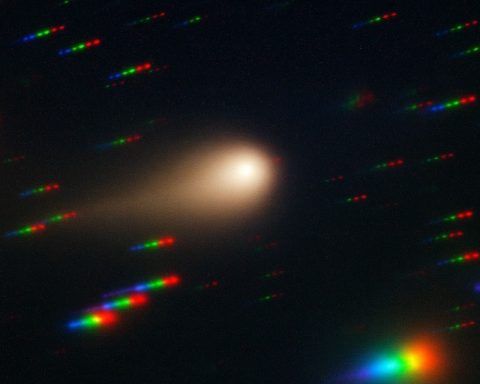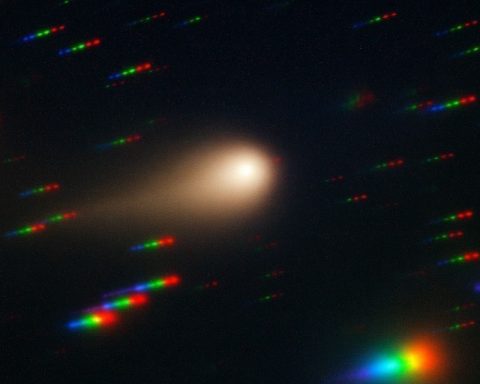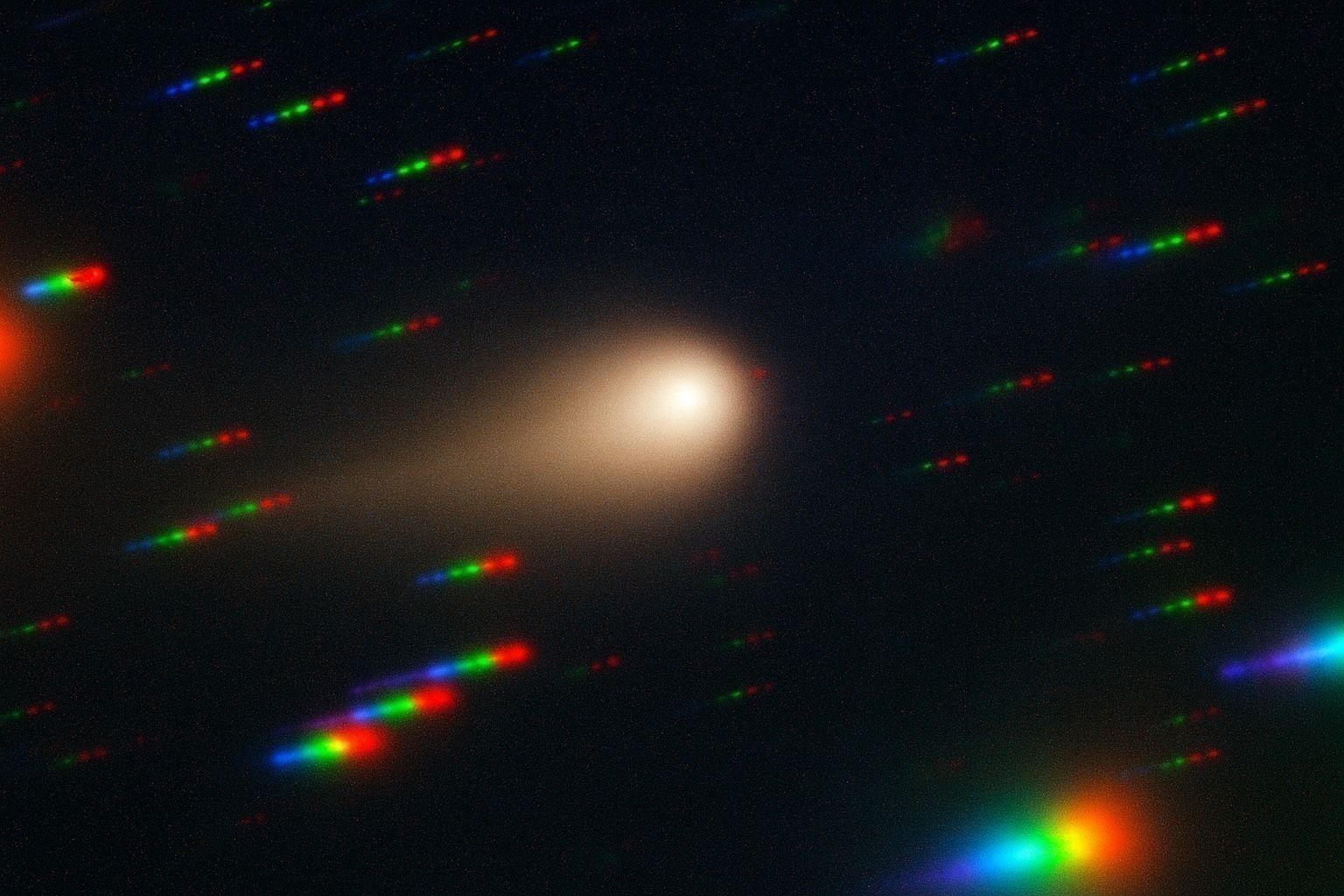
As of December 8, 2025, interstellar comet 3I/ATLAS (also known as C/2025 N1 (ATLAS)) has gone from an obscure discovery to a global headline-maker. New observations are revealing cryovolcano‑like eruptions, an atmosphere rich in prebiotic molecules, and spectacular images from NASA and ESA ahead of its December 19 close approach to Earth— all while fringe claims about aliens and “electromagnetic sickness” swirl online.
Here’s a clear, evidence-based look at what we actually know right now about 3I/ATLAS, and why this visitor from another star system matters.
What is Comet 3I/ATLAS?
3I/ATLAS is the third confirmed interstellar object ever seen in our Solar System, after 1I/ʻOumuamua (2017) and 2I/Borisov (2019).Wikipedia+1
Key facts:
- Origin: Its orbit is strongly hyperbolic, meaning it is not gravitationally bound to the Sun and clearly comes from interstellar space, likely from the direction of the constellation Sagittarius, near the Milky Way’s center.Wikipedia+1
- Discovery: It was first spotted on July 1, 2025 by the NASA‑funded ATLAS survey telescope in Río Hurtado, Chile, and initially cataloged as C/2025 N1 (ATLAS).Wikipedia+1
- Size & rotation: Hubble and other telescopes indicate a nucleus somewhere between 0.3 and 5.6 km across, with a likely diameter under 1 km, and a rotation period of about 16.16 hours.Wikipedia+1
- Orbit & speed: It reached perihelion (closest to the Sun) on October 29, 2025, at about 1.36 AU from the Sun (between Earth and Mars) and is traveling through the inner Solar System at roughly 130,000 mph (210,000 km/h).Wikipedia+1
Crucially, the comet will not come closer than about 1.8 AU to Earth — roughly 270 million km, almost twice the Earth–Sun distance — and therefore poses no impact threat, according to NASA and ESA.NASA Science+1
Today’s Headlines (December 8, 2025): Organics, Methanol and Active Jets
Several new stories today expand our picture of 3I/ATLAS. The themes are consistent: this is a chemically rich, highly active comet and a unique natural laboratory for studying the ingredients of planets and life.
1. Methanol and “life’s building blocks” in an interstellar comet
A new report in The Indian Express highlights results from a team using the ALMA radio array in Chile to study the comet’s chemistry in detail. Scientists find unusually high levels of methanol and hydrogen cyanide in 3I/ATLAS — far more than typically seen in comets formed in our own Solar System.The Indian Express
According to that analysis:
- 3I/ATLAS is releasing a “remarkable amount of carbon-based chemicals”, especially methanol, a simple organic molecule crucial to prebiotic chemistry.
- Hydrogen cyanide (HCN) appears to be emerging close to the nucleus at estimated rates of hundreds of grams per second, while methanol is abundant throughout the extended coma.
- Earlier infrared and space‑based observations had already shown that 3I/ATLAS is unusually rich in carbon dioxide, with water, carbon monoxide and carbonyl sulfide present in smaller amounts.Wikipedia+1
A separate piece published today on Red94, summarizing Hubble data, focuses on methanol, hydrogen cyanide and CO₂ detected in the comet’s outgassing, framing them as “building blocks of life” and highlighting that the comet may be ejecting cyanide at roughly tens of grams per second.Red94
Taken together, these results reinforce what NASA and ESA scientists have been saying for weeks: 3I/ATLAS is a chemically exotic object, yet it contains many of the same kinds of organic molecules we see in Solar‑System comets — only in unusual proportions.Wikipedia+1
Importantly, no one has detected life itself in or around the comet; researchers are talking about prebiotic chemistry, not organisms.
2. New JUICE NavCam preview: an active halo and two tails
A same‑day article on Meyka’s Global Market Insights, based on an ESA teaser image, describes early observations of 3I/ATLAS from ESA’s Jupiter Icy Moons Explorer (JUICE) spacecraft.Meyka+1
Key points from that report and ESA’s release:
- JUICE’s navigation camera (NavCam) captured 3I/ATLAS surrounded by a bright coma, confirming strong activity as the comet moves away from the Sun.
- The image hints at two distinct tails:
- A plasma tail, made of charged particles interacting with the solar wind.
- A fainter dust tail, made of solid grains blown away from the nucleus.
- Detailed science data from JUICE’s dedicated instruments will not arrive until early 2026, because the spacecraft is using its main antenna as a heat shield near the Sun and is sending only low‑bandwidth previews for now.Live Science+1
This dovetails with a December 6 feature in Live Science, which showed side‑by‑side Hubble and JUICE images and described the comet as “very bright and active” after its close pass by the Sun.Live Science
3. Hubble’s November 30 image: a sharper look at the visitor
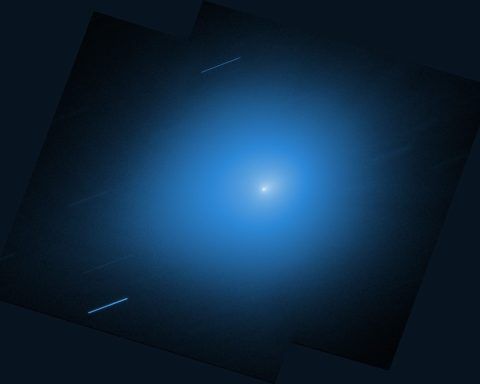
Multiple outlets — including Live Science, Bangladesh’s ZoomBangla and NASA’s own updates — have been covering a new Hubble Space Telescope image acquired on November 30 and released publicly in early December.Live Science+2Bangla news+2
From these reports:
- Hubble tracked the fast‑moving comet and resolved a bright nucleus + inner coma, with faint indications of jets and a developing tail.
- The image was taken when Hubble was about 178 million miles (286 million km) from the comet, significantly closer than its first images in July.
- Combined with earlier Hubble data, this allows astronomers to bound the nucleus size and better understand how the coma’s composition evolves as the comet warms.
NASA’s wider “multiple lenses” campaign, published Nov. 19, shows that at least a dozen spacecraft — including MAVEN, Perseverance, Psyche, Lucy, PUNCH and SOHO — have now observed 3I/ATLAS from all over the Solar System.NASA Science+1
4. NASA’s Psyche mission joins the tracking effort
On December 3, NASA published a blog post from the Psyche mission describing how its asteroid‑bound spacecraft briefly turned its camera toward 3I/ATLAS in early September.NASA Science+1
Highlights:
- Psyche’s multispectral imager recorded four observations over eight hours when the comet was about 33 million miles (53 million km) from the spacecraft.
- These images help refine the comet’s trajectory and provide additional measurements of its faint coma.
- Psyche is one of many missions contributing to a kind of Solar System‑wide tracking network for this interstellar visitor.
“Ice Volcanoes” on 3I/ATLAS: Cryovolcanism from Another Star System
One of the most intriguing scientific results so far is the claim that 3I/ATLAS may host cryovolcanoes — “ice volcanoes” that erupt volatile material instead of molten rock.
In a December 1 article, Live Science reports on a new (not yet peer‑reviewed) preprint led by Josep Trigo‑Rodríguez. Using Spain’s Joan Oró Telescope and other instruments, the team imaged spiral jets and complex structures in the coma as the comet approached perihelion in late October.Live Science
Their interpretation:
- As 3I/ATLAS approached about 378 million km from the Sun, it entered a phase of rapid brightening and intense sublimation.
- Heating triggered sublimation of solid carbon dioxide (dry ice); this allowed an oxidizing liquid to penetrate the interior, reacting with metal grains and sulfides and driving jetting events akin to cryovolcanic eruptions.
- Spectroscopic comparisons with carbonaceous chondrite meteorites suggest that the comet’s outer layers are chemically similar to trans‑Neptunian objects (TNOs) in our own Solar System, even though 3I/ATLAS clearly originated elsewhere.Live Science+1
In other words, 3I/ATLAS may behave a lot like the icy worlds beyond Neptune — which are thought to have helped deliver volatile materials and organics to the early Earth.
A Rare Chemical Laboratory from Another Star
Combining NASA, ESA and ground‑based results, a consistent chemical picture is emerging:Red94+3Wikipedia+3NASA Science+3
- CO₂‑rich: 3I/ATLAS has an unusually carbon‑dioxide‑rich coma, compared with many Solar‑System comets.
- Water & other volatiles: It contains water ice and vapor, carbon monoxide and carbonyl sulfide.
- Cyanide & metals: Spectroscopy from large ground‑based telescopes detects cyanide gas and nickel vapor at levels broadly comparable to those in local comets.
- Methanol & HCN excess: New ALMA results suggest methanol and hydrogen cyanide are particularly abundant, with HCN released close to the nucleus and methanol spread throughout the coma.
These are all non‑biological molecules, but they are central to prebiotic chemistry. Methanol and HCN, in particular, are involved in pathways that can eventually lead to amino acids, nucleobases and other organic building blocks in the right environments.
Finding this cocktail in an interstellar comet strongly supports the idea that complex carbon chemistry is common across planetary systems — and that comets like 3I/ATLAS may help distribute these ingredients throughout the galaxy.
Alien Theories, “Heartbeat” Signals and EM Scares — What’s Real?
Alongside serious science, 3I/ATLAS has become the focus of a wave of highly speculative and sometimes misleadingcoverage.
The “alien seeding” and “heartbeat” claims
Recent coverage in outlets like The Economic Times and various blogs summarizes ideas from Harvard astrophysicist Avi Loeb, who has suggested that interstellar objects, including 3I/ATLAS, could in principle be artificial probes or part of a directed panspermia effort to “seed” life across worlds.The Economic Times+1
Other articles, including some published today, riff on:
- A reported 16.16‑hour “heartbeat” or brightness modulation in the coma.
- The idea that the comet’s aggressive jets might be “stabilization thrusters” of a spacecraft.inkl+1
Crucial context:
- That 16‑hour modulation matches the rotation period derived from mainstream analyses of the comet’s coma and jets. It’s entirely expected for an active, rotating comet nucleus to produce periodic brightness changes.
- NASA and ESA continue to characterize 3I/ATLAS as a natural comet, with its behavior explainable by outgassing, solar heating and interaction with the solar wind.NASA Science+1
- There is no direct evidence of artificial structures, controlled propulsion or communication signals associated with 3I/ATLAS in the scientific literature.
Loeb’s ideas fall into the category of speculative hypotheses, not established fact. Most planetary scientists regard 3I/ATLAS as an unusual but natural icy body, not a spacecraft.
The “electromagnetic field making people sick” story
A viral piece on the aggregator site inkl amplifies social‑media anecdotes claiming that 3I/ATLAS’s “electromagnetic field” is making people feel unwell — causing headaches and fatigue as the comet passes through the inner Solar System.inkl
From a physics perspective and based on current observations:
- 3I/ATLAS is hundreds of millions of kilometers away. Even at its closest on December 19, it will be about 1.8 AU from Earth, and on the other side of the Sun.NASA Science+1
- Comets do interact with the solar wind and generate local plasma environments, but the impact on Earth’s magnetic field from a distant comet at this range is negligible compared with day‑to‑day variations driven by the Sun itself.
- There is no credible scientific evidence linking 3I/ATLAS to human health symptoms.
If anyone is feeling unwell, the right course is to consult medical professionals, not assume a causal connection with a distant comet.
How, When and Where to See Comet 3I/ATLAS
Even though it’s interstellar and scientifically dramatic, 3I/ATLAS is not a naked‑eye showpiece like some great comets of the past. To see it yourself, you’ll need optical aid and dark skies.
Closest approach to Earth
- Date: About December 19, 2025.
- Distance: Roughly 270 million km (1.8 AU) from Earth — nearly twice the Earth–Sun distance.NASA Science+1
- Geometry: During closest approach, the comet will be roughly on the far side of the Sun relative to Earth, so the exact moment of closest approach is not the best viewing moment.IFLScience
Where in the sky?
According to TheSkyLive and updated ephemerides summarized on Wikipedia:TheSkyLive+2Wikipedia+2
- Throughout December 2025, 3I/ATLAS is moving from Virgo into Leo.
- Around December 8, it lies in the constellation Leo, near the bright star Regulus, and is roughly magnitude 10–11— within reach of good binoculars and small telescopes under dark skies.
- On December 11, it will pass within about 2° of the half Moon, a helpful landmark.
- By December 12, it will be more than 90° away from the Sun in the sky, making it observable closer to midnight.
- True opposition (up most of the night) arrives on January 22, 2026, but by then the comet will be significantly fainter.
What equipment do you need?
IFLScience, citing NASA and TheSkyLive, notes:IFLScience+1
- At current magnitudes around 10–11, you’ll want at least:
- Good 10×50 binoculars or
- A telescope with ~20–30 cm (8–12 inch) aperture for a more obvious view.
- Under dark skies, you may see 3I/ATLAS as a faint fuzzy patch with perhaps a subtle elongation indicating its tail.
Always consult an up‑to‑date sky chart or an ephemeris (e.g. TheSkyLive or your planetarium app) for your specific location and time zone, since the comet’s apparent position shifts night by night.
Key Dates for 3I/ATLAS (2025–2026)
Putting the story in chronological order:IFLScience+3Wikipedia+3Live Science+3
- July 1, 2025 – Discovery by the ATLAS survey in Chile; quickly recognized as a hyperbolic, likely interstellar object.
- Late September–early October 2025 – Close pass by Mars, coming within about 29 million km, with images from Mars Reconnaissance Orbiter, MAVEN, and the Perseverance rover.
- October 21, 2025 – Solar conjunction: from Earth’s perspective, the comet passes behind the Sun and becomes unobservable from the ground.
- October 29, 2025 – Perihelion: closest point to the Sun at about 1.36 AU, triggering strong activity and, according to some observers, cryovolcano‑like jets.
- November 2025 – Re‑emerges into the pre‑dawn sky; becomes a major target for professional and amateur observatories.
- November 19, 2025 – NASA publishes “View Interstellar Comet 3I/ATLAS Through NASA’s Multiple Lenses,” detailing observations by about a dozen spacecraft across the Solar System.
- November 30, 2025 – Hubble acquires a high‑resolution image that becomes the basis for many early December news stories.
- December 1, 2025 – Live Science reports on “ice volcanoes” (cryovolcanism) inferred from ground‑based imaging.
- December 3, 2025 – NASA’s Psyche mission blog describes its role in tracking the comet’s trajectory.
- December 6, 2025 – Live Science publishes new NASA and ESA images from Hubble and JUICE, emphasizing 3I/ATLAS’s growing activity before its Earth flyby.
- December 8, 2025 (today) –
- Reports from The Indian Express and others highlight unusually high methanol and cyanide levels, reinforcing the “life’s building blocks” narrative.The Indian Express+1
- Meyka and ESA tease NavCam images from JUICE, showing a vivid coma and two tails.
- December 11–12, 2025 – The comet passes near the half Moon and becomes observable at midnight as its solar elongation grows.
- December 19, 2025 – Closest approach to Earth at about 1.8 AU; no danger, but an important checkpoint for telescopic observations and orbit refinement.
- March 16, 2026 – A relatively close pass by Jupiter, about 0.36 AU (~53 million km) away, may slightly tweak its outbound trajectory.IFLScience
- Early 2026 – JUICE’s full science data set on 3I/ATLAS arrives on Earth, and the James Webb Space Telescopeconducts its final targeted observations of the fading comet.Live Science+1
After that, 3I/ATLAS will gradually dim and head back into deep interstellar space, never to return.
Why 3I/ATLAS Is a Once‑in‑a‑Lifetime Opportunity
3I/ATLAS is giving scientists something they almost never get: a comparatively bright, chemically active interstellar comet, observed by a fleet of spacecraft and telescopes spanning Mars, Earth orbit, deep‑space missions and even the Jupiter‑bound JUICE probe.NASA Science+1
This unique visitor is helping researchers:
- Compare interstellar comet chemistry with that of comets formed around our own Sun.
- Test models of comet activity, cryovolcanism and jet physics under extreme conditions.
- Probe how complex organics and volatile ices form and survive in the cold spaces between stars.
- Refine strategies for future missions that might one day intercept an interstellar object up close.
For the rest of us, 3I/ATLAS is a reminder that our Solar System is not isolated. Objects from other stars do occasionally pass through our neighborhood — and, thanks to modern instrumentation, we can now watch them in detail as they go.
If you have access to a telescope or a local astronomy club, the coming weeks are likely your only chance in a lifetime to say you personally observed an object from another star system.