As of 11 December 2025, interstellar comet 3I/ATLAS has turned into the most closely watched object in the night sky — and not just by astronomers. In the last few days we’ve had:
- the first-ever X‑ray detection of an interstellar comet,
- a chemical profile rich in “ingredients for life”,
- stunning new Hubble and ESA JUICE images showing twin tails,
- observation campaigns from Mars orbit and the Red Planet’s surface, and
- fresh guidance on how to see 3I/ATLAS around its 19 December closest approach.
At the same time, a swirl of headlines about “World War I chemical weapons” and “alien probes” is competing with the science. Here’s a clear, news-style rundown of what we actually know today.
What is interstellar comet 3I/ATLAS?
3I/ATLAS is only the third known interstellar object to sweep through our Solar System, after 1I/ʻOumuamua (2017) and 2I/Borisov (2019). NASA classifies it as interstellar because its orbit is strongly hyperbolic – it doesn’t loop the Sun, it just swings by once and leaves forever. NASA Science+1
- It was first reported on 1 July 2025 by the ATLAS survey telescope in Río Hurtado, Chile, which is how it got its name. The “3” marks it as the third interstellar object; “I” stands for interstellar. NASA Science
- Orbital calculations trace its path back toward the constellation Sagittarius, indicating it arrived from deep interstellar space rather than from any known Solar System reservoir like the Oort Cloud. Wikipedia
Dynamical and stellar-population studies suggest 3I/ATLAS likely belongs to the Milky Way’s thick disk, a population of very old stars. Independent teams estimate its age at roughly 3–14 billion years, meaning it could be several billion years older than the Solar System and quite possibly the oldest comet ever observed. Wikipedia+1
Where is 3I/ATLAS now, and how close will it get?
3I/ATLAS already passed its closest point to the Sun (perihelion) on 29 October 2025, skimming inside the orbit of Mars at about 1.36 AU from the Sun. Wikipedia+1
Key dates:
- 19 December 2025 – Closest to Earth:
The comet will pass at about 1.8 AU from our planet, roughly 170 million miles (270 million km) – nearly twice the Earth–Sun distance. NASA and multiple observatories stress that 3I/ATLAS poses no threat to Earth at any stage. NASA Science+2Live Science+2 - 11–12 December 2025 – Sky geometry today:
Ephemeris calculations show that on 11 December, 3I/ATLAS passes less than two degrees from the half Moon, a useful pointer if you’re trying to hunt it down with a telescope. By 12 December, it’s more than 90° away from the Sun in the sky, making it accessible near midnight for many observers. Wikipedia+1
Despite the drama, you won’t see it with the naked eye. Current estimates put its brightness around magnitude ~12 or fainter: you’ll need a moderately powerful telescope (around 8-inch aperture or more) and dark skies to spot it. Wikipedia+1
New this week: 3I/ATLAS glows in X‑rays
One of the most significant updates as of 10–11 December is that 3I/ATLAS has become the first interstellar comet ever detected in X‑rays.
XRISM’s deep stare
The XRISM (X-Ray Imaging and Spectroscopy Mission), a joint mission of JAXA, NASA and ESA, carried out a special “target of opportunity” observation from 26–28 November 2025, once the comet had moved far enough from the Sun in the sky. Medium+1
- XRISM’s Xtend X‑ray imager stared at the comet for about 17 hours and detected a faint X‑ray glow extending roughly 400,000 km from the nucleus – about the Earth–Moon distance. Medium+1
- A JAXA statement and coverage in Live Science describe this as the first X‑ray detection from an interstellar comet, adding 3I/ATLAS to the family of X‑ray–emitting comets previously seen in our own Solar System. Live Science+1
The most likely explanation is the same charge‑exchange process known from comets like Hyakutake and 67P/Churyumov–Gerasimenko: neutral gas streaming off the comet collides with the solar wind, causing highly charged ions to steal electrons and emit X‑rays. Medium+2ESA Blog+2
Researchers are still refining the data reduction, and XRISM scientists caution that some of the extended glow could be influenced by instrumental effects. But if confirmed, this halo will offer a new probe of how interstellar ices respond to our Sun’s radiation and plasma environment. Live Science+1
The comet’s chemistry: rich in “ingredients for life”
The other big story breaking this week concerns the chemical cocktail venting from 3I/ATLAS.
ALMA maps methanol and hydrogen cyanide
Using the Atacama Large Millimeter/submillimeter Array (ALMA) in Chile, a NASA‑led team has mapped methanol (CH₃OH) and hydrogen cyanide (HCN) in the comet’s coma at several dates between August and October 2025. arXiv+1
Key findings reported in a recent preprint and summarized by outlets including Chron, Futurism, Times of India and VICE: VICE+3Chron+3Futurism+3
- Both methanol and hydrogen cyanide are clearly detected, with ALMA confirming they come from the comet itself rather than foreground or background gas. arXiv+1
- Methanol accounts for about 8% of all vapor escaping from 3I/ATLAS – around four times higher than typical Solar System comets. Chron+1
- The team calls these among “the most enriched values measured in any comet” for these molecules. Chron+1
Why this matters: methanol and hydrogen cyanide are well‑known players in prebiotic chemistry, helping build more complex organic molecules that can ultimately lead to amino acids and nucleic‑acid bases. A NASA astrochemist involved in the work notes that seeing them so abundant in an interstellar comet hints that life‑friendly chemistry might be common in planetary systems across the galaxy. Chron+2The Times of India+2
Hydrogen sulfide and “World War I chemical weapons” headlines
Some coverage – especially in the Economic Times and New York Post – has seized on the detection of hydrogen sulfide (H₂S) in 3I/ATLAS and pointed out that H₂S was historically used as a chemical weapon in World War I. Harvard astrophysicist Avi Loeb has leaned into this angle in blog posts and interviews, describing the comet as potentially a “friendly gardener” or “serial killer” depending on its chemistry. New York Post+2The Economic Times+2
Scientifically, though, hydrogen sulfide is not unusual in comets:
- ESA’s Rosetta mission found that H₂S was actually the dominant sulfur‑bearing gas in comet 67P/Churyumov–Gerasimenko’s coma, strongly contributing to its famous “rotten egg” smell. ESA Blog+2OUP Academic+2
- Earlier work on comet Halley and others also found H₂S at fractions of a percent to a few percent relative to water – entirely natural outcomes of icy chemistry in cold outer regions of planetary systems. ResearchGate+1
So while the presence of H₂S in 3I/ATLAS is scientifically interesting, linking it to human warfare is more a rhetorical flourish than a sign of danger. The combination of methanol, hydrogen cyanide and hydrogen sulfide fits comfortably within what we know from Solar System comets – just pushed to more extreme, chemically rich values. Chron+2The Times of India+2
Stunning new images: twin tails and a hyperactive coma
Over the last week, several observatories have dropped new images and videos that show 3I/ATLAS in unprecedented detail.
Hubble and JUICE: twin tails and bright jets
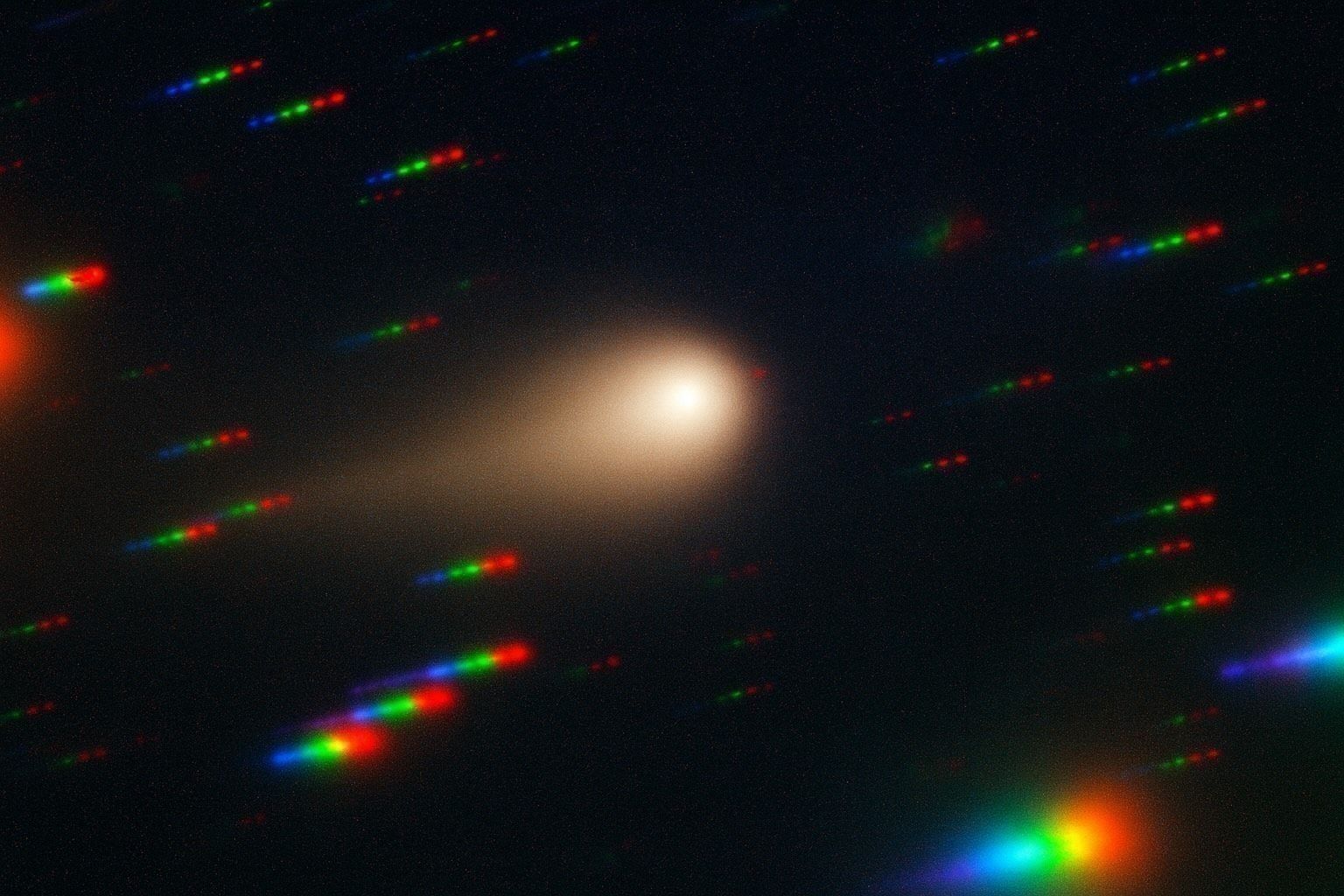
NASA’s Hubble Space Telescope captured its latest high‑resolution view of the comet on 30 November 2025, using its Wide Field Camera 3. The image shows a bright central coma, with hints of a sunward jet and a trailing tail. Hubble tracked the fast‑moving comet, so background stars are smeared into streaks. Chron+3Live Science+3FOX Weather+3
Around the same time, ESA’s Jupiter Icy Moons Explorer (JUICE) spacecraft, en route to Jupiter, observed 3I/ATLAS from just ~41 million miles (66 million km) away. JUICE images show a very active comet with at least two distinct tails: Live Science+2Discover Magazine+2
- a plasma tail made of electrically charged gas, and
- a dust tail composed of tiny solid grains swept back by sunlight.
Together, Hubble, JUICE and other spacecraft contribute to a NASA‑coordinated “fleet” campaign that also includes Mars orbiters, the Perseverance rover, the Lucy and Psyche missions, Parker Solar Probe, SOHO and more – many of them repurposed temporarily to track this one cosmic visitor. NASA Science+2University of Colorado Bould…
A view from Mars
From Mars orbit, NASA’s MAVEN spacecraft spent about 10 days in September and October imaging 3I/ATLAS with its ultraviolet spectrometer, capturing the comet as a fuzzy “dandelion ball” of gas and dust. MAVEN happened to be on the right side of the Sun when Earth’s view was blocked, giving scientists a unique perspective on the comet’s water and hydrogen outflow. University of Colorado Boulder+1
MAVEN’s principal investigator Shannon Curry notes that while the mission was designed to study Mars’ upper atmosphere, its instruments turned out to be perfect for measuring how fast the comet is losing water, helping constrain the size and activity of its icy nucleus. University of Colorado Boulder
Amateur astrophotographers join in
Back on Earth, the comet is now reappearing in the pre‑dawn winter sky. A widely shared image from Egypt’s Black Desert, shot on 29 November by photographer Osama Fathi and featured in BBC Sky at Night Magazine, shows 3I/ATLAS as a faint green glow slipping between desert trees – a very human‑scale view of a visitor older than our Sun. Sky at Night Magazine
Smart, app‑guided telescopes are making it easier for amateurs to lock onto the comet’s coordinates without needing to star‑hop manually – though its faintness still demands dark skies and patience. Sky at Night Magazine+1
Speculation vs. scientific consensus: could 3I/ATLAS be artificial?
No coverage of 3I/ATLAS is complete without mentioning the ongoing debate sparked by Avi Loeb, a Harvard astrophysicist known for arguing that 1I/ʻOumuamua might have been artificial.
Loeb has published several essays in recent days, including “First X‑Ray Detection of 3I/ATLAS” and “Is 3I/ATLAS a Friendly Gardener or a Serial Killer?”, plus interviews picked up by outlets like the New York Post. New York Post+3Medium+3Medium+3
He argues, broadly, that:
- the high methanol‑to‑cyanide ratio could indicate a deliberately “friendly” chemical payload,
- the comet’s complex jet structure might resemble propulsion, and
- its unusual chemistry could be consistent with a technological origin.
However, mainstream comet scientists and NASA missions strongly disagree:
- NASA’s official 3I/ATLAS page, along with multiple mission teams, describes the object simply as an interstellar comet, with characteristics well explained by ices sublimating under solar heating and by its high‑speed hyperbolic orbit. NASA Science+2Live Science+2
- MAVEN’s team lead Shannon Curry states that “everything about this object” – its trajectory, size and evolution – points to a natural comet, with no evidence for exotic propulsion or artificial behavior. University of Colorado Boulder
In other words, the evidence so far fits a very active, chemically rich comet from another star system, not an alien weapon or probe. The exotic framing makes for dramatic headlines, but astronomers are treating it as a test case for understanding planet formation and organic chemistry in other planetary systems.
How to see interstellar comet 3I/ATLAS from Earth
Even though 3I/ATLAS will stay far from Earth, you can try to observe it if you have the right gear. Recent viewing advice published on 11 December emphasizes a few key points. The Economic Times+2Wikipedia+2
1. Manage expectations
- The comet will never be a naked‑eye spectacle. Expect a faint smudge in a telescope, not a blazing “Great Comet”.
- As it recedes after December and continues to dim, it will become a tougher target even for experienced observers. Wikipedia+1
2. Use adequate equipment
- Use a telescope with at least an 8‑inch (20 cm) aperture; larger is better. Many reports suggest that anything smaller struggles to pull the comet out of the background noise. The Economic Times+1
- A sensitive camera (DSLR, mirrorless or dedicated astro‑camera) plus stacking software will dramatically improve your chances compared to visual observing alone.
3. Pick the right time and direction
- In early to mid‑December, 3I/ATLAS is best seen in the pre‑dawn eastern sky, moving through the constellations Virgo and Leo as it pulls away from the Sun. Wikipedia+2The Sky Live+2
- On 11 December, use the half Moon as a landmark: the comet passes within a couple of degrees of it, so you can center the Moon and then slowly sweep nearby with a low‑power eyepiece. Wikipedia+1
4. Use live tracking tools
NASA’s “Eyes on the Solar System” web app allows you to visualize 3I/ATLAS in 3D and generate up‑to‑date plots of its position relative to Earth, the Sun and the planets. Several mobile astronomy apps are also adding the comet to their databases; search for “3I/ATLAS” or “C/2025 N1”. NASA Science+2The Economic Times+2
5. Chase the photos if you can’t chase the comet
If you don’t have access to a telescope, keep an eye on:
- NASA’s 3I/ATLAS image gallery, which is being updated as new spacecraft data arrive. NASA Science+1
- Astronomy news outlets and astrophotography communities – recent days have already brought twin‑tail images from JUICE, Hubble close‑ups, and landscape shots like the Black Desert photo from Egypt. Live Science+3Discover Magazine+3FOX Weath…
Why 3I/ATLAS matters long after it’s gone
Beyond the headlines, 3I/ATLAS is giving scientists a once‑in‑a‑generation chance to:
- Sample the chemistry of another star’s planetary system via its ices and gases. Chron+2arXiv+2
- Test how interstellar objects interact with the Sun – from dust jets and plasma tails to X‑ray halos produced by the solar wind. Medium+2Live Science+2
- Compare it with ʻOumuamua and Borisov to refine estimates of how many such objects roam the galaxy, and how often we can expect similar visitors. NASA Science+1
Once 3I/ATLAS swings past Jupiter in March 2026 it will head back into the dark, taking its secrets with it. Wikipedia
What’s different this time is that dozens of spacecraft and observatories – from Mars orbiters to JUICE, XRISM, JWST and Hubble – are watching almost every step of the journey. The data they collect over the next few months will shape how we think about interstellar comets, panspermia, and future missions designed to intercept the next visitor.