On December 9, 2025, interstellar comet 3I/ATLAS (also known as C/2025 N1 (ATLAS)) is racing through the inner solar system, just 10 days away from its closest approach to Earth. Today’s wave of new images and data — from Hubble, ESA’s JUICE spacecraft, Japan’s XRISM X‑ray observatory, ALMA, and both professional and amateur telescopes — is turning this icy visitor into one of the most studied comets in history. Chron+3NASA Science+3European Space Agency…
Below is a roundup of what’s new today, why 3I/ATLAS matters, and what skywatchers can realistically expect to see.
Today’s Big 3I/ATLAS Updates (December 9, 2025)
1. The comet’s current distance, speed and brightness
A detailed science roundup published today notes that as of December 9, 2025, 3I/ATLAS is: SSBCrack News
- About 278 million km (173 million miles) from Earth
- Moving at roughly 60 km/s (over 215,000 km/h) relative to the Sun
- Shining at around magnitude 10.9–11.5, far too faint for the naked eye but accessible to moderate amateur telescopes
The same analysis confirms that on December 19 the comet will pass Earth at about 1.8 astronomical units (AU) — roughly 270 million km — and crucially, on the opposite side of the Sun, so there is no impact risk. SSBCrack News+2European Space Agency+2
2. New multi‑mission image sets: Hubble, JUICE and amateurs
A series of articles today highlight three key new visuals of 3I/ATLAS: NASA Science+3www.ndtv.com+3Indian Defence…
- Hubble Space Telescope (Nov 30)
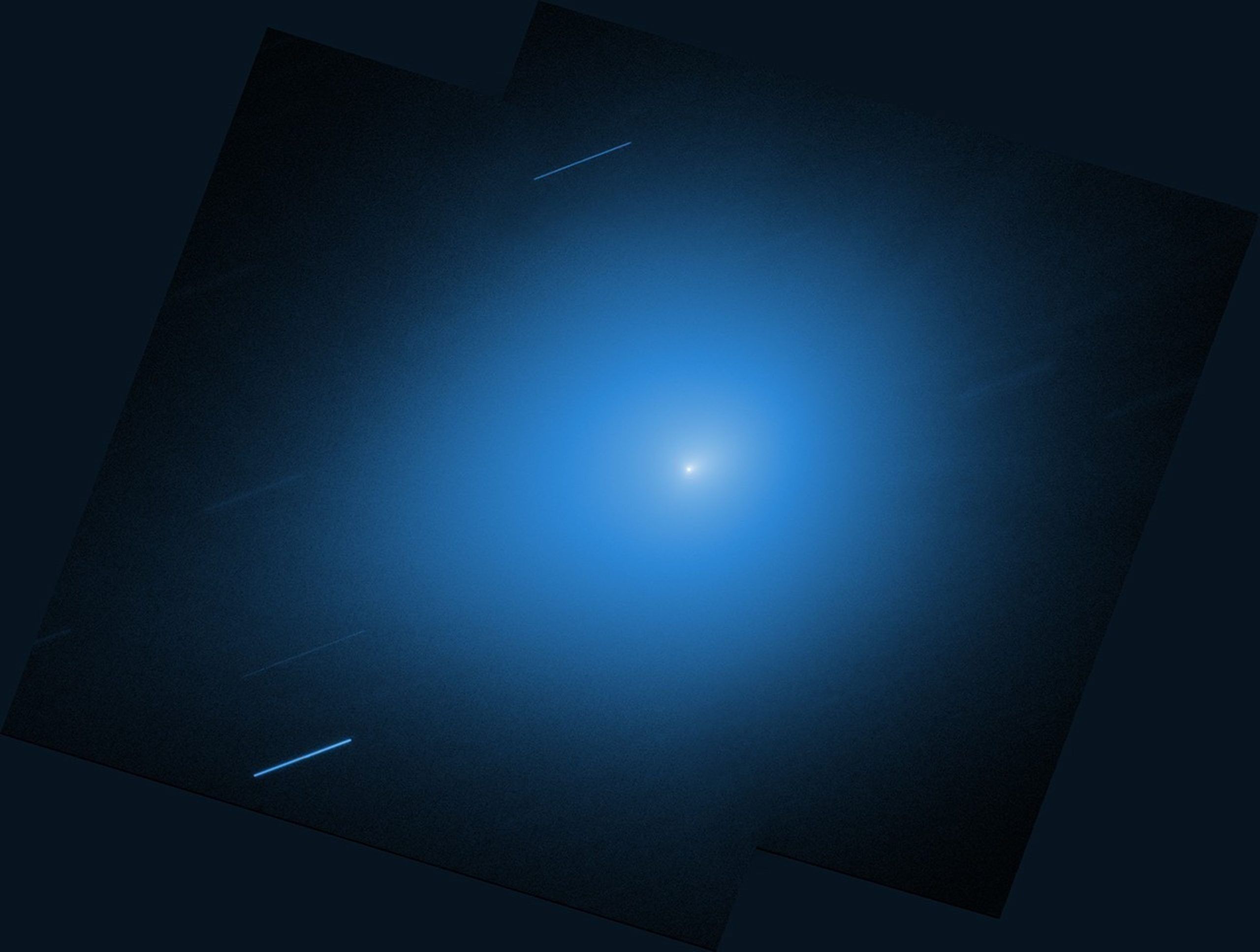
- NASA’s Hubble re‑observed 3I/ATLAS on November 30 using its Wide Field Camera 3, when the comet was about 178 million miles (286 million km) from Earth.
- Because Hubble tracked the fast‑moving comet, background stars appear as streaks, while the comet itself shows a compact nucleus, bright coma and a short tail.
- ESA’s JUICE spacecraft (early November)
- On its way to Jupiter, JUICE used its NavCam and other instruments to image the comet from about 66 million km away.
- The images reveal a glowing coma and at least two distinct tails: a plasma tail of charged gas and a fainter dust tail, classic hallmarks of an active comet heated by the Sun.
- Wide‑field amateur image from Namibia (Dec 2)
- Amateur astronomers Gerald Rhemann and Michael Jäger captured a deep image on December 2 with a 12‑inch telescope in Namibia, showing the comet’s extended coma and a long anti‑tail stretching tens of thousands of kilometers. www.ndtv.com+1
Together, these views show an object that is highly active, with jets feeding a huge halo of gas and dust and multiple tails responding to the solar wind.
3. First‑ever X‑ray detection of an interstellar object
The headline result today is that the XRISM satellite’s Xtend telescope has captured the first X‑ray image of 3I/ATLAS — and of any interstellar object, ever. primetimer.com+1
Key points from the XRISM team and today’s write‑ups:
- Xtend observed 3I/ATLAS from November 26–28, 2025 for about 17 hours.
- The data reveal a faint X‑ray glow extending roughly 5 arcminutes on the sky, corresponding to about 400,000 km around the comet.
- The X‑ray spectrum shows excess emission from carbon, nitrogen and oxygen ions, consistent with a known mechanism:
- Charge‑exchange between the solar wind (charged particles from the Sun) and neutral gas in the comet’s giant coma.
- This strongly supports the idea that 3I/ATLAS is outgassing a huge cloud of gas that interacts with the solar wind in much the same way as comets born in our own solar system.
Astronomer Avi Loeb’s technical note today emphasizes that this is a pioneering detection and a powerful new way to probe how interstellar ices behave under solar irradiation. Medium
4. Weird chemistry: methanol‑rich and “prebiotic”
Yesterday’s reporting on new ALMA (Atacama Large Millimeter/submillimeter Array) data is still driving today’s discussion: 3I/ATLAS is chemically odd even by comet standards. Chron
- ALMA detects unusually high amounts of methanol (CH₃OH) and hydrogen cyanide (HCN) in the gas streaming off the comet.
- Methanol appears to make up about 8% of all the vapor coming off 3I/ATLAS — roughly four times higher than typically seen in comets from our solar system.
- Researchers describe these production rates as “among the most enriched values measured in any comet.”
Methanol and hydrogen cyanide are both important in prebiotic chemistry — the set of reactions that can lead from simple molecules to the building blocks of life. That’s why some scientists are excited about the possibility that interstellar comets like 3I/ATLAS could have delivered organic material to young planetary systems, including our own. Chron+1
A few commentators, including Loeb, have floated attention‑grabbing ideas about artificial or “alien” origins, but there is no evidence for this. The unusual chemistry can be explained naturally, and mainstream scientists treat 3I/ATLAS as a particularly interesting — but still natural — comet. Chron+1
5. Global observing campaign reaches its halfway point
The International Asteroid Warning Network (IAWN) is using 3I/ATLAS as the focus of a worldwide astrometry campaign to practice precisely tracking fuzzy, active comets. The campaign runs from November 27, 2025, to January 27, 2026, and includes a mid‑campaign check‑in telecon scheduled for today, December 9. iawn.net
Although 3I/ATLAS is not a threat, the exercise helps planetary‑defense teams refine methods that would be critical if a future comet ever were on a hazardous trajectory.
What Exactly Is 3I/ATLAS?
3I/ATLAS is only the third confirmed interstellar object ever seen passing through our solar system, after: European Space Agency+1
- 1I/ʻOumuamua (2017) – a cigar‑ or pancake‑shaped object with puzzling behavior.
- 2I/Borisov (2019) – a more conventional comet from another star system.
- 3I/ATLAS (C/2025 N1) – discovered on July 1, 2025 by the ATLAS survey telescope in Río Hurtado, Chile.
The “3I” prefix means “third interstellar object,” and “ATLAS” honors the survey program that first spotted it. European Space Agency+1
Initial orbit calculations showed that:
- 3I/ATLAS follows a hyperbolic trajectory — its path is open, not elliptical, so it is not gravitationally bound to the Sun and will never return. FOX Weather+1
- Its orbit is strongly retrograde, tilted by about 175° relative to the plane of the solar system, effectively passing “backwards” through the planetary orbits. SSBCrack News+1
Current size estimates put the nucleus somewhere between a few hundred meters and a few kilometers across, likely under 1 km. SSBCrack News+1
A Record‑Fast Visitor — But No Threat to Earth
According to ESA’s latest FAQ and NASA’s orbit data: European Space Agency+2NASA Science+2
- Closest to the Sun (perihelion):
- Around October 29–30, 2025, at about 1.36–1.4 AU (≈ 200 million km) from the Sun.
- At perihelion, the comet’s speed reached roughly 250,000 km/h (~70 km/s), making it one of the fastest solar‑system visitors on record.
- Closest to Mars:
- October 3, 2025, at about 29 million km, allowing Mars‑orbiting spacecraft to image the comet.
- Closest to Earth:
- Will occur on December 19, 2025, at about 270 million km (1.8 AU) — nearly twice Earth–Sun distance, and behind the Sun as seen from Earth.
Multiple agencies stress that 3I/ATLAS is far too distant to be a hazard and is not classified as a near‑Earth object. European Space Agency+2Indian Defence Revi…
How 3I/ATLAS Is Being Studied Across the Spectrum
One reason 3I/ATLAS is such a scientific jackpot is that nearly every major observatory that can see it is seeing it. NASA’s dedicated 3I/ATLAS page lists a dense timeline of observations: NASA Science+2NASA Science+2
- July 2025 – Discovery and early size estimates
- ATLAS first reports the object.
- Hubble quickly follows up to estimate the size and detect early signs of a coma.
- August 2025 – Infrared and spectral chemistry
- James Webb Space Telescope (JWST) captures near‑infrared spectra with NIRSpec, revealing a mixture of water, carbon dioxide, carbon monoxide and other ices in the coma. European Space Agency+1
- SPHEREx and other facilities map the large gas plume around the comet.
- September–October 2025 – Multi‑spacecraft chase
- Psyche, STEREO, Lucy, PUNCH, MAVEN, Mars orbiters and even China’s Tianwen‑1 all contribute images and measurements of the coma and tail as the comet sweeps through the inner solar system. NASA Science+1
- November 2025 – Post‑perihelion activity
- ESA’s JUICE spacecraft conducts a dedicated observing campaign in early November, using cameras, spectrometers and particle instruments to study tails, coma and the surrounding plasma. European Space Agency+1
- Late November–Early December 2025 – High‑detail imaging and X‑rays
- Hubble’s November 30 image shows an expanded coma and revived tail structure as the comet recedes from the Sun. NASA Science+2FOX Weather+2
- XRISM Xtend records the first X‑ray glow around an interstellar comet, opening a brand‑new observational window. primetimer.com+1
This cross‑mission approach allows scientists to match shape and brightness (from imaging) with gas composition(from spectra) and interaction with the solar wind (from X‑rays and particle sensors).
Why the Strange Chemistry Matters for Life’s Origins
The ALMA results and ESA’s earlier JWST findings suggest that 3I/ATLAS is a chemical outlier: Chron+2European Space Agency+2
- High abundances of methanol and hydrogen cyanide, both linked to prebiotic reaction chains that can form amino acids and other building blocks of life.
- Significant carbon dioxide and other volatiles typical of comets, but in ratios unlike most solar‑system examples.
Because 3I/ATLAS formed in another star system, its ices preserve a snapshot of conditions around a foreign young star. Comparing its chemistry to comets in our own Oort Cloud helps answer questions like:
- Are the ingredients for life common in planetary systems across the galaxy?
- Do interstellar comets routinely swap material between star systems, seeding planets with complex organics?
Some researchers argue that objects like 3I/ATLAS may have helped deliver life’s raw ingredients to early Earth — not as deliberate messengers, but as part of a long‑running galactic exchange of icy debris. Chron+1
Can You See 3I/ATLAS Yourself?
Realistically: only if you have decent gear and dark skies.
Today’s observing guides and scientific summaries agree on a few practical points: SSBCrack News+2Wikipedia+2
- Brightness
- The comet is hovering around magnitude 10–11.5.
- That is far fainter than the threshold for naked‑eye visibility (about magnitude 6 in good conditions).
- Where to look (roughly)
- Around early December, 3I/ATLAS is found in the predawn sky, currently in or near the constellation Leo, close to the bright star Regulus from many locations.
- Exact position changes night‑to‑night; observers should consult up‑to‑date charts or planetarium apps.
- Equipment
- A telescope with at least a 20–30 cm (8–12 inch) aperture or very strong binoculars is recommended.
- Under dark skies, it may appear as a faint, diffuse smudge with a slightly elongated coma rather than a dramatic naked‑eye spectacle.
Always follow standard safety rules: never point optics near the Sun in twilight without being certain of the Sun’s position, and use star charts or reliable software to confirm the comet’s location.
What Happens After the December 19 Flyby?
Even after 3I/ATLAS is at its “closest” to Earth, the science won’t stop:
- JUICE data dump in early 2026
- Because the spacecraft is currently using its main antenna as a heat shield, detailed data are being trickled back slowly.
- ESA expects the full science dataset from the JUICE comet observations — including higher‑resolution images and spectra — to arrive around February 2026. European Space Agency+1
- Continued JWST and Hubble monitoring
- Both telescopes have follow‑up observations planned to watch how the coma and tails evolve as the comet recedes. European Space Agency+1
- IAWN astrometry campaign through January 27, 2026
- Professional and advanced amateur observers will keep measuring the comet’s position precisely, refining its orbit and testing techniques for future planetary‑defense work. iawn.net
- Eventual escape into interstellar space
- Over the coming years, 3I/ATLAS will climb back out of the solar system, carrying with it a treasure trove of data now stored in human archives — our only permanent record of this particular visitor.
Bottom line
As of December 9, 2025, 3I/ATLAS has gone from a faint blip in an all‑sky survey to a multi‑wavelength celebrity:
- It’s the third interstellar object ever seen, moving on a hyperbolic path that ensures it will never return. European Space Agency+1
- It’s chemically extraordinary, rich in methanol and cyanide‑bearing molecules that may hold clues to the galactic chemistry of life. Chron
- Today’s first X‑ray detection by XRISM’s Xtend instrument shows that its vast gaseous coma is actively interacting with the solar wind. primetimer.com+1
- And despite breathless headlines, it remains a distant, harmless object, offering science, not danger. European Space Agency+2Indian Defence Revi…
For now, 3I/ATLAS is a reminder that our solar system is not isolated. Icy debris from other stars can and does wander through our neighborhood — and when it does, we now have the tools to catch it, dissect its light, and learn how typical (or unusual) our own cosmic backyard might be.