Published: 5 December 2025
A once‑in‑a‑lifetime interstellar visitor hits the headlines again
Interstellar comet 3I/ATLAS has just delivered a fresh burst of science – and controversy.
Over the last few days, NASA’s Hubble Space Telescope has captured a new high‑resolution image of the comet, ESA’s JUICE spacecraft has beamed back a surprise navigation‑camera view showing multiple tails, and scientists in Europe have posted a preprint arguing that the object may be erupting in cryovolcanoes – “ice volcanoes” – on its surface.NASA Science+2Sci.News: Breaking Science N…
At the same time, Harvard astrophysicist Avi Loeb has published new analyses of the latest Hubble image and renewed his call to keep an open mind about unexplained features of the comet, while also warning about AI‑generated deepfakes misrepresenting his work.Medium+1
Here’s where the science stands as of December 5, 2025 – what we know about 3I/ATLAS, what is still uncertain, and why astronomers worldwide are racing to study it before it vanishes back into interstellar space.
What is interstellar comet 3I/ATLAS?
3I/ATLAS (also catalogued as C/2025 N1 (ATLAS)) was discovered on 1 July 2025 by the Asteroid Terrestrial‑impact Last Alert System (ATLAS) survey telescope in Rio Hurtado, Chile.Sci.News: Breaking Science News+1
It is only the third confirmed interstellar object ever seen passing through our Solar System, after 1I/ʻOumuamua (2017) and 2I/Borisov (2019). Its orbit is strongly hyperbolic, meaning it’s moving too fast to be gravitationally bound to the Sun and will never return once it leaves.Wikipedia
Key facts now established:
- Interstellar origin: orbital eccentricity > 1 and a high incoming speed (~58 km/s relative to the Sun at infinity) identify it as an interstellar visitor.Wikipedia
- Size: Hubble imaging suggests a nucleus between about 0.3 and 5.6 km across, with the most likely value under 1 km – but the coma still hides the exact size.Wikipedia+1
- Composition: JWST and large ground‑based telescopes find that 3I/ATLAS is unusually rich in carbon dioxide, with smaller amounts of water ice, water vapour, carbon monoxide and carbonyl sulfide, plus cyanide and nickel vapour – broadly similar to, but not identical with, Solar System comets.Wikipedia+1
- Trajectory and safety: the comet passed closest to the Sun in late October 2025 (perihelion at about 1.36 AU) and will pass Earth at a minimum distance of roughly 1.8 AU (269 million km / 167 million miles) on 19 December 2025, so it poses no impact threat.Wikipedia+2IFLScience+2
As of December 5, 3I/ATLAS is around magnitude 12 and located in the constellation Virgo, making it a faint telescopic target for experienced observers using substantial equipment.Wikipedia
Hubble revisits 3I/ATLAS: a sharper look after perihelion
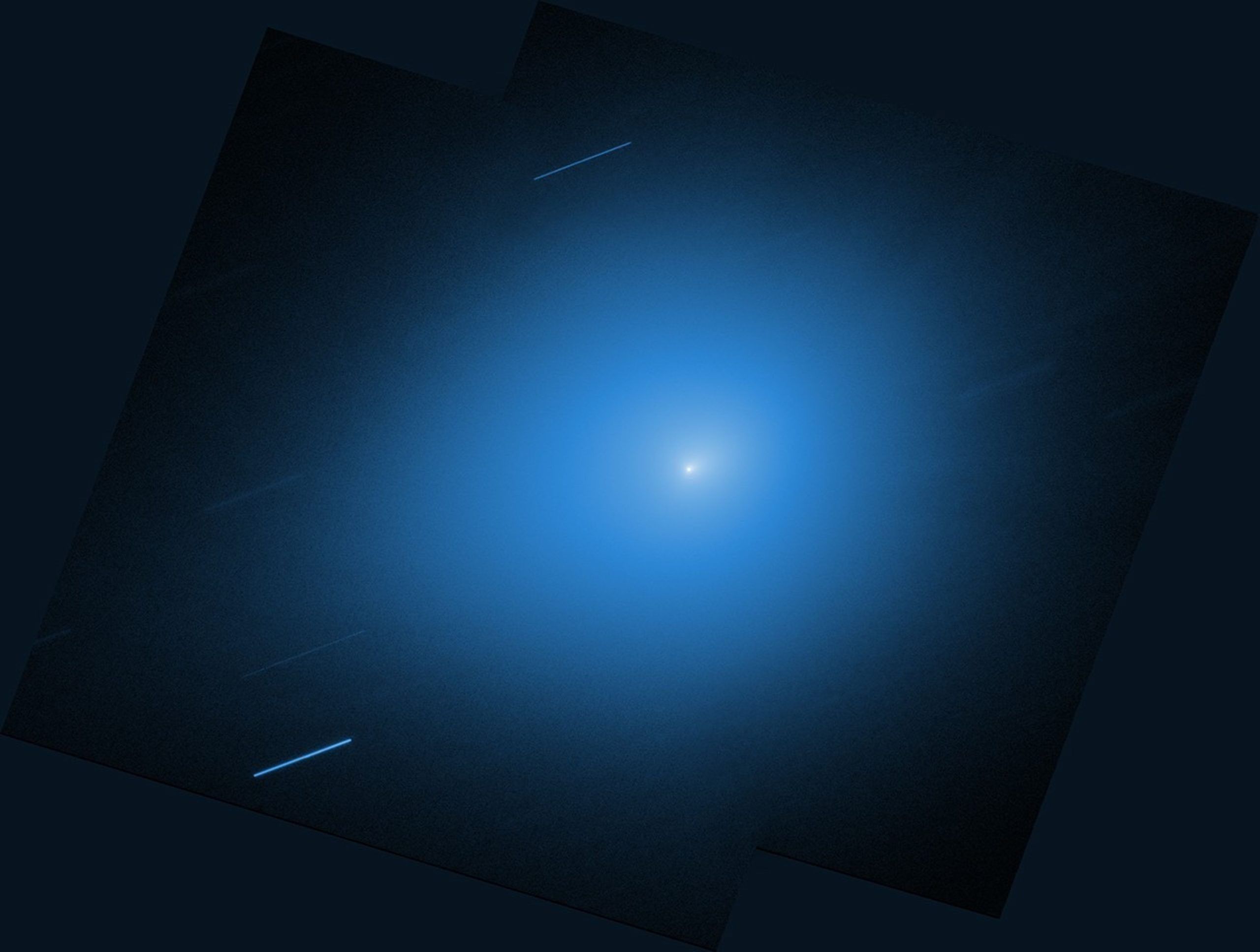
On 30 November 2025, NASA’s Hubble Space Telescope turned its Wide Field Camera 3 back toward 3I/ATLAS. At the time, the comet was about 286 million km (178 million miles) from Earth. Hubble tracked the comet as it moved, causing background stars to appear as streaks while the comet sits as a fuzzier, teardrop‑shaped glow in the centre.NASA Science+1
NASA’s new blog post on the observation emphasizes:
- The new image follows an earlier Hubble view from 21 July 2025, taken soon after discovery, allowing astronomers to compare pre‑ and post‑perihelion activity.NASA Science
- Hubble is part of a coordinated 3I/ATLAS observing campaign involving multiple NASA missions and international partners, which will continue as the comet recedes.NASA Science+1
Independent coverage from Sci.News and IFLScience highlights the “teardrop” dust cocoon around the nucleus and the way the inner coma appears to stretch towards the Sun, not just away from it – a behaviour that turns out to be important for the current scientific debate.Sci.News: Breaking Science News+1
Avi Loeb’s new analysis: a sunward anti‑tail and a possible swarm
In a new essay, “A New Hubble Space Telescope Image of 3I/ATLAS,” Avi Loeb examines the November 30 Hubble image in detail.Medium He notes that:
- The coma extends in a teardrop shape roughly 40,000 km in radius, with an “anti‑tail” stretching some 60,000 km sunward – again, toward the Sun rather than away from it.Medium
- In a recent paper, he had predicted that a swarm of macroscopic, non‑volatile fragments could separate from the comet due to its measured non‑gravitational acceleration. By November 30, he expected this swarm to lie roughly 60,000 km closer to the Sun than the nucleus – similar to the observed anti‑tail extension.Medium
Loeb interprets this match as support for his hypothesis that the teardrop‑shaped glow contains a cloud of large, sunward‑offset objects – potentially fragments, boulders or something more exotic.
In a separate November 19 essay responding to NASA’s 3I/ATLAS press conference, he argued that the agency was too quick to present 3I/ATLAS as a “normal” comet and highlighted several statistical and dynamical “puzzles”, including its unusually large mass compared to ʻOumuamua and Borisov and the improbability of its trajectory lining up so neatly with the plane of the planets by chance.Medium
At the far edge of the debate, tabloid coverage of Loeb’s earlier comments has suggested possibilities such as artificial jets, accompanying swarms of objects and even deliberate seeding of life by advanced civilizations.New York Post+2New York Post+2
How mainstream scientists respond
The mainstream scientific view, reflected in NASA’s statements and most peer‑reviewed reports so far, is that 3I/ATLAS behaves like an active comet:
- It shows gas and dust outgassing driven by solar heating.
- Spectroscopy reveals a mix of common cometary volatiles.
- Its motion can be explained by a combination of gravity and normal outgassing forces, within current uncertainties.NASA Science+2Live Science+2
A news summary today captured the split succinctly: Loeb estimates up to a 40% chance that 3I/ATLAS could be technological, but NASA and ESA scientists reject the spacecraft idea, emphasizing the natural, icy‑comet explanation.Somos Hermanos
At present, no robust evidence supports a technological origin. Loeb’s proposals are best viewed as speculative hypotheses that will either be ruled out or constrained by forthcoming imaging and spectroscopy from Hubble, JWST, JUICE and other missions.
Loeb’s new Hubble piece also includes a broader warning: he describes how AI‑generated fake videos have impersonated him and misrepresented his views on 3I/ATLAS, arguing that this is a cautionary tale about verifying sources and distinguishing evidence‑based science from fabricated content.Medium
JUICE’s surprise navigation‑camera image: two tails from Jupiter’s pathfinder
While Hubble grabbed the headlines, ESA’s Jupiter Icy Moons Explorer (JUICE) quietly scored one of the most dramatic views of 3I/ATLAS so far.
During November 2025, JUICE used five science instruments to observe the comet. Because of thermal constraints, the spacecraft is currently using its high‑gain antenna as a makeshift heat shield, forcing data to trickle back slowly via a smaller antenna. Most of the scientific data won’t arrive until February 2026.European Space Agency+1
The team, however, couldn’t resist an early peek. They downloaded just one quarter of a single image from the onboard Navigation Camera (NavCam) – a camera designed for guidance around Jupiter’s moons, not cutting‑edge comet science. The result astonished them:
- 3I/ATLAS appears as a clearly visible bright coma.
- There is a distinct plasma tail – a jet of electrically charged gas pointing roughly away from the Sun.
- A fainter dust tail seems to stretch in a slightly different direction, likely tracing heavier grains pushed by sunlight and shaped by the comet’s motion.European Space Agency+2Sci.News: Breaking …
The NavCam image was taken on 2 November 2025, two days before JUICE’s closest approach to the comet on 4 November, when the spacecraft passed at a distance of about 66 million km (41 million miles). From that vantage point, between the comet and the Sun, JUICE had an excellent view of the inner coma and tails just after perihelion, when comet activity was ramping up.Sci.News: Breaking Science News+1
The science instruments – including JANUS (optical camera), MAJIS and UVS (spectrometers), SWI (sub‑millimetre instrument) and PEP (particle detector) – are expected to reveal how the comet’s composition and activity changed near and after its closest approach to the Sun.
Psyche, STEREO, PUNCH and friends: a multi‑mission portrait
3I/ATLAS is now one of the best‑observed comets in history, thanks to an armada of spacecraft that weren’t built with interstellar comets in mind.
Psyche: testing a metal‑asteroid camera on an interstellar comet
NASA’s Psyche mission, en route to the metal‑rich asteroid of the same name, turned its multispectral imager toward 3I/ATLAS on 8–9 September 2025. Over eight hours, Psyche acquired four images when it was about 53 million km (33 million miles) from the comet.Sci.News: Breaking Science News
According to the mission team, these observations:
- Helped refine the comet’s trajectory, improving predictions for later encounters and Earth‑based observing windows.
- Provided additional measurements of the faint coma surrounding the nucleus.
- Demonstrated that Psyche’s imager can track faint, moving objects with high precision.Sci.News: Breaking Science News
Psyche thus joined a growing list of missions contributing to NASA’s interstellar‑comet tracking campaign.
STEREO and PUNCH: heliophysics missions see an alien comet
NASA’s STEREO‑A (Solar Terrestrial Relations Observatory) – a mission designed to monitor solar activity – tracked 3I/ATLAS between 11 September and 2 October 2025 using its Heliospheric Imager‑1 telescope. At first, scientists thought the comet would be too faint, but by stacking and aligning multiple exposures, they were able to tease out a faint, fuzzy orb moving against the noisy background.NASA Science+1
The derived images show the comet hurtling through the inner Solar System at about 130,000 mph (209,000 km/h), and mark the first time NASA’s heliophysics fleet has knowingly observed an interstellar object.NASA Science+1
In parallel, NASA’s PUNCH mission, which studies the solar wind and corona, caught 3I/ATLAS photobombing observations of another bright comet, C/2025 R2 (SWAN). PUNCH was imaging SWAN at high cadence between August and October; a tiny dot moving the “wrong way” through the frames turned out to be 3I/ATLAS.IFLScience
Together with observations from SOHO, Mars orbiters and ground‑based telescopes, these data sets give astronomers a multi‑scale view of how an interstellar comet responds to the Sun’s radiation and solar wind.
Are there ‘ice volcanoes’ on 3I/ATLAS?
One of the most intriguing scientific claims this week comes from a new study led by Josep M. Trigo‑Rodríguez and colleagues, described in a 1 December Live Science report.Live Science
Using the Joan Oró Telescope at Montsec Observatory in Spain along with other regional observatories, the team monitored 3I/ATLAS as it approached perihelion. They found:
- The comet entered a markedly more active phase when it came within about 378 million km (235 million miles) of the Sun.
- High‑resolution images showed spiral‑like jets of gas and dust emanating from the comet, which the authors interpret as evidence for cryovolcanism – “ice volcanoes” powered by internal processes.Live Science
In their preprint (not yet peer‑reviewed), the researchers propose that:
- Solar heating triggers sublimation of carbon dioxide ice, crossing a threshold where an oxidizing liquid can percolate through the comet’s interior and react with metallic grains and sulfides.
- This reaction releases energy and gas, driving eruption‑like jets that resemble cryovolcanoes seen on some outer Solar System bodies.Live Science
- Spectral comparisons with carbonaceous chondrite meteorites, including samples from Antarctica, suggest that 3I/ATLAS may share properties with trans‑Neptunian objects rich in volatile ices and metals.Live Science
If correct, this would be a remarkable result: despite coming from an unknown star system, 3I/ATLAS could be chemically similar to icy worlds on the fringes of our own Solar System. That, in turn, would support the idea that building blocks of planets and perhaps of life – water, organics, reactive metals – may be broadly common in the galaxy.
However, it’s important to stress that this is early‑stage, pre‑review work. Upcoming ultraviolet and infrared spectroscopy from Hubble, JWST and JUICE will be crucial for testing whether the observed jets truly require cryovolcanoes, or can be explained by more standard patterns of cometary outgassing.
Where 3I/ATLAS is now – and how to see it in December 2025
As of December 5, 2025, 3I/ATLAS is:
- Roughly 286 million km from Earth and moving away from the Sun after perihelion.NASA Science+1
- Around magnitude 12, according to current estimates – well beyond naked‑eye visibility, and challenging even for small backyard telescopes.Wikipedia
- Located in Virgo, and over the coming weeks it will traverse the sky into Leo, where it will be closest to Earth around 19 December, still at a safe distance of 1.8 AU.Wikipedia+2IFLScience+2
A December skywatching guide notes that:
- Observers with at least 30 cm (12‑inch) aperture telescopes under dark skies may glimpse 3I/ATLAS near the bright star Regulus in Leo around its closest approach, especially in the pre‑dawn hours.Midland Reporter-Telegram
- The comet will remain a faint, diffuse smudge, not a dramatic naked‑eye spectacle – but for experienced amateurs, simply knowing that the fuzzy patch in the eyepiece came from another star system is its own reward.
Professional and advanced amateur observatories are expected to continue imaging the comet intensively through late December, before it fades beyond easy reach and heads back into the darkness between the stars.IFLScience+1
What scientists agree on – and the big open questions
Despite the media buzz around alien‑probe hypotheses, there is strong consensus on several key points:
- 3I/ATLAS is interstellar and unique: its hyperbolic orbit and high incoming speed are beyond dispute.Wikipedia+1
- It is an active comet: multiple missions see gas and dust jets, a coma and tails responding to solar heating, all consistent with cometary physics.Live Science+3NASA Science+3Sci.News: Brea…
- It poses no danger to Earth: its minimum distance is around 1.8 AU; its closest planetary encounter was actually with Mars earlier in the year.Wikipedia+1
Where the frontier lies now is in understanding the details:
- Internal structure and activity: Are the jets and the sunward anti‑tail the result of unusual distributions of CO₂ ice, or do they indicate more exotic processes like cryovolcanoes or fragmentation?
- Origin and age: Kinematic studies suggest 3I/ATLAS may come from the Milky Way’s thin or thick disk, potentially making it older than the Solar System by billions of years if it originated in the thick disk.Wikipedia+1
- Population statistics: 3I/ATLAS is significantly more massive than ʻOumuamua and Borisov. Does that mean there are many more smaller interstellar debris objects we haven’t yet seen, or is this comet an outlier? Loeb argues the latter; many dynamicists think the survey statistics are still too sparse to say.Medium+1
Whatever the outcome, the data set now being assembled is unprecedented: Hubble, JWST, JUICE, Psyche, STEREO, PUNCH, SOHO, Mars orbiters, and dozens of ground‑based observatories are all contributing. As these observations are reduced and published over the coming months and years, 3I/ATLAS is likely to become a benchmark case for understanding icy planetesimals formed around other stars.
Why 3I/ATLAS matters
Beyond the eye‑catching headlines, 3I/ATLAS offers several profound opportunities:
- A direct sample of another planetary system’s building blocks
By studying its ices, dust and metals, astronomers can compare how planet‑forming chemistry unfolded in a foreign system versus our own, and test whether the ingredients thought to seed atmospheres and maybe even life are common in the galaxy.Live Science+1 - A stress‑test for planetary‑defense tools
Even though 3I/ATLAS is harmless, tracking a fast, incoming interstellar object gives NASA and ESA a chance to practice detection, orbit refinement and mission‑planning workflows that would be vital if a hazardous object were ever found on a collision course.NASA Science+1 - A case study in science, speculation and misinformation
The public debate around 3I/ATLAS – natural comet versus speculative spacecraft; peer‑reviewed preprints versus viral headlines; real experts versus AI‑generated impostors – is a live demonstration of how modern space science unfolds in the age of social media and generative AI. Loeb’s own struggle with deepfake videos underscores how critical it is to rely on verifiable, reputable sources when interpreting extraordinary claims.Medium+1
Regardless of whether 3I/ATLAS proves to be merely a particularly odd comet or something that forces a rewrite of our theories, it is already serving its purpose as a cosmic messenger: reminding us that our Solar System is not isolated, that material from other stars does wander through our neighbourhood, and that careful observation – not wishful thinking – is our best guide to understanding it.