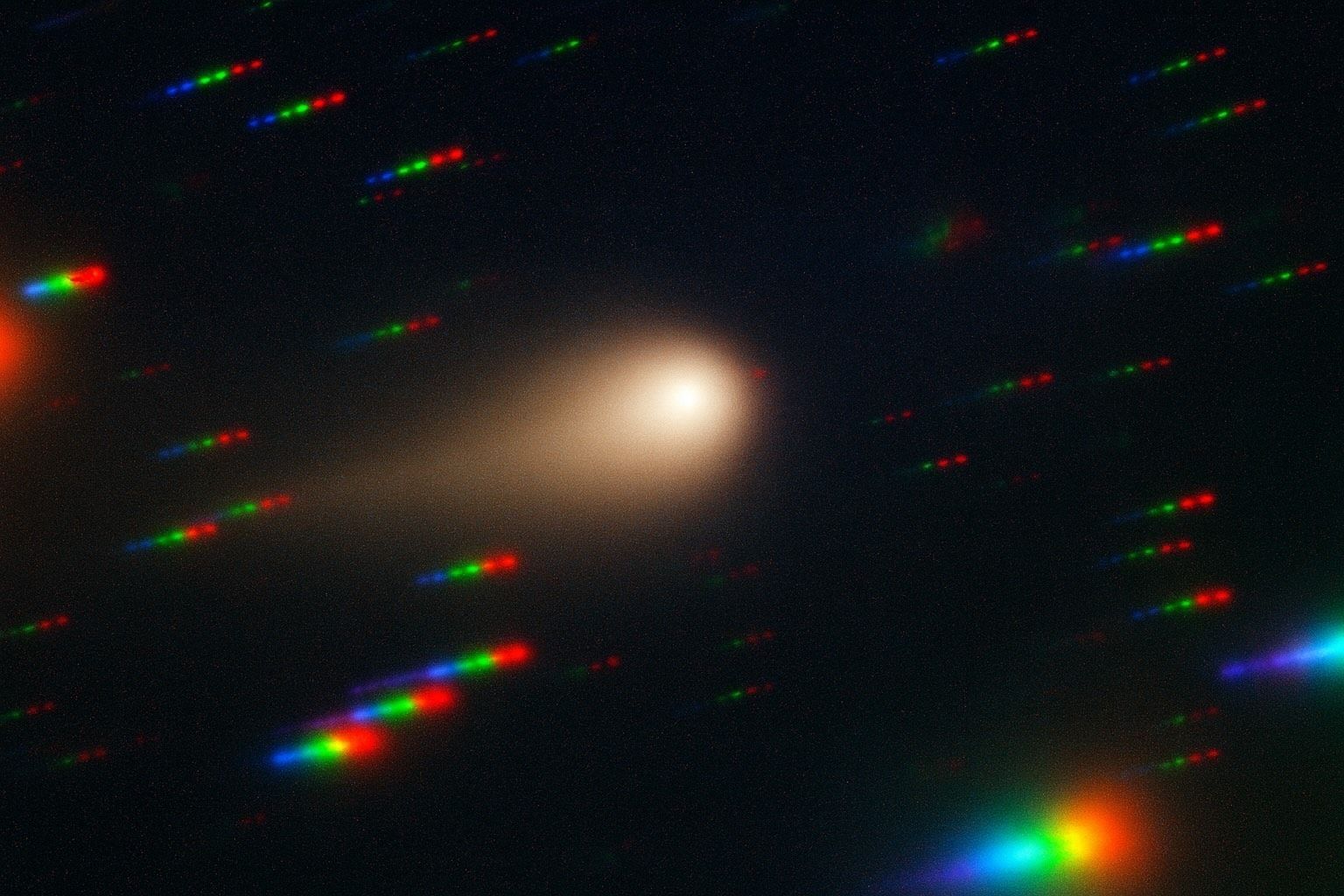
As of Friday, 28 November 2025, interstellar comet 3I/ATLAS has gone from “weird new visitor” to the centerpiece of a United Nations–endorsed planetary‑defence drill, a live trajectory experiment using spacecraft around Mars, and a lightning rod for speculation about alien technology. 1
Over the last 48 hours (27–28 November), three big themes have emerged:
- The UN and International Asteroid Warning Network (IAWN) have formally made 3I/ATLAS the target of their latest global observing exercise. 1
- New orbit work based on Mars orbiter data has sharpened predictions of the comet’s path by about an order of magnitude. 2
- NASA is doubling down on “it’s a comet”, even as high‑profile scientists like Avi Loeb publish fresh arguments about strange non‑gravitational forces and a suspiciously precise future fly‑by of Jupiter. 3
Below is a detailed, news‑style rundown of what’s actually new today, why it matters, and how to follow 3I/ATLAS safely and sensibly.
What’s New On 27–28 November 2025?
1. UN‑Backed Planetary‑Defence Exercise Officially Starts
The Times of India has confirmed that 3I/ATLAS has been formally adopted as the focus of the eighth official IAWN observing exercise, a live planetary‑defence campaign endorsed by the United Nations, IAWN, SMPAG (Space Mission Planning Advisory Group) and the UN Office for Outer Space Affairs (UNOOSA). 1
Key points from the UN/IAWN documentation as reported:
- 3I/ATLAS (comet designation C/2025 N1 (ATLAS)) was discovered on 1 July 2025 by the ATLAS telescope in Chile. 1
- It poses no impact threat to Earth; it will never come closer than roughly 1.8–2.0 AU (nearly twice Earth–Sun distance). 4
- The official observing window for the campaign runs from 27 November 2025 to 27 January 2026, with a mid‑campaign check‑in on 9 December and a close‑out teleconference on 3 February 2026. 1
The goal is not to “shoot down” anything. Instead, the exercise uses a real, scientifically interesting but harmless cometas a stress test for:
- rapid orbit refinement,
- coordination between observatories worldwide, and
- communication between space agencies and global decision‑makers if a genuine threat were ever found. 1
This also explains the more dramatic tabloid headlines claiming the “UN activates Earth’s planetary defences” over 3I/ATLAS: the “activation” is a training campaign, not an emergency response. 5
2. Mars Orbiter Data Sharpen 3I/ATLAS’s Orbit
On 27 November, Universe Today reported that ESA’s ExoMars Trace Gas Orbiter (TGO) and Mars Express have been used to triangulate 3I/ATLAS’s position from Mars orbit, dramatically improving the precision of its calculated path. 2
Highlights:
- 3I/ATLAS passed about 29–30 million km from Mars in early October. 2
- Teams at ESA’s Near‑Earth Object Coordination Center (NEOCC) combined Mars‑orbiter observations with Earth‑based data, improving orbit predictions by a factor of ~10 compared with ground‑based tracking alone. 2
- This is the first time data from a spacecraft orbiting another planet have been used to triangulate an interstellar object’s trajectory, and it’s being treated as a planetary‑defence rehearsal as much as pure science. 2
The refined trajectory confirms:
- Perihelion (closest point to the Sun): 29 October 2025, at about 1.36 AU. 4
- Current speed: around 250,000 km/h as it climbs away from the Sun. 2
- Closest approach to Earth: around 19 December 2025, at roughly 270 million km (~1.8 AU) — still safely distant, about twice the Earth–Sun distance. 2
In other words: the new Mars‑based work makes “no threat to Earth” even more secure, while giving astronomers a tighter window for high‑value observations in December.
3. NASA Reaffirms: “It Looks Like A Comet – A Very Weird One”
A new Hindustan Times explainer on 28 November pulls together NASA statements and independent research and emphasises that the agency still officially classifies 3I/ATLAS as an interstellar comet, not alien hardware. 3
Key scientific points:
- 3I/ATLAS is only the third confirmed interstellar object, after 1I/ʻOumuamua (2017) and 2I/Borisov (2019). 3
- When it approached the Sun, telescopes worldwide saw classic comet features: a bright coma, an extended tail, and vigorous outgassing. 3
- Spectroscopy, especially from JWST and big ground‑based telescopes, shows a coma unusually dominated by carbon dioxide (CO₂), with relatively little water and carbon monoxide compared to typical Solar System comets. 4
That composition, plus strange changes in brightness and gas flow, has led some researchers to argue that 3I/ATLAS may be:
- a new class of interstellar comet formed in very different conditions from anything in our Solar System, or
- at least an extremely old object, possibly older than the Solar System itself (estimates run to ~7 billion years). 4
NASA’s public line, however, remains conservative: a natural comet with unusual properties, scientifically “fascinating and important” but not evidence of extraterrestrial technology. 6
4. Loeb’s New Claim: A Suspicious Jupiter Fly‑By
On 28 November, Harvard astrophysicist Avi Loeb published a new Medium post about the non‑gravitational acceleration acting on 3I/ATLAS — that is, the small deviations from a pure gravity‑only orbit, usually caused by jets of gas and dust from a comet’s surface. 7
Loeb’s argument, in brief:
- NASA’s JPL Horizons system has repeatedly revised the non‑gravitational parameter A1 as more data arrive, dropping it from ~1.6×10⁻⁶ to ~6.8×10⁻⁸ AU/day² as models were updated to better match CO₂‑driven outgassing rather than water‑ice sublimation. 7
- Those changes slightly shift the predicted closest approach to Jupiter on 16 March 2026, now estimated at about 53.6 million km. 7
- Loeb notes that this distance is tantalisingly close to Jupiter’s Hill radius (its sphere of gravitational dominance) at that time and suggests that, if the match remains extremely precise, it might hint at intentional course‑tuning — in other words, a technological origin. 8
This follows his earlier pieces arguing that the unusually strong, tightly collimated anti‑tail seen in late‑November images, and the large mass‑loss implied by that tail, might be hard to explain with purely natural mechanisms. 9
It’s important context that:
- Loeb’s “mothership” hypothesis is a minority view and remains highly controversial. 10
- Most dynamicists expect the Jupiter encounter to be just another gravitational nudge, albeit a strong one that slightly reshapes the comet’s escape trajectory, not a sign of deliberate manoeuvring. 11
For now, this is an active scientific debate, not settled fact — and it does not change the basic safety assessment for Earth.
5. Where Is 3I/ATLAS Today, And Can You See It?
According to live ephemerides from TheSkyLive, on 28 November 2025 3I/ATLAS is: 12
- in the constellation Virgo,
- about 291 million km from Earth (~1.95 AU),
- shining at around magnitude 10.2,
- with a coma roughly 4.4 arcminutes across and a tail extending nearly 9 arcminutes in recent amateur observations.
For observers near Greenwich, UK, today’s indicative times are:
- Rise: ~01:48 local time
- Transit (highest in sky): ~07:42
- Set: ~13:37
The exact times and altitude will vary with your location, but a few practical notes apply worldwide:
- At magnitude ~10, 3I/ATLAS is not naked‑eye visible; you’ll need at least a small to medium amateur telescopeunder dark skies.
- Look for it in the morning sky, low to moderate altitude, guided by up‑to‑date charts or a planetarium app that supports custom objects (many now include 3I/ATLAS as C/2025 N1). 12
As we approach the 19 December closest approach, the comet should become a more attractive target for serious amateurs, though still faint compared to headline comets of the past.
Why 3I/ATLAS Was Chosen For The UN Planetary‑Defence Drill
From the UN and IAWN’s perspective, 3I/ATLAS is perfect practice material:
- It’s interstellar and hyperbolic (eccentricity ≈ 6.14), so its path is steep and fast, which stresses orbit‑prediction tools. 4
- As an active comet with a large, bright coma and complex tail, its extended structure can actually make precise astrometry harder — ideal for testing how well different observatories extract accurate positions. 1
- It is high‑profile but harmless, which helps get public attention without frightening people with a real impact risk. 1
The official IAWN timeline for the 3I/ATLAS campaign includes: 1
- Registration for participating observatories (closed 7 November 2025).
- An online astrometry workshop on 10 November.
- A formal kick‑off on 25 November.
- The main observing window from 27 November 2025 to 27 January 2026.
- A mid‑campaign review on 9 December and a wrap‑up meeting in early February 2026.
This is exactly the sort of drill that would be run if a real object had a non‑zero impact probability — the difference here is that 3I/ATLAS’s orbit is known to miss Earth comfortably, so everyone can treat it as a live‑fire training exercise rather than a crisis. 1
Big‑Picture Science: What Makes 3I/ATLAS Special?
Pulling together work from NASA, ESA, and multiple observatories: 6
- Origin
- Interstellar comet, probably ejected from a distant star system, possibly associated with the Milky Way’s thick disk or the transition region between thin and thick disks.
- Dynamical studies suggest it may have travelled alone for billions of years before crossing our neighbourhood. 4
- Orbit & Kinematics
- Hyperbolic trajectory with eccentricity ≈ 6.14.
- Perihelion 29 October 2025 at 1.36 AU.
- Incoming speed at infinity ~58 km/s; peak orbital speed around 68 km/s near perihelion. 4
- Physical Properties
- Nucleus size uncertain; Hubble and other data put it somewhere between ~0.3 and 5–6 km wide, probably under 1 km. 4
- Coma dominated by CO₂ gas, with water ice, water vapour, carbon monoxide, cyanide and even nickel detected. 4
- Activity began unusually far from the Sun, hinting at very volatile ices that sublimate at low temperatures. 4
- Observation Campaign
For planetary scientists, this is a once‑in‑a‑generation chance to sample the building blocks of another star system with a whole armada of instruments — effectively turning the Solar System into a giant lab bench.
What Happens Next? Key Dates To Watch
Over the coming months, expect several milestones:
- Now – January 2026:
The UN/IAWN observing campaign continues, focusing on high‑precision astrometry and spectroscopy to understand both the orbit and composition. 1 - 19 December 2025:
Closest approach to Earth at about 270 million km – still distant, but a prime opportunity for Hubble, JWST and large ground‑based telescopes to capture high‑signal‑to‑noise images and spectra. 2 - Late 2025 – Early 2026:
- Ongoing data analysis of Mars‑based observations (MRO, MAVEN, Perseverance).
- Possible new releases from NASA and ESA summarising what we’ve learned about the comet’s chemistry and jet behaviour. 14
- 16 March 2026:
The much‑discussed close encounter with Jupiter, which will be monitored carefully by orbit‑dynamicists watching for tiny deviations that might refine models of the comet’s non‑gravitational acceleration. 11
After that, 3I/ATLAS will gradually fade as it heads out toward the constellation Gemini and back into interstellar space, never to return. 11
Staying Grounded: How To Follow 3I/ATLAS Without The Hype
Given the mix of serious science, UN exercises and speculative alien headlines, it’s worth keeping a few filters in mind:
- For orbit safety and impact risk, rely on:
- NASA, ESA, the Minor Planet Center and IAWN, which all state that 3I/ATLAS poses no danger to Earth. 6
- For science updates, look to:
- Treat dramatic, click‑heavy stories about “alien probes” or imminent disaster as speculation or entertainment, not established fact — especially if they contradict NASA/IAWN risk assessments. 5
However the debate about its anomalies plays out, 3I/ATLAS is already doing something remarkable: it’s forcing us to test our planetary‑defence systems in real time, sharpen our models of interstellar visitors, and ask deeper questions about how many such objects — natural or otherwise — may be wandering through the galaxy.