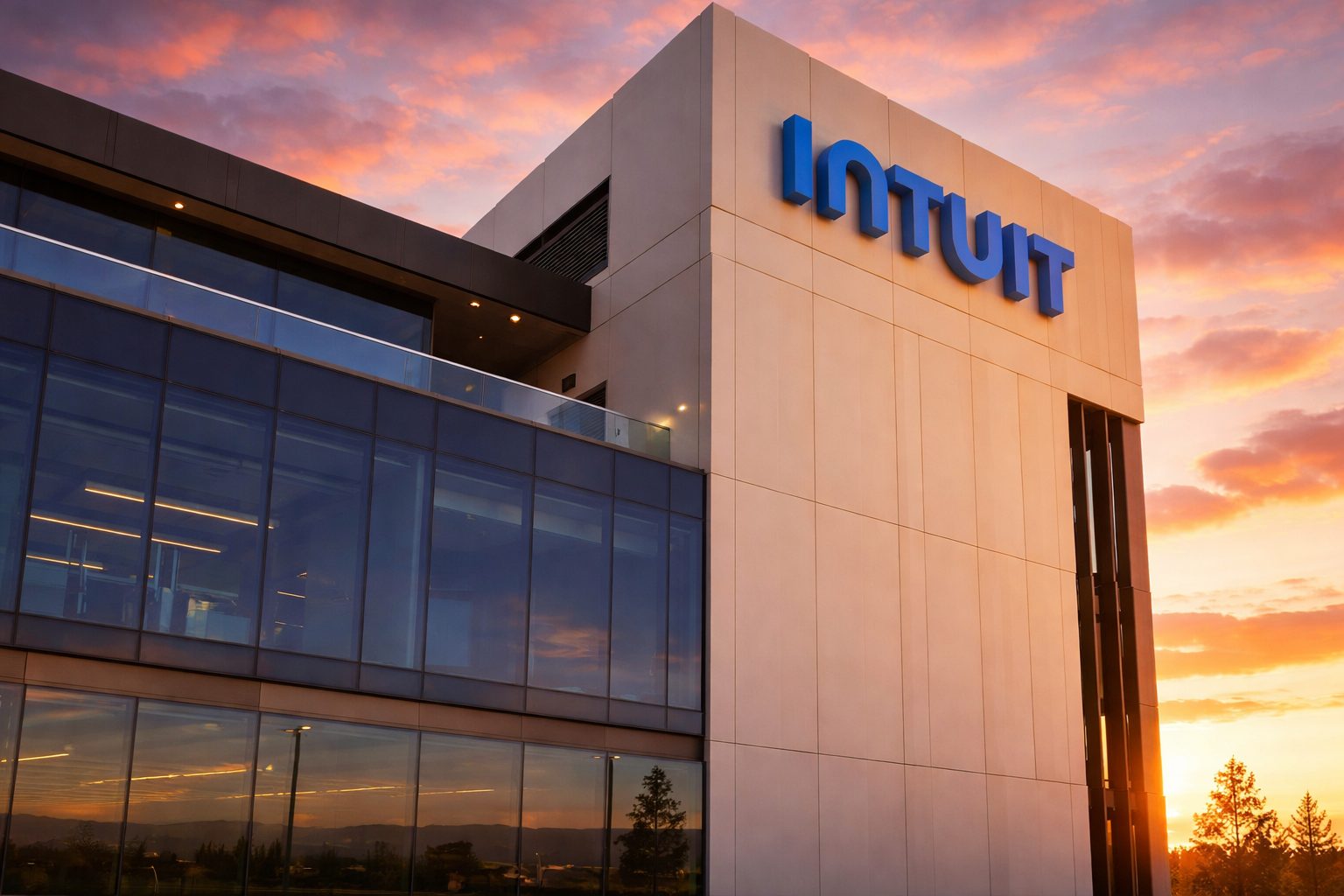
Intuit Inc. shares (NASDAQ: INTU) were trading around $670 on Friday, December 19, 2025, edging higher in early afternoon trading as investors digested a fresh fintech catalyst alongside tax-season positioning.
The headline driver behind the latest attention is Intuit’s multi-year strategic partnership with Circle to bring stablecoin (USDC) infrastructure into parts of the Intuit ecosystem—an announcement that connects directly to some of Intuit’s biggest platforms (TurboTax, QuickBooks, Credit Karma) and its long-term push to make money movement faster, more programmable, and more global. Intuit Inc.+1
Below is a roundup of the most current news, forecasts, and analyses circulating on Dec. 19, 2025, plus what investors are watching next.
What’s moving Intuit stock on Dec. 19: Stablecoins arrive in the Intuit narrative
Intuit announced a multi-year partnership with Circle Internet Group that creates a framework for Intuit to leverage Circle’s stablecoin infrastructure and USDC across the Intuit platform. Intuit framed stablecoins as a “next logical step” for enabling programmable, 24/7 money movement and pointed to potential use cases including refunds, remittances, savings, and payments. Intuit Inc.
Third-party coverage on Dec. 19 leaned into the same strategic theme: stablecoins as a modern “rail” that could reduce friction and extend money movement beyond traditional banking hours—especially meaningful for a company that sits close to consumers’ tax refunds and small businesses’ cash flow. FinTech Magazine+1
The near-term market reaction
Coverage of the announcement noted an immediate positive stock response around the news window, with reports saying Intuit shares rose about 1.5% on the day the partnership was disclosed. Investing.com
Market recap coverage also highlighted that on Thursday, Dec. 18, Intuit closed at $668.88, up 1.23%, and outperformed some peers in a broadly positive session. MarketWatch
Why the Circle USDC partnership matters for Intuit’s business model
Intuit’s value proposition to investors has long been built around a simple flywheel:
- TurboTax drives consumer engagement around tax season and refund flows
- QuickBooks sits inside day-to-day small business operations (accounting, invoicing, payroll, payments)
- Credit Karma connects credit demand and underwriting/offer ecosystems
- Increasingly, platform data + AI aims to personalize and automate decisions across that stack
The stablecoin partnership is notable because Intuit isn’t positioning USDC as a “crypto feature.” It’s describing it as infrastructure for “money movement,” where speed, cost, uptime, and programmability become competitive advantages.
Two specific points from Intuit’s own framing stand out:
- Tax refunds are a massive payments moment. Intuit said it operates in a market with more than $100 billion in annual tax refunds, implying that even small improvements in refund delivery speed and cost could matter at scale. Intuit Inc.+1
- The scope is broader than a single app. Intuit’s statement highlighted USDC capabilities aimed at experiences across TurboTax, QuickBooks, and Credit Karma (and referenced the broader platform that includes Mailchimp). Intuit Inc.+1
What investors will want clarity on
The strategic logic is easy to understand; the execution questions are tougher—and likely to shape the stock narrative into 2026:
- Where does USDC show up first (refunds vs. SMB payments vs. cross-border transfers)?
- How quickly can Intuit productize it without adding customer friction?
- How will compliance, risk controls, and dispute handling work at consumer scale?
Intuit explicitly emphasized continued commitments around privacy, security, and governance as it builds platform innovations. Intuit Inc.+1
Tax season 2026 positioning: “Now This Is Taxes” campaign adds a consumer catalyst
Alongside fintech infrastructure news, Intuit also launched the second year of its “Now This is Taxes” brand campaign for tax year 2025 (taxes filed in 2026), describing its consumer platform as an “all-in-one destination” blending Agentic AI and human intelligence across TurboTax and Credit Karma experiences. Intuit Inc.
For investors, this matters because TurboTax’s growth and mix (DIY vs. assisted vs. full service) can swing seasonally—and consumer acquisition is often a margin story as much as a revenue story.
Key campaign offers disclosed by Intuit include:
- Free DIY mobile filing for customers who file by Feb. 28, 2026 through the TurboTax mobile app if they didn’t use TurboTax last year Intuit Inc.+1
- A $150 flat fee (federal + state) for certain “expert / full service” filers if they file by Feb. 28, 2026 Intuit Inc.+1
This is the kind of detail that can become important later if investors start debating whether Intuit is leaning into promotions to grow share—or whether these offers efficiently pull new cohorts into a higher-LTV platform relationship.
The earnings backdrop: Strong Q1, reiterated full-year guidance, and a Q2 setup
The Dec. 19 coverage and analyst positioning is happening against a relatively clear earnings backdrop from Intuit’s most recent quarter.
In its fiscal first quarter 2026 release, Intuit reported:
- Global Business Solutions revenue of $3.0 billion, up 18%, with Online Ecosystem revenue up 21% to $2.4 billion Intuit Inc.
- QuickBooks Online Accounting revenue up 25% in the quarter Intuit Inc.
- Consumer revenue of $894 million, up 21% Intuit Inc.
- Credit Karma revenue up 27% to $651 million Intuit Inc.
Guidance that matters for valuation debates
Intuit reiterated full-year fiscal 2026 guidance, including:
- Revenue: $20.997B to $21.186B (about 12%–13% growth) Intuit Inc.
- Non-GAAP diluted EPS: $22.98 to $23.18 (about 14%–15% growth) Intuit Inc.
For the second quarter of fiscal 2026 (ending Jan. 31), Intuit guided to:
- Revenue growth of ~14%–15%
- Non-GAAP EPS of $3.63–$3.68 Intuit Inc.
Reuters’ coverage of that quarter’s setup emphasized a split investors often fixate on: revenue growth outlook above some Street expectations, while adjusted EPS guidance came in below at the time. Reuters
AI remains a core pillar: OpenAI partnership and “AI-powered financial tools” narrative
Intuit’s current strategic positioning is not just “tax and accounting software.” It is increasingly “AI-enabled financial management.”
Reuters reported that Intuit signed a multi-year deal exceeding $100 million with OpenAI to incorporate AI models into Intuit’s offerings, and noted the company described the integration as maintaining privacy standards and involving no revenue sharing. Reuters
That matters for the stock because the bull case for Intuit increasingly revolves around:
- Higher-value tiers and “done-for-you” workflows
- Lower churn and stronger monetization via automation
- Faster product cycles and new service lines built on platform data
Analyst forecasts and price targets: What the Street is saying on Dec. 19
Analyst commentary and consensus targets remain supportive overall—though the dispersion is still wide (typical for large-cap software where the multiple is sensitive to growth durability).
MarketBeat consensus: Moderate Buy with ~$797 average target
MarketBeat’s compiled consensus for Intuit showed:
- Consensus rating: Moderate Buy
- Average 12-month price target: $796.60
- High: $900 | Low: $530 (based on 29 analyst ratings) MarketBeat
Mizuho watchlist call: $875 target and “highest-quality long-term growth”
On Dec. 19, Investing.com summarized a Mizuho software watchlist that included Intuit, reporting that analyst Siti Panigrahi set an $875 price target and characterized Intuit as “one of the highest-quality long-term growth stories in Software.” The note also pointed to growth in higher-end products (including references to QBO Advanced and IES) and highlighted the Circle partnership as a fresh strategic development. Investing.com
Recent bank actions: Wells Fargo and others
In a separate analyst note recap from late November, Investing.com reported Wells Fargo lowered its Intuit price target to $840 from $880 while maintaining an Overweight rating, and also referenced positive stances from multiple firms (including reiterated positive ratings and price targets from several banks). Investing.com
Zacks view on Dec. 19: Hold rating and recent momentum
The Dec. 19 Zacks commentary (published via Nasdaq) reiterated the Circle partnership angle and noted Intuit held a Zacks Rank #3 (Hold) while citing recent relative performance over the prior month. Nasdaq
Ownership and insider activity: Institutions still dominate, insiders have been sellers
Several Dec. 19 filings-focused writeups put the spotlight on institutional ownership and insider transactions:
- MarketBeat reported Talbot Financial increased its Intuit stake in Q3 and highlighted broader institutional ownership levels. MarketBeat
- A separate MarketBeat item said Voya Investment Management increased its position, again reinforcing that Intuit remains heavily institution-owned. MarketBeat
Those same writeups also flagged insider selling activity, including disclosed sales by board members and executives over recent months. MarketBeat+1
Insider selling does not automatically signal bearishness—executives sell for many reasons—but it can become part of the narrative when a stock is valued at a premium and investors are looking for confirmation signals.
Valuation and trading snapshot on Dec. 19: Where INTU sits right now
As of Dec. 19, INTU was trading near $670, up modestly on the session, with an intraday range roughly in the mid-$660s to mid-$670s.
Recent market recap coverage noted Intuit remained meaningfully below its 52-week high of $813.70 (set July 30), even after the prior session’s gain. MarketWatch
A filings-focused snapshot published Dec. 19 listed Intuit around:
- Market cap: ~$186B
- P/E: ~45.7
- 50-day moving average: ~$657
- 200-day moving average: ~$703 MarketBeat
These are the numbers that keep valuation debates active: Intuit has strong category positions and growth, but it’s still priced like a premium software compounder—so catalysts (stablecoins, AI automation, tax-season execution) matter disproportionately.
What to watch next: Upcoming events and the 2026 setup
Next major calendar items
Intuit’s Investor Relations site lists an Annual Stockholder Meeting on Jan. 22, 2026. Intuit Inc.
For earnings, external trackers estimate the next report in late February 2026 (with one estimate pointing to Feb. 24, 2026, based on historical patterns), though Intuit has not posted that future earnings date on its IR calendar as of the latest visible entries. MarketBeat+1
The big three catalysts investors will likely debate into Q2 and beyond
- Tax season conversion: Do TurboTax/CK offers win incremental customers without compressing margins? Intuit Inc.
- AI monetization: Can Intuit translate AI partnerships and automation into measurable ARPU expansion and retention? Reuters
- Stablecoin execution: Does USDC integration become a real product advantage—or stay a longer-dated platform ambition? Intuit Inc.+1
Bottom line
On Dec. 19, 2025, Intuit stock is being shaped by a combination of near-term tax-season strategy and longer-term platform ambition. The Circle partnership gives Intuit a fresh narrative lane—stablecoins as always-on money movement infrastructure—while analysts continue to frame INTU as a premium-quality software compounder with multiple growth engines (QuickBooks, Credit Karma, TurboTax, and AI-led automation). Investing.com+2MarketBeat+2
As always with premium-valued software, the next leg is likely to depend less on headlines and more on execution: customer growth, mix shift, margin discipline, and proof that new “platform rails” (AI + stablecoins) translate into durable financial outcomes. Intuit Inc.+1