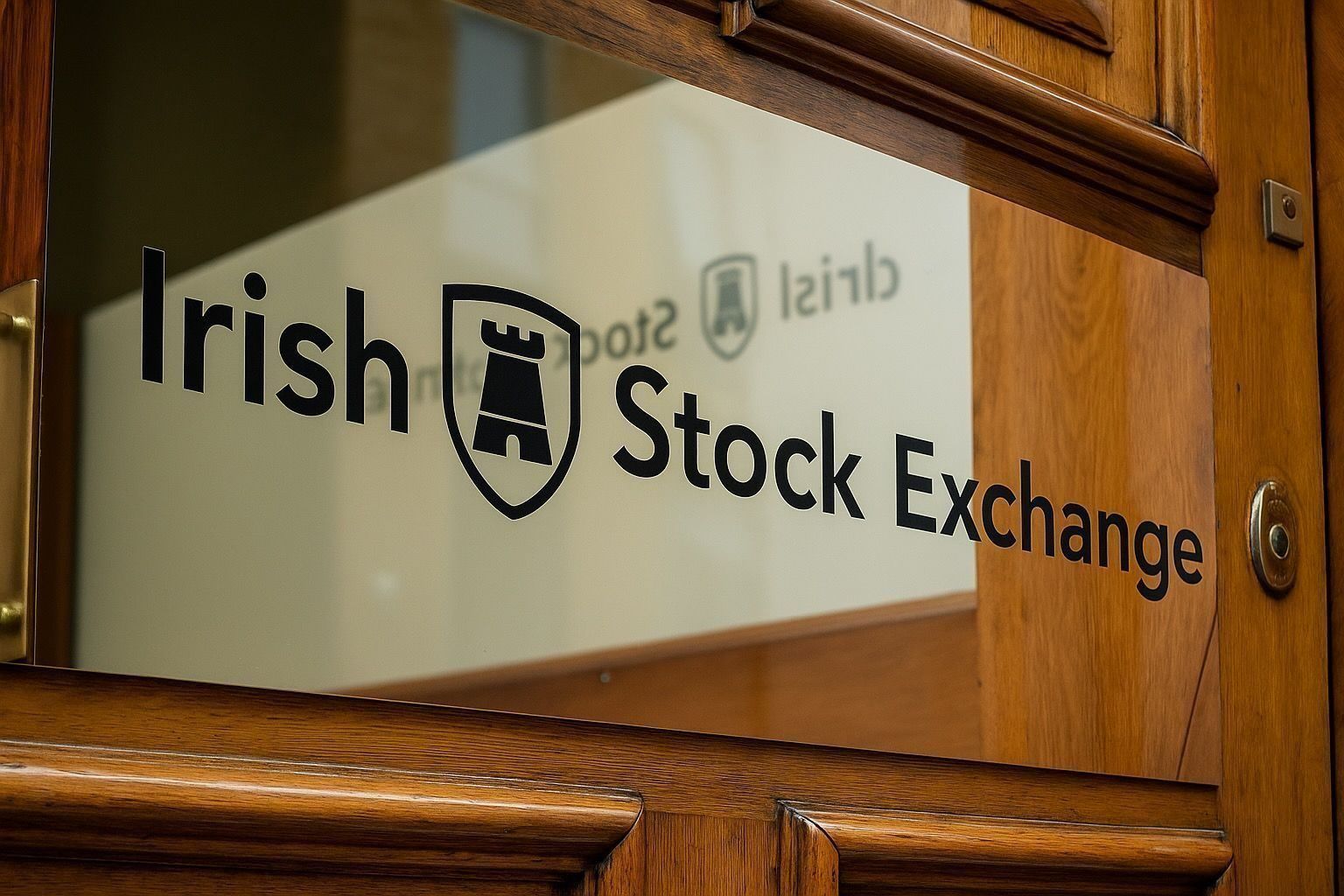
Ireland’s stock market heads into Tuesday’s session with the ISEQ All-Share index sitting close to record territory and a busy backdrop of global central-bank drama, fresh economic data and stock‑specific headlines.
As of 06:44 on 9 December, the ISEQ All-Share stood at 12,770.34, up 0.22% from the previous close, according to data from Davy.davy.ie That puts Irish equities near the top of their 52‑week range of roughly 9,165 to 12,926 points as reported by Euronext Dublin.Euronext Over the past year the index has delivered a gain of about 35%, outpacing many European peers.Bloomberg
At the same time, global markets are subdued: Wall Street slipped overnight ahead of a widely expected US Federal Reserve rate cut, Asian stocks are weaker, and futures for European benchmarks are broadly flat as traders fret over how hawkish the Fed’s guidance for 2026 may be.Reuters+2SWI swissinfo.ch+2
Below is a structured look at what investors need to know before Euronext Dublin’s opening auction at 08:00 local time.tradinghours.com+1
1. When Dublin Opens – and Where the ISEQ Stands
Trading hours
- Euronext Dublin’s regular equity session runs roughly 08:00–16:28 local time, with an opening auction before continuous trading and a closing auction in the late afternoon.tradinghours.com+1
- Today (Tuesday, 9 December 2025) is a normal trading day; no Irish market holiday is scheduled.
Index level and range
- ISEQ All-Share
- ISEQ 20 (large‑cap index)
- Recently quoted around 2,124.64, with a year‑to‑date gain close to +29%, according to MarketScreener’s latest data.MarketScreener
- ISEQ Financial Index (IFIN)
- Last reported live level 678.27, with a 52‑week range from 380.71 to 700.14, indicating Irish financials are trading near their yearly highs.Investing.com
In short, the Irish equity market is entering today’s session from a position of strength: indices are close to their peaks, and financials in particular are near the upper end of recent trading ranges.
2. Global Overnight Picture: Cautious Tone Before the Fed
The main story shaping risk sentiment today is the US Federal Reserve’s final policy meeting of 2025, with a decision due tomorrow.
Wall Street: softer ahead of the Fed
- On Monday, all three major US indices closed lower as traders pared risk ahead of the Fed:
- The S&P 500 slipped roughly 0.3–0.4%,
- The Dow Jones Industrial Average fell around 0.45%,
- The Nasdaq Composite eased by about 0.1%, according to Reuters and market-wrap reports.The Economic Times+2MarketWatch+2
- A Reuters wrap noted that most S&P sectors finished in the red and that volumes were slightly below their recent 20‑day average, suggesting a cautious but not panicked tone.Reuters+1
Asia and global equities: subdued
- A Bloomberg/Swissinfo markets wrap reports that:
- MSCI’s gauge of world equities was down about 0.1%,
- A broad Asia‑Pacific ex‑Japan index lost roughly 0.5%, and
- US equity futures were little changed, while Euro Stoxx 50 futures were flat heading into the European morning.SWI swissinfo.ch
- Separately, a Reuters “Morning Bid” column notes that European equity futures point to a “lacklustre opening”, reflecting unease about the Fed’s policy path.Reuters
Rates and central banks
- The Fed is widely expected to deliver a 25 basis‑point rate cut this week, taking another step in the 2025 easing cycle.Reuters+1
- Markets are pricing roughly 77 basis points of total easing by end‑2026, implying two further cuts beyond December, according to Reuters.Reuters+1
- A Bloomberg‑sourced wrap notes that:
- US 10‑year Treasury yields have climbed to their highest level since September,
- Australian bond yields spiked after the Reserve Bank of Australia held rates but flagged upside inflation risks,
- Japanese government bond demand weakened at a recent auction, with yields near 2%, the highest in many years.SWI swissinfo.ch+1
- The Swiss National Bank and Bank of Canada are also expected to keep policy rates unchanged this week, adding to the cluster of central-bank events.Reuters
Commodities: oil softer, gold frothy
- Oil:
- Brent crude for near delivery has been trading in the low US$60s per barrel, around US$62–63, after its biggest daily drop in almost three weeks.MarketWatch+1
- For Irish issuers such as Ryanair and other transport‑linked stocks, softer oil prices are generally margin‑supportive if they persist.
- Gold:
- The Bank for International Settlements (BIS), via the Financial Times, warns that gold and US equities both show “bubble‑like” characteristics, with gold up about 60% year‑to‑date and US indices also strongly higher, driven partly by AI‑related stocks.Financial Times
- Gold prices are cited around US$4,200 per troy ounce, slightly below an October peak, which matters for Dublin‑listed commodity ETFs and structured products.
Implication for Ireland:
With futures for major European indices flat to slightly negative and bond yields edging higher, Irish stocks are likely to open cautiously, with index direction heavily driven by how rate‑sensitive sectors (banks, property and growth stocks) respond to Fed expectations.
3. Irish Macro Backdrop: Strong Activity, but Inflation Still Sticky
The domestic macro story going into today’s session is relatively upbeat: growth indicators are firm, and while inflation remains above the ECB’s 2% target, it looks manageable.
Services and manufacturing PMIs
- The AIB Ireland Services Business Activity Index rose to 58.5 in November from 56.7 in October – the fastest expansion in over three years.The Irish Times+3Reuters+3SPG Global PMI+3
- Financial services led the upturn, followed by technology, media and telecoms. Transport, tourism and leisure recorded their first rise in activity since February, a positive signal for travel‑exposed names such as Ryanair.Reuters+1
- The AIB Ireland Manufacturing PMI increased to 52.8 in November from 50.9, marking the fastest expansion since July, with improving new orders and exports.Morningstar+3SPG Global PMI+3Trading Econo…
Both readings sit comfortably above the 50 threshold that separates expansion from contraction, indicating synchronized growth across services and industry.
GDP, domestic demand and investment
- The Central Statistics Office (CSO) data show that Modified Domestic Demand (MDD) – the preferred gauge of underlying Irish activity – grew 2.3% quarter‑on‑quarter in Q3 and is up 4.1% in the first nine months of 2025.Reuters+1
- The jump in MDD was driven largely by an 8.3% surge in modified investment, including spending on software, aircraft and R&D by domestic firms.Reuters
- Headline GDP fell 0.3% q/q in Q3, but remains about 15.8% higher year‑to‑date, heavily influenced by strong pharmaceutical exports to the US.Reuters+1
The Irish finance ministry has raised its 2025 MDD growth forecast to 3.3% from 2.0%, signalling confidence that the domestic economy can absorb external shocks such as US tariffs and global uncertainty.Reuters+1
Inflation and the consumer
- The CSO’s flash estimate for the Harmonised Index of Consumer Prices (HICP) indicates:
- Prices rose 3.2% year‑on‑year in November,
- Fell 0.2% month‑on‑month.Central Statistics Office+1
- Energy prices are estimated to be up 3.3% over the year, while food prices are roughly 4.2% higher than a year earlier.Central Statistics Office+1
Labour market
- Recent data cited in market commentary show unemployment easing to about 4.9% in November from 5.0% in October, still above last year’s lows but consistent with a tight labour market.TechStock²
Takeaway for equities:
The combination of strong PMIs, solid domestic demand and only moderately elevated inflation is supportive for corporate earnings, especially in domestically geared financials, homebuilders and consumer‑facing stocks. That’s a key reason why the ISEQ has outperformed many European indices this year.
4. Central Bank of Ireland: Enjoying the Boom, Wary of Bubbles
While the macro data look healthy, Ireland’s regulators have been raising the volume on valuation and systemic‑risk warnings.
Financial Stability Review 2025:II
- In its November Financial Stability Review 2025:II, the Central Bank of Ireland (CBI) highlighted:
- “Stretched valuations” in segments of global financial markets, particularly US equities driven by technology and AI‑related names,
- Ongoing trade and economic uncertainty as major risks to Ireland’s financial system.Chartered Accountants Ireland+3Central Ban…
- Irish media summarised the message as a warning that a “disorderly correction” in AI‑fuelled global stock markets could spill over into the Irish economy through multiple channels.Irish Examiner
Retail participation and household wealth
- A recent Central Bank consumer‑research report concluded that Ireland has one of the lowest levels of direct retail participation in capital markets in the EU, with household wealth skewed toward property, life assurance and traditional savings rather than listed equities or funds.Chartered Accountants Ireland+1
- A Davy wealth report cited in local coverage notes that Irish households’ net wealth has more than doubled over the past decade, from roughly €573 billion in 2014 to €1.32 trillion in 2024, and could approach €2.6 trillion by 2035 – but much of that is tied up in housing rather than diversified financial assets.TechStock²
What this means for today’s trade
- The investor base for Irish equities remains relatively narrow, with a large role for international institutions. That can amplify moves when global risk sentiment shifts – something to keep in mind on a day when the Fed is in focus and the CBI is openly discussing valuation risks.
- However, household balance sheets are strong and banks are well‑capitalised, which supports the case that Ireland is entering any potential global correction from a position of relative resilience.
5. Banks in Focus: Upgraded Ratings, Privatisation Milestones and PTSB Headlines
Financials dominate the Irish market, so any move in the ISEQ Financial index will heavily influence the main benchmarks.
Ratings upgrades for AIB and Bank of Ireland
- On 6 November 2025, S&P Global Ratingsupgraded its long‑term issuer credit ratings for:
- AIB Group plc, and
- Bank of Ireland Group plc,
citing solid risk‑adjusted profitability, improved asset quality and strong balance sheets.AIB+1
- Earlier in May, Fitch Ratings upgraded Bank of Ireland Group’s long‑term issuer default rating to ‘A‑’ from ‘BBB+’, reinforcing the narrative of improved credit quality in Irish banking.Fitch Ratings
These upgrades help explain why Irish bank stocks have re‑rated sharply higher over 2025.
The state exits AIB, focuses on PTSB
- In June 2025, the Irish government completed the sale of its remaining 2% stake in AIB Group, effectively ending state ownership 15 years after the financial crisis. Reuters notes that across AIB, Bank of Ireland and PTSB, the state has now recouped slightly more than the €29.4 billion it injected during the crisis, thanks especially to gains on Bank of Ireland.Reuters+1
- The state still holds about 57% of Permanent TSB (PTSB), making that bank the last major lender under majority public ownership.Reuters+1
PTSB: formal sale process and Goldman Sachs exit
- On 30 October 2025, PTSB announced the commencement of a formal sale process, effectively putting itself up for sale. Irish media report that the bank’s shares jumped over 20% on the day, and the Department of Finance has acknowledged the process as a potential route to full privatisation.The Irish Times+1
- More recently, a regulatory filing under Irish takeover rules shows that Goldman Sachs has reduced its holdings in PTSB to zero, having sold the last 2,798 shares in a “Borrow Full Return” transaction.Investing.com
Taken together, upgraded ratings, the AIB exit and an active sale process for PTSB underline a new phase for Irish banking: less state ownership, stronger capital and a more “normal” equity‑market profile.
Trading angle for today
- The ISEQ Financial index remains near its 52‑week high.Investing.com
- With US and European bond yields rising into the Fed decision, bank stocks may see higher intraday volatility, particularly if traders interpret Fed guidance as implying a slower or shallower easing cycle than previously expected.
6. Property and Construction: Kingspan and Glenveagh in the Spotlight
Kingspan: data‑centre boom and buybacks
- Kingspan Group plc, a major ISEQ heavyweight, issued a trading update on 10 November 2025:
- Sales for the nine months to 30 September reached €6.8 billion, up 8% year‑on‑year.kingspangroup.com+1
- Growth was driven in part by its Advensys advanced building systems unit, which is benefiting from strong demand linked to data‑centre development.The Irish Times+2RTE+2
- Kingspan is exploring a partial IPO of around 25% of Advnsys on Euronext Amsterdam, potentially in Q1 2026.MarketScreener+1
- The company is also progressing a €650 million share buyback, having repurchased roughly 376,000 shares during early November, while keeping net debt around €1.9 billion and leverage near 1.5–1.6x EBITDA, according to broker commentary.Financial Reports+1
Markets reacted positively to the update, with several news outlets noting a surge in Kingspan’s share price on the day.RTE+2Halifax Investments+2
Glenveagh Properties: buybacks and delivery
- Glenveagh Properties, a key listed homebuilder, continues to benefit from Ireland’s chronic housing shortage:
- The company reported 906 home completions in H1 2025, more than double the 424 units delivered a year earlier, and reaffirmed guidance of roughly 2,600 completions for the full year.Investing.com
- On 5 December 2025, Glenveagh bought back 90,508 shares on Euronext Dublin at a volume‑weighted average price of €1.965, as part of its ongoing share‑repurchase programme. The bought‑back shares will be cancelled, leaving about 520.4 million shares in issue.Investegate+2Shares Magazine+2
Analysts have linked Glenveagh’s story to forecasts that Irish housing completions could reach around 34,500 units in 2025, the highest since the pre‑crisis boom, which would still fall short of estimated long‑term demand but represents a significant improvement.TechStock²
Implication for today’s trade
- Property and construction names are leveraged to both domestic growth and global rates:
- Strong PMIs and upbeat MDD numbers are supportive,
- But higher long‑term yields and the CBI’s warnings about valuations may cap multiples.
- Any fresh moves in US or euro‑area yields after Fed commentary could quickly filter into Irish builders and building‑materials stocks.
7. Travel & Consumer: Ryanair Remains a Key Bellwether
As one of Ireland’s most internationally recognised companies and a major ISEQ constituent, Ryanair often sets the tone for sentiment in cyclicals.
Earnings, dividend and buybacks
- In a Q2/H1 2025 results release on 3 November, Ryanair reported:
- Q2 profit up about 20% to €1.72 billion,
- H1 profit up 42% to €2.54 billion, supported by strong traffic and recovering fares.Ryanair Corporate
- The Board declared an interim dividend of €0.193 per share, payable in late February 2026, and continued to execute a €750 million share buyback, with over €188 million spent by 30 September.Ryanair Corporate+2Investing.com+2
- A later note from Simply Wall St emphasised that this €0.193 dividend is around 13% lower than last year’s €0.223 payment, putting the yield near 1.6% at current prices — modest, but backed by strong earnings coverage and double‑digit EPS growth expectations.Simply Wall St+1
Traffic and network expansion
- For November 2025, Ryanair carried about 13.8 million passengers, a 6% year‑on‑year increase, operating roughly 78,000 flights, according to aviation and Irish media reports.Aviation.Direct+1
- The airline has also:
- Announced it has carried 22 million passengers through Shannon Airport since 1987, alongside a “record‑breaking” summer 2026 schedule for the airport, and
- Marked 7 million passengers at Kerry Airport since launch there in 1989.The Sun+2Ryanair Corporate+2
These milestones underline Ryanair’s central role in Irish tourism and regional connectivity.
Strategy tweaks: subscription scheme scrapped
- Late last month, Ryanair scrapped its “Prime member” subscription scheme after an eight‑month trial, explaining that the programme generated around €4.4 million in fees but roughly €6 million in fare discounts, making it uneconomic.Reuters+1
Trading angle today
- With oil prices off recent highs, traffic still growing and a recalibrated dividend, Ryanair remains a key cyclical barometer for the Irish market:
- A softer oil backdrop and strong PMIs favour the stock,
- Any Fed‑driven risk‑off move or renewed concerns about travel demand could still weigh, especially given the CBI’s focus on stretched global valuations.
8. CRH and Global Infrastructure: An Irish Name in the S&P 500
Although CRH plc no longer has its primary listing in Dublin, it remains a Dublin‑headquartered building‑materials giant widely held by Irish institutions.
- On 8 December 2025, CRH confirmed it will join the S&P 500 index on 22 December, following a selection decision by S&P Dow Jones Indices.TechStock²
- Recent commentary notes:
- Strong Q3 results,
- Fresh 52‑week highs in London, and
- An expanded share‑buyback programme,
all underpinned by expectations of sustained US infrastructure spending into 2026 and beyond.TechStock²
For Irish investors, the inclusion of CRH in the S&P 500 strengthens the link between US infrastructure cycles and Irish corporate earnings, even if much of the trading now occurs in New York and London rather than on Euronext Dublin.
9. FX and Rates: The Euro, the Dollar and Irish Exporters
The currency backdrop is another important piece of today’s puzzle:
- Davy’s morning market snapshot shows:
- EUR/USD around 1.1644,
- EUR/GBP about 0.8734, as of 06:44.davy.ie
A somewhat stronger euro versus sterling and the dollar:
- Helps euro‑area importers and airlines (cheaper dollar‑priced fuel and inputs),
- But can trim the translation benefits for exporters whose revenues are largely in foreign currencies (e.g., US‑exposed industrials and pharma).
Combined with the Fed meeting and CBI warnings, FX moves today could add another layer of volatility for globally oriented Irish corporates.
10. What to Watch in Today’s Dublin Session
Here are the key themes and tick‑boxes for investors as the Irish market opens:
1. Market direction vs global futures
- Do Irish indices track the flat–slightly‑negative tone implied by Euro Stoxx 50 futures, or do strong domestic fundamentals help the ISEQ outperform?SWI swissinfo.ch+1
2. Banks and financials
- How do AIB, Bank of Ireland and PTSB trade in light of:
- Recent rating upgrades,
- The government’s completed exit from AIB, and
- The ongoing sale process and shareholder reshuffling at PTSB?
- Are investors still willing to pay near‑peak multiples for Irish banks given the CBI’s warnings about stretched global valuations?
3. Property, housing and construction
- Do Kingspan and Glenveagh extend their recent strength on the back of:
- Positive trading updates,
- Buyback activity, and
- Strong domestic housing demand?
4. Travel and cyclicals
- Does Ryanair trade more like a beneficiary of lower oil and strong traffic or a high‑beta risk asset under pressure from Fed and valuation worries?
5. Macro and data calendar
- Domestically, today’s scheduled data are light; the key focus is on:
- The Fed meeting (decision and dot plot tomorrow),
- Any fresh commentary on valuations or financial stability from the CBI or ECB,
- German and euro‑area data highlighted in global morning notes.
11. Bottom Line: A High‑Wire Act Between Growth and Valuations
Heading into the 9 December 2025 open:
- Irish equities are near their highs, backed by strong PMIs, solid domestic demand and robust corporate balance sheets.
- The main risk is not the Irish economy itself, but the global backdrop:
- The Fed’s message on the future path of rates,
- High valuations in US tech and AI‑related stocks, and
- The potential for a sudden shift in global risk appetite – precisely the scenario Ireland’s Central Bank has been warning about.
For investors, today is likely to be about positioning rather than big directional bets: fine‑tuning exposure to banks, builders and travel stocks while waiting for clearer guidance from the Fed and watching whether the ISEQ can hold near its record zone.
This article is for informational purposes only and does not constitute investment advice or a recommendation to buy or sell any security. Market conditions and prices can change rapidly, especially around major central‑bank meetings.