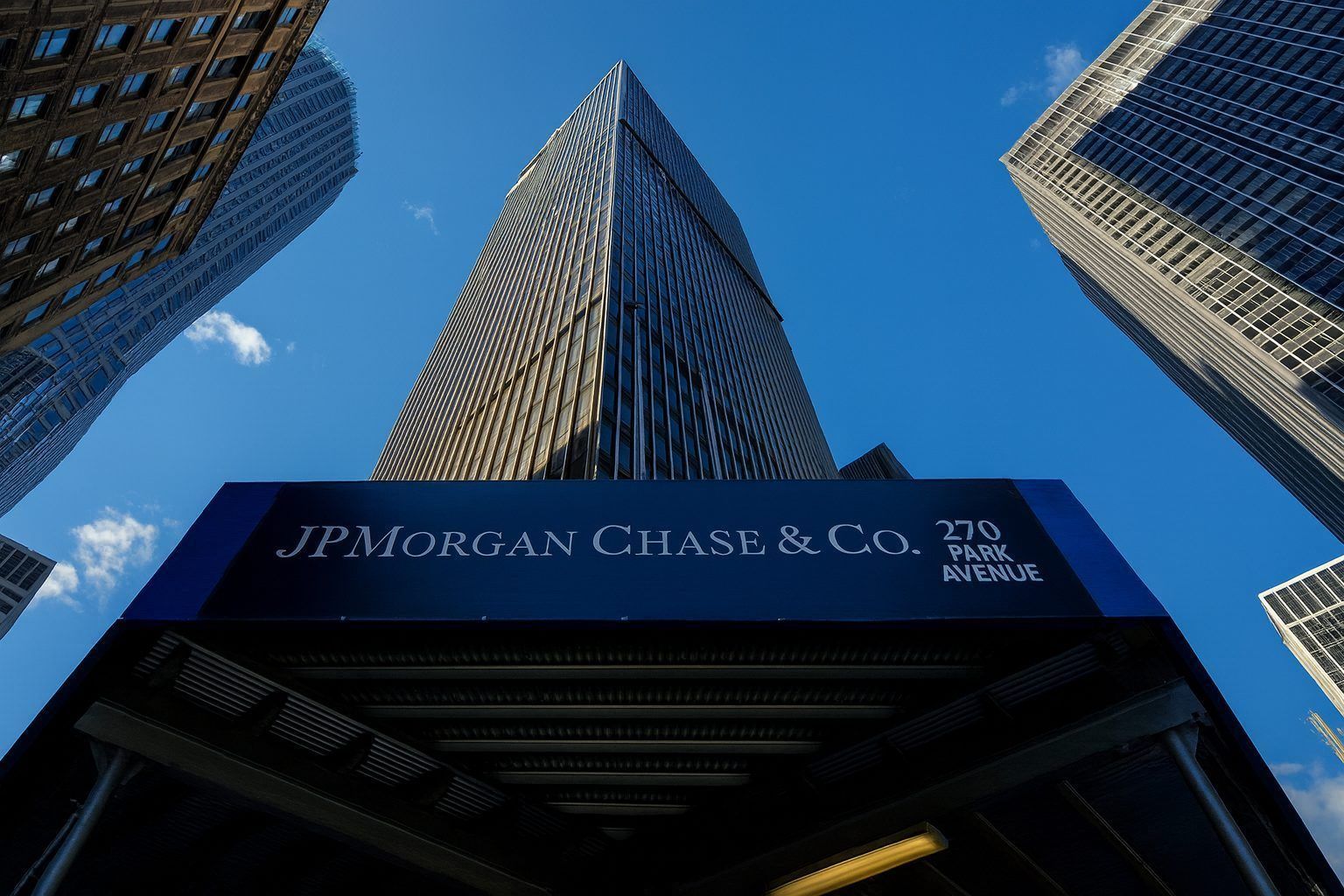
JPMorgan Chase & Co. (NYSE: JPM) shares rallied again on Thursday, December 11, 2025, closing around $317.38, up roughly 2.3% on the day and trading in a wide intraday range between about $309 and $318. That puts the stock within a few dollars of its 52‑week high near $322 and marks a second straight day of gains after Tuesday’s sharp expense‑driven sell‑off. Barchart.com+3StockAnalysis+3MarketWatch+3
After the closing bell, JPMorgan traded essentially flat, ticking up to roughly $317.6 in light post‑market dealing, while early pre‑market indications for Friday show the stock changing hands just below the prior close, with quotes around $310 on some platforms — a negligible move so far. Seeking Alpha+1
Year‑to‑date, JPMorgan shares are up around 30%, outpacing the S&P 500 and edging ahead of the broader investment‑banking peer group, making it one of 2025’s standout large‑cap financials. Trefis+1
Below is a detailed look at what drove JPM stock after the bell on December 11 — and what traders and investors should know before U.S. markets open on Friday, December 12, 2025.
JPMorgan Chase Stock Today: Recap of December 11 Trading
Market data show that JPMorgan opened near $309.24, climbed to an intraday high of $318.00, and closed at $317.38 on volume of about 9.4 million shares, a gain of roughly 2.3% versus Wednesday’s close at $310.11. StockAnalysis
That performance outpaced the S&P 500, which rose only modestly, and came as the Dow and S&P 500 notched fresh record territory following the Federal Reserve’s latest rate cut and a signal that it may pause further easing. Reuters+1
Crucially, Thursday’s bounce followed a bruising session on Tuesday, when comments from Consumer & Community Banking chief Marianne Lake about higher‑than‑expected 2026 expenses sent JPMorgan down roughly 4.6%, its biggest one‑day fall since early April. Reuters+2Yahoo Finance+2
The stock has now recovered most of that drawdown, but the debate that triggered the sell‑off — whether JPMorgan is spending too aggressively for growth — is still front and center.
The Big Story: 2026 Expense Guidance Still Dominates the JPM Narrative
At the Goldman Sachs U.S. Financial Services Conference this week, Lake told investors that JPMorgan now expects total expenses of about $105 billion in 2026, driven mainly by growth‑ and volume‑related costs in the consumer bank, with strategic investments (including technology and branch expansion) as the second‑largest contributor. Analysts had been modeling roughly $100.8 billion in expenses for next year, so the new outlook implies a mid‑single‑digit overshoot versus consensus. Reuters
Lake also said JPMorgan expects fourth‑quarter 2025 investment banking revenue to be up in the low single digits year over year, with markets revenue up in the low‑teens percentages, reflecting a more constructive environment for capital markets and bank M&A. Reuters
The expense news, however, overshadowed that positive revenue commentary. The guidance sparked a 4.3–4.7% drop in JPM shares on Tuesday, highlighting investor concern that higher structural costs could pressure margins just as the Fed moves further into a rate‑cutting cycle. Reuters+2Yahoo Finance+2
Independent equity research from Trefis on December 11 argues that, after this year’s run‑up, JPMorgan is now trading above their estimate of fair value, which they peg around $280 per share, versus a market price in the low $310s when they published. They highlight:
- Strong recent earnings momentum (Q3 managed revenue up about 9% to $47.1 billion and net income up 12% to $14.4 billion, or $5.07 per share).
- Robust performance across Asset & Wealth Management, Investment Banking, and Markets.
- But also a significantly higher expense base and a premium valuation versus peers. Trefis
A column at Barchart similarly notes that JPM still trades at under 16× trailing and forward earnings, which looks reasonable for a best‑in‑class franchise, but warns that the combination of rising costs and CEO Jamie Dimon’s well‑known macro caution could justify a more guarded stance after Tuesday’s nearly 4.7% drop. Barchart.com+1
Bottom line: The 2026 expense trajectory is the key fundamental story hanging over JPMorgan heading into Friday’s open. Thursday’s rally shows investors are willing to give the bank some benefit of the doubt — for now.
Fresh Headlines After the Bell: Blockchain Deal, New Treasury ETF and a Regulatory Overhang Lifted
1. Galaxy Digital Commercial Paper on Solana
On Thursday evening, Reuters reported that J.P. Morgan arranged a $50 million commercial paper issuance for Galaxy Digital Holdings on the Solana blockchain, with Coinbase and Franklin Templeton participating as investors. The deal uses a token representing U.S. commercial paper and settles issuance and redemption in USDC, the dollar‑pegged stablecoin issued by Circle. Reuters+1
This transaction is among the first U.S. commercial paper deals executed on a public blockchain by a major global bank, rather than on a private permissioned ledger. J.P. Morgan’s head of Markets Digital Assets, Scott Lucas, told Reuters the bank plans to extend this structure to more issuers, investors and security types in 2026, signalling a long‑term push into asset tokenisation. Reuters
Financially, $50 million is trivial for a firm of JPMorgan’s scale, but the symbolism is significant: it reinforces the bank’s role as an early mover in institutional crypto and blockchain infrastructure at a time when regulatory conditions for digital assets in the U.S. are gradually clarifying. Reuters+1
2. New 100% U.S. Treasury Money‑Market ETF (JMMF)
Meanwhile, J.P. Morgan Asset Management announced the launch of the JPMorgan 100% U.S. Treasury Securities Money Market ETF (ticker: JMMF) on NYSE Arca. The ETF invests solely in U.S. Treasury bills, notes and bonds, provides weekly income distributions, and wraps money‑market exposure in an ETF structure that offers intraday liquidity and transparency. PR Newswire+1
The firm describes JMMF as its entry into the “rapidly evolving money‑market ETF space”, targeting investors who want cash‑like exposure with ETF tradability rather than traditional mutual‑fund money markets. PR Newswire+1
Given that the Federal Reserve and New York Fed are about to begin roughly $40 billion in short‑term Treasury purchases as part of a reserve‑management programme starting December 12, demand for high‑quality T‑bill strategies could remain healthy, which may indirectly benefit JPMorgan’s asset‑management fees over time. Financial Times+1
3. Fed Terminates Cease‑and‑Desist Order Against JPMorgan
In a notable regulatory development, the Federal Reserve Board announced on Thursday that it has terminated several enforcement actions, including a March 8, 2024 cease‑and‑desist order against JPMorgan Chase & Co. The order was officially terminated on December 4, 2025, with the decision published on December 11. Federal Reserve+2Federal Reserve+2
While the Fed’s statement does not spell out the financial impact, the termination indicates that supervisors are satisfied with JPMorgan’s remediation of the underlying issues. For investors, this removes a small but lingering regulatory overhang and underscores the bank’s progress in tightening risk and compliance controls. Federal Reserve+1
4. Security & Resiliency Initiative Led by Todd Combs
Earlier this week, JPMorgan announced that Todd Combs — long‑time Berkshire Hathaway investment manager and former CEO of GEICO — will lead a new Strategic Investment Group within its Security and Resiliency Initiative (SRI). The unit will deploy an initial $10 billion of direct equity investments, as part of a broader $1.5 trillion commitment toward sectors deemed critical to U.S. economic and national security (such as critical minerals, aerospace & defense, healthcare infrastructure and frontier technology). JPMorgan Chase+2Business Chief+2
The move positions JPMorgan to sit at the intersection of national‑security priorities and private capital, potentially opening up attractive long‑duration opportunities aligned with public‑policy support. It also adds another high‑profile investor to the firm’s bench, alongside Dimon and longtime lieutenants in the investment bank and asset‑management arms. JPMorgan Chase+1
5. Healthcare Workforce Commitment and ESG Footprint
On the social‑impact front, JPMorganChase pledged $1 million to Futuro Health to help launch a Healthcare Workforce Resilience Initiative focused on building healthcare talent pipelines, particularly for rural providers and health plans facing chronic staffing shortages. The program aims to support workforce training, retention and career advancement in critical healthcare roles. The AI Journal+2PR Newswire+2
For a bank that generates tens of billions of dollars in annual profit, the dollar amount is modest. But for ESG‑oriented investors, it reinforces JPMorgan’s narrative of combining community investments with its broader healthcare‑ and infrastructure‑financing activities. The AI Journal+1
Macro Backdrop: Fed Cuts, Liquidity Moves and What They Mean for Big Banks
JPMorgan’s stock is moving within a macro environment that changed meaningfully this week.
On December 10, the Federal Reserve delivered its third consecutive 25‑basis‑point rate cut, lowering the federal funds target range to 3.50%–3.75%. In its updated projections, the Fed signalled it expects to pause further cuts for now, with the median policymaker pencilling in just one additional cut in 2026 and one in 2027, even as futures markets still discount a somewhat faster easing path. Reuters
The outlook is clouded by two complicating factors:
- A 43‑day government shutdown earlier this autumn has delayed several key economic statistics, making it harder for the Fed (and markets) to gauge real‑time conditions.
- Fed Chair Jerome Powell’s term ends in May 2026, raising uncertainty about his successor’s stance amid still‑elevated inflation. Reuters
To address recent money‑market strains, the Fed and the New York Fed are also launching a roughly $40 billion short‑term Treasury purchase programme starting December 12, focused on bills and notes with maturities between four weeks and one year. Officials describe these purchases as technical reserve‑management operations, distinct from broader quantitative easing, but they should help stabilise short‑term funding markets and anchor front‑end yields. Financial Times+1
On the labour side, U.S. initial jobless claims jumped by 44,000 to 236,000 in the week ended December 6 — the largest weekly increase in about four and a half years — though economists and the Labor Department attribute much of the spike to seasonal adjustment noise rather than a clear deterioration in hiring. Reuters
For JPMorgan, this macro mix cuts both ways:
- Lower rates and a more dovish Fed stance may compress net interest margins over time, reducing one of the key profit tailwinds of the last two years.
- But easier policy and improved liquidity can support capital markets activity, reduce funding stress and, if the economy avoids a hard landing, help contain credit losses — dynamics highlighted in recent analyses from both Trefis and Zacks. Trefis+1
Dimon himself has repeatedly warned about risks from inflation, geopolitics and fiscal deficits, even as he continues to describe U.S. consumers as generally “in good shape” compared with pre‑pandemic norms — a nuance echoed in recent JPMorgan commentary on the jobs market. Seeking Alpha+1
How Wall Street Is Valuing JPMorgan Right Now
Despite the expense overhang and macro uncertainty, sell‑side analysts remain broadly positive on JPM stock.
Aggregated data from Simply Wall St and Investing.com show an average 12‑month price target around $328–$332, only mid‑single‑digit upside from current levels. The consensus is built on roughly 20‑plus analysts, with most rating the stock a “Buy” or equivalent, and target prices ranging from about $250 on the low end to $370 on the high end. Nasdaq+4Simply Wall St+4Investing.com+4
Some specifics:
- Morgan Stanley maintains an “overweight” rating with a target around $331 per share. Financial Modeling Prep
- Goldman Sachs recently boosted its target to roughly $354, highlighting JPMorgan’s scale advantages and durable earnings power. MarketBeat
- Earlier in 2025, Keefe Bruyette & Woods, TD Cowen and Wolfe Research issued upgrades, while HSBC and Robert W. Baird moved to more cautious stances at various points — underscoring the divergence of opinion at higher valuation levels. Finviz+1
Valuation metrics also tell a nuanced story:
- Simply Wall St estimates JPMorgan trades at about 14.9× forward earnings, versus a peer average of 13.8× and a U.S. banks industry average near 11.9×, implying a clear premium. Simply Wall St
- However, the same analysis suggests that relative to its “fair” PE of 15.5× (based on growth and profitability), JPM still looks slightly undervalued on a purely quantitative basis. Simply Wall St
- Trefis’ December 11 note, by contrast, argues the stock trades at roughly 2.9× tangible book value and is “priced for perfection” near current levels, with their internal fair value estimate at about $280. Trefis
Zacks, which included JPMorgan in a recent list of top analyst‑backed picks, emphasises the bank’s diversified business mix, strong capital position and continued business expansion, but also projects expenses rising at a mid‑single‑digit CAGR and loan‑loss provisions rising over 10% in 2025, underscoring that not all of the cost and credit risk is behind the bank. Nasdaq
Taken together, the Street views JPMorgan as a high‑quality franchise that deserves a premium — but where upside from here may be more modest, and sensitive to how management balances growth investments with shareholder returns.
What to Watch Before the Bell on Friday, December 12, 2025
Here are the key factors to monitor in pre‑market trading and into Friday’s cash session:
- Pre‑Market Price Action and Early Volume
Post‑market prints around $317.6 and early pre‑market quotes just under $310 suggest a mostly flat tone so far, but liquidity is thin and can change quickly. Watch how the order book develops near the $310–$318 band: sustained bids above Wednesday’s close would confirm the bulls are still in control, while a drift back toward the low $300s could signal lingering nervousness about 2026 expenses. Seeking Alpha+2Investing.com+2 - Treasury Yields and Fed Liquidity Operations
Friday marks the start of the Fed’s short‑term Treasury purchase programme, which should support front‑end yields and money‑market functioning. If yields continue to edge lower while curves modestly steepen, that mix can be constructive for JPMorgan’s markets and investment‑banking units, even if it gradually trims net interest margins. Sudden moves higher in yields, by contrast, could rekindle concerns around funding costs and rate‑sensitive loan demand. Reuters+2Financial Times+2 - Follow‑Up Commentary on 2026 Costs
Any additional remarks from management, the sell‑side or rating agencies regarding the $105 billion 2026 expense outlook could move the stock. Clarity that the spending is tightly tied to high‑return growth initiatives (such as AI, payments, or higher‑margin card growth) would ease worries, while hints of further upward revisions could revive the kind of selling seen on Tuesday. Reuters+1 - Bank Sector Flows and Macro Data Sensitivity
JPMorgan often trades as a bellwether for the U.S. banking sector. Watch how other large banks move relative to JPM, especially if there are new data surprises after Thursday’s spike in jobless claims. Continued evidence that the labour market is merely cooling, not cracking, generally supports a “soft‑landing” narrative that’s good for both credit quality and deal activity. Reuters+1 - Investor Response to Blockchain and ETF Initiatives
While the Galaxy Digital commercial paper deal and JMMF ETF launch are not near‑term profit drivers, they matter for JPMorgan’s strategic positioning in two important areas: asset tokenisation and short‑duration cash management. Any renewed focus in pre‑market research notes on JPM’s leadership in these niches could help support the stock’s premium valuation story. Reuters+2PR Newswire+2
Bottom Line: Strong Franchise, Higher Bar
Heading into Friday’s open, JPMorgan Chase stands in a paradoxical spot:
- Operationally, it is delivering strong earnings, leading market share across retail, wholesale and asset‑management businesses, and positioning itself at the front of emerging themes like blockchain‑based finance and national‑security‑aligned investing. Trefis+2Reuters+2
- Strategically, it is doubling down on technology, AI, payments, physical branches and security infrastructure, all of which could sustain growth over the long run — but at the cost of a higher near‑term expense base. Reuters+1
- Valuation‑wise, the stock trades at a significant premium to most U.S. bank peers on both earnings and book‑value multiples, with consensus targets suggesting only modest upside, even as some research houses see scope for a pullback from current levels. Nasdaq+3Simply Wall St+3Value Investing+3
For short‑term traders, Friday’s session will likely hinge on how the market digests the Fed’s new liquidity operations, the recent macro data noise and any incremental commentary on JPM’s 2026 cost plan.
For longer‑term investors, the key question is whether JPMorgan can translate its heavy spending on technology, security and growth into faster, more durable revenue, without eroding the high returns on capital that justify its premium valuation.