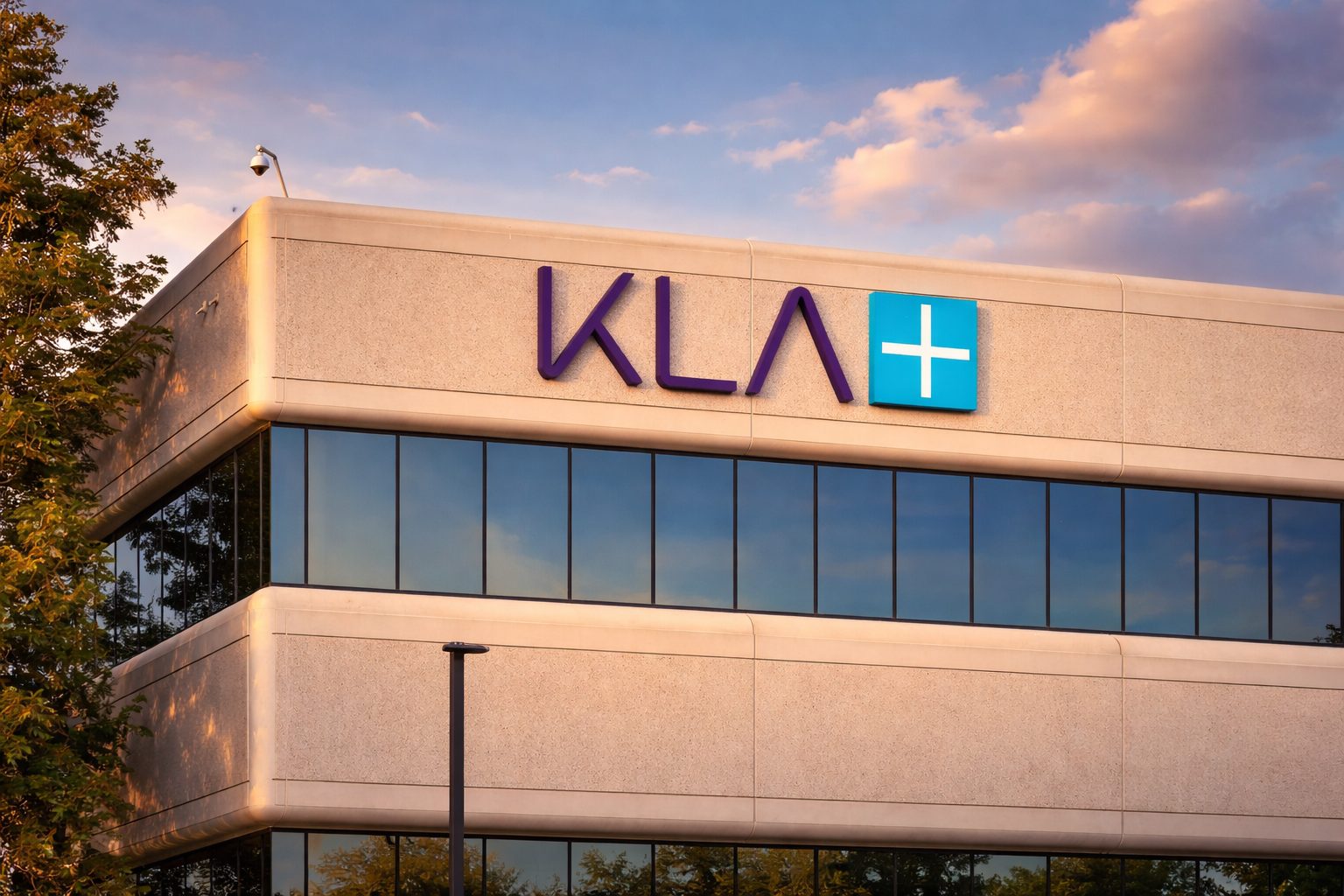
NEW YORK, Dec. 28, 2025, 3:58 p.m. ET — Market Closed
KLA Corporation (NASDAQ: KLAC) enters the final full trading week of 2025 with its stock hovering near record territory after a strong late-December run, as investors continue to price in a multi-year ramp in AI-driven semiconductor capital spending—particularly in the process-control and metrology tools where KLA is a global leader.
With U.S. stock exchanges closed for the weekend, the next key test for KLAC arrives when trading resumes on Monday, Dec. 29, with pre-market activity beginning as early as 4:00 a.m. ET and the regular session at 9:30 a.m. ET. Nasdaq+1
Where KLAC Left Off: A New Peak, Then a Hold Near the Highs
In the most recent regular session (Friday, Dec. 26), KLAC closed at $1,279.60, after trading in a narrow band near the top of its recent range and printing an intraday high of $1,286.81—a level highlighted across multiple market data sources as the top end of the stock’s current 52-week range. Investing.com
That price action followed a wave of momentum coverage over the past two days. For example:
- Investing.com published a company-news update noting KLAC hit an “all-time high” area around $1,285 on Dec. 26, describing the move as consistent with surging returns over the past year and upbeat sentiment around semiconductor equipment demand. (Source: Investing.com – Company News) Investing.com
- MarketBeat flagged Friday’s tape as a “new 1-year high” moment for KLAC, reporting prints up to about $1,285 intraday. (Source: MarketBeat – Instant Alert) MarketBeat
The 24–48 Hour News Cycle: What Investors Are Reacting To Now
Even though there was no company earnings release in the last 48 hours, the market narrative around KLAC has been actively reinforced by a cluster of fresh analysis pieces and price-action headlines—many of them focused on how AI infrastructure is changing the capex cycle.
1) AI infrastructure thesis gets a same-day refresh
A widely circulated note on Sunday emphasized that KLAC has been among the stronger S&P 500 performers in 2025, and tied the continued strength to Wall Street’s evolving assumptions for 2026 semiconductor spending. The piece highlighted price-target changes and rating actions from major firms, including:
- Bank of America raising its price target to $1,450 (from $1,400) while maintaining a Buy rating (dated Dec. 16),
- Cantor Fitzgerald upgrading to Overweight and lifting its target to $1,500 (from $1,350),
- Jefferies upgrading to Buy and lifting its target to $1,500 (from $1,100).
Source: Insider Monkey Insider Monkey
Why this matters for KLAC specifically: the market increasingly treats process-control intensity as a “shadow beneficiary” of leading-edge complexity. If AI accelerators, high-bandwidth memory, and advanced packaging keep pushing defect sensitivity and overlay requirements higher, process-control spending can scale faster than wafer volumes—an environment that tends to support premium valuation for KLA.
2) A late-week run-up framed as a “streak”—with valuation questions attached
A separate Saturday analysis characterized KLAC’s recent tape as a six-day winning stretch totaling about 9.2%, arguing the move reflects both analyst target hikes and broader semiconductor optimism, while also warning that valuation now looks “relatively expensive” after the surge.
3) The “new highs” coverage continues to be the near-term catalyst
Momentum headlines—particularly those attached to year-end positioning—often matter more in thin holiday liquidity than they would in the middle of earnings season. That’s been the setup for KLAC over the last two sessions, with multiple outlets focusing on the stock’s breakout above prior highs. Investing.com+2MarketBeat+2
Fundamentals Check: What KLA Itself Said Most Recently
While this weekend’s coverage is mostly market-driven, investors still anchor to the company’s most recent official outlook.
In its latest quarterly release (fiscal Q1 2026, ended Sept. 30, 2025), KLA reported:
- Revenue of $3.21 billion (above the midpoint of its guidance range),
- Non-GAAP EPS of $8.81,
and issued fiscal Q2 2026 guidance (quarter ending in December) of: - Revenue: $3.225 billion ± $150 million
- Non-GAAP EPS: $8.70 ± $0.78
- Non-GAAP gross margin: 62.0% ± 1.0%
Source: KLA Investor Relations press release KLA Corporation
CEO Rick Wallace framed the company’s positioning around the AI cycle in that release, saying the “AI infrastructure buildout” represents a “profound change” that should impact industries over coming years. KLA Corporation
Industry Backdrop: Spending Forecasts Still Point Up
A key reason KLAC remains in focus is that semiconductor equipment spending expectations have been drifting higher into 2026, with AI infrastructure demand frequently cited as the driver. In mid-December, Reuters reported that SEMI forecasts chipmaking equipment sales rising 9% to $126 billion in 2026, with further growth projected for 2027—while listing major beneficiaries that include KLA, ASML, Applied Materials, Lam Research, and Tokyo Electron. Reuters
For investors trying to contextualize KLAC’s year-end strength, this macro equipment-spend signal is important: the market is increasingly treating the 2026 setup as less of a “typical cycle” and more of a capex uptrend tied to AI-related compute and memory buildouts.
Insider Activity: What’s Been Disclosed Recently
Holiday weeks can amplify sensitivity to headlines around insider transactions. Recent SEC filings show:
- KLA CFO Bren D. Higgins reported a sale of 2,254 shares at $1,237.01 (transaction date Dec. 16, 2025), with the form noting it was under a Rule 10b5-1 plan. Source: SEC Form 4 SEC
- CEO Richard P. Wallace reported a sale of 10,803 shares at $1,203.10 (transaction date Nov. 11, 2025), also disclosed as under a Rule 10b5-1 plan. Source: SEC Form 4 SEC
These disclosures don’t automatically signal a change in business fundamentals—10b5-1 plans are commonly used for scheduled selling—but they can influence near-term sentiment when a stock is pressing new highs.
What the Market Being Closed Means: Key Items to Watch Before Monday’s Open
Because markets are closed right now, most investors’ actionable focus shifts from intraday price moves to Monday catalysts, liquidity conditions, and calendar effects.
1) Watch the week’s U.S. macro calendar (thin liquidity can amplify reactions)
Investopedia’s “week ahead” preview flagged several data points for the final week of the year, including pending home sales (Monday), Case-Shiller (Tuesday), weekly jobless claims (Wednesday), and Fed minutes (Tuesday)—all of which can move yields and risk appetite, especially with lighter holiday volumes. Investopedia
2) Know the New Year’s trading schedule
Investors also face calendar friction: U.S. stock markets are closed on New Year’s Day (Thursday, Jan. 1, 2026), while New Year’s Eve (Wednesday, Dec. 31, 2025) is a full trading day for stocks (with bonds closing early). Investopedia+1
3) Understand when price discovery resumes for KLAC
For U.S.-listed shares, the typical schedule is:
- Pre-market: 4:00 a.m. to 9:30 a.m. ET
- Regular session: 9:30 a.m. to 4:00 p.m. ET
- After-hours: 4:00 p.m. to 8:00 p.m. ET
Sources: Nasdaq market activity and NYSE hours calendars Nasdaq+1
Setup for the Next Session: What Would Move KLAC From Here?
With KLAC already near highs, Monday’s tape may hinge less on company-specific headlines and more on whether the market continues to reward high-multiple, AI-adjacent semiconductor names into year-end.
Here are the practical signposts investors often track into the open:
- Follow-through above recent highs: KLAC’s late-week high near $1,286.81 is a visible reference level after Friday’s push. Investing.com
- Peer and ETF confirmation: Semiconductor ETF performance can shape group sentiment. (For reference, the last close for semiconductor ETFs like SMH and SOXX reflected modest moves into the weekend.)
- Valuation sensitivity: At these levels, investors may scrutinize valuation more aggressively; market data shows KLAC trading at a higher earnings multiple relative to many industrial peers, consistent with its “AI capex” positioning. Investing.com
Bottom Line
KLA stock goes into Monday’s session with momentum on its side: new-high headlines, freshly recirculated AI capex arguments, and recent analyst target resets have all contributed to the late-December push. Investing.com+3Investing.com+3Insider Monk…
But with the market closed today and year-end liquidity often thinner than usual, the next decisive moves for KLAC are likely to come from macro-driven risk appetite, sector rotation, and whether investors keep paying up for the “process-control intensity” theme as the calendar turns to 2026. Investopedia+1