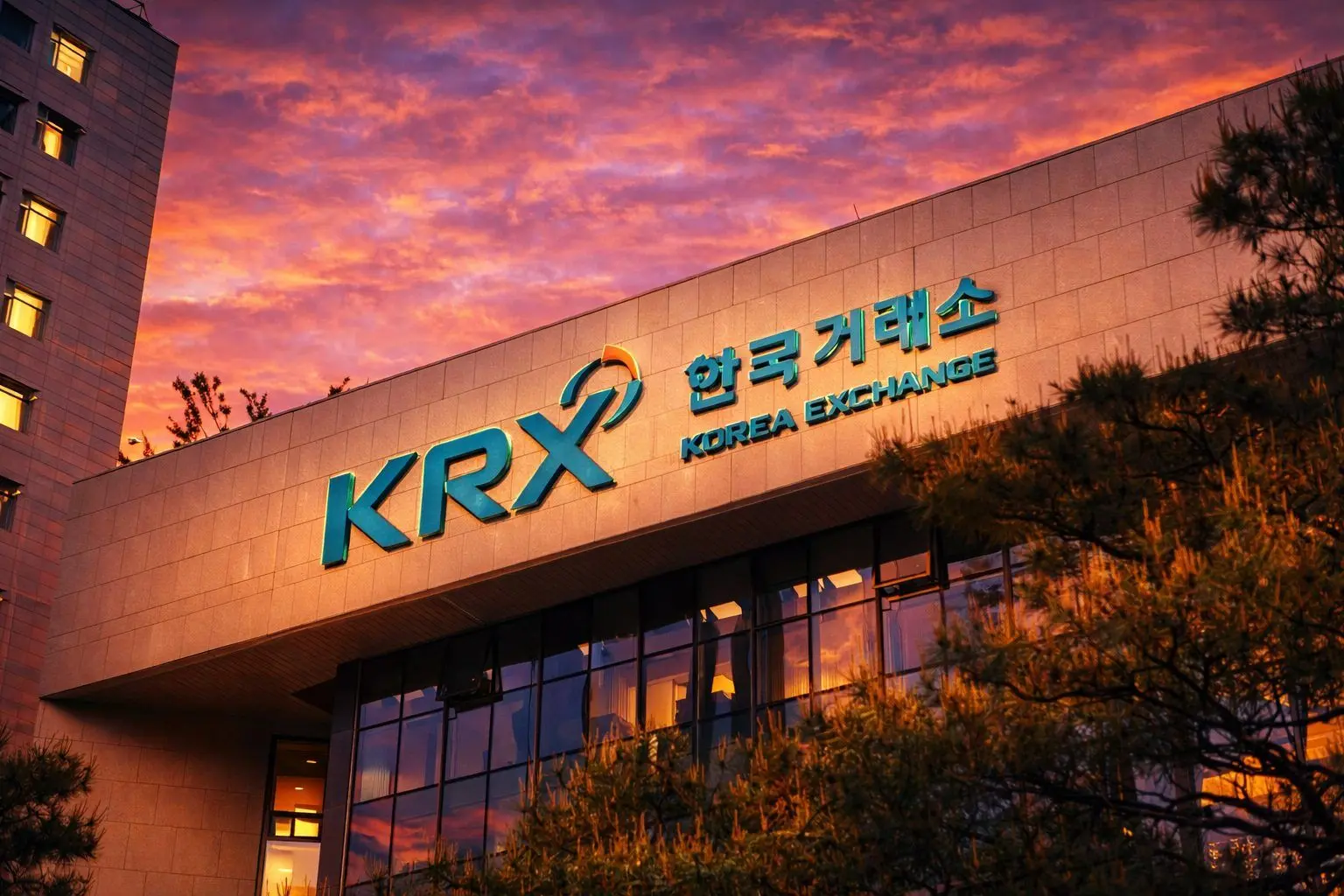
NEW YORK, January 1, 2026, 09:06 ET — Market closed
Investors headed into South Korea’s first trading session of 2026 with a strong export print in hand. Exports rose 13.4% in December from a year earlier, beating forecasts, and 2025 shipments climbed to a record $709.7 billion, government data showed on Thursday. Reuters
The benchmark KOSPI last finished 0.15% lower at 4,214.17 on Dec. 30, the final trading day of 2025 on the Korea Exchange (KRX). The tech-heavy Kosdaq ended down 0.76% at 925.47, local market data showed. FirstClass Business News
That setup matters because South Korea is starting the new year with equities sitting near record highs after a chip-led rally, while investors reassess how much of the good news is already in the price. Fresh trade and inflation data can quickly swing expectations for the won and interest rates — and foreign fund flows tend to follow.
Chip heavyweights outperformed even as regional trading stayed subdued into the holidays. SK Hynix rose 1.72% and Samsung Electronics added 0.33% in the last session, while battery names lagged, with LG Energy Solution down 3% and Samsung SDI off 2.9%, market data showed. AJU PRESS
Korean shares still closed out 2025 up 75.6% — the biggest yearly rise since 1999 — helped by the global artificial intelligence boom that lifted semiconductor stocks and by government market reform efforts, Reuters reported. The Seoul market was closed on Dec. 31 and Jan. 1 for year-end holidays. Reuters Japan
“We expect the KOSPI, still undervalued, to be on its own upward trend next year,” Daishin Securities analyst Lee Kyoung-min said. He set a 2026 target of 5,300, pointing to a semiconductor up-cycle — a period when chip demand and pricing improve — and a policy push aimed at shrinking the “Korea discount,” shorthand for Korean equities’ valuation gap tied to governance and dividend practices; the record high is 4,226.75, set on Nov. 4. Business Recorder
On the macro side, inflation data may shape the rate narrative just as trading restarts. South Korea’s consumer inflation slowed to 2.1% in 2025, close to the Bank of Korea’s 2% target, and December CPI rose 2.3% year-on-year in line with forecasts, Reuters reported. Reuters
Before next session
Korea Exchange will start regular trading at 10 a.m. local time on Jan. 2, one hour later than usual, after a market-opening ceremony; it will still close at the normal 3:30 p.m., Seoul Economic Daily reported. Alternative trading platform NextTrade will not run its pre-market session that morning. Seoul Economic Daily
Investors also have a clear policy waypoint: the Bank of Korea’s first rate-setting meeting of 2026 is scheduled for Thursday, Jan. 15, according to the central bank’s published calendar. Bank of Korea