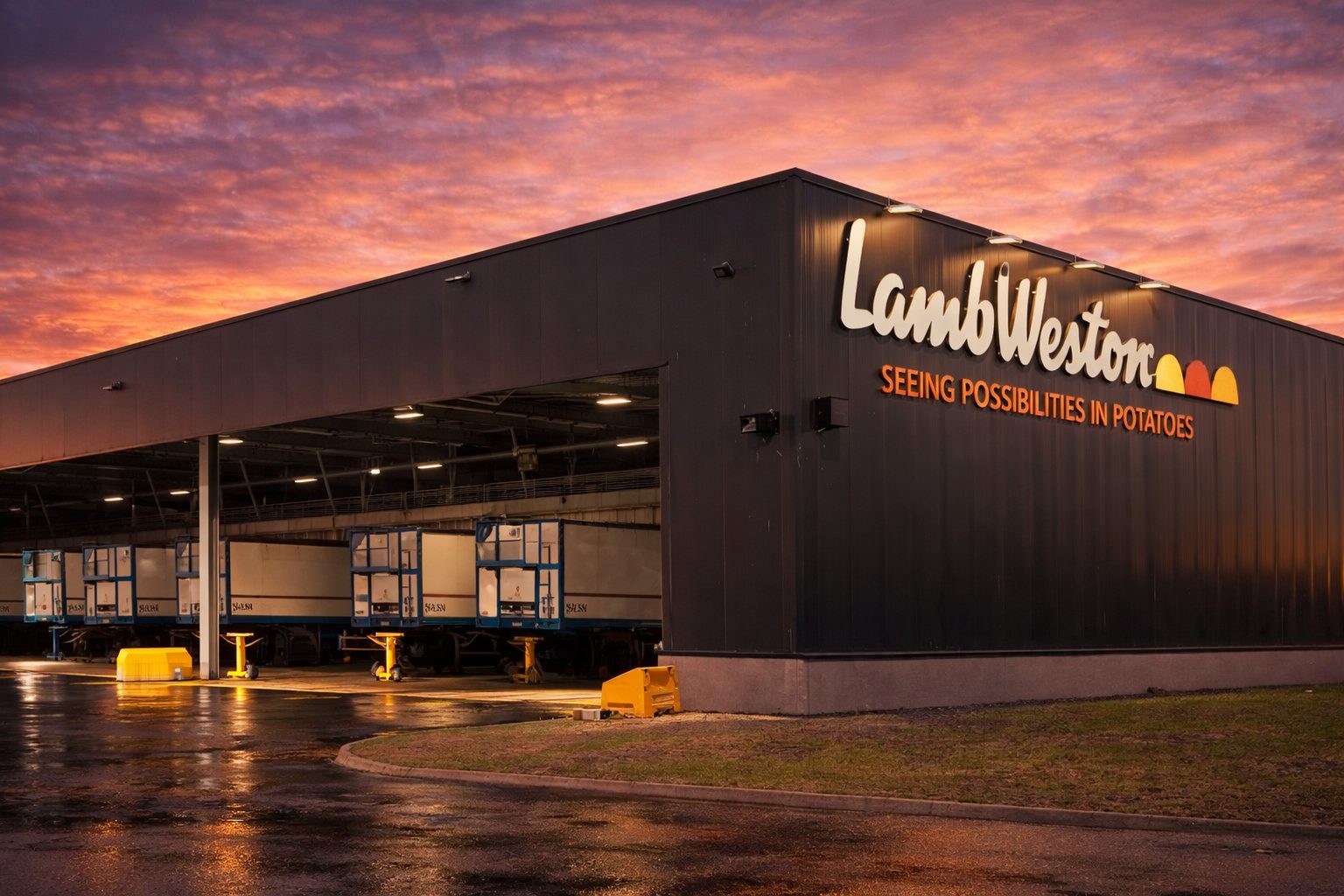

December 19, 2025 — Lamb Weston Holdings, Inc. (NYSE: LW) stock tumbled sharply Friday after the frozen potato products giant posted a modest earnings beat for its fiscal second quarter, but reaffirmed full-year guidance in a way that left investors bracing for a tougher back half of the year. Shares were down roughly 24%–25% in Friday trading, hovering around $44–$45 and near fresh lows.
That headline contradiction—“beat the quarter, spook the market”—is exactly what made LW stock one of the most talked-about consumer staples movers of the day. Barron’s+1
Why Lamb Weston stock fell so hard today
Lamb Weston’s results weren’t a disaster on the surface: revenue edged up and adjusted EPS came in above consensus. The selloff instead revolved around three intertwined fears:
- Pricing pressure is erasing volume gains
Management described an environment where volume rose ~8% year over year, but price/mix fell ~8% (constant currency), leaving sales essentially flat when adjusting for FX. In plain English: Lamb Weston is moving more fries, but earning less per pound in a highly competitive market. - Guidance “held” can still read like a warning
Reuters highlighted a key point echoed by Jefferies analysts: maintaining the annual forecast despite a better-than-expected quarter can imply the second half will be weaker than the market had hoped. Reuters - International profitability is dragging
North America looked sturdy, but the International segment’s adjusted EBITDA fell sharply, pressured by manufacturing costs, lower utilization, and startup expenses tied to the company’s new Argentina facility.
Layer on macro anxiety—Reuters pointed to inflation and trade uncertainty squeezing restaurant traffic—and you get a market that decided to punish the stock now rather than wait for margins to prove themselves later.
Lamb Weston Q2 FY2026 earnings: the key numbers investors are digesting
For the quarter ended November 23, 2025, Lamb Weston reported:
- Net sales:$1.618 billion, up about 1% year over year MarketScreener+2Reuters+2
- GAAP net income:$62.1 million (vs. a $36.1 million loss a year earlier) MarketScreener+1
- Adjusted EPS:$0.69, versus analyst expectations around $0.65 (and down from $0.73 last year) Finviz+3Reuters+3Investing.com+3
- Adjusted EBITDA:$285.7 million, down about $8.5 million year over year MarketScreener+1
The company also emphasized strong cash generation in the first half of the fiscal year:
- Net cash from operations (first half):$530.4 million MarketScreener+2Finviz+2
- Capex (first half):$155.7 million, sharply lower than the prior-year period as major growth projects wrapped MarketScreener+1
Those cash-flow lines matter because Lamb Weston has been in a capital-intensive stretch—and Wall Street wants evidence that the spending cycle is translating into durable returns (not just more capacity in a soft pricing market).
Segment check: North America holds up, International takes the hit
North America: stronger execution, but price/mix still down
North America net sales were essentially flat at ~$1.07 billion, with volume +8% offset by price/mix -8%. Segment adjusted EBITDA rose to $287.8 million (up ~7%), helped by volume, cost savings, and operating efficiencies—partially offset by continued customer support through pricing and trade.
Notably, Lamb Weston said it restarted previously curtailed production lines in North America in response to demand—an operational vote of confidence in the volume side of the equation.
International: revenue up, profitability down
International net sales increased to $548.6 million (helped by currency), but were down ~1% in constant currency. Volume was up 7%, but price/mix again fell about 8% on a constant-currency basis.
The real problem: International adjusted EBITDA dropped to $27.2 million from $48.6 million, pressured by higher manufacturing costs, lower utilization, and startup expenses at the Argentina facility.
The outlook: Lamb Weston reaffirms FY2026 guidance—market reads between the lines
Lamb Weston reaffirmed its fiscal 2026 targets:
- Net sales:$6.35 billion to $6.55 billion
- Adjusted EBITDA:$1.00 billion to $1.20 billion MarketScreener+2Reuters+2
On paper, that’s steady. In market psychology, it landed as cautious—especially since Reuters noted the guidance midpoint sits below the analyst estimate cited by LSEG (about $6.52 billion).
Management commentary also flagged margin turbulence ahead. In the earnings call, the company indicated it expects second-half adjusted gross margin to be flat to down versus the first half’s 20.4%, citing price/mix dynamics and higher international manufacturing costs (including ramp-up costs in Argentina and underutilization in Europe).
That’s the core tension for LW stock right now: volume momentum is improving, but pricing and mix are compressing economics at the same time that international costs are acting like ankle weights.
Dividend and buybacks: a brighter note amid the selloff
Even as the stock sank, Lamb Weston underscored shareholder returns:
- Q2 capital returned: about $51.6 million in dividends and $39.6 million in buybacks (617,623 shares repurchased at an average price of $64.18) MarketScreener+1
- Remaining repurchase authorization: about $308 million MarketScreener+1
- Dividend increase: Board authorized a 3% hike to $0.38 per share, payable Feb. 27, 2026 to shareholders of record Jan. 30, 2026 MarketScreener+2Investing.com South Africa+2
Dividends don’t “fix” pricing pressure, but they do signal management’s confidence in cash flow durability—even in an uneven margin environment.
What today’s analysts and forecasts are saying about LW stock
Analyst takes are splitting into two camps: “cheap now” versus “cheap for a reason.”
Price targets: still clustered above the post-drop price
After today’s plunge, the gap between where LW stock trades and where analysts think it could go widened dramatically:
- MarketBeat lists a consensus price target around $65.20, with targets ranging roughly $57 to $70 (based on the analysts it tracks).
- MarketWatch’s analyst estimates page shows targets centered in the mid-$60s, with a high near $70 and low near $60.
Recent notable callouts
- Reuters reported Jefferies analysts said reaffirming the annual forecast despite the quarterly beat points to a weaker-than-expected second half.
- Earlier in December, Jefferies raised its price target to $70 while keeping a Buy rating, according to MarketBeat’s summary of the note.
- Pre-earnings previews heading into today often framed consensus expectations around mid-$0.60s EPS and ~$1.59B revenue—numbers Lamb Weston slightly exceeded, but without calming bigger worries about pricing/mix and international margins.
Separately, at least one widely read commentary today argued the market’s issue wasn’t the quarter—it was guidance that implies weaker profitability at the midpoint compared with last year.
The hidden risk Reuters flagged: tariffs and input exposure
One angle that popped more explicitly in today’s Reuters coverage: tariff risk.
Reuters noted Lamb Weston faces tariff exposure because it relies on imported commodities such as palm oil, even as some raw materials like potatoes have become less costly.
That matters for investors because it can create a nasty asymmetry:
- Potato costs may ease, but
- A tariff-driven shock on other inputs (or trade friction that dents demand) can still hit margins.
What to watch next for Lamb Weston stock
If you’re tracking LW stock into 2026, the next chapters likely revolve around a handful of measurable signals—not vibes:
Pricing and mix trajectory
If price/mix stops falling (or falls less), volume growth could start translating into healthier profit leverage. Right now, the company is still describing significant customer support through price and trade in a competitive market.
International utilization and Argentina ramp
International profitability is getting pinched by underutilization and startup costs. Investors will be listening for evidence those costs normalize and capacity starts earning its keep.
Second-half margin performance
Management’s expectation that second-half adjusted gross margin could be flat to down versus the first half sets a clear bar. If margins hold up better than that framing, sentiment can change fast; if not, the stock may keep trading like a turnaround in progress.
Restaurant demand and macro sensitivity
Lamb Weston supplies major fast-food chains, and Reuters linked today’s caution to consumer pullbacks in dining out amid inflation and trade uncertainty. If restaurant traffic stabilizes, that helps; if it worsens, pricing competition can intensify.
Cash flow discipline and capital returns
With capex down sharply versus last year and ongoing buybacks/dividends, Lamb Weston has a path to keep returning cash—assuming profitability doesn’t erode faster than volumes grow.
Lamb Weston’s story on December 19, 2025 is basically a market parable written in french fries: volume is recovering, but pricing power is not—yet. Until investors see evidence that the company can convert those growing shipments into sturdier margins (especially internationally), LW stock may keep trading on “proof” rather than “potential.” MarketScreener+2Reuters+2
Related articles: Earnings Reports