Malaysia’s long‑promised electric train link between Kuala Lumpur and Johor Bahru is finally ready to roll.
On Thursday, 11 December 2025, a pre‑launch Electric Train Service (ETS) run from Kuala Lumpur to Johor’s Kempas Baru station marked the completion of the Gemas–Johor Bahru Electrified Double‑Track Project (EDTP) and the start of a new era in rail travel along the peninsula’s west coast. Full passenger services on the KL Sentral–JB Sentral route begin on Friday, 12 December 2025. The Straits Times+1
A preview run that closes a 192km gap
The launch ceremony in Kempas Baru brought together some of the most powerful figures in Johor and federal politics.
- Johor Regent Tunku Ismail Sultan Ibrahim officiated the opening of the Gemas–Johor Bahru double-tracking line and the ETS3 extension to JB Sentral.
- Prime Minister Anwar Ibrahim hailed the project as a “key chapter” in Malaysia’s development, putting modern rail alongside airports, ports and highways as core infrastructure for Johor’s rapid growth. CNA+1
- Transport Minister Anthony Loke framed the line as both a mobility upgrade for everyday commuters and a catalyst for investment and logistics along the southern corridor.
The 192km EDTP fills the last missing piece of the electrified double‑track spine from Padang Besar in Perlis all the way down to Johor Bahru, allowing continuous higher‑speed inter‑city services along the west coast for the first time. The Straits Times+1
First announced in 2011, construction on this southern section began in 2016 with an estimated cost of around RM8.9 billion, but opening was pushed back by the Covid‑19 pandemic and complicated land acquisition. CNA
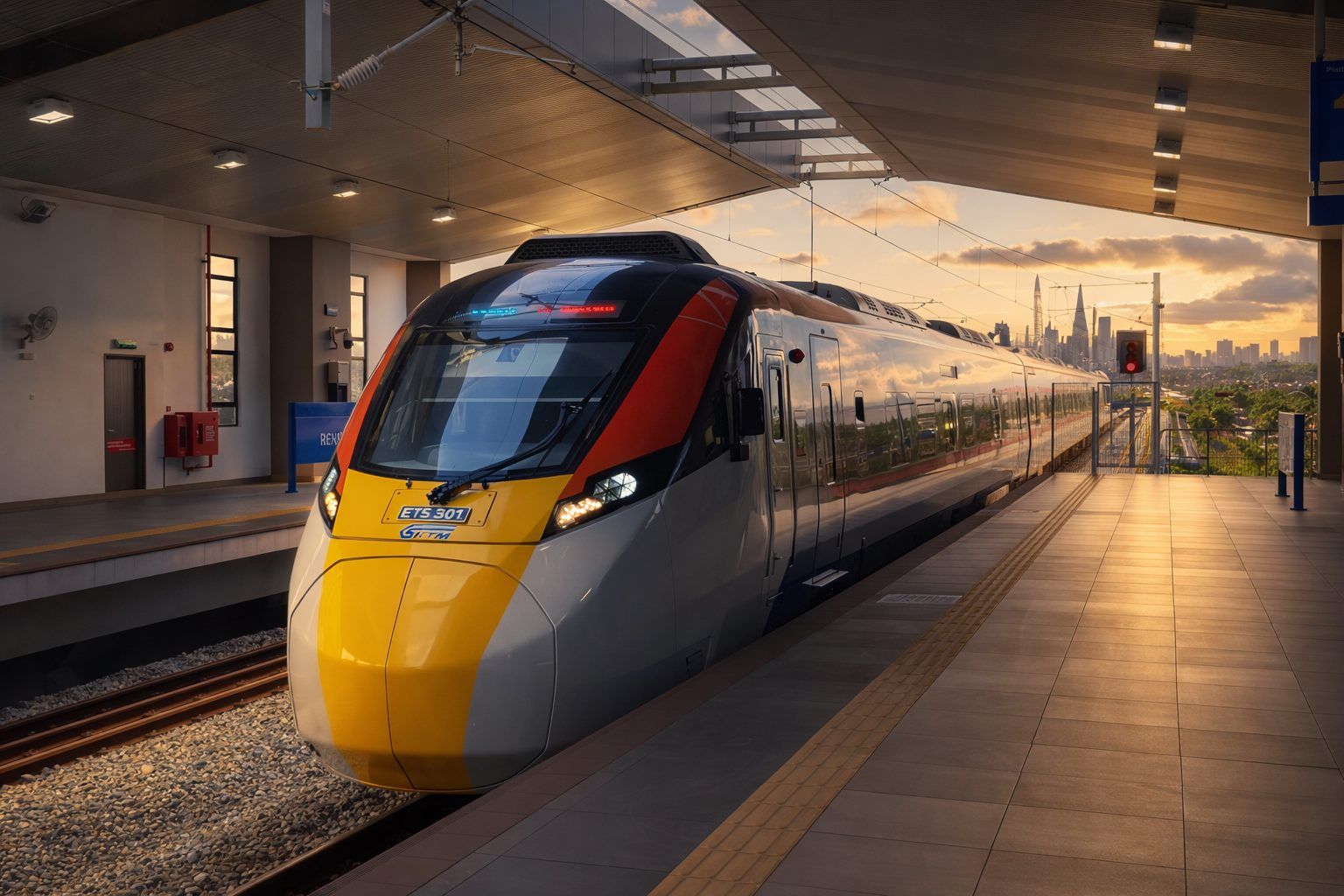
Thursday’s preview run left Kuala Lumpur Railway Station at about 6am and arrived at Kempas Baru around 10am, showcasing the new ETS3 rolling stock and the completed infrastructure ahead of Friday’s public launch. The Straits Times+1
How fast is the new KL–JB ETS — and what’s the route?
The KL–JB ETS3 service builds on earlier 2025 extensions that pushed electric trains south from Gemas to Segamat in March, and then to Kluang in August. Malay Mail+1
Key performance and route details as of the launch:
- Journey time:
- Roughly 3.5 to 4.5 hours between KL and JB, depending on service type and number of stops — about half the ~7 hours taken by existing diesel intercity services. Malay Mail+2CNA+2
- Top operating speed:
- Up to 140km/h on suitable stretches of track. Malay Mail+1
- New and upgraded stations on the southern extension:
- Segamat, Genuang, Labis, Bekok, Paloh, Kluang, Mengkibol, Renggam, Layang-Layang, Kulai and Kempas Baru, before terminating at JB Sentral .The Business Times+1
While exact stopping patterns vary by service tier (Silver, Gold, Platinum/Express), the southern corridor also serves residents of smaller towns like Kluang and Segamat, giving them direct electric‑train access to Kuala Lumpur instead of relying solely on slower diesel trains or buses.
Timetable from 12 December: morning and evening trains each way
From 12 December 2025, KTMB’s initial ETS3 timetable on the KL Sentral–JB Sentral route extends four existing KL–Kluang services all the way to Johor Bahru: Gaya Travel Magazine+1
- Southbound (KL Sentral → JB Sentral)
- Train 9511: Departs 7.45am, arrives around 12.05pm
- Train 9515: Departs 5.35pm, arrives around 9.55pm
- Northbound (JB Sentral → KL Sentral)
- Train 9510: Departs 8.40am, arrives around 1.00pm
- Train 9514: Departs 4.20pm, arrives around 8.40pm
A revised timetable will kick in on 1 January 2026, with minor tweaks to departure times and more services planned. Transport officials have signalled that additional ETS sets will be deployed from January and February 2026 to boost frequency ahead of Chinese New Year and Hari Raya, with the aim of operating the line near full capacity by late Q1. Malay Mail+2CNA+2
Longer‑distance ETS services from Johor Bahru to Butterworth and Padang Besar are planned once operations stabilise, but for now passengers heading further north will connect via KL Sentral. Malay Mail+1
On board the ETS3: business‑class seats, bistro coach and prayer room
The trains used on the KL–JB route are six‑coach ETS3 sets designed for long‑distance comfort: The Straits Times+2Malay Mail+2
- Capacity: 312 seats
- 5 standard‑class coaches
- 1 business‑class coach
- Facilities in standard class:
- Individual power sockets or USB charging at every seat
- Air‑conditioning and overhead luggage racks
- Four toilets distributed along the train
- A dedicated bistro coach serving hot meals and drinks
- Business class extras:
- Wider, reclining seats with more legroom
- Own toilet and complimentary meal service
- Individual entertainment screens with movies and route information
- In‑seat food ordering and onboard Wi‑Fi
- Religious facilities:
- A small surau (prayer room) located in a middle coach for Muslim passengers.
The design mirrors ETS services on the northern sector, but this is the first time such amenities have reached Johor Bahru, which previously relied on slower diesel intercity trains.
Fares, promo code “JBBEST” and tickets selling out fast
KTMB is positioning the KL–JB ETS as a competitively priced alternative to both buses and budget flights between southern Malaysia and the capital.
Base fares and classes
As of launch week:
- Standard‑class one‑way fares between KL and JB start from around RM82, rising with demand and flexibility. The Straits Times+2CNA+2
- Business‑class seats are typically priced in the RM150–RM170 range for the full sector, depending on date and train. CNA+1
Tickets are sold via:
- The KITS Style mobile app
- KTMB’s official website and online booking portal
- Self‑service kiosks and ticket counters at major stations. The Straits Times+1
Sales opened just after midnight on 9–10 December, with seats available for travel through to at least May 2026.
Launch discount and near‑instant sell‑out
To mark the opening of the southern ETS sector, KTMB rolled out a 30% discount for travel between 12 December 2025 and 11 January 2026 on the KL Sentral–JB Sentral–KL Sentral route, limited to the first 5,000 promo redemptions using the code “JBBEST”. The Straits Times+2The Star+2
That offer vanished almost as soon as it went live. Both The Straits Times and The Business Times report that all promotional seats were snapped up on the first day, and KTMB’s own booking system quickly showed only scattered availability — mostly seats reserved for passengers with disabilities — on the inaugural trains. The Straits Times+2The Business Times+2
One early northbound service from JB Sentral reportedly has over 400 passengers booked, more than 100 of them non‑Malaysian, underscoring strong interest from Singapore‑based travellers even before the line formally opens. The Business Times+1
Why the KL–JB ETS line matters for Malaysia’s economy
In his launch speech at Kempas Baru, Anwar Ibrahim tied the ETS directly to Malaysia’s broader development strategy.
He argued that Johor has already become a standout destination for investment, pointing to a target of RM100 billion in inflows via the Johor–Singapore Special Economic Zone (JS‑SEZ) and noting that Johor’s recent performance rivals or surpasses that of industrial powerhouses like Penang and Selangor. The Business Times+1
The ETS, in this view, does three things at once:
- Connects growth centres
- Rapid rail links Johor Bahru with Greater KL and, via connections, with northern cities like Ipoh, Butterworth and Padang Besar.
- Spreads benefits beyond big cities
- Stations in towns such as Segamat, Paloh, Renggam and Layang‑Layang become potential hubs for new housing, logistics parks, small businesses and tourism. Anwar explicitly called for coordinated federal and state planning to ensure people living near smaller stations see concrete “trickle‑down” benefits in jobs and infrastructure. CNA+1
- Strengthens Johor as a logistics and industrial hub
- Transport planners and economists quoted by regional media say the EDTP and ETS will support cargo flows to ports, improve labour mobility into industrial zones, and make it easier to staff new facilities in and around Johor Bahru. The Business Times+1
Environmental arguments are also in play: by shifting travellers from cars and buses to electrically powered trains, Malaysia can cut highway congestion and lower emissions over the long term.
The Singapore connection: RTS Link + ETS for ~4‑hour city‑to‑city travel
Although the ETS does not cross into Singapore, the new line is being launched just as the Johor Bahru–Singapore Rapid Transit System (RTS) Link moves toward completion.
- The RTS is a 4km cross‑border metro line between Bukit Chagar (JB) and Woodlands North (Singapore), due for completion in late 2026 and operations in early 2027.
- It will gradually replace the current Tebrau Shuttle and is designed to interchange seamlessly with ETS services at JB Sentral via covered walkways, escalators and lifts. Malay Mail+1
Transport experts interviewed by CNA estimate that once RTS and ETS are both fully up to speed, travellers could get from Singapore’s northern border to central Kuala Lumpur in roughly four hours by rail, entirely bypassing Causeway traffic jams and highway bottlenecks. CNA+1
That prospect positions JB Sentral as a future rail gateway for Singaporeans heading deeper into Malaysia — not just to KL, but, with onward connections, to Penang and the Thai border.
More trains coming: Kulai–JB commuter line in early 2026
The KL–JB ETS launch isn’t the only rail news out of Johor on 11 December.
Anthony Loke has confirmed that:
- A dedicated commuter service between Kulai and Johor Bahru is scheduled to start in Q1 2026.
- It will reuse existing KTMB coaches that previously shuttled between Gemas and JB, repurposed to run a high‑frequency local service.
- The route will see 32 services a day — 16 toward JB and 16 toward Kulai — with journey times of around 20 minutes and headways of roughly half an hour. The Straits Times+2The Sun Malaysia+2
The commuter line is intended to funnel Johor residents into rail, ease traffic on roads heading into JB, and feed future RTS passengers once that system goes live.
Within Johor Bahru itself, the Transport Ministry is still weighing options for an Autonomous Rapid Transit (ART) system, an elevated or guided bus‑like rail hybrid that could form another layer of urban transit feeding into ETS and RTS stations. CNA+1
How the new ETS stacks up against buses, cars and flights
For decades, most travel between Johor Bahru and Kuala Lumpur has been by road, with some passengers using budget airlines from Senai Airport.
Here’s how the ETS compares:
- Versus driving or coaches
- Typical road journeys take five to seven hours, especially when factoring in holiday traffic and toll‑plaza queues.
- ETS journey times of around 3.5–4.5 hours are competitive, and crucially, they are predictable — unaffected by accidents or weather‑related jams. The Straits Times+2CNA+2
- Versus flying
- Flying between Senai and Kuala Lumpur International Airport often looks faster on paper, but door‑to‑door trips include airport transfers, early check‑in and security queues.
- Economists and transport consultants interviewed in Singapore media note that being able to sit and work for four hours on a train that starts and ends in city centres is particularly attractive for business travellers, and can make ETS more time‑efficient overall for many itineraries. The Business Times+1
- Cost and comfort
- With standard fares starting around RM82, ETS tickets are often cheaper than last‑minute airfares and comparable to premium coach prices, with the added benefits of more legroom, the ability to walk around, and onboard food and Wi‑Fi on selected services. The Straits Times+2CNA+2
Practical guide: riding the KL–JB ETS from launch day
For travellers looking to use the line as soon as it opens:
- Book early, especially for weekends and holidays
- Launch‑weekend trains and key festive dates are already close to sold out or full. If your dates are fixed, secure tickets as soon as possible via KTMB’s official channels.
- Choose your departure city and time
- From Kuala Lumpur, opt for the 7.45am departure if you want to arrive in JB in time for lunch or to connect onward to Singapore.
- From Johor Bahru, the 8.40am departure gets you to KL early afternoon; the 4.20pm train suits those wrapping up business in JB. Gaya Travel Magazine+1
- Allow buffer time at stations
- KTMB advises arriving at least 30 minutes before departure; boarding gates typically close a few minutes before the scheduled departure time. Gaya Travel Magazine
- Connecting from or to Singapore
- Until the RTS Link opens, passengers will still need to cross the Causeway using existing bus or shuttle services between JB and Woodlands or other connecting points, then continue by local MRT or bus in Singapore.
- Once RTS is operational, a seamless rail‑to‑rail transfer at Bukit Chagar/JB Sentral is expected to cut overall travel time and make “train all the way to KL” a realistic default choice for many cross‑border commuters.
A new backbone for west‑coast rail
From a policymaking perspective, 11 December 2025 will likely be remembered as the day Malaysia’s west‑coast rail map finally became whole.
With electrified double‑track now running unbroken from the Thai border down to Johor Bahru, and with long‑distance ETS services linking major cities along that corridor, Malaysia has moved significantly closer to a modern, rail‑centred transport system — one that could, in time, knit together ETS, the East Coast Rail Link, RTS, future ART lines and expanded commuter networks into a genuinely national grid. The Straits Times+2CNA+2