
New York, February 20, 2026, 16:50 ET — Trading after the bell.
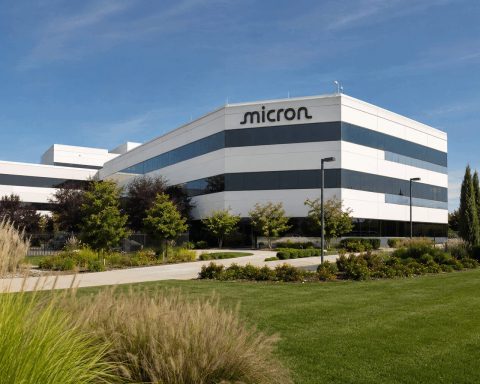
- Micron picked up around 2.6% in after-hours trading, shaking off a turbulent session earlier.
- Investors keep grouping memory makers under the “AI infrastructure” umbrella instead of looking at them purely in terms of chip cycles.
- Nvidia is set to report earnings Feb. 25, putting the spotlight back on AI demand.
Micron Technology, Inc. climbed $10.69, or 2.6%, wrapping up late Friday at $428.17. Shares bounced between $413.16 and $430.46 through the session.
Money’s flowing out of the big-name AI “hyperscalers” and turning up in their supply chain instead—companies making chips, storage, and all the tangible hardware running those sprawling new data centers. “Our goal is that every time someone like Meta or Amazon invests in a data center, the cash registers ring across our portfolio,” said Adam Patti, chief executive at VistaShares. His AI infrastructure ETF counts Micron as one of its top holdings. Reuters
Stocks ended higher Friday after the Supreme Court tossed out President Donald Trump’s global tariffs—a decision that briefly cooled trade friction. But Trump floated the idea of a fresh 10% global tariff, this time with different legislative backing. “Today is a removal of some uncertainty, and we’re on to the next phase,” said Mike Dickson, head of research and quantitative strategies at Horizon Investments. Reuters
Premium memory’s on the move—prices have been ticking up, and chip traders are taking notice. Samsung Electronics, per a Barron’s report, is preparing to roll out its next HBM4 chip, aiming for a price tag 20% to 30% above the prior model. That kind of hike, traders point out, gives the trio of HBM suppliers—Micron, Samsung, SK Hynix—added pricing muscle.
Reuters Breakingviews pointed to data-center spending possibly hitting $800 billion by 2026, as memory stocks rallied on expectations of ongoing supply constraints. The column emphasized SK Hynix’s edge in high-bandwidth memory, but also noted that investors are zeroing in on who can ship real volume—flashy roadmaps alone aren’t cutting it anymore.
High-bandwidth memory, or HBM, puts DRAM directly alongside an AI processor, pushing data through much faster. That’s the bottleneck for today’s AI servers. This shift goes a long way toward explaining Micron’s recent stock action: it’s tracking less with classic PC-memory cycles and more like a turbocharged bet on data-center spending.
Micron caught Wall Street off guard in December, issuing an upbeat forecast that topped analysts’ expectations and hiking its 2026 capital spending plan to $20 billion, citing supply still coming up short. “AI-related demand remains the biggest driver for Micron,” Summit Insights analyst Kinngai Chan said at the time. Reuters
Pressure is mounting. Samsung said earlier this month it’s shipped HBM4 chips out to customers, pushing ahead on the next-gen memory front. The company is also aiming to have HBM4E samples ready in the second half of 2026—underscoring the rapid pace of new hardware hitting the market.
Memory, though, is never a free ride. The business swings: push too much capacity and suddenly, shortages flip to oversupply. If AI data-center spending eases or buyers balk at contract rates, Micron’s shot at premium margins could dull fast.
Nvidia steps into the spotlight with its Feb. 25 earnings coming up, and traders are hanging on guidance details, plus anything CEO Jensen Huang says about demand. “It’s hard for Nvidia to surprise when everyone expects it to surprise,” said Marta Norton, chief investment strategist at Empower. Melissa Otto at S&P Global Visible Alpha pointed out the wide range of forecasts and noted the shares are “not that cheap” if the bears turn out to be right. Reuters
Related articles: NASDAQ:MU