Seattle, Jan 6, 2026, 05:14 (PST)
- Four private companies are targeting lunar landing attempts in 2026, led by Blue Origin, Firefly, Intuitive Machines and Astrobotic
- NASA’s Artemis plans and China’s Chang’e-7 keep attention on the Moon’s south pole and harder-to-reach regions
- NASA’s CLPS program remains a key customer as it buys commercial deliveries to the lunar surface
Private lunar landings are back on the calendar for 2026, with Blue Origin, Firefly Aerospace, Intuitive Machines and Astrobotic lining up robotic missions to the Moon. The run of attempts would add fresh pressure to prove that commercial lunar delivery can work more than once.
The push comes as NASA prepares Artemis II, a crewed flight around the Moon no earlier than February, and China aims a south-pole landing with Chang’e-7 in the second half of the year. The combined timetable is drawing renewed attention to the Moon as both a science target and a strategic proving ground. dailygalaxy.com
Several of the missions connect to NASA’s Commercial Lunar Payload Services, or CLPS, a program that buys delivery services from U.S. companies for science instruments and technology demonstrations. NASA says CLPS contracts are structured for multiple task orders with a cumulative ceiling of $2.6 billion through 2028, and its public timeline lists Blue Origin’s Mark 1 mission as carrying the agency’s Stereo Cameras for Lunar Plume Surface Studies payload.
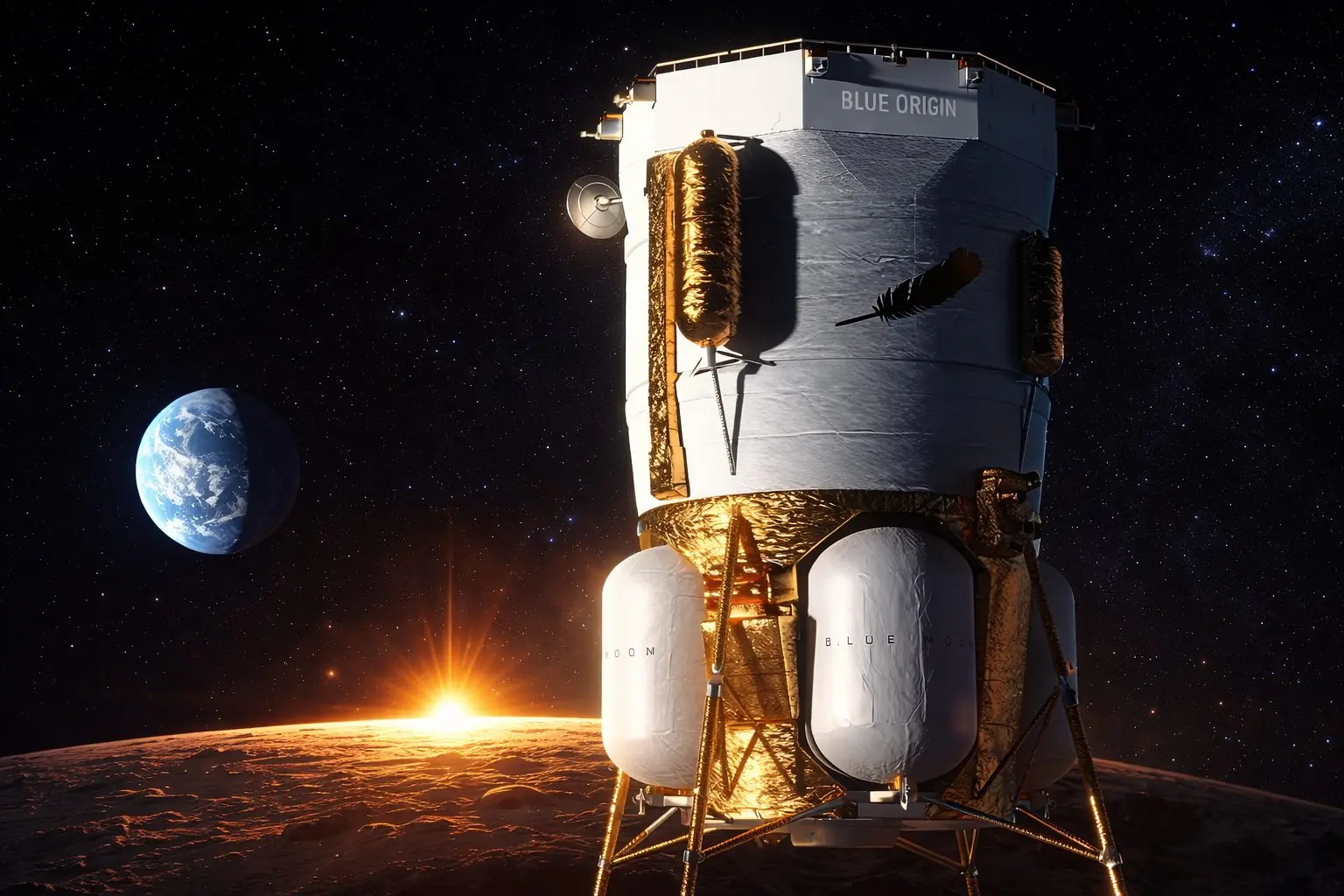
Blue Origin’s Blue Moon Mark 1 is designed as a single-launch cargo lander that can deliver up to three metric tons and test systems such as precision landing within about 100 meters of a target site, the company says. Blue Origin also describes the pathfinder flight as a step toward its uncrewed NASA Human Landing System work — NASA’s astronaut lunar-lander program.
Founder Jeff Bezos wrote on Instagram late last year that the MK1 flight vehicle “will land near Shackleton crater” and said, “We’ll soon be doing fully integrated checkout tests,” Primetimer reported. primetimer.com
Firefly’s Blue Ghost Mission 2 plans a far-side landing — terrain that has no direct line of sight to Earth and needs a relay for communications. The mission uses a two-spacecraft stack — Blue Ghost and Firefly’s Elytra Dark orbital vehicle — to deploy the European Space Agency’s Lunar Pathfinder satellite and support roughly 10 days of surface operations, Firefly said. The lander will power down before lunar night to avoid interfering with NASA’s LuSEE-Night radio telescope, which Firefly said could operate for up to two years.
Intuitive Machines is targeting a third landing attempt with its IM-3 mission, aiming for the Reiner Gamma region on the near side, Space.com reported. The company’s first two landers — Odysseus in February 2024 and Athena last year — ended up on their sides after touchdown, underscoring how thin the margin is in lunar landing design.
Astrobotic’s Griffin-1 is scheduled to launch no earlier than July 2026 on a SpaceX Falcon Heavy, Space.com said, after its first Peregrine lander failed to reach the Moon in 2024. Griffin-1 is now set to carry Astrolab’s 1,000-pound (450-kg) FLIP rover and Astrobotic’s smaller CubeRover; NASA’s VIPER rover has moved to a later mission, according to Space.com.
The new wave of missions also has a supply-chain angle far from Florida launchpads. Newstalk870, citing GeekWire, said an L3Harris Technologies team in Redmond, Washington, built thrusters for Artemis II’s Orion crew vehicle, while Blue Origin’s lunar lander work is based in Kent.