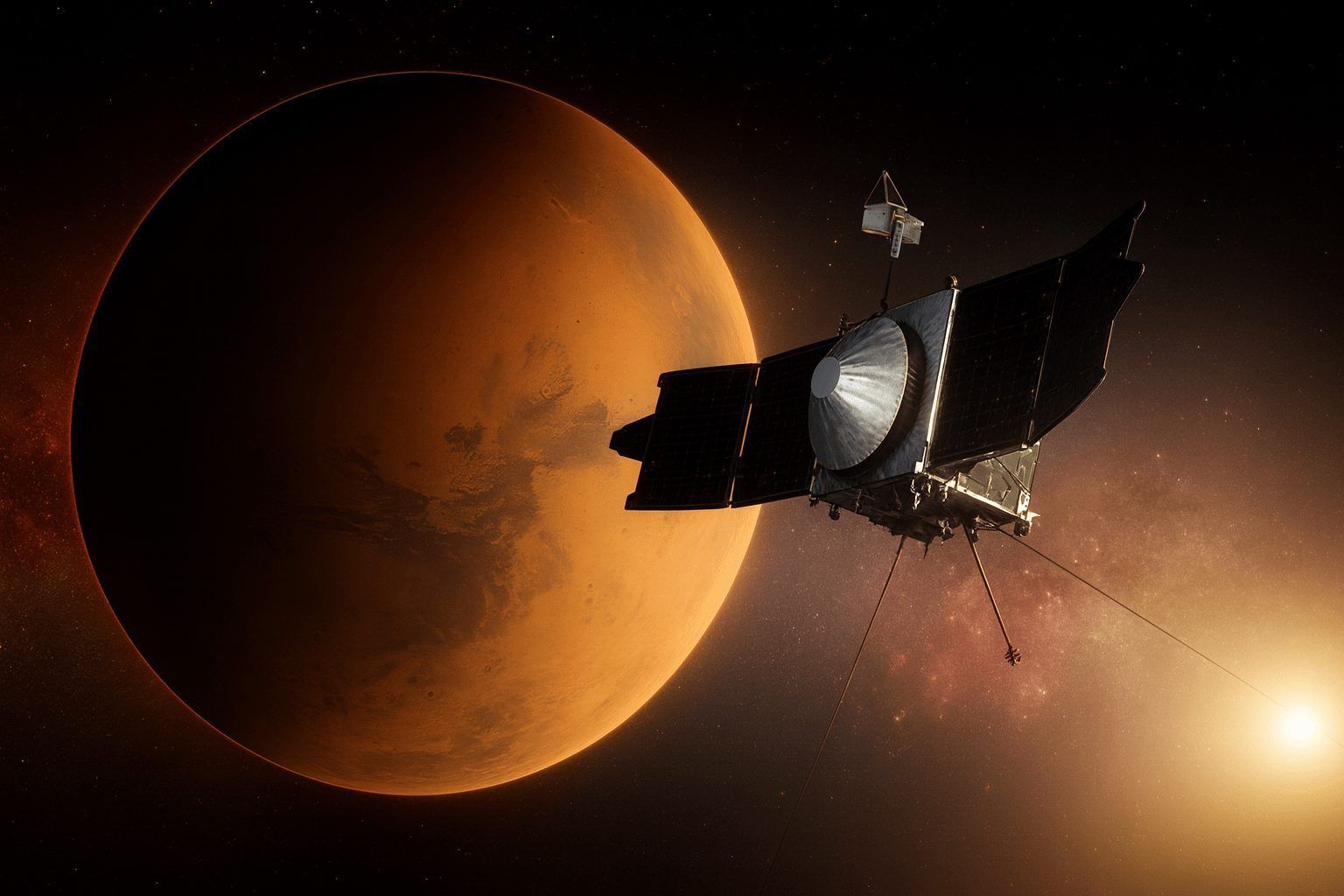
NASA is racing to re‑establish contact with MAVEN, a Mars orbiter that has quietly underpinned Red Planet science and communications for more than a decade, after the spacecraft unexpectedly fell silent on December 6, 2025.
The loss of signal raises urgent questions about the health of the spacecraft, the resilience of NASA’s aging Mars communications network, and the knock‑on effects for current and future missions — including plans to eventually return Martian rock samples to Earth.
When and how NASA lost contact with MAVEN
According to NASA, MAVEN (short for Mars Atmosphere and Volatile EvolutioN) was operating normally as it slipped behind Mars during a routine orbit on December 6, 2025. Before the planet blocked radio contact, telemetry showed all subsystems functioning as expected.
Normally, when a Mars orbiter passes behind the planet, the space agency’s Deep Space Network (DSN) reacquires the signal as the spacecraft reappears. This time, no signal arrived.
In a brief December 9 status update, NASA confirmed that MAVEN had “experienced a loss of signal with ground stations on Earth” on December 6 and that engineers were investigating the anomaly.NASA Science+1
Major news outlets including ABC News, CBS, The Guardian, PBS and the Associated Press have since reported that the spacecraft, in Mars orbit since 2014, has not responded to repeated attempts to contact it.
As of December 11, 2025, NASA has not announced any successful re‑contact or definitive root cause. The spacecraft remains officially classed as lost‑signal and under investigation.
MAVEN: The mission that rewrote Mars’ atmospheric history
MAVEN launched in November 2013 and entered Mars orbit in September 2014, originally as a one‑year primary science mission.
In the 11 years since, it has become one of NASA’s most scientifically productive Mars orbiters. The spacecraft’s core mission is to study:
- The upper Martian atmosphere and ionosphere
- How the atmosphere interacts with the solar wind
- How gas escapes to space over time
Data from MAVEN helped establish that atmospheric escape driven by the Sun played a major role in transforming Mars from a warmer, wetter world into the cold, thin‑aired desert we see today.
Over the years, MAVEN has:
- Shown how water can be lofted high into the atmosphere during global dust storms, where its components are stripped away by the solar wind.
- Helped map Martian winds and circulation patterns in the upper atmosphere.
- Revealed Mars’ invisible magnetic “tail”, a hybrid between a magnetosphere and an induced field.ScienceAlert+1
- Identified a “sputtering” mechanism, in which high‑energy particles knock atmospheric atoms into space.ScienceAlert+1
- Discovered a rare type of proton aurora, shedding light on exotic space‑weather interactions at Mars.
These results are central to our broader understanding of planetary evolution: how two worlds that started out similar, Earth and Mars, diverged so dramatically in climate and long‑term habitability.
Even if MAVEN never transmits again, scientists will be working through its data for years.
A quiet workhorse of Mars’ communications network
Science is only half of MAVEN’s importance. The orbiter also carries a UHF relay radio, making it a key node in the interplanetary internet that links Earth to robots on the Martian surface.
Alongside NASA’s Mars Reconnaissance Orbiter (MRO) and Mars Odyssey, and the European Space Agency’s Trace Gas Orbiter (TGO) and Mars Express, MAVEN relays large volumes of data for the Curiosity and Perseverance rovers.
- ESA’s TGO now carries much of the relay workload.
- MAVEN and the older NASA orbiters provide additional coverage and redundancy.
- ESA’s Mars Express remains a valuable backup.
Because multiple orbiters share the relay role, the rovers are not currently cut off from Earth. However, losing MAVEN would:
- Reduce redundancy in case of problems with other orbiters
- Shrink overall data capacity, potentially limiting how much science data rovers can send home each day
- Increase operational risk for long‑term campaigns such as Mars Sample Return, which assume a robust relay network in the 2030s.
Scientific American has highlighted that even the “newest” member of the relay fleet, MAVEN, has been operating at Mars for nearly a decade — underscoring how much NASA is stretching its current assets.Scientific American
An aging spacecraft with a history of navigation scares
The current loss of contact comes after several years of increasingly delicate navigation for MAVEN.
Beginning in late 2021, engineers saw worrying signs that the spacecraft’s inertial measurement units (IMUs) — sensors that track rotation and help keep antennas and solar arrays pointed correctly — were degrading.
Key milestones in that earlier saga:
- February 2022 – MAVEN went into safe mode after IMUs behaved anomalously during a power cycle. Engineers temporarily lost contact, then restored it using a backup IMU and a redundant computer.
- April–May 2022 – The team uploaded and tested a new “all‑stellar” navigation mode, letting MAVEN determine its orientation using star‑tracker cameras instead of aging IMUs — a standard life‑extension tactic for old orbiters.lasp.colorado.edu+2Space+2
- February 2023 – MAVEN again entered safe mode during preparations for a small maneuver; NASA reported that the spacecraft recovered and resumed normal operations in all‑stellar mode.
Those past issues were successfully resolved, and in 2022 NASA and its partners publicly expressed confidence that all‑stellar navigation would allow the orbiter to keep operating through at least the end of the decade.
Crucially, NASA has not said that the current loss of contact is related to attitude control or the star‑tracker system. But given MAVEN’s history with orientation problems, experts expect engineers to scrutinize:
- The navigation system (star trackers, attitude control software, reaction wheels)
- The communications chain (high‑gain antenna pointing, onboard radio hardware)
If the spacecraft loses its ability to point the antenna accurately, DSN receivers on Earth may simply be listening in the wrong direction — a classic failure mode for aging probes.
How NASA is trying to find a silent spacecraft
From more than 200 million kilometers away, troubleshooting is slow and methodical.
Based on MAVEN’s known orbit and latest good telemetry, NASA and its DSN operators can predict where the spacecraft should be and when it should rise and set from Earth’s point of view. They can then:
- Sweep antennas across the expected position to hunt for even a faint carrier tone.
- Transmit commands at different times and data rates, hoping to trigger a safe‑mode reset or reconfiguration.
- Repeat the process over multiple orbits, in case the spacecraft is slowly precessing or tumbling.
Space.com reports that NASA is continuing to ping MAVEN along its predicted orbit, working from the assumption that the spacecraft’s path itself has not drastically changed.
As long as power and thermal conditions remain within survivable limits — for example, if the solar arrays are still catching enough sunlight and the spacecraft isn’t overheating or freezing — there is still a chance that a future command or automatic reset could bring MAVEN’s radio back to life.
What happens if MAVEN never phones home?
If NASA ultimately declares MAVEN lost, the implications will be serious but not catastrophic for Mars exploration.
Short‑term impact on current missions
- Curiosity and Perseverance will continue to send data via MRO, Mars Odyssey, ESA’s TGO, and Mars Express.
- Daily data volume might need to be rebalanced among orbiters, and some science campaigns could be paced differently to match bandwidth.
- The system will have less redundancy if another orbiter suffers a failure.
News outlets from AP and CBS to NDTV and ScienceAlert have stressed that MAVEN’s simultaneous roles as a science platform and a relay node make its continued silence an operational concern as much as a scientific one.
Long‑term implications for Mars infrastructure
MAVEN’s troubles are a warning shot for NASA’s aging orbital fleet:
- Mars Odyssey launched in 2001
- MRO launched in 2005
- MAVEN has been in Mars orbit since 2014
Scientific American notes that NASA has floated various proposals for a next‑generation Mars telecommunications orbiter over the past two decades. One such concept, sometimes dubbed the Mars Telecommunications Orbiter, has recently been revived with new funding — but any new spacecraft would still be years from launch.
If MAVEN is permanently lost, it will likely add urgency to:
- Funding and fast‑tracking a dedicated Mars relay satellite
- Coordinating more tightly with ESA and other agencies to share relay duties
- Designing future science orbiters with strong relay capabilities from the outset
For programs like Mars Sample Return, which already face cost and schedule pressures, any reduction in orbital support could further complicate mission architecture and risk analyses.
An extraordinary mission, already far past its design life
It’s worth remembering that MAVEN has dramatically outlived its planned lifetime. NASA and university partners originally designed the mission for about one year of primary science, with the possibility of extensions if the spacecraft remained healthy.
Instead, MAVEN has:
- Spent over 11 years at Mars
- Provided a continuous record of how the upper atmosphere responds to changing solar conditions
- Helped build the modern picture of Mars as a once‑habitable world reshaped by slow atmospheric loss
In that sense, the mission has already achieved — and arguably surpassed — the goals that justified its launch. As one space‑enthusiast comment on Reddit put it, the mission “has done the job it was sent to do,” even as many hope for a successful recovery.Reddit+1
What to watch next
Over the coming days and weeks, key milestones to watch for include:
- A formal status update from NASA indicating either renewed contact, a suspected cause, or the end of recovery attempts.
- Any changes in operations for Curiosity and Perseverance, such as altered data‑downlink schedules that might hint at long‑term loss of relay capacity.
- New announcements about future Mars orbiters or relay strategies, especially from NASA’s Mars Exploration Program and its international partners.