NASA is racing to re-establish contact with one of its most important Mars orbiters after an unexpected loss of signal on December 6, 2025.
Key facts at a glance
- Spacecraft: MAVEN – Mars Atmosphere and Volatile EvolutioN
- Problem: Lost radio contact with Earth on 6 December 2025 as it passed behind Mars
- Confirmed by: NASA on 9 December in an official status updateNASA Science+1
- Role: Studies Mars’ upper atmosphere and acts as a communications relay for the Curiosity and Perseverance roversThe Guardian+1
- Status as of 11 December 2025: Still silent; engineering and operations teams are actively investigating and listening for a signalNASA Science+2ScienceAlert+2
What happened to MAVEN?
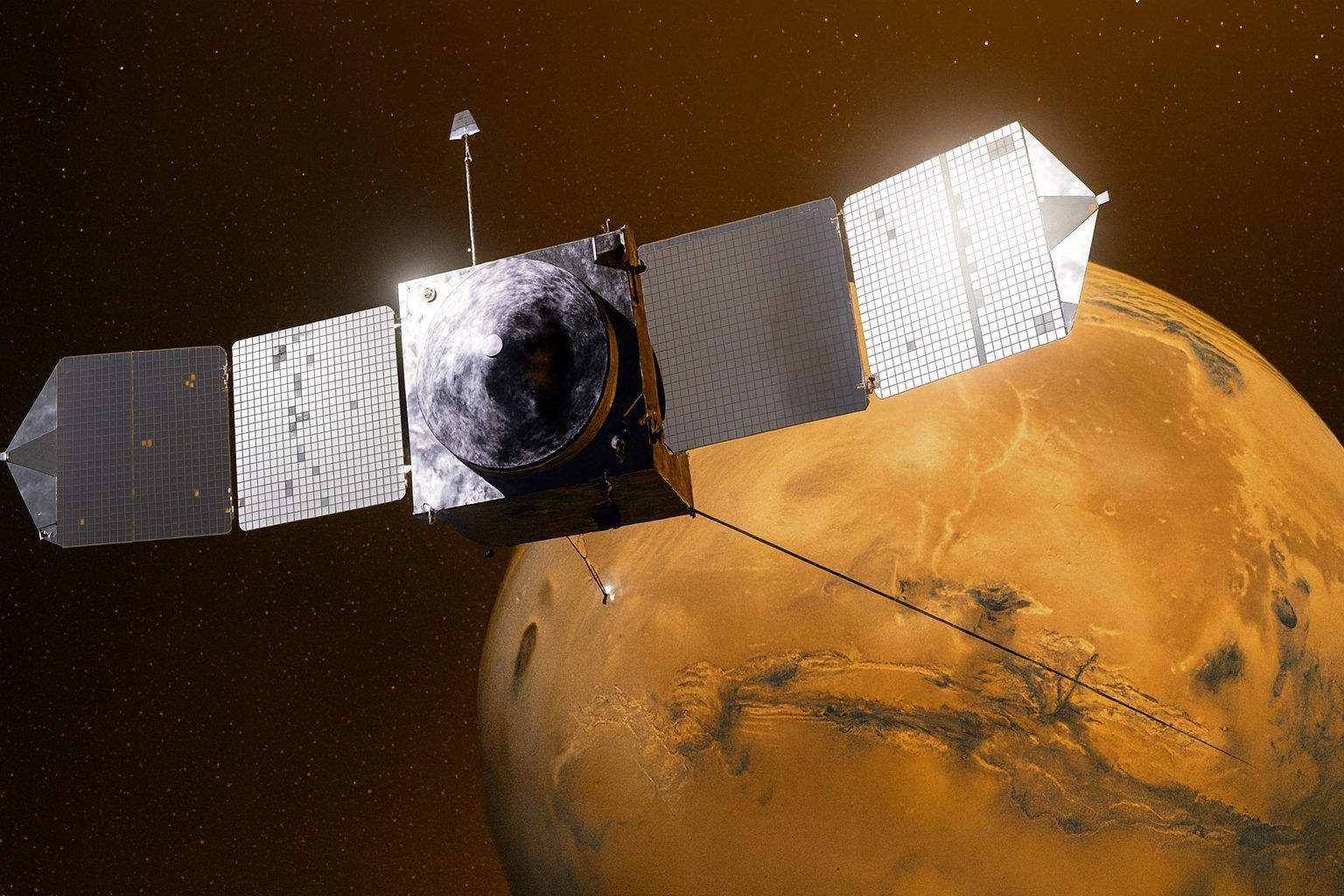
NASA’s MAVEN spacecraft, which has been orbiting Mars since 2014, stopped talking to Earth on December 6, 2025. Before the blackout, telemetry showed the spacecraft behaving normally as it slipped behind Mars in its usual orbit. But when MAVEN emerged from the planet’s far side, NASA’s Deep Space Network didn’t hear the expected carrier signal.NASA Science+1
In a short statement published on December 9, NASA confirmed the loss of signal (LOS) and said that both the spacecraft and operations teams are working to diagnose the anomaly and attempt to recover the mission. The agency has not yet disclosed a specific cause, and no major hardware failure has been publicly identified.NASA Science+1
News of the problem quickly spread through global media on December 10–11, with wire reports from the Associated Press and other outlets describing MAVEN as a Mars orbiter that has “abruptly stopped communicating” after more than a decade of service.AP News+1 Science outlets, including Scientific American and ScienceAlert, have framed the event as a serious blow to NASA’s Mars infrastructure, given MAVEN’s critical scientific and relay roles.Scientific American+1
As of December 11, 2025, there has been no official announcement that contact has been restored. NASA’s guidance remains: teams are investigating, and more information will be shared when available.NASA Science+1
What is MAVEN and why is it so important?
MAVEN was launched in November 2013 and entered orbit around Mars in September 2014 as part of NASA’s Mars Scout program. It is the first mission specifically designed to study the upper atmosphere and ionosphere of Mars, and how they interact with the solar wind – the constant flow of charged particles from the Sun.NASA Science+2NASA Astrobiology+2
The core scientific question MAVEN was built to answer is deceptively simple:
How did Mars go from a thicker, warmer, wetter world to the cold, dry desert we see today?
By measuring how gases such as hydrogen, oxygen and carbon dioxide escape into space, MAVEN has shown that atmospheric loss driven by the Sun played a major role in stripping away much of Mars’ original atmosphere over billions of years.Le Monde.fr+2NASA Science+2
Among its headline discoveries:
- Evidence that dust storms can loft water high into the atmosphere, accelerating the loss of water to space.NASA Science+1
- The first detection of a “proton aurora” at Mars, a type of aurora powered by solar-wind protons rather than electrons.NASA Science+2NASA Science+2
- Mapping of high-altitude wind patterns in Mars’ thermosphere, revealing how the planet’s rugged surface can disturb winds far above.NASA Science+1
- Observations that helped confirm “sputtering” – atmospheric erosion by energetic particles – as a key mechanism in Mars’ long-term climate evolution.Le Monde.fr+2Facebook+2
MAVEN recently celebrated 10 years in Mars orbit, and NASA has projected that, fuel permitting, the spacecraft could support science and relay operations into the late 2020s or even around 2030.NASA Science+1
The relay node that ties Mars together
MAVEN is not just a science observatory; it also carries a UHF radio that forms part of the communications network linking Earth to missions on the Martian surface.ScienceAlert+1
In practice, that means:
- Curiosity and Perseverance can send large volumes of data “up” to orbiters like MAVEN during short passes.
- Those orbiters then transmit the data back to Earth using high‑power, high‑gain antennas and more efficient deep-space links.
NASA’s Mars relay architecture currently relies on a small, aging fleet:
- NASA: Mars Reconnaissance Orbiter (MRO) and Mars Odyssey, both launched in the 2000s
- NASA: MAVEN, launched 2013
- ESA: Mars Express and ExoMars Trace Gas Orbiter (TGO)
- UAE: Hope (Emirates Mars Mission)
- China: Tianwen-1ScienceAlert+2Scientific American+2
ScienceAlert notes that MAVEN is one of seven active orbiters at Mars and an important part of the relay network for Curiosity and Perseverance.ScienceAlert
If MAVEN remains offline, the rovers are not immediately stranded – they can still communicate via MRO, Odyssey, TGO and other orbiters – but overall bandwidth and scheduling flexibility would shrink, potentially limiting how much data can be returned from Mars each day. Several reports also point out that Odyssey and MRO are both well past their original design lifetimes, raising concerns about a future with fewer reliable relay spacecraft.CBS News+2Scientific American+2
Engineers racing to recover the silent orbiter
NASA has not released technical details of the current anomaly, but its blog post makes clear that:
- Telemetry looked normal before MAVEN slipped behind Mars on December 6
- After re-emerging, the Deep Space Network failed to detect any signal
- Spacecraft and operations teams are investigating, and more updates will follow when availableNASA Science+1
For now, the likeliest immediate priorities include:
- Listening across expected frequencies and time windows for any sign of a carrier or telemetry
- Attempting blind commands – sending carefully crafted signals that might coax a partially functioning spacecraft to respond
- Modelling possible failure modes, such as power issues, antenna mis‑pointing, or computer faults, to narrow down recovery options
Although NASA hasn’t publicly linked the current issue to prior problems, MAVEN does have a history of serious but recoverable anomalies.
In 2022, the spacecraft spent about three months in safe mode after its inertial measurement units (IMUs) – sensors that keep it correctly oriented – began behaving unpredictably. Engineers developed a new way for MAVEN to navigate by tracking star patterns instead of relying heavily on the struggling IMUs, and the mission successfully returned to normal operations.SciTechDaily+2Scientific American+2
That episode shows that deep-space failures are not always the end. However, safe‑mode recoveries are complex, and past success is no guarantee that this new anomaly can be resolved.
What MAVEN has already taught us about Mars
Whatever happens next, MAVEN’s science legacy is already substantial. Highlights from NASA and recent research include:ScienceAlert+3NASA Science+3IN+3
- How Mars lost its water
MAVEN data helped show that during global dust storms, water vapor can be lofted higher into the atmosphere, where sunlight and solar wind more easily break it apart and sweep hydrogen into space. Over billions of years, this process may have removed much of Mars’ once-abundant surface water. - Auroras across the planet
Unlike Earth’s auroras, which are usually confined near the poles, MAVEN observed planet‑wide ultraviolet auroras triggered by solar storms. It also discovered proton auroras, where incoming solar‑wind protons steal electrons and plunge into the atmosphere, a phenomenon that may not occur in the same way on Earth. - Invisible “tail” and electric currents
MAVEN revealed that Mars has a long, magnetized tail formed as the solar wind interacts with the planet’s patchy crustal magnetic fields and upper atmosphere. These interactions help strip away atmospheric ions and shape the space environment around the planet. - Atmospheric sputtering confirmed
Recent studies using nearly a decade of MAVEN data directly observed sputtering – energetic particles from the solar wind knocking atmospheric particles into space – as a key mechanism behind Mars’ atmospheric erosion.Le Monde.fr+2Facebook+2
For planetary scientists, MAVEN has been a time machine of sorts, offering clues to how Mars transformed from a potentially habitable world with rivers and lakes into the frozen desert we know today.
An aging Mars fleet and the push for a new relay orbiter
MAVEN’s sudden silence has sharpened attention on a long‑recognized problem: Mars depends on a small, aging communications fleet.
NASA’s other Mars orbiters that support relay work – Mars Odyssey (launched 2001) and Mars Reconnaissance Orbiter (launched 2005) – have dramatically outlived their original missions. While they remain productive, they cannot operate indefinitely, and several analyses have warned that their fuel and hardware margins are gradually shrinking.CBS News+2Scientific American+2
For years, NASA has explored concepts for a dedicated, next‑generation Mars Telecommunications Orbiter (MTO) to provide high‑bandwidth, robust relay services and possibly optical (laser) links back to Earth. Many of those early concepts were postponed or cancelled.Ars Technica+1
That picture changed in 2025, when the U.S. Congress passed the wide‑ranging “One Big Beautiful Bill Act”, which includes $700 million earmarked for a high‑performance Mars telecommunications orbiter and additional billions for other NASA programs.Congress.gov+2Wikipedia+2 Rocket Lab and other commercial partners have since expressed interest in helping realize this mission concept.NASASpaceFlight.com
However:
- Designing, building, launching and cruising a new orbiter to Mars will take years
- Even on an aggressive timetable, a dedicated telecom orbiter would not be in place to help with the current MAVEN anomaly
In other words, MAVEN is still part of the bridge between today’s Mars fleet and tomorrow’s, and its loss would make that bridge narrower and more fragile.
How serious is this for current Mars missions?
From what NASA and international partners have shared so far, several points are clear:Scientific American+3NASA Science+3Science…
- Curiosity and Perseverance are safe. There is no indication that the rovers themselves are in danger; they can still send and receive data via other orbiters.
- Data return could become more constrained. If MAVEN stays offline long term, mission planners may need to juggle relay time more carefully, prioritize critical data, or accept lower data rates.
- Redundancy is reduced. Every lost orbiter chips away at the resilience of Mars operations. If another spacecraft later develops problems, there will be fewer backups.
ESA’s Trace Gas Orbiter already carries a large share of relay traffic, and Mars Express, MRO and Odyssey can help cover gaps. But MAVEN’s unique orbit and payload made it especially valuable for combining science and relay tasks in one platform.Scientific American+2ScienceAlert+2
Lessons from past scares – and what to watch next
MAVEN is not the first Mars mission to go silent unexpectedly. Other spacecraft – from ESA’s Beagle 2 lander to Russia’s Fobos‑Grunt – were lost after communications failed and contact was never recovered.Wikipedia+1
But MAVEN’s 2022 safe‑mode crisis is a reminder that silence doesn’t always spell the end. That earlier problem forced engineers to redesign how the spacecraft points and navigates, ultimately extending its life.SciTechDaily+2Scientific American+2
For this latest anomaly, key milestones to watch for include:
- A new NASA status update – confirming either partial or full contact, or acknowledging that recovery efforts have failed
- Evidence of a weak or intermittent signal – which could indicate a problem with antenna pointing, power levels or onboard software rather than a total failure
- Impacts on rover operations – any NASA commentary about data rates or scheduling constraints for Curiosity and Perseverance
Until then, all we can say with confidence is that MAVEN is currently silent, but not yet officially declared lost. NASA and its partners have considerable experience reviving troubled spacecraft – and they now have a strong incentive to try every option.
The bottom line
As of December 11, 2025, NASA’s MAVEN mission is in a critical but uncertain state:
- The orbiter has not communicated with Earth since December 6
- Engineering teams are actively troubleshooting and listening for a signal
- Mars surface missions remain safe, but long‑term relay capacity could be weakened if MAVEN cannot be recovered
- The incident underscores both MAVEN’s scientific importance and the fragility of the aging Mars communications network, even as a new telecom orbiter is only just entering the planning pipeline