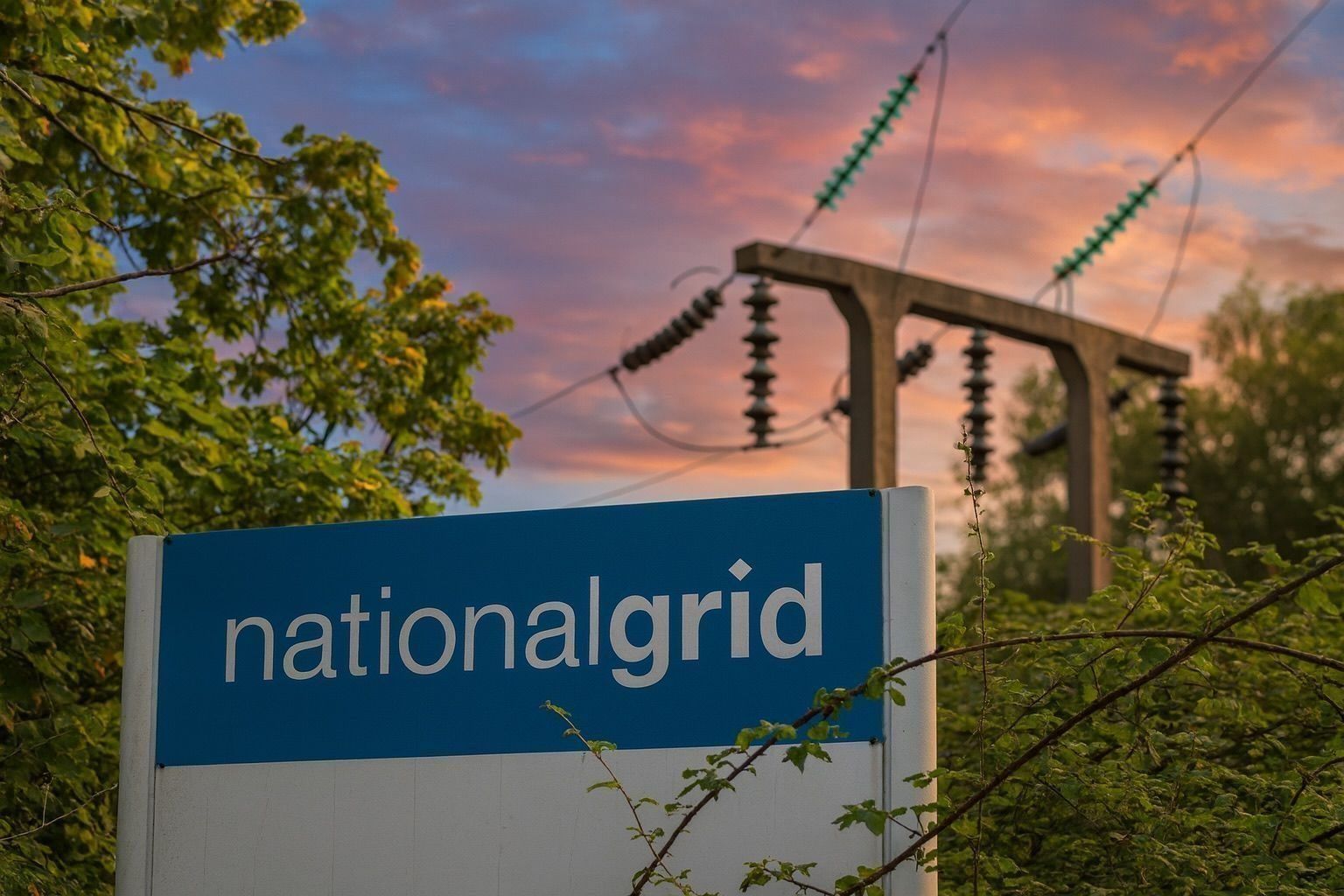
National Grid plc’s share price is trading close to 52‑week highs, supported by a new UK regulatory package, a massive investment pipeline and a solid dividend yield of just over 4%. As of 5 December 2025, investors are digesting Ofgem’s final RIIO‑T3 determination, a £28 billion upgrade to Britain’s energy networks, fresh half‑year results and a change of CEO — all of which will shape the stock’s path into 2026. Investing.com+2Reuters+2
Where National Grid’s share price stands today
On the London Stock Exchange, National Grid’s ordinary shares (ticker: NG. or NG) closed on 4 December at 1,142.5 pence, down a fraction on the day but still near the top of their 52‑week range of 909.8p to 1,183.5p. Investing.com
Key current metrics for the London line include: Investing.com
- Prev. close: 1,142.5p
- Day’s range (4 Dec): 1,131.5p – 1,144.0p
- 1‑year change: about +17%
- Dividend (TTM): 47.23p, implying a trailing yield around 4.1% at recent prices
- Market capitalisation: c. £56.7 billion
- P/E ratio: ~19.6x
- Price/book: ~1.5x
- Beta: ~0.56 (lower volatility than the broader equity market)
In New York, the NGG ADR (five ordinary shares per ADR) has recently traded around $76–77, versus a 52‑week range of roughly $55.8 to $78.5. MarketBeat cites a consensus analyst target price of about $80.40 for NGG, with a rating skewed to “Hold” overall. MarketBeat+1
Put simply, National Grid stock is priced as a premium, low‑beta regulated utility, sitting near multi‑year highs but still offering an income yield above 4%.
The big catalyst: Ofgem’s RIIO‑T3 ruling and a £28bn grid upgrade
The most important near‑term driver for National Grid is the UK regulatory backdrop. On 4 December 2025, Britain’s energy regulator Ofgem published its Final Determination for the RIIO‑T3 price‑control framework for electricity transmission, which will run from April 2026 to March 2031. Investing.com+1
Key elements of the package for National Grid’s UK Electricity Transmission business include: Investing.com+1
- A real allowed cost of equity of 6.12% at 60% gearing
- A framework of spending allowances, incentives and penalties that will govern how much National Grid can invest and what returns it can earn
- A detailed licence‑modification process, with Ofgem expecting to publish draft licence changes soon and a final decision in February 2026
- National Grid indicating it will review the package in detail before announcing its response in early March 2026
The RIIO‑T3 ruling sits within a broader decision by Ofgem to approve around £28 billion of upfront investment in Britain’s gas and electricity networks over the next five years — part of a potential £90 billion of grid spending by 2031. Reuters+2Financial Times+2
According to multiple reports (Reuters, the Financial Times and UK press): Reuters+2Financial Times+2
- About £10.3 billion of the initial £28 billion is earmarked for high‑voltage electricity transmission networks, where National Grid is a key player.
- The remainder will go mostly to gas networks.
- The plan is expected to add about £108 a year to average household network charges by 2031, though Ofgem estimates a net impact closer to £30 per year once system‑efficiency savings are included.
Alliance News reports that National Grid and SSE have “welcomed” the framework but are still reviewing the finer details of Ofgem’s £28 billion plan, underlining that final investor judgments will depend on the exact mechanics of incentives, penalties and cost recovery. London South East+1
For shareholders, the message is mixed:
- Positive: regulatory clarity, a large allowed investment envelope and a cost of equity that looks robust versus historic UK utility norms.
- Cautionary: higher household bills raise political risk; and the approved spend still has to be delivered on time, on budget and with acceptable returns.
Half‑year 2025/26 results: strong profit growth and record capex
National Grid’s half‑year results for 2025/26, covering the six months to 30 September 2025, show a business leaning hard into the energy‑transition capex cycle. National Grid+1
Headline numbers (continuing operations, at constant currency): National Grid
- Underlying operating profit: £2,292 million, up 13% year‑on‑year
- Underlying EPS: 29.8p, up 6% versus the prior period
- Capital investment: £5,052 million, up 12%, a record first‑half level
- Net debt: £41.8 billion at 30 September, around £0.5 billion higher than at 31 March 2025
Operationally, growth was driven by: National Grid
- Higher investments and returns in UK Electricity Transmission
- Increased asset‑health and reinforcement spending in UK Electricity Distribution
- Strong performance in New York and New England, helped by rate cases, storm‑recovery mechanisms and capital‑tracker revenues
- The classification of Grain LNG as held‑for‑sale in the period (depreciation ceased)
The company emphasised that it has delivered another record level of first‑half capital investment, is on track for over £11 billion of capex for the full year, and is progressing key projects such as the Wave 1 Accelerated Strategic Transmission Investment (ASTI) programme, London Power Tunnels 2, and major US grid upgrades. National Grid
£60bn investment plan and portfolio reshape
Alongside the half‑year numbers, National Grid has set out a medium‑term financial framework that underpins much of the current equity story: National Grid+1
- Around £60 billion of capital investment between FY2025 and FY2029, the majority in regulated “green” projects
- Group regulated asset base growth of roughly 10% per year
- Underlying EPS growth of 6–8% per year from a FY2024/25 baseline of 73.3p
- Regulatory gearing expected to move towards the mid‑60% range by March 2029, then trend towards the high‑60s by the end of RIIO‑T3
- A commitment to maintain a strong investment‑grade credit rating
Recent portfolio moves illustrate how the group is concentrating on core regulated networks: National Grid+1
- Sale of National Grid Renewables: completed during the half‑year to Brookfield Asset Management and partners for total proceeds of about $2.1 billion, freeing capital from US onshore renewables.
- Grain LNG divestment: National Grid agreed to sell its Grain LNG terminal in Kent to a consortium led by Centrica and Energy Capital Partners for around £1.66 billion, with enterprise‑value estimates near £1.5 billion; the deal completed on 28 November 2025.
- At the same time, the group has secured much of the supply chain needed for its £60 billion plan, with over three‑quarters of the programme now underpinned by delivery frameworks, including multibillion‑pound contracts for HVDC cables, converter stations and civils work.
Rating agency Fitch has described UK networks as facing an “unprecedented investment surge” through the RIIO‑3 transition, highlighting both the opportunity and the need for careful capital‑structure management across the sector. Fitch Ratings+1
Leadership change and AI‑driven grid resilience
2025 is also a transitional year at the top of National Grid: National Grid+1
- John Pettigrew, Chief Executive for nearly a decade, retired from the board on 16 November 2025.
- Zoë Yujnovich, formerly Shell’s Integrated Gas and Upstream director, joined as CEO‑designate on 1 September 2025 and took over as Chief Executive on 17 November 2025.
Her background in large, capital‑intensive energy businesses and complex regulatory environments lines up closely with National Grid’s £60 billion build‑out and RIIO‑T3 negotiations. Investors will be watching how she balances UK versus US growth, handles execution risk on mega‑projects and whether further portfolio simplification is on the table. TS2 Tech+1
On the operational side, National Grid is trying to show regulators and stakeholders that it is serious about resilience and climate risk. On 2 December 2025, the company announced a collaboration with Rhizome’s AI‑driven “gridFIRM” platform, to be deployed across its networks in Massachusetts, New York and the UK. The system uses data and modelling to identify high‑risk areas where utility assets could spark wildfires, prioritise mitigation and balance safety, reliability and cost. TS2 Tech
This fits into a broader backdrop of rising electricity demand from data centres, electric vehicles and heat pumps, as well as regulatory scrutiny after incidents such as the North Hyde substation fire, which temporarily shut down Heathrow earlier this year and prompted an Ofgem investigation into aspects of National Grid’s asset‑health management. National Grid+1
Dividend, yield and income profile
Income remains a core part of the National Grid investment case.
On 6 November 2025, alongside its half‑year results, the board declared a 2025/26 interim dividend of 16.35p per ordinary share and $1.0657 per ADR. Stock Titan+1
Key dates for this interim payout are: Stock Titan+1
- Ex‑dividend date (ordinary shares): 20 November 2025
- Ex‑dividend date (ADRs): 21 November 2025
- Record date: 21 November 2025
- Scrip election deadlines: 8 December (ADRs) and 11 December (ordinaries)
- Payment date: 13 January 2026
National Grid has also set a scrip dividend reference price of 1,130.40p per ordinary share, and $74.2334 per ADR, allowing shareholders to receive new shares instead of cash. Stock Titan
Policy‑wise, the company aims to grow the dividend per share in line with UK CPIH inflation over the medium term, backed by its 6–8% EPS growth target and expanding asset base. National Grid+1
At a London share price around 1,140–1,150p, and using recent trailing dividends (around 47p per share), the stock currently offers a yield of roughly 4.1–4.2%, modestly above the broader utilities sector median. Investing.com+1
Analyst ratings, fair‑value estimates and forecasts
Views on valuation are nuanced rather than wildly bullish or bearish.
Sell‑side price targets
According to data compiled by TS2 from Investing.com, MarketBeat and other broker sources: TS2 Tech
- For LSE: NG., the average 12‑month target price sits around 1,180p, with a typical range of 1,070–1,300p and a consensus rating described as “Buy” or “Buy/Outperform” from most covering analysts.
- Some aggregators place the average in the 1,200–1,225p bracket, implying low‑ to mid‑single‑digit upside from current levels.
For the NYSE‑listed NGG ADR, MarketBeat and other US‑focused sources show: MarketBeat+1
- A consensus rating of “Hold”, based on roughly 3 Buy, 5 Hold and 2 Sell recommendations.
- An average target price around $80–80.5, versus a current price in the mid‑$70s.
- A target range stretching from around $70 to the low‑$80s.
Intrinsic‑value and quant models
Independent valuation models are somewhat more optimistic: Simply Wall St+1
- Simply Wall St estimates a “narrative fair value” of about £11.93 per share versus a recent close of £11.43, implying National Grid is roughly 4% undervalued. It notes a 23% total return over the past year and around 80% total shareholder return over five years.
- Alphaspread and similar DCF‑style tools, summarised in TS2’s analysis, peg intrinsic value closer to 1,550–1,570p, suggesting 25–30% upside under their assumptions.
- Forward‑looking models typically bake in earnings growth of around 10–12% per year for the next few years, driven by the regulated capex pipeline.
Taken together, human analyst consensus tends to see modest upside, while some quantitative models are more bullish. There is little evidence of a consensus view that the stock is deeply mispriced in either direction.
Technical picture and short‑term trading signals
Short‑term technical and trading models paint a mixed but generally constructive picture.
On StockInvest.us, National Grid’s London‑listed shares are currently rated “Hold/Accumulate”: StockInvest
- Last close: 1,142.5p (4 December), down 0.09% on the day.
- The stock trades in the lower part of a strong rising short‑term trend, which their model treats as a potentially attractive entry point if the trend holds.
- Their AI‑based forecast expects the share price to rise about 13.6% over the next three months, with a 90%‑probability range of roughly 1,289–1,382p.
- At the same time, they flag sell signals from some moving‑average relationships and from a three‑month MACD indicator after a pivot top in mid‑November.
Investing.com’s technical summary for NG points to something similar: broadly neutral signals on the daily timeframe, but “Strong Buy” on weekly and monthly horizons, reflecting the stock’s sustained outperformance over 12 months. Investing.com+1
In short, the trend remains upwards, but momentum indicators suggest the stock is no longer in an obvious fresh “bargain” zone after its 2025 rally.
Institutional positioning
Recent 13F filings and fund‑flow reports show continued institutional interest in the US‑listed ADR: MarketBeat+1
- American Century Companies Inc. increased its stake in NGG by around 10%, buying 17,544 shares to bring its holding to 189,463 shares (about $14.1 million at the time of filing).
- Global Retirement Partners LLC disclosed a new position of 6,549 NGG shares, valued near $0.5 million.
- Several other institutions, including JPMorgan, Goldman Sachs, Royal Bank of Canada and Envestnet, have also added to their holdings.
MarketBeat estimates that institutional investors collectively own around 4.7% of the NGG float it tracks — a figure that under‑represents total global institutional ownership because many investors hold the London line rather than the ADR, but still signals healthy professional participation. MarketBeat+1
Key risks to watch in 2026
Even for a regulated utility, the National Grid story carries meaningful risks:
- Execution risk on capex: Delivering £60 billion of projects — including offshore HVDC links, London Power Tunnels and major US upgrades — on time and on budget will be challenging in a world of tight supply chains and skilled‑labour shortages. National Grid+1
- Regulatory and political risk: Ofgem’s RIIO‑T3 decisions, the broader £28 billion grid‑upgrade plan and rising household energy bills create political scrutiny. Future governments could push for tougher allowed returns or stricter performance regimes if public pressure mounts. Investing.com+3Reuters+3Financial Times+3
- Balance‑sheet and interest‑rate risk: Net debt already exceeds £40 billion, and regulatory gearing is expected to climb into the mid‑ to high‑60% range by 2029. The investment case assumes continued access to low‑cost debt and equity markets, plus stable credit ratings. National Grid+1
- Operational and climate risk: Events like the North Hyde substation fire and rising wildfire risk in parts of the US highlight the importance of asset‑health management and grid resilience — an area where National Grid is now leaning on AI tools but remains under regulatory scrutiny. National Grid+1
Outlook: a regulated growth‑and‑income play at the heart of the energy transition
As of 5 December 2025, National Grid plc sits at the intersection of three powerful forces:
- A massive, regulator‑approved investment wave into UK and US energy infrastructure.
- A dependable, inflation‑linked dividend starting from a yield just above 4%.
- A relatively full valuation after a strong multi‑year share‑price run, with consensus pointing to modest but not explosive upside.
Investors who buy the stock today are effectively backing a “toll‑road” model on the energy transition: slow‑and‑steady earnings growth, a growing regulated asset base and an income stream designed to keep pace with inflation — all in exchange for accepting regulatory, political and execution risk rather than classic cyclical risk.
The next key milestones to watch include:
- National Grid’s formal response to Ofgem’s RIIO‑T3 package in early March 2026. Investing.com+1
- Ongoing updates on the Great Grid Upgrade / ASTI projects and US transmission investments. National Grid
- The next earnings release, scheduled around 14 May 2026, where management will update guidance, capex phasing and balance‑sheet metrics. Investing.com
For now, National Grid remains a core defensive holding for many income and infrastructure‑focused portfolios, with its 2026 return profile likely to be driven as much by regulatory and political developments as by classic company‑specific surprises. This article is informational and should not be taken as investment advice; investors should consider their own objectives and risk tolerance or seek professional guidance before making decisions.