
New York, May 23, 2026, 12:04 EDT
- Netlist closed Friday at $2.895, up 8.02%, after a volatile week that still left the shares slightly below the prior Friday’s close.
- U.S. OTC trading is shut for the weekend and Monday’s Memorial Day holiday, putting the next test on Tuesday.
- Investors are balancing record first-quarter sales against legal, supply and resale-product risks.
Netlist Inc. shares rose sharply in the final session before the long U.S. holiday weekend, closing Friday at $2.895, up 8.02%, as traders bought back into the over-the-counter memory technology stock after a midweek slide. The stock still ended the week down about 1% from the previous Friday’s close of $2.93.
The timing matters. Netlist trades on the OTC market, an over-the-counter venue rather than a main national exchange, and that market is closed on weekends and on Monday, May 25, for Memorial Day. Normal OTC hours are 9:30 a.m. to 4 p.m. New York time, leaving Tuesday as the next cash-market session.
Friday’s gain capped a choppy stretch. Netlist fell 11.43% on Tuesday, slipped 2.61% on Wednesday, then rose 10.29% on Thursday and 8.02% on Friday, according to delayed market data. Volume Friday was 1.61 million shares, below Tuesday and Wednesday but enough to confirm a late-week bounce.
The move is still tied to the company’s May 12 results. Netlist reported first-quarter net sales of $104.9 million, up 262% from a year earlier, gross profit of $22.4 million and net income of $8.6 million, or 3 cents a share. Chief Executive C.K. Hong said the quarter showed “strong first quarter results” driven by “robust demand for our memory products.” Nasdaq
That demand story is the core of the stock. In its quarterly filing, Netlist said accelerated adoption of artificial intelligence had tightened industry supply and helped push memory prices higher. It added that extra industry fabrication capacity may not begin to ease the pressure until late 2027 or 2028.
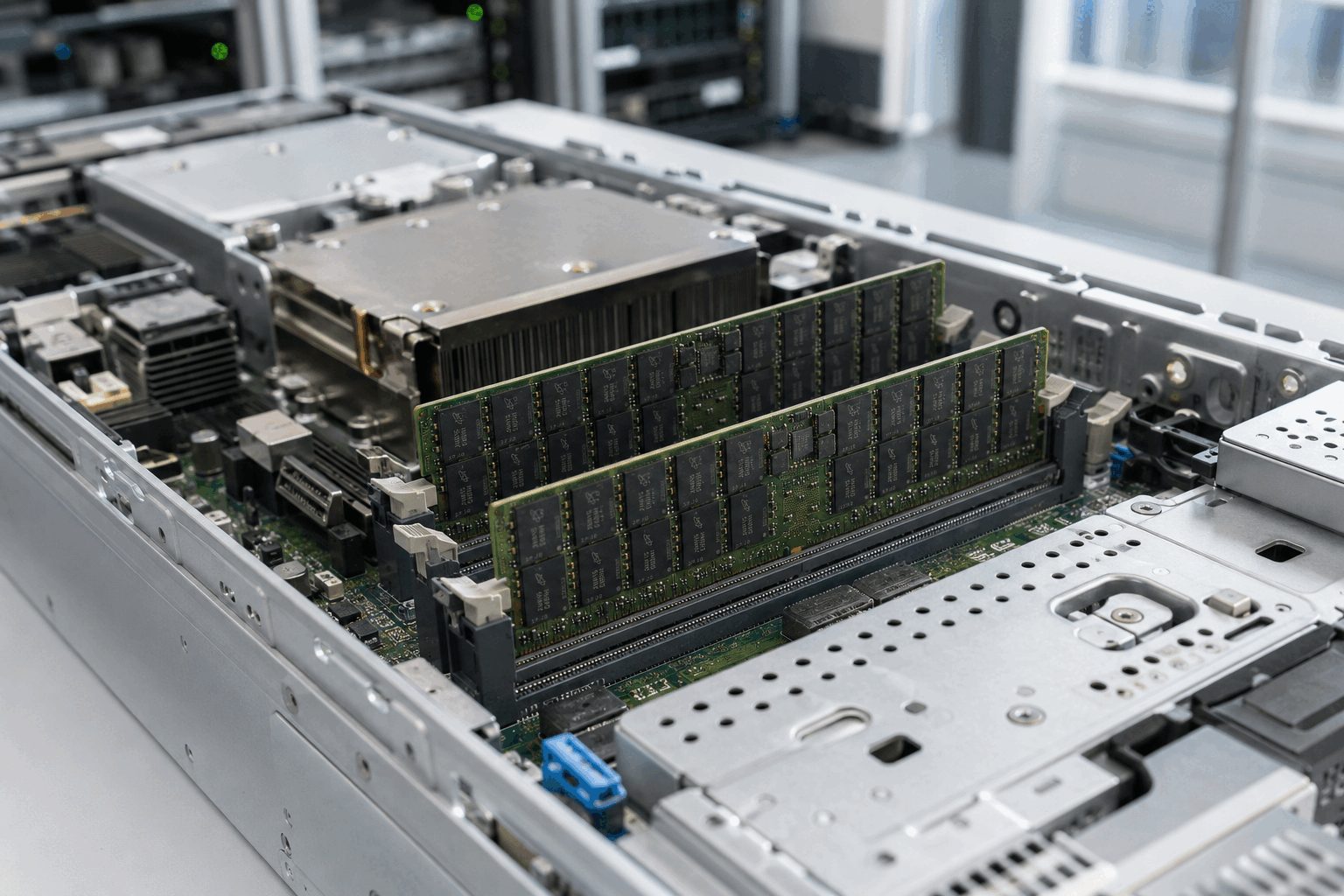
On the earnings call, Hong put it more bluntly: “The memory market remains structurally undersupplied.” Chief Financial Officer Gail Sasaki said revenue strength reflected tight memory supply, faster demand and rising DRAM prices; DRAM, or dynamic random-access memory, is a core chip memory used in servers and computers. Investing.com
The competitive backdrop is unusually tangled. Netlist’s business sits near much larger memory players such as Samsung Electronics, Micron Technology and SK hynix. The company said the vast majority of recent net product sales came from resales of products sourced from SK hynix, while its patent litigation remains focused on Samsung and Micron, among others.
The legal track is another reason the stock can swing hard. Netlist has sought import-blocking and cease-and-desist orders at the U.S. International Trade Commission, a trade agency that can bar infringing products from entering the country, against Samsung, Google and Super Micro over DDR5 and high-bandwidth memory, or HBM, products. DDR5 is a newer generation of computer memory, while HBM is high-speed memory used in advanced computing systems.
Past verdicts have kept that legal angle in view. A Texas jury ordered Samsung to pay Netlist $118 million in November 2024, after an earlier $303 million verdict against Samsung; Netlist also won a $445 million verdict against Micron in 2024, though appeals and patent-review proceedings remain part of the picture.
But the trade is not one-way. Netlist told investors that future results may not match the current quarter, that more memory supply could pressure prices and margins, and that its SK hynix supply arrangement expired in April 2026, with purchases continuing on a purchase-order basis. The company also said litigation recoveries may be lower than awarded, or may not be realized, and disclosed a material weakness in internal controls that had not yet been remediated.
For the week ahead, the question is simpler: whether the two-day rebound holds when OTC trading reopens Tuesday. With no confirmed fresh company release in the last 24 to 48 hours beyond the market move, investors are left with the same mix that drove the past week — memory pricing, liquidity, litigation timing and a stock that has shown it can move several percentage points in a day.