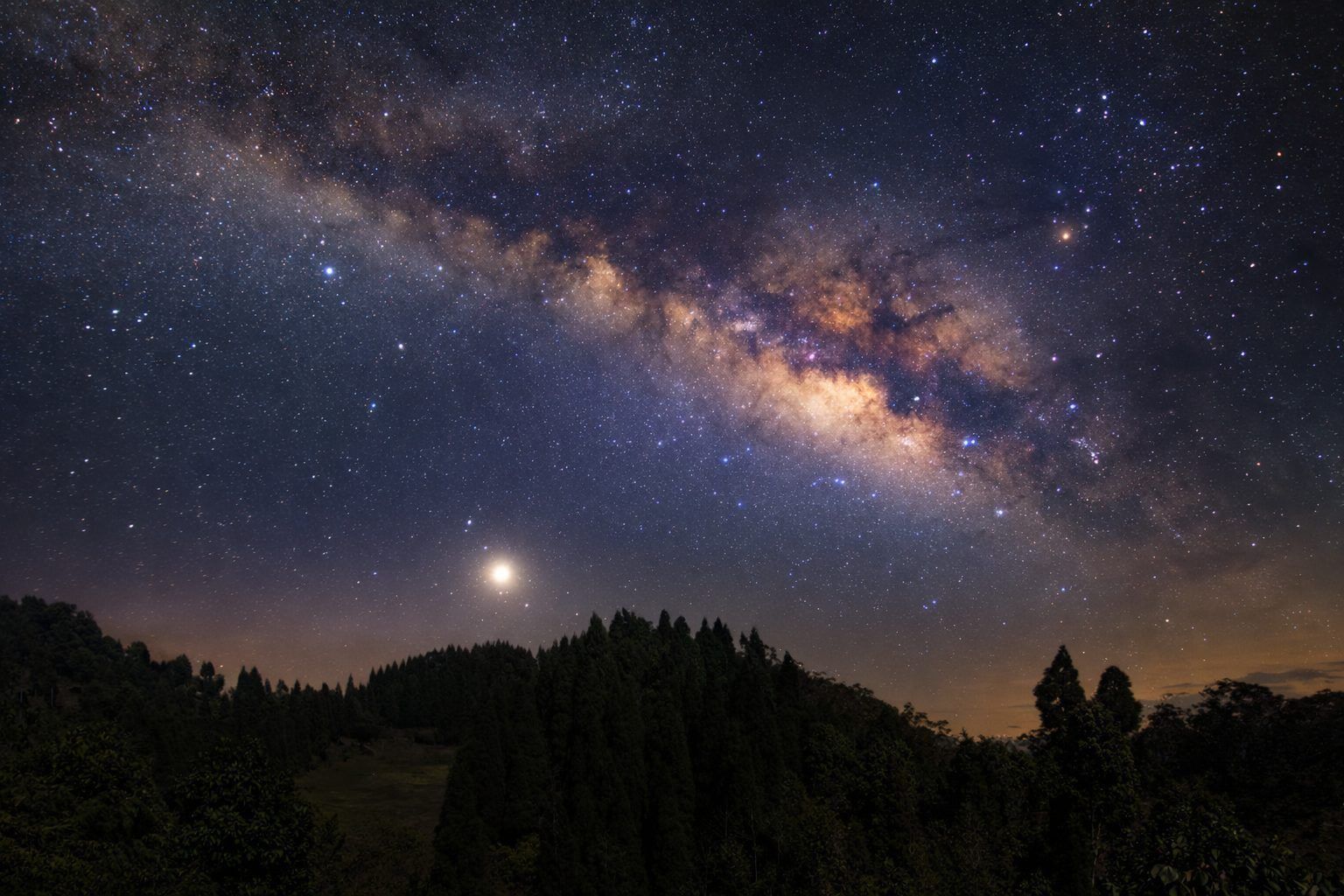

Boxing Day has a gift for anyone who can step outside for five minutes: a bright crescent Moon and Saturn hanging close together in the evening sky—an easy, naked-eye pairing that also happens to be one of the simplest ways all year to “find” Saturn for the first time. Later tonight, Jupiter takes over as the brightest planet in the sky, and it’s heading toward its January 2026 opposition, when it will be at its biggest and brightest of the season. EarthSky
Below is a roundup of today’s (Dec. 26, 2025) skywatching coverage and what it adds up to in practical terms—where to look, when to look, and what’s actually worth your time in the cold.
Tonight’s main event: the Moon-Saturn conjunction after sunset
The headline across astronomy sites today is simple: the Moon is passing very close to Saturn on the evening of Friday, Dec. 26, 2025. Most guides describe them as separated by only a few degrees—close enough to feel like a “pair” rather than two unrelated dots. Vineyardgazette
When to look: timing depends on your latitude and local sunset, but the reliable advice is “early evening”—once it’s dark enough to see stars. BBC Sky at Night Magazine notes the pair will generally be in the dark southern sky by around 6 p.m. and drifting toward the southwest by around 7 p.m., with exact timings varying by location. Sky at Night Magazine
Where to look: multiple sources place Saturn with the Moon in the zodiac constellation Pisces (or right on the Aquarius–Pisces neighborhood line), meaning you’ll be looking generally toward the southern sky early in the evening (then more southwest as the night goes on).
A useful orientation quirk: if you’re comparing notes with friends across the ocean, don’t panic if your “left/right” doesn’t match theirs. The same BBC guide points out that from the UK, Saturn appears to the left of the Moon, while from North America it will likely appear below the Moon—an everyday reminder that the sky is a dome and we’re all standing on different parts of the spinning sphere. Sky at Night Magazine
Why this is a great Saturn night (even if you’ve never seen it before)
Saturn often gets oversold as “the one with the rings,” and then undersold in practice because beginners don’t know what they’re looking at. Tonight fixes that. As the Vineyard Gazette puts it, the Moon “finds” Saturn for you—a bright, obvious landmark sitting right beside it. Vineyardgazette
If you’re wondering whether you need a telescope: no to spot Saturn (it’s visible to the naked eye), yes to see rings as rings. Sky & Telescope’s observing notes peg Saturn around magnitude +1.1, making it one of the brighter “stars” in that part of the sky—and it’s well placed in the evening before it sets later at night. Sky & Telescope
Saturn’s rings are doing the “now you see me, now you don’t” thing
Here’s the nerdy twist that makes this Saturn season special: Saturn’s rings are nearly edge-on right now, meaning the classic “hula hoop” look is muted compared to other years. Sky & Telescope notes the rings are tilted by only about 1°, which is extremely close to edge-on. In a telescope, this can make Saturn look more like a bright orb with a thin line through it than the big, wide ring system you see in photos. Sky & Telescope
That sounds like a downgrade, but it’s actually a neat observing moment: it’s a reminder the Solar System isn’t a static museum display. We’re watching a 3D clockwork from the inside.
Moon phase check: tomorrow is First Quarter
Tonight’s Moon is a waxing crescent on its way to First Quarter. Sky & Telescope gives the First Quarter moment as Dec. 27 at 2:10 p.m. EST, so tonight is basically “First Quarter eve,” a sweet spot for binoculars and telescopes because shadows along the Moon’s terminator (the day-night line) still have depth and drama. Sky & Telescope
Jupiter takes the late-night crown and it’s getting better by the day
Once the Moon-and-Saturn pairing starts sliding toward the western horizon, Jupiter becomes the main character. Several outlets today frame it as the bright “Christmas Star” lookalike—because unlike stars, Jupiter shines steady (it generally doesn’t twinkle much) and absolutely dominates the eastern sky. Vineyardgazette
Sky & Telescope lists Jupiter around magnitude –2.6 in Gemini, bright enough that you can identify it confidently even from suburban skies.
Mark the date: Jupiter’s opposition is January 10, 2026
If you’re tracking “best night” timing, the widely cited target is January 10, 2026, when Jupiter reaches opposition—the geometry where Earth sits between Jupiter and the Sun, so Jupiter rises at sunset and stays up all night. EarthSky specifies opposition at 09:00 UTC on Jan. 10, 2026, and notes Jupiter is closest to Earth about a day earlier (Jan. 9), at a distance of about 393 million miles (633 million km). EarthSky
That means right now (late December 2025) is already prime time: Jupiter is bright, well placed, and getting slightly more “all-night” as the calendar flips.
What you can see with basic gear
Space.com’s telescope guide published today recommends a simple progression for beginners: start with bright, forgiving targets like the Moon, then move to Jupiter. With even a modest telescope, you may catch cloud bands and up to four Galilean moons (Io, Europa, Ganymede, Callisto) as tiny points lined up beside the planet.
Last call tonight: the Ursid meteor shower is still active
If you want a “bonus mode” after midnight, tonight is also the tail end of the Ursid meteor shower, a smaller, quieter shower that still has charm—especially when the Moon isn’t full and blasting out the stars.
Two key points from authoritative sources:
- The International Meteor Organization says the Ursids are active from Dec. 17–26, with a sharp maximum around Dec. 22. Away from the peak, activity can be low (often less than 1 Ursid per hour), but it’s still “in season” through tonight. International Meteor Organization
- The Associated Press notes the Ursids are visible until Dec. 26 from the Northern Hemisphere, typically producing about 5–10 meteors per hour during the height (with occasional stronger bursts).
Where to look for Ursids
The radiant (the point meteors appear to come from) sits near Kochab in Ursa Minor (the Little Dipper), according to the IMO—so you’re generally looking north, but the practical trick is to watch a broad patch of sky rather than staring directly at the radiant.
Aurora watch: how to check the odds the right way
Aurora forecasts are the most emotionally chaotic genre of forecasting (“maybe green curtains, maybe nothing, maybe clouds”), so the best approach is to use live model output instead of vibes.
NOAA’s Space Weather Prediction Center explains that its OVATION-based product provides a 30 to 90 minute forecast of aurora location and intensity, and notes two grounding realities:
- Aurora isn’t visible during daylight, and
- Under bright conditions and the right geometry, aurora can sometimes be seen from as far as ~1000 km away.
If you’re anywhere near auroral latitudes, the smart play tonight is:
- check the latest NOAA aurora forecast close to darkness,
- find a dark northern view, and
- give it time (aurora is notorious for arriving on its own schedule).
New telescope owners: today’s best advice is “don’t rush the universe”
A lot of “Night Sky Today” coverage on Dec. 26 isn’t just about what’s up—it’s about what to do with the telescope that just appeared in your living room like a long metal reindeer.
Space.com’s guide published today emphasizes a beginner sequence that saves frustration:
- Set up while it’s still light, level the tripod, tighten clamps, and align your finder on a distant object.
- Start with low power / wide field first (usually the longer focal length eyepiece) to make targets easier to locate.
- Use the Moon’s terminator as a training ground for focusing and contrast, then graduate to Jupiter for your first planetary detail.
This matches the reality of the sky tonight: the Moon is bright and cooperative, Saturn is conveniently “tagged” beside it, and Jupiter is shining like it’s trying to sell you a subscription box.
A quick “go outside now” checklist for Dec. 26, 2025
- Just after dark: find the crescent Moon and spot Saturn right beside it (southern sky early, sliding southwest later).
- Early evening with a telescope: try Saturn anyway—rings are nearly edge-on, which is rare and cool.
- Later evening into night: look east for Jupiter, the brightest planet in the sky right now.
- After midnight (Northern Hemisphere): if skies are dark, you might catch late Ursid meteors—don’t expect a blizzard, expect a few graceful streaks.
What’s next in the near-term sky calendar
- Dec. 27, 2025: First Quarter Moon (exact moment given as 2:10 p.m. EST).
- Jan. 10, 2026: Jupiter at opposition, brightest and best placed for all-night viewing (with closest approach about a day earlier).
Tonight is one of those rare “low effort, high reward” nights: a naked-eye planet next to a bright Moon, plus the season’s brightest planet waiting later like an encore. The universe is often subtle; Dec. 26 is not.